Cell Functions
Cells are the basic living units of tissue.
Bone cells form and regenerate the bones in the body.
Nerve cells send messages within the brain and throughout the body to produce actions.
Cell in the blood carry oxygen and help the immune system.
Sex cells unite to produce offspring.
Cells in the body are specialized to perform a wide variety of functions:
Bone cells support the bone, which makes up the skeletal system.
Blood cells carry oxygen, making up the circulatory or cardiovascular system.
Nerve cells transmit signals, making up the nervous system.
Muscle cells move the body, making up the muscular system.
Skin cells protect organs, creating the integumentary (Skin) system.
Sex cells enable reproduction, making up the reproductive system and a female body’s ovarion system.
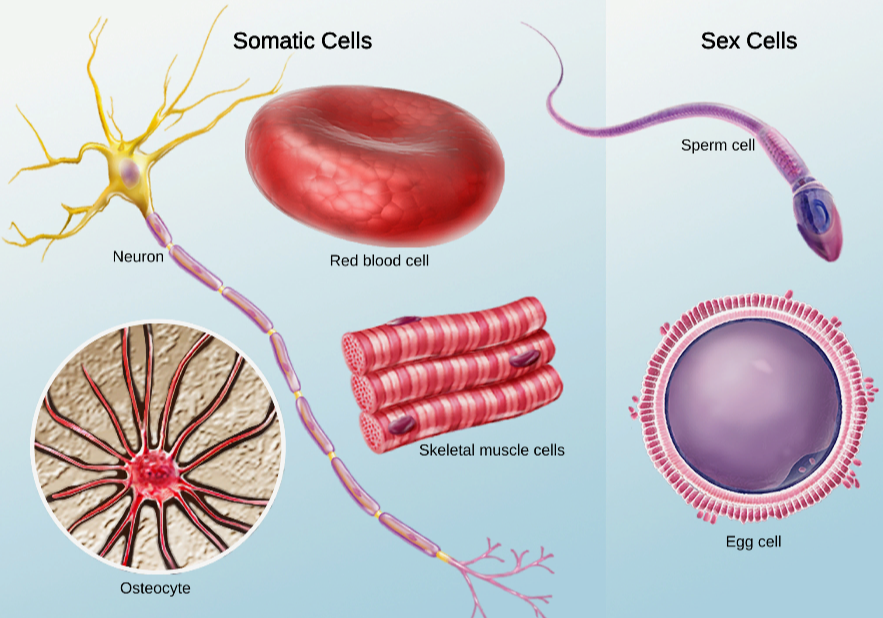
The body contains over 200 different types of cells. Below are a few examples:
Somatic cells: All body cells which arise from the zygote formed by two sex cells during fertilization
Sex cells: the cells used to fertilize and reproduce.
Differentiation: A process where cells change in shape and structure depending on which parts of their genetic code are activated.