Mood Disorders
Mood Disorders
The emotional extremes of mood disorders come in two principal forms: (1) major depressive disorder, in which the person experiences prolonged hopelessness and lethargy until usually rebounding to normality, and (2) bipolar disorder (formerly called manic depressive disorder), in which the person alternates between depression and mania, an overexcited, hyperactive state.
Major Depressive Disorder
Perhaps you know what depression feels like. If you are like most college students, at some time during this year—more likely the dark months of winter than the bright days of summer—you will probably experience a few of the symptoms of depression. You may feel discouraged about the future, dissatisfied with your life, or isolated from others. You may lack the energy to get things done or even force yourself out of bed; be unable to concentrate, eat, or sleep normally; or even wonder if you would be better off dead. Perhaps academic success came easily to you in high school, and now you find that disappointing grades jeopardize your goals. Maybe social stresses, such as feeling you don’t belong or the breakup of a romance, have plunged you into despair. And maybe brooding has at times only worsened your self-torment.
You are not alone. Depression is the “common cold” of psychological disorders—an expression that effectively describes its pervasiveness but not its seriousness. Although phobias are more common, depression is the number one reason people seek mental health services. Moreover, it is the leading cause of disability worldwide. In any given year, a depressive episode plagues 5.8% of men and 9.5% of women, reports the WHO.
As anxiety is a response to the threat of future loss, depression is often a response to past and current loss. To feel bad in reaction to profoundly sad events (such as the death of a loved one) is to be in touch with reality. In such times, depression is like a car’s low-oil-pressure light—a signal that warns us to stop and take protective measures. Recall that, biologically speaking, life’s purpose is not happiness but survival and reproduction. To this end, coughing, vomiting, and various forms of pain protect the body from dangerous toxins. Similarly, depression is a sort of psychic hibernation: it slows us down, defuses aggression, and restrains risk-taking. To grind temporarily to a halt and ruminate, as depressed people do, is to reassess one’s life when feeling threatened, and to redirect energy in more promising ways. From this perspective, there is sense to suffering.
But when does this response become seriously maladaptive? The line separating life’s normal “downs” from major depression is difficult to draw. Joy, contentment, sadness, and despair are different points on a continuum, points at which any of us may be found at any given moment.
Major depressive disorder occurs when signs of depression (including lethargy, feelings of worthlessness, or loss of interest in family, friends, and activities) last two weeks or more and are not caused by drugs or a medical condition. The difference between a blue mood after bad news and a mood disorder is like the difference between gasping for breath for a few minutes after a hard run and being chronically short of breath. To sense what major depression feels like, suggest some clinicians, imagine combining the anguish of grief with the sluggishness of jet lag.
Between the temporary blue moods we all experience and the crushing impact of major depression is a condition called dysthymic disorder—a down-in-the-dumps mood that fills most of the day, nearly every day, for two years or more. Although less disabled than people with major depression, those with dysthymic disorder tend to experience chronic low energy and self-esteem, have difficulty concentrating or making decisions, and sleep and eat too much or too little.
Bipolar Disorder
With or without therapy, episodes of major depression usually end, and people temporarily or permanently return to their previous behavior patterns. However, some people rebound to, or sometimes start with, the opposite emotional extreme—the euphoric, hyperactive, widely optimistic state of mania. If depression is living in slow motion, mania is fast forward. Alternation between depression and mania signals bipolar disorder. During the manic phase of bipolar disorder, the person is typically overtalkative, overactive, and elated (though easily irritated if crossed); has little need for sleep; and shows fewer sexual inhibitions. Speech is loud, flighty, and hard to interrupt.
One of maina’s maladaptive symptoms is grandiose optimism and self-esteem, which may lead to reckless investments, spending sprees, and unsafe sex. Although people in a manic state find advice irritating, they need protection from their own poor judgment. In milder forms, however, the energy and free-flowing thinking of mania can fuel creativity. History offers many examples of creative bipolar people, from Walt Whitman and Ernest Hemingway to actress Margot Kidder. Bipolar disorder is especially common among creative artists and poets. George Frideric Handel, who many believe suffered a mild form of bipolar disorder, composed his nearly four-hour-long Messiah during three weeks of intense, creative energy. Robert Schumann composed 51 musical words during two years of mania and none during 1844, when he was severely depressed. Creative professionals who rely on precision and logic (architects, designers, journalists) less often suffer bipolar disorder than those who rely on emotional expression and vivid imagery (poets, novelists, entertainers), reports Arnold Ludwig.
It is as true of emotions as of everything else: What goes up comes down. Before long, the elated mood either returns to normal or plunges into a depression. Though as maladaptive as major depression, bipolar disorder is much less common. Unlike major depression, it afflicts as many men as women.
Explaining Mood Disorders
Because depression profoundly affects so many people, it understandably has been the subject of thousands of studies. Psychologists are working to develop a theory of mood disorders that will suggest more effective ways to treat and prevent them. Researcher Peter Lewinsohn and his colleagues summarized the facts that any theory of depression must explain. Among them are the following:
Many behavioral and cognitive changes accompany depression. Depressed people are inactive and feel unmotivated. They are sensitive to negative happenings, expect negative outcomes, and more often recall negative information. In a depressed mood, we expect our team to lose, our grades to fall, our love to fail. When the depression lifts, these behavioral and cognitive accompaniments disappear. Nearly half the time, depressed people also exhibit symptoms of another disorder, such as anxiety or substance abuse.
Depression is widespread. Its commonality suggests that its causes, too, must be common.
Compared with men, women are nearly twice as vulnerable to major depression. In general, women are most vulnerable to disorders involving internalized states, such as depression, anxiety, and inhibited sexual desire. Men’s disorders tend to be more external—alcohol abuse, antisocial conduct, and lack of impulse control. When women get sad, they often get sadder than men do. When men get mad, they often get madder than women do.
Most major depressive episodes self-terminate. Therapy tends to speed recovery, yet most people suffering major depression eventually return to normal even without professional help. The plague of depression comes and, a few weeks or months later, it usually goes, though it sometimes recurs later.
Stressful events related to work, marriage, and close relationships often precede depression. A family member’s death, a job loss, a marital crisis, or a physical assault increases one’s risk of depression. If stress-related anxiety is a “crackling, menacing bushfire,” notes biologist Robert Sapolsky, '“depression is a suffocating heavy blanket thrown on top of it.” One study followed 2000 people over time. It found that the risk of the onset of depression in the ensuing month ranged from less than 1 percent among those with three such events. The early loss of a parent due to death or separation also increases later vulnerability to depression.
With each new generation, the rate of depression is increasing, and the disorder is striking earlier (now often in the late teens). This is true not only in Canada and the US but also in Germany, Italy, France, Lebanon, New Zealand, Taiwan, and Puerto Rico. In Australia, 12% of adolescents interviewed reported symptoms of depression Most hid it from their parents; almost 90% of their parents perceived their depressed teen as not suffering depression. In North America, today’s young adults are three times as likely as their grandparents to report having recently—or ever—suffered depression (despite the grandparents’ many more years of being at risk). Asked, “Have you ever felt that you were going to have a nervous breakdown?” 17% of Americans said “yes” in 1957, as did 24% in 1996. The increase appears partly authentic, but may also reflect today’s young adults’ greater willingness to disclose depression, as well as our tendency to forget many negative experiences over time.
As you might expect, researchers understand and interpret these facts in ways that reflect their different perspectives. Psychoanalytic theory, applying Freud’s ideas about the importance of early childhood experiences and unconscious impulses, suggests that depression occurs when significant losses evoke feelings associated with losses experienced in childhood. Loss of a romantic relationship or a job might evoke feelings associated with the loss of the intimate relationship with one’s mother, for example. Alternatively, unresolved anger towards one’s parents might be turned inward against the self. Today’s biopsychosocial perspective is broadening our understanding with biological and cognitive explanations.
Suicide
Each year some 1 million despairing people worldwide will say no to life by electing a permanent solution to what may be a temporary problem. Comparing the suicide rates of different groups, researchers have found
national differences: The suicide rates of England, Italy, and Spain are little more than half those of Canada, Australia, and the US; Austria and Finnish suicide rates are about double according to the WHO. Within Europe, the most suicide-prone people have been 15 times more likely to kill themselves than the least.
racial differences: White Americans are nearly twice as likely as black Americans to kill themselves.
gender differences: Women are much more likely than men to attempt suicide. But men are two to four times more likely (depending on the country) to succeed. (An exception is China, where women account for most suicides). Men are more likely to use lethal methods, such as firing a bullet into the head, the method of choice in 6 of 10 US suicides. The more lethal a suicide attempt, the more depressed the frontal lobe’s serotonin-based activity often is.
age differences and trends: The suicide rate surges among older men. Across the Western world, suicide rates have also surged since 1960 among older teens, especially males. For American, Australian, British, Canadian, and New Zealand 15-25-year-olds, suicide rates all doubled or more than doubled in the 30 years after 1960, paralleling the increasing late-teen and early-twenties rates of anxiety and depression.
other group differences: suicide rates are much higher among the rich, the nonreligious, and those who are single, widowed, or divorced. In both the US and Australia, the teen suicide surge was almost entirely among males. Gay and lesbian youth much more often suffer distress and attempt suicide than do their heterosexual peers.
Those who have been depressed have at least five times the general population’s risk of suicide, but people seldom commit suicide while in the depths of depression, when energy and initiative are lacking. It is when they begin to rebound and become capable of following through that the risk increases. Teenage suicides may follow a traumatic event, such as a romantic breakup or a guilt-provoking antisocial act; they are often linked with drug and alcohol abuse. Compared with people who suffer no disorder, those addicted to alcohol are roughly 100 times more likely to commit suicide; some 3% of them do. Even among those who have attempted suicide, those who abuse alcohol are five times more likely than others to kill themselves eventually.
Social suggestions may trigger the final act. Following highly publicized suicides and TV programs featuring suicide, known suicides increase. So do fatal auto “accidents” and private airplane crashes.
Suicide is not necessarily an act of hostility or revenge. The elderly sometimes choose death as an alternative to current or future suffering. In people of all ages, suicide may be a way of switching off unendurable pain and relieving the perceived burden on family members.
In retrospect, families and friends may recall signs that they believe should have forwarned them—verbal hints, giving possessions away, or withdrawal and preoccupation with death. But few who talk of suicide or think suicidal thoughts (a number that includes one-third of all adolescents and college students) actually attempt suicide, and dew of those who attempt it complete the act. The US, for example, records about 30,000 suicides annually, but a half-million emergency room visits for attempted suicide. One-third of those who kill themselves have tried to kill themselves previously. Most who do commit suicide have talked of it, and anyone who does threaten suicide is at least sending a signal of being desperate or feeling despondent. So, if a friend talks about suicide, it’s important to listen and direct the friend to professional help.
The Biological Perspective
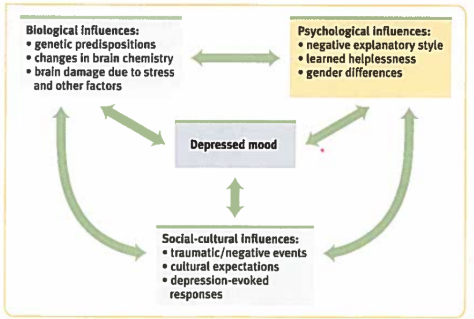
Most recent mental health research dollars have funded explorations of biological influences on mood disorders. Depression is a whole-body disorder. It involves genetic predispositions, biochemical imbalances, negative thoughts, and melancholy moods.
Genetic Influences: We have long known that mood disorders run in families. The risk of major depression and bipolar disorder increases if you have a depressed parent or sibling. If one identical twin is diagnosed with major depressive disorder, the chances are about 1 in 2 that at some time the other twin will be, too. If one identical twin has bipolar disorder, the chances are 7 in 10 that the other twin will at some point be diagnosed similarly. Among fraternal twins, the corresponding odds are just under 2 in 10. The greater similarity of identical twins’ depressive tendencies also occurs among twins reared apart. Moreover, adopted people who suffer a mood disorder often have close biological relatives who suffer mood disorders, become dependent on alcohol, or commit suicide.
A search for the genes that put people at risk for depression is now underway. To tease out which genes are implicated, researchers use linkage analysis. First, they find families that have had the disorder across several generations. Then they draw blood from both affected and unaffected family members and examine their DNA, looking for differences. Linkage analysis points us to a chromosome neighborhood, note behavior genetics researchers Robert Plomin and Peter McGuffin; “a house-to-house search is then needed to find the culprit gene.” Association studies search for correlations between more specific DNA variation and a population trait. One such DNA variation occurs, for example, in about 40% of people with late-onset Alzheimer’s disease and about 15% of those without Alzheimer’s. The anticipated outcome of linkage and association studies in research on depression is a complex picture: Many genes have small effects that can combine with one another and with nongenetic factors to put some people at greater risk.
The Depressed Brain. Genes acts by directing biochemical events that, down the line, influence behavior. The biochemical key is neurotransmitters, those messenger molecules that shuttle signals between nerve cells. Norepinephrine, a neurotransmitter that increases arousal and boosts mood, is scarce during depression and overabundant during mania. (Drugs that alleviate mania reduce norepinephrine.) Most people with a history of depression also have a history of habitual smoking. This may indicate an attempt to self-medicate with inhaled nicotine, which can temporarily increase norepinephrine and boost mood.
A second neurotransmitter, serotonin, is also scarce during depression. Drugs that relieve depression tend to increase norepinephrine or serotonin supplies by blocking either their reuptake (as Prozacm Zoloft, and Paxil do with serotonin) or their chemical breakdown. Repetitive physical exercise, such as jogging, reduces depression as it increases serotonin.
Some of the genes under scrutiny provide codes for neurotransmitter systems such as serotonin. One large study identified New Zealand young adults who had experienced several major stresses, such as a relationship breakup or a family death. These stressed individuals were much more likely to suffer depression if they carried a variation of a gene that codes for a protein that controls serotonin activity. As we have seen so often throughout this book, genes and environments—nature and nurture—interact to form us.
People with depression have also recently been observed to have lower levels in their diet and blood of a “good” fat, omega-3 fatty acid, believed to enhance brain function. Countries such as Japan, where people eat omega-3-rich fish, tend to have low depression rates. Future research may determine whether eating more fish, walnuts, and other foods rich in omega-3 support mental health.
Using modern scanning machines, researchers are also spotting neurological signs of depression. In many recent studies, the brain shows less activity during periods of depression, indicating a slowed-down state, and more activity during periods of mania. The left frontal lobe, which is active during positive emotions, is likely to be inactive during depressed states. In one study of people with severe depression, MRI scans found their frontal lobes 7% smaller than normal. The hippocampus, a memory-processing center linked with the brain’s emotional circuitry, is vulnerable to stress-related damage. By boosting serotonin, which stimulates hippocampus neuron growth, antidepressant drugs may promote recovery from depression.
The Social-Cognitive Perspective
Some people slide into depression for no obvious reason, even when life has been going well. However, as we have noted, biological risk factors can predispose psychological reactions to stressful experiences. And the mind’s negative thoughts somehow influence biological events that in a vicious cycle amplify depressing thoughts.
Depressed people view life through dark glasses. Their intensely negative assumptions about themselves, their situation, and their future lead them to magnify bad experiences and minimize good ones. Listen to Norman, a Canadian college professor recalling his depression:
I [despaired] of being human again. I honestly felt subhuman, lower than the lowest vermin. Furthermore, I was self-deprecatory and could not understand why anyone would want to associate with me, let alone love me….I was positive that I was a fraud and a phony and that I didn’t deserve my Ph.D. I didn’t deserve to have tenure; I didn’t deserve to be a Full professor….I didn’t deserve research grants I had been awarded; I couldn’t understand how I had written books and journal articles…I must have conned a lot of people.
Research reveals how self-defeating beliefs and a negative explanatory style feed depression’s vicious cycle.
Negative Thoughts and Negative Moods Interact. Self-defeating beliefs may arise from learned helplessness. Both dogs and humans act depressed, passive, and withdrawn after experiencing uncontrollable painful events. Gender differences in uncontrollable stress help explain why, beginning in their early teens, women are nearly twice as vulnerable to depression. Women more often than men have been abused or made to feel helpless, and they may respond more strongly to stress. 36% of women and 16% of men entering American colleges feel “frequently overwhelmed by all I have to do”. (Men report spending more of their time in “light anxiety” activities such as sports, TV watching, and partying, possibly avoiding activities that might make them feel overwhelmed.)
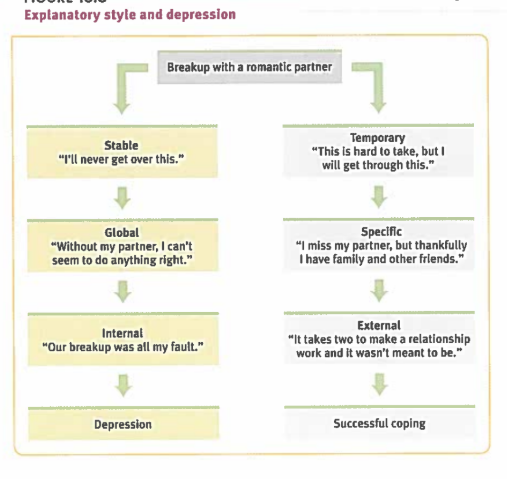
But why do life’s unavoidable failures lead some people and not others to become depressed? The difference lies partly with people’s explanatory style. We have some choice of whom or what to blame for our failures. If you fail a test and blame yourself, you may feel stupid and depressed. If you externalize the blame—perhaps at-tributing your failure to an unfair test—you are more likely to feel angry.
Depressed people tend to explain bad events in terms that are stable (It’s going to last forever”), global (“It’s going to affect everything I do”), and internal (“It’s all my fault”). Lyn Abramson, Gerald Metalsky, and Lauren Alloy theorized that the result of these pessimistic, overgeneralized, self-blaming attributions is a depressing sense of hopelessness. If you tend to see bad grades, social rejection, and work problems as inevitable and your own fault, and if you ruminate about such things, then when bad things happen you will probably experience the blues.
What might you expect of new college students who are not depressed but do exhibit a pessimistic explanatory style (some of whom are about to complete Seligman’s depression recipe: pessimism encountering failure)? Lauren Alloy and her collaborators monitored Temple University and University of Wisconsin students every 6 weeks for 2.5 years. Among those identified as having pessimistic thinking styles, 17 percent had a first episode of major depression, as did only 1 percent of those who began college with optimistic thinking styles. Follow-up research has found that students who exhibit optimism as they begin college develop more social support, which contributes to a lowered risk of depression.
Martin Seligman argues that depression is common among young Westerners because of epidemic hopelessness stemming from the rise of individualism and the decline of commitment to religion and family. When facing failure or rejection, contends Seligman, the self-focused individual takes on personal responsibility for problems and has nothing to fall back on for hope. In non-Western cultures, where close-knit relationships and cooperation are the norm, major depression is less common and less tied to self-blame over personal failure. In Japan, for example, depressed people instead tend to report feeling shame over letting others down.
There is, however, a chicken-and-egg problem with the social-cognitive explanation of depression. Self-defeating beliefs, negative attributions, and self-blame surely do support depression. Peter Barnett and Ian Gotlib note that such cognitions coincide with a depressed mood and are indicators of depression, any more than a speedometer’s reading of 70 mph cause a car’s speed? Before or after being depressed, people’s thoughts are less negative. Perhaps this is because, as we noted in our discussion of state-dependent memory, a depressed mood triggers negative thoughts. If you temporarily put people in a bad or sad mood, their memories, judgments, and expectations suddenly become more pessimistic.
Joseph Forgas and his associates provided a striking demonstration of the mood effect. First, they videotaped people talking to each other. The next day, they put those participants in a good or bad mood via hypnosis and had them watch the videotape of themselves. The happy participants detected in their screen selves more positive than negative behaviors; the unhappy participants more often saw themselves behaving negatively. Thus, even when watching themselves on videotape, mildly depressed people judge themselves more negatively.
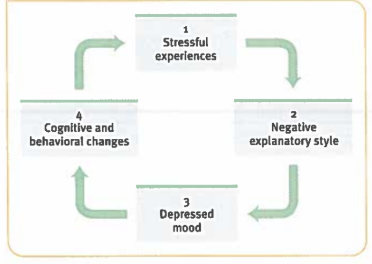
Depression’s Vicious Cycle. “A recipe for severe depression is preexisting pessimism encountering failure,” notes Martin Seligman. Depression, as we have seen, is often brought on by stressful experiences—losing a job, getting divorced or rejected suffering physical trauma—anything that disrupts your sense of who you are and why you are a worthy human being. We have also seen that depression can be adaptive, a time for lying lo and gaining insights that can later lead to more effective strategies for interacting with the world. But depression-prone people respond to bad events in an especially self-focused, self-blaming way. Their self-esteem fluctuates more rapidly up with boosts and down with threats. When down, their brooding amplifies their negative feelings, which in turn triggers depression’s other cognitive and behavioral symptoms.
This cycle also helps explain women’s doubled risk of depression. When trouble strikes, men tend to act, and women tend to think—and often to overthink, as Susan Nolen-Hoeksema describes their rumination. Women often have vivid recall of both wonderful and horrid experiences; men more vaguely recall such experiences. This gender difference in emotional memory may feed women’s greater rumination over negative events and explain why fewer men than women reported being “frequently overwhelmed on entering college.”
None of us is immune to the dejection, diminished self-esteem, and negative thinking brought on by rejection or defeat. As Edward Hirt and his colleagues demonstrated, even small losses can temporarily sour our thinking. They studied some avid Indiana University basketball fans who seemed to regard the team as an extension of themselves. After the fans watched their team lose or win, the researchers asked them to predict the team’s future performance and their own. After a loss, the morose fans offered bleaker assessments not only of the team’s future, but also of their own likely performance at throwing darts, solving anagrams, and getting a date. When things aren’t going our way, it may seem as though they never will.
But being withdrawn, self-focused, and complaining can elicit rejection. In one study, researchers Stephen Strack and James Coyne noted that “depressed persons induced hostility, depression, and anxiety in others and got rejected. Their guesses that they were not accepted were not a matter of cognitive distortion.” Weary of the person’s fatigue, hopeless attitude, and lethargy, a spouse may threaten to leave or a boss may begin to question the person’s competence. Indeed, people in the throes of depression are at high risk for divorce, job loss, and other stressful life events. (This provides another example of genetic-environmental interaction: People genetically predisposed to depression more often experience depressing events.) The losses and stress only serve to compound the original depression. Rejection and depression feed each other. Misery may love another’s company, but the company does not love another’s misery.
We can now assemble some of the pieces of the depression puzzle: (1) Negative, stressful events interpreted through (2) a ruminating, pessimistic explanatory style create (3) a hopeless, depressed state that (4) hampers the way the person thinks and acts. This, in turn, fuels (1) negative experiences such as rejection.
It is a cycle we can all recognize. Bad moods feed on themselves: When we feel down, we think negatively and remember bad experiences. On the brighter side, we can break the cycle of depression at any of these points—by moving to a different environment, by reversing our self-blame and negative attributions, by turning our attention outward, or by engaging in more pleasant activities and more competent behavior.
Winston Churchill called depression a “black dog” that periodically hounded him. Poet Emily Dickinson was so afraid of bursting into tears in public that she spent much of her adult life in seclusion. Abraham Lincoln was so withdrawn and brooding as a young man that his friends feared he might take his own life. As each of these lives reminds us, people can and do struggle through depression. Most regain their capacity to love, to work, and even to succeed at the highest levels.