Arteries, Veins and Capillaries
Overview of Blood Vessels
Focus on how the structure of arteries, veins, and capillaries relates to their specific functions in the circulatory system.
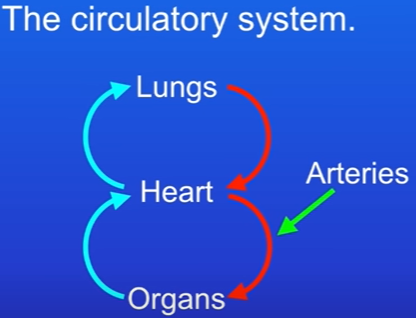
Double Circulatory System
Blood circulates from the heart to the lungs to collect oxygen, returning to the heart before being pumped around the body to deliver oxygen to body cells.
Blood vessels involved in this process:
Arteries
Function: Carry high-pressure blood from the heart to the body's organs.
Structure:
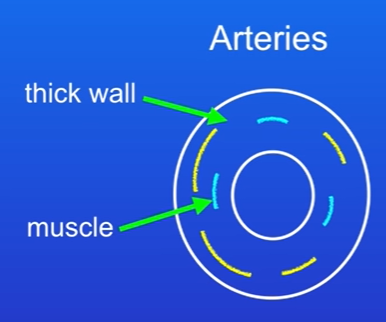
Thick Muscular Walls:
Adapted to withstand high pressure from surging blood due to heartbeats.
Allows arteries to deal with the pulse felt at the wrist.
Elastic Fibers:
Stretch during the surge of blood and recoil, maintaining blood flow between heartbeats. (regulates bloodflow)
Capillaries
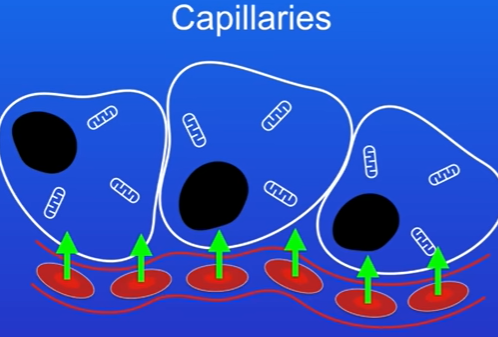
Function: Site of substance exchange between blood and body cells.
Structure:
Thin Walls:
Allows rapid diffusion of substances (e.g., glucose, oxygen) from blood to cells and carbon dioxide from cells back to blood.
Short diffusion pathway enhances rapid nutrient and gas exchange.
When the blood passes through capillaries, substances such as glucose and oxygen diffuse from the blood to the cells, like this, and carbon dioxide diffuses from the cells back to the blood. Now, capillaries have very thin walls, so the diffusion pathway is very short. This allows substances to diffuse rapidly between the blood and the body cells.
Veins
Function: Return blood to the heart under low pressure after it has passed through the organs.
Blood is now traveling slowly under low pressure. That means that it could stop or even go backwards.
Adaptations:
Thin Walls:
Blood pressure is lower, so walls do not require thickness like arteries.
Veins contain Valves:
Stop backflow of blood. Valves open to allow forward flow and close when blood attempts to flow backward, ensuring unidirectional flow back to the heart.