Introduction to Design Thinking
The Double Diamond Design Thinking Process Model
This is a design framework that provides a structured approach to problem-solving and innovation

Challenge - you will be presented with a problem or challenge in the first step of the process
Understand - This is where you understand what the problem is about by doing additional research into the topics relating to the problem
Define - After you have done enough initial research, you will be able to use the knowledge to define or pin down the problem
Ideate - Now you start to solve the problems. You will gather lots of ideas, explore and generate the potential solutions to the defined problem. No solutions is a bad solutions at this stage.
Solution - This is the final stage where you have achieved your solution to the problem or challenge.
Problem Space - Before you develop a solution, you must understand the problem you are trying to solve.
Solution Space - This is where potential solutions are being explored, developed, tested and refined.
Divergent vs Convergent Thinking
“Divergent Thinking” - is a creative and exploratory process that encourages free thinking, brainstorming and innovation without any judgement.
“Convergent Thinking” - is an analytical process that is used to narrow down the options. It involves evaluating, refining and validating the information or ideas.
How do we analyse and make sense of a problem?
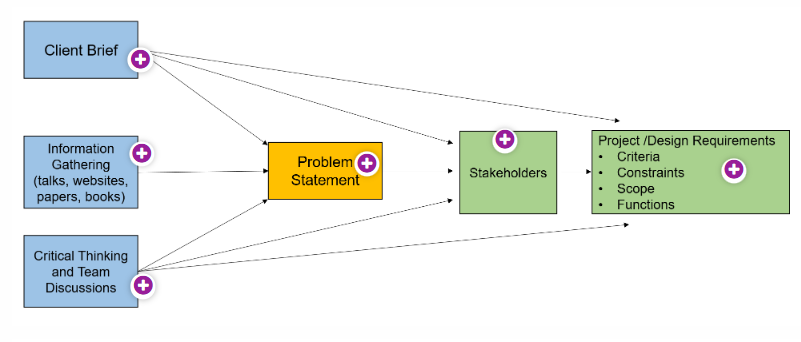
Client Brief
Client will provide you with a brief detailing the problems at hand. It can be in the form of written document, presentation or meeting. Sometimes, clients will state what they want, not what they need. This is called a solution driven statement. The statement tells you what the client thinks is the right solution. You want to avoid being trapped in this as it might not be the right solution to the problem. Your job is to analyse the statement to uncover what the need is and decide if the solution the client has stated is really the right way to go.
Information Gathering (talks, websites, papers, books)
The client’s brief won’t always provide you with all the information that you will need to solve the problem. Therefore, you will have to perform further research across a range of sources including websites, academic research, grey literature etc. to gather more information about the problem.
Critical Thinking and Team Discussions
You need to think critically about the information gained from the brief as wells as from your personal research in order to pinpoint exactly what the problems to be addressed are. It is vital that all your team members are on the same page here and remember to Share, Understand, Integrate and make a Team decision that you all agree with.
Problem Statement
A problem statement is a clear, concise description of the issue that needs to be addressed. This must not indicate a preference for any solution or indication of any particular solution. This is to avoid limiting your potential solutions later on in the project. It is the engineer’s job to create a solution independent statement that only contains the actual problem and removes any unnecessary solution driven information.
Stakeholders
Who are the players in the project and what are their needs, wants and influence?
Project/Design Requirements
Design requirements are vital in reframing the problem to be addressed.
Want vs Need
As an engineer, you will need to be able to distinguish between what the client wants and what the client needs.
For example: Client says to you that "I want a bag that attaches to my wheelchair so I can carry groceries home from the store easily".
The engineer’s job is to analyse this statement – statement can be broken into parts:
Which part of the statement is the real need here?
Does the client only want to get the groceries home, or do they want to be able to carry other things?
Do they want something they can operate alone, or would it be acceptable to be dependent on others for help?
How much volume and weight is the client thinking they need to transport?
Does it need to protect the things being carried from rain, heat, dust, vibration, and other environmental factors?
Project Requirements
After you have understood the problem, completed the initial research, identify what the client wants, you will then develop a project requirements.
Developing a clear set of requirements will help keep your design project manageable.
Design problems are inherently complex because
They have many possible solutions
They often involve ambiguous or unknowable information
Hence, following the design thinking process in solving the problem/challenge will help you to breakdown a complex problem and lead to the solution that is best for the client.
Prioritising Stakeholders
So how do you weigh up the relative influence of these stakeholders? This is commonly done using Mendelow's Matrix (attached below), where differing combinations of stakeholder power and interest inform how they should be engaged.

Keep informed remain aware of their contact with others
Known as "Potential Players" these stakeholders are very interested in the project but lack the power to influence its outcomes significantly. Examples include employees, local community groups, and minor customers. Regular updates and open communication are essential to keep them informed and address any concerns they might have.
Monitor closely, keep informed regularly, lobby actively
Known as "strategic players" these stakeholders are crucial to the success of the project. They have significant influence and a strong interest in the outcomes. Examples include senior executives, major investors, and key customers. They should be closely managed and kept fully engaged.
Keep advised low level of reaction needed
Known simply as "others" these stakeholders have minimal interest and influence over the project. They require minimal attention, but it's still important to monitor their status to ensure they don't become more influential or interested unexpectedly.
Keep informed regularly, stay attuned to their needs and behaviours
Known as "weak players" these stakeholders have considerable influence but may not be highly interested in the day-to-day details. Examples include government regulators, major suppliers, and board members. It's important to keep them satisfied and ensure their needs are met without overwhelming them with too much information.
Criteria and Constraints
The first step in framing a solution is to form Design Requirements which are composed of Criteria, Constraints & Scope.
Constraints are limitations on the design which must apply to every solution for them to be considered. These are "must" statements.
For example, "The design must produce at least 3ML/day of Class A water"
Criteria are desirable characteristics that are preferred in the design and should be prioritised. These are "should" statements that can be used to rank designs against one another.
For example, "The design upgrades should be as low cost as is practicable"
Scope
Alongside your criteria and constraints, you will need to provide information regarding what was and was not considered in your design process (Scope).
Scope defines the boundaries and extent of the project. It outlines what will be included and excluded in the design process whilst providing a logic for how scoping decisions were made. Creating the scope of a project is important because it sets clear boundaries, ensuring that goals, tasks, and deliverables are well-defined.
It is also important to list the assumptions that were made in your scoping process as to make all stakeholders aware of potential risks.