Language
LANGUAGE – Cognitive Psychology Notes
1. What Is Language?
Definition (Harley, 2008): Language is a system of symbols (e.g., words) and rules (syntax) that enable communication.
Functions of Language (Crystal, 1997):
Communication
Thinking
Recording information
Expressing emotion
Pretending
Expressing group identity
2. Language in Other Species
Key Example: Panbanisha the Bonobo
Used a keypad with 400 lexigrams
Learned ~3000 words
Could form grammatical sentences
Limitations:
Few novel sentences
Rarely talked about invisible objects
Less complex than children’s language
Chomsky's view: If animals could naturally acquire language, it would be an evolutionary miracle.
3. Is Language Innate?
A. Chomsky’s Theory
Proposed Language Acquisition Device (LAD)
Language is innate, with built-in universal grammar
Children quickly acquire language, learning 10+ new words/day by age 16 months; mastering grammar by age 5
B. Counterarguments
Critics argue grammar must be flexible enough to allow for all languages (e.g., Italian, Japanese, sign languages)
C. Bickerton’s Language Bioprogram Hypothesis
Children can create grammar even without full language input
Supported by:
Pidgin languages (basic, no grammar)
Creole languages (next generation, full grammar)
E.g., Hawaiian Creole evolved from simple pidgin
D. Nicaraguan Sign Language
Deaf children created a new sign language with grammar, despite little exposure to Spanish or formal sign language
Shows innate drive to acquire language
4. Genetic Evidence
The KE Family (London)
50% had severe language disorders: ungrammatical speech, understanding problems
FOXP2 gene mutation linked to these disorders
Affects motor control in speech (e.g., tongue movement)
❗ Note: FOXP2 is not the sole cause of common language disorders
5. Environmental Factors
Child-directed speech (simplified speech from adults) plays a crucial role
Exposure determines which language is learned
6. The Whorfian Hypothesis (Linguistic Relativity)
Versions:
Strong: Language determines thought
Weak: Language influences perception
Weakest: Language influences memory
Evidence & Studies:
Heider (1972): Dani people (New Guinea) with only 2 color terms performed like English speakers — weak support
Roberson et al. (2000): Berinmo speakers (5 color terms) showed different categorical perception compared to English speakers — supports Whorfian hypothesis
E.g., English distinguishes green/blue, Berinmo uses nol/wor (green/yellow)
Participants grouped colors based on their language’s categories
Russian study (Winawer et al., 2007):
Russian has separate words for light blue (goluboy) and dark blue (siniy)
Russian speakers were faster at distinguishing colors across these categories
Hoffman et al. (1986):
Bilinguals (English-Chinese) used different stereotypes depending on the language they were thinking in
Casasanto (2008):
English uses distance metaphors (long meeting), Greek uses amount (meeting with much)
Language affected time estimation in experiments
7. Evaluation of the Whorfian Hypothesis
Support for weak and weakest forms is growing
Modest evidence even for strong version in open-ended tasks
Cognitive cost may determine influence of language (Hunt & Agnoli, 1991)
Still unclear how flexible or fixed the language-cognition relationship is
8. Overview of Language Skills (Next Chapters Preview)
Four main language skills:
Listening
Reading
Speaking
Writing
Each has different strengths and weaknesses, especially in second-language acquisition
Key Terms to Know
Term | Definition |
|---|---|
Lexigram | Symbol used by apes in communication |
Language Acquisition Device | Chomsky’s innate mechanism for grammar learning |
Pidgin Language | Simple language with no grammar |
Creole Language | Fully grammatical language developed from pidgin |
FOXP2 gene | Genetic factor linked to speech and language production |
Whorfian Hypothesis | Idea that language influences or determines thought |
Categorical Perception | Better discrimination between different categories than within the same category |
Langauge Comprehension
🔍 1. Differences Between Reading and Speech
Feature | Reading | Speech |
|---|---|---|
Modality | Visual, spatial | Auditory, temporal |
Word boundaries | Explicit (spaces between words) | Implicit, harder to detect |
Persistence | Persistent (can re-read text) | Transient (once spoken, gone) |
Cues for structure | Punctuation | Prosodic cues (intonation, stress, etc.) |
Evolutionary history | New skill, no hardwired system | Evolutionarily older, more automatic |
Example: Children and some brain-damaged patients can understand speech but struggle with reading.
🧪 2. Research Methods in Word Recognition
Lexical Decision Task: Decide quickly if a string is a real word.
Naming Task: Read aloud as fast as possible.
Priming: A word like "NURSE" speeds up recognition of "DOCTOR" (semantic priming).
Eye Tracking: Reveals where and how long the eyes fixate—provides insight into attention during reading.
Brain Imaging: Identifies active regions during different reading tasks.
🔤 3. Phonological Processing in Reading
Weak Phonological Model: Phonology is slow and not always involved.
Strong Phonological Model: Phonology is automatic and essential.
📌 Supporting Evidence
Homophone confusion: “Is ROWS a flower?” → errors due to confusion with “ROSE”.
Masked Phonological Priming: “klip” → “clip” = faster recognition.
Phonological Neighborhoods: Words with more similar-sounding neighbors are processed faster (Yates, 2005).
⚠ Challenges
Some patients (e.g., PS) recognize word meanings without phonology.
Context and semantics sometimes dominate phonological processing.
🧠 4. The Interactive Activation Model (McClelland & Rumelhart, 1981)
🔁 Structure
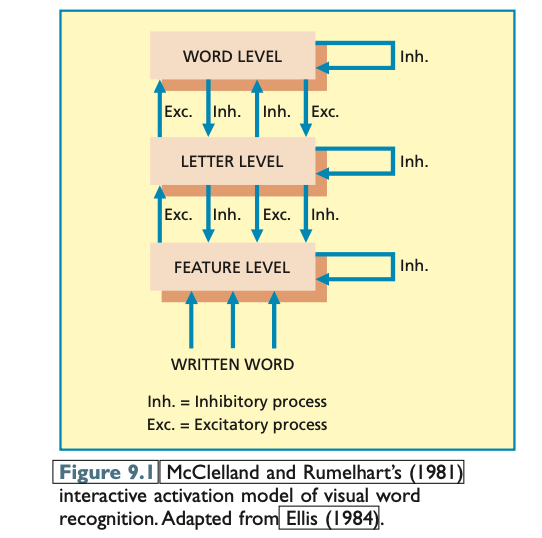
Three levels: Feature → Letter → Word
There are recognition units at three levels: the feature level at the bottom; the letter level in the middle; and the word level at the top.
When a feature in a letter is detected (e.g., vertical line at the right-hand side of a letter), activation goes to all letter units containing that feature (e.g., H, M, N), and inhibition goes to all other letter units.
Letters are identified at the letter level. When a letter within a word is identified, activation is sent to the word level for all four-letter word units containing that letter in that position within the word, and inhibition is sent to all other word units.
Words are recognised at the word level. Activated word units increase the level of activation in the letter-level units for the letters forming that word.
Activation spreads both ways (bottom-up and top-down)
Word superiority effect: Letter recognition is better within a real word (e.g., “SEAT” vs. “A” in isolation)
Pseudoword superiority effect: Also applies to pronounceable nonwords like “MAVE”
word frequency:
high frequency - words encountered frequently in our day-to-day life. → opposite = low frequency
orthographic neighbours:
the words that can be formed by changing just one of its letters.
for example, the word “stem” has words including “seem”, “step”, and “stew” as orthographic neighbours.
According to the model, time to identify a word depends in part on its orthographic neighbours. When a word is presented, these orthographic neighbours become activated and increase the time taken to identify it. Theoretically, this inhibitory effect is especially great when a word’s orthographic neighbours are higher in frequency in the language than the word itself.
📉 Limitations
Doesn’t include phonological processing or semantics
Word frequency doesn't affect word superiority effect as predicted
🧠 5. Dual-Route Cascaded Model (Coltheart et al., 2001)
📘 Three Routes
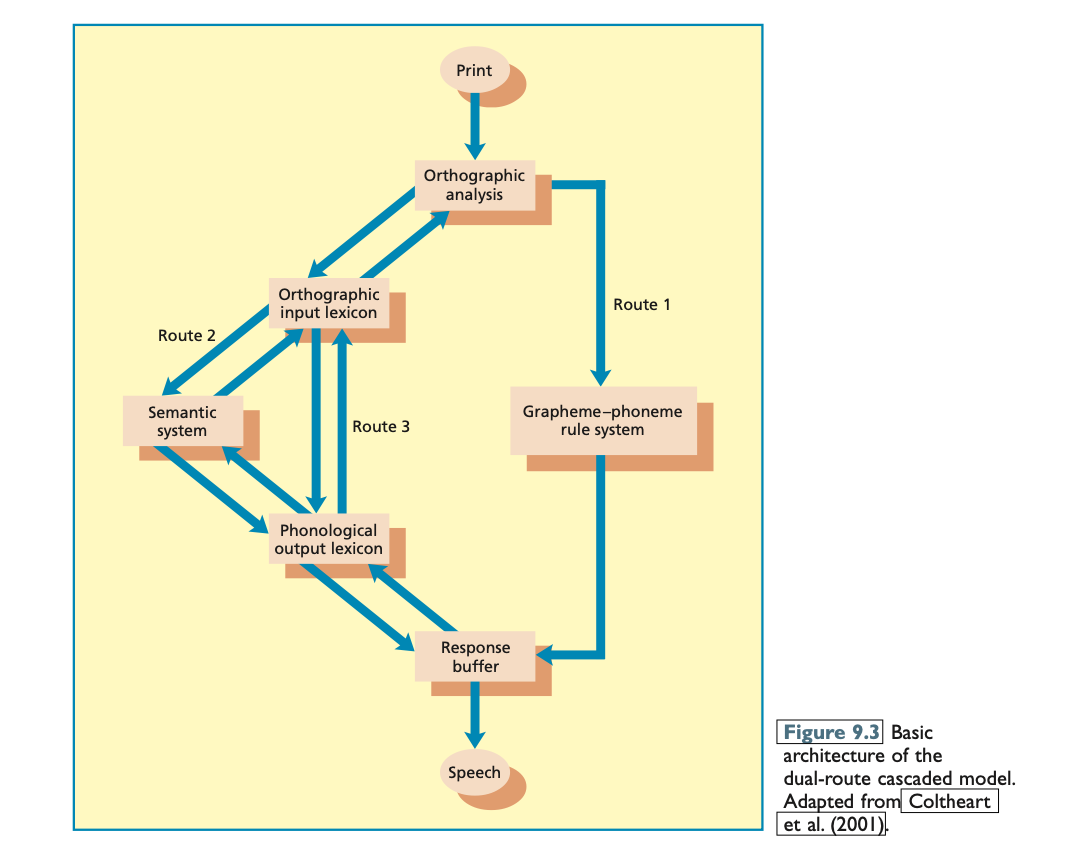
Route 1 (Non-lexical): turning Graphemes (spelling) to phonemes (sounds) rule (good for nonwords)
If a brain-damaged patient used only Route 1, what would we find? The use of grapheme– phoneme conversion rules should permit accurate pronunciation of words having regular spelling–sound correspondences but not of irregular words not conforming to the conversion rules. For example, if an irregular word such as “pint” has grapheme–phoneme conversion rules applied to it, it should be pronounced to rhyme with “hint”. This is known as regularisation.
McCarthy and Warrington (1984) studied KT, who had surface dyslexia. He read 100% of nonwords accurately, and 81% of regular words, but was successful with only 41% of irregular words. Over 70% of the errors KT made with irregular words were due to regularisation.
Route 2 (Lexical + Semantics): For irregular words (e.g., “comb”)
How could we identify patients using Route 2 or Route 3 but not Route 1? Their intact orthographic input lexicon means they can pronounce familiar words whether regular or irregular. However, their inability to use grapheme–phoneme conversion should mean they find it very hard to pronounce unfamiliar words and nonwords.
Route 3 (Lexical only): Bypasses meaning
👤 Evidence from Disorders
Surface Dyslexia: Problems with irregular words (Route 2 damage)
According to the model, the main reason patients with surface dyslexia have problems when reading irregular words is that they rely primarily on Route 1. If they can also make reasonable use of Route 3, then they might be able to read aloud correctly nearly all the words they know in the absence of any knowledge of the meanings of those words stored in the semantic system. Thus, there should not be an association between impaired semantic know- ledge and the incidence of surface dyslexia.
Phonological Dyslexia: Struggles with nonwords (Route 1 damage)
The first case of phono- logical dyslexia reported systematically was RG (Beauvois & Dérouesné, 1979). RG successfully read 100% of real words but only 10% of nonwords. Funnell (1983) studied a patient, WB. His ability to use Route 1 was very limited because he could not produce the sound of any single letters or nonwords. He could read 85% of words, and seemed to do this by using Route 2. He had a poor ability to make semantic judgements about words, suggesting he was bypassing the semantic system when reading words.
Deep Dyslexia: Semantic errors (e.g., "ship" → "boat") - damage to left-hemisphere brain areas involved in language.
Deep dyslexics have particular problems in reading unfamiliar words, and an inability to read nonwords.
Deep dyslexia may result from damage to the grapheme–phoneme conversion and semantic systems. Deep dyslexia resembles a more severe form of phonological dyslexia.
❗ Limitations
Can’t explain consistency effects: reading is more influenced by consistency than regularity
Model is hardwired: doesn't simulate learning
Semantic system is not implemented
Assumes phonology is slow, which contradicts evidence
🧠 6. Distributed Connectionist (Triangle) Model
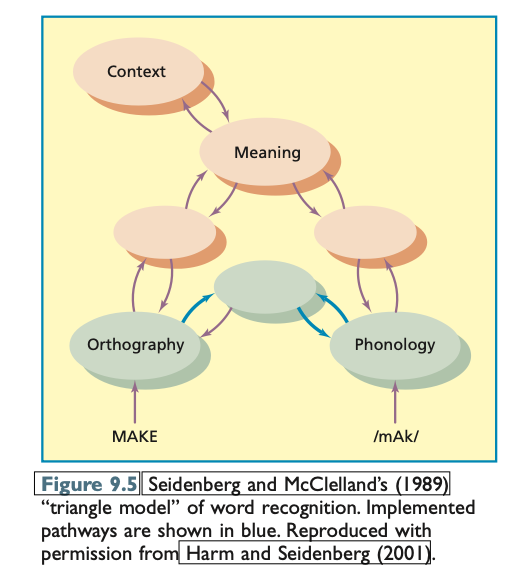
Plaut et al. (1996): All routes (orthography (spelling), phonology (sound), semantics (meaning) ) are used in parallel
There are two routes from spelling to sound: (1) a direct pathway from orthography to phonology; and (2) an indirect pathway from orthography to phonology that proceeds via word meanings.
Learns through back-propagation, in which the actual outputs or responses of the system are compared against the correct ones
Handles both words and nonwords
Better accounts for learning and consistency effects
💡 Key Ideas
Consistency (the extent to which their pronunciation agrees with those of similarly spelled words) > Regularity: Inconsistent words are slower (Highly consistent words and nonwords can generally be pronounced faster and more accurately than inconsistent words and nonwords, because more of the available knowledge supports the correct pronunciation of such words.)
Semantics helps more with inconsistent words (more time = more semantic influence)
👤 Dyslexia & Simulation
Damage to semantic system → Surface dyslexia symptoms
Damage to phonology → Phonological dyslexia
Model matches performance patterns of dyslexic and healthy readers
👁 7. Eye Movement in Reading
Saccades: Rapid jumps (no info taken in)
Fixations: Info processed (~200–250ms)
Perceptual span: ~3–4 letters to the left, ~15 right of fixation
Parafoveal processing: Previewing next word
Skipped words: Common, predictable, or short words
Spillover effect: Word takes longer to read if preceded by a rare word
👀 8. E-Z Reader Model (Reichle et al., 1998)
to see how people can decide which words to skip when reading.
Serial processing model (that at any given moment only one word is processed.)
Eye movement is planned after:
Familiarity check
Lexical access (meaning and phonology)
Can attend to 2 words during 1 fixation
Frequency checking and lexical access are completed faster for common words than rare ones (more so for lexical access).
Skipped words: short, frequent, or predictable
✅ Evidence
Reichle et al. (2003) compared 11 models of reading in terms of whether each one could account for each of eight phenomena (e.g., frequency effects; spillover effects; costs of skipping). E-Z Reader accounted for all eight phenomena, whereas eight of the other models accounted for no more than two.
One of the model’s main assumptions is that information about word frequency is accessed rapidly during word processing. There is support for that assumption. For example, Sereno, Rayner, and Posner (1998) observed effects of word frequency on event-related potentials within 150 ms.
Explains: frequency, predictability, spillover, skipping
Outperforms most other models in predictive power
❗ Limitations
Ignores higher-level integration (sentence meaning)
Assumes serial attention; SWIFT model allows parallel processing
Some parafoveal-on-foveal effects suggest partial parallelism
🔄 E-Z Reader vs. SWIFT
Feature | E-Z Reader | SWIFT |
|---|---|---|
Processing | Serial (one word at a time) | Parallel (multiple words at once) |
Skips | Based on predictability | Explained via distribution of attention |
Evidence | Strong for serial, limited for parallel | Mixed—some support for parallelism |
🧠 Speech Perception (Overview)
Harder than reading due to lack of clear boundaries
Prosodic cues help comprehension
Disorders (e.g., pure word deafness, word meaning deafness) reveal separate routes between sound and meaning
📚 Key Definitions
Term | Definition |
|---|---|
Orthography | Spelling/visual form of words |
Phonology | Sound structure of words |
Semantics | Meaning of words/sentences |
Saccades | Fast eye movements |
Fixation | Pause for information intake |
Lexical Decision Task | Is it a real word? |
Priming | Earlier stimulus speeds up later processing |
Spillover Effect | Longer fixation due to prior rare word |
Perceptual Span | Letters visible during fixation |
more detailed notes on chapter 9 :
🔎 1. Reading vs. Speech Perception
Feature | Reading | Speech |
|---|---|---|
Input type | Visual (static) | Auditory (dynamic) |
Structure | Punctuation & spacing | Prosodic cues (intonation, stress) |
Word boundaries | Clear | Often ambiguous |
Information duration | Persistent (can re-read) | Transient (fades quickly) |
Reliance on memory | Lower | Higher (info fades) |
Evolutionary age | Recent, learned skill | Ancient, biologically evolved |
Example: Young children can understand speech without reading ability; some brain-damaged patients lose reading ability but not speech comprehension.
🧪 2. Research Methods in Reading
Lexical Decision Task: "Is BLENT a real word?" — measures word recognition speed.
Naming Task: Say words aloud as fast as possible.
Priming Tasks: Prior exposure to related words affects speed (e.g., "NURSE" after "DOCTOR").
Eye Tracking: Measures fixations/saccades during reading.
Brain Imaging (e.g., fMRI, ERP): Localizes active areas during reading.
🔠 3. Phonological Processing in Reading
Weak Phonological Model: Phonology not essential; accessed later.
Strong Phonological Model: Phonology is always accessed early.
✅ Evidence for phonology:
Van Orden (1987): Homophone error: "Is ROWS a flower?" → "Yes" due to phonological confusion with "ROSE".
Ziegler & Ferrand (1998): Masked phonological priming (e.g., "klip" → "clip") speeds recognition.
Jared et al. (1999): Poor readers depend more on phonology than skilled readers.
Yates (2005): Phonological neighborhood density affects word recognition.
❌ Evidence against:
Hanley & McDonnell (1997): Patient PS could comprehend without phonology.
Daneman et al. (1995): Meaning accessed faster than phonology.
🧩 Conclusion: Phonology is common and automatic, but not necessary in all reading.
🔡 4. Word Recognition
Automatic Processing: Recognition happens without conscious effort.
Stroop Effect (Stroop, 1935): Naming ink color is slowed by conflicting word (e.g., "RED" in blue ink).
Word Superiority Effect (Reicher, 1969)
A letter is more easily recognized in a real word ("WORD") than in a nonword ("WRDO").
Pseudoword Superiority Effect (McClelland & Johnston, 1977)
Letters are recognized better in pronounceable nonwords (e.g., “MAVE”) than in random strings.
🔁 5. Interactive Activation Model (McClelland & Rumelhart, 1981)
Levels:
Feature level → Letter level → Word level
Top-down & bottom-up processing: Prior knowledge (word frequency) and visual input interact.
Features:
Inhibition and excitation between levels
Accounts for:
Word superiority effect
Effects of orthographic similarity
Criticism:
Doesn’t include phonology or semantics
Word frequency doesn’t always predict recognition time in English
📖 6. Reading Aloud – Dual-Route Cascaded Model (Coltheart et al., 2001)
3 Routes:
Non-lexical (Route 1): Uses grapheme-to-phoneme conversion (for nonwords: “flirp”).
Lexical (Route 2): Uses word form & meaning (irregular words: “yacht”).
Direct lexical (Route 3): Word form only, no semantics.
Reading Disorders:
Surface Dyslexia: Irregular word errors (e.g., “pint” → rhymes with “mint”).
Phonological Dyslexia: Can't read nonwords.
Deep Dyslexia: Semantic errors (e.g., “dog” read as “cat”).
🔍 Limitations:
Ignores learning
Cannot explain consistency effects
Lacks implemented semantic system
🔺 7. Triangle Model (Plaut et al., 1996)
Connectionist approach: All routes (orthography–phonology–semantics) interact dynamically.
Learning-based: Adjusts with experience (via back-propagation).
Handles both words & nonwords via shared mechanisms.
Key Points:
Consistency (not regularity) is critical.
E.g., “pint” (inconsistent) is harder than “mint” (consistent)
McKay et al. (2008): Semantics helps read inconsistent words better.
Zevin & Seidenberg (2006): More inconsistent = slower reading
👁 8. Eye Movements in Reading
Saccades: Rapid eye jumps (~30 ms); no info processed.
Fixations: Stops (~250 ms); info processed.
Perceptual Span: ~3–4 letters to left, ~15 to right of fixation.
Key Phenomena:
Spillover Effect: Rare/long words increase time spent on next word.
Skipping: Common/predictable words skipped.
Parafoveal Preview: Readers pre-process next word during fixations.
Boundary Paradigm:
Replaces word during saccade → shows importance of preview for fluency.
👓 9. E-Z Reader Model (Reichle et al., 1998, 2003)
Serial attention: One word processed at a time.
Two stages:
Familiarity check (triggers saccade)
Lexical access (triggers attention shift)
Can process 2 words per fixation (current + previewed word)
✅ Explains:
Fixation times
Word skipping
Spillover effects
🔄 Comparison with SWIFT:
Feature | E-Z Reader | SWIFT |
|---|---|---|
Word processing | Serial | Parallel |
Attention | One word | Distributed across words |
Better at explaining | Word skipping, fixation timing | Parafoveal-on-foveal effects |
📚 Key Researchers & Studies Summary
Researcher(s) | Contribution |
|---|---|
Van Orden (1987) | Homophone errors (ROWS–ROSE) |
McClelland & Rumelhart (1981) | Interactive Activation Model |
Coltheart et al. (2001) | Dual-Route Cascaded Model |
Plaut et al. (1996) | Triangle Model (Connectionist) |
Jared et al. (1999) | Phonology in poor readers |
Yates (2005) | Phonological neighborhood effects |
Reichle et al. (1998) | E-Z Reader model |
Hanley & McDonnell (1997) | Reading without phonology |
McKay et al. (2008) | Semantics aid inconsistent nonwords |
Zevin & Seidenberg (2006) | Learning effects in word consistency |
Chapter 10
🧠 Overview
Focuses on understanding phrases, sentences, and discourse during reading and listening.
Higher-level comprehension processes are similar across reading and listening.
Main areas covered:
Parsing (syntactic analysis)
Pragmatics (intended meaning)
Prosodic cues
Working memory & individual differences
Figurative language (e.g., metaphor)
Discourse comprehension
🔤 1. Parsing: Syntactic Analysis
Parsing = the grammatical analysis of sentence structure.
Parsing is essential when meaning is ambiguous.
🪜 Garden-Path Model
(Frazier & Rayner, 1982)
Two-stage model:
Syntactic structure is assigned using minimal attachment (simplest structure) and late closure (attach new words to current phrase).
If the structure fails, it is reanalyzed using semantic information.
Example:
“The horse raced past the barn fell.”
→ Initially misinterpreted; syntactic revision required.
Supporting Evidence:
Ferreira & Clifton (1986) used eye-tracking to show minimal attachment errors.
Criticism: Assumes no early semantic influence, which has been challenged.
🧠 Constraint-Based Model
(MacDonald, Pearlmutter, & Seidenberg, 1994)
Parsing uses multiple simultaneous constraints:
Syntax
Semantics
Verb bias
Context
Frequency of usage
Examples:
Pickering & Traxler (1998): Eye fixations longer when semantic constraint misled readers.
Garnsey et al. (1997): Verb bias affected parsing speed.
“Read” usually followed by object: “She read the book” (vs. rare syntactic forms).
Strengths:
Supported by evidence of early semantic processing (Spivey et al., 2002).
Limitations:
Boland & Blodgett (2001): Not all constraints are used immediately.
Unclear how syntactic structures are formed in detail.
🔁 Unrestricted Race Model
(Van Gompel, Pickering, & Traxler, 2000)
Combines Garden-Path and Constraint-Based models.
Uses all information sources to pick one structure quickly.
Reanalysis occurs only if initial parse fails.
Evidence:
Sentences with verb-phrase vs. noun-phrase attachment.
Readers interpreted sentences faster when structure matched bias.
🔊 2. Prosodic Cues (Speech Structure Signals)
Prosody = stress, intonation, duration — helps listeners understand speech.
Key Findings:
Duffy & Pisoni (1992): Without prosody (monotone), comprehension dropped.
Steinhauer & Friederici (2001): ERP responses to punctuation in text mirrored intonation in speech.
Ashby & Clifton (2005): Eye movements affected by stress patterns.
Snedeker & Trueswell (2003): Prosodic cues influenced sentence interpretation even before ambiguous phrase appeared.
Frazier et al. (2006): Structure depends on relationship between phrase boundaries, not just presence of one.
🧠 3. Pragmatics: Intended Meaning
Pragmatics: How context and speaker intention affect meaning.
🧪 Examples:
Irony/sarcasm: “Great job!” when plates are dropped.
Holtgraves (1998): Indirect speech (e.g., “She’s not my type”) often interpreted negatively to save face.
🧠 Grice’s (1975) Cooperative Principle:
Speakers and listeners share common ground.
Violations cause misinterpretation unless context helps.
🧠 Keysar et al. (2000):
People often use an egocentric heuristic — consider their own perspective before adjusting for the speaker’s view.
🧬 4. Figurative Language & Metaphor
🧪 Standard Pragmatic Model (Grice, 1975):
3-stage process:
Literal meaning accessed
Context checked
Figurative meaning retrieved (if needed)
Predicts literal meaning is always faster → Often incorrect.
🧠 Glucksberg (2003):
Metaphors processed in parallel with literal meanings.
🧠 Giora’s Graded Salience Hypothesis:
Salient meanings (frequent, familiar) accessed first, regardless of whether they’re literal.
🧠 Kintsch’s (2000) Predication Model:
Metaphors: “X is Y” → Select only relevant features of Y.
Example: “Lawyer is a shark” → Extract "aggressive", not "has fins".
Evidence:
McGlone & Manfredi (2001): Activating literal shark traits slows metaphor comprehension.
Chiappe & Chiappe (2007): High working memory = 23% faster metaphor comprehension.
🧠 5. Individual Differences in Working Memory
📏 Measurement:
Reading Span (Daneman & Carpenter, 1980): Recall final words of sentences read for comprehension.
Operation Span: Solve math + recall associated words.
🔬 Key Studies:
Just & Carpenter (1992): High working memory → better comprehension and faster recovery from ambiguity.
Daneman & Merikle (1996): Working memory predicts comprehension better than simple memory spans.
Calvo (2001): High-span individuals draw elaborative inferences (e.g., connecting “The pupil studied…” with implied goal).
Sanchez & Wiley (2006): Low-span readers more distracted by irrelevant visuals (“seductive detail effect”).
Kaakinen et al. (2003): High-span readers focus more on relevant content.
Prat, Keller & Just (2007):
High-span readers show:
Greater efficiency
Greater adaptability
Better brain region synchronisation
🧠 Gernsbacher et al. (1990):
High-comprehenders suppress irrelevant meanings faster (e.g., “ace” after “spade”).
🧩 6. Discourse Processing (Connected Text)
Graesser et al. (1997): Discourse involves goals, events, obstacles, emotional reactions.
🧠 Inference Drawing
Rumelhart & Ortony (1977) example:
“Mary heard the ice-cream van coming.”
“She remembered the pocket money.”
→ We infer: She wants to buy ice cream and needs money quickly.
Types of Inferences:
Elaborative: Add extra info (Calvo, 2001)
Bridging: Connect earlier and later parts of the text
🗂 Key Terms Recap
Term | Definition |
|---|---|
Parsing | Grammatical analysis of sentence structure |
Minimal Attachment | Use of simplest grammatical structure |
Late Closure | Attach new words to the current phrase |
Prosody | Intonation, stress, rhythm in speech |
Pragmatics | Intended meaning beyond literal expression |
Figurative Language | Non-literal language (e.g., metaphor) |
Reading Span | Comprehension + memory test (sentence-final words) |
Common Ground | Shared knowledge between speaker and listener |
📘 Chapter 11: Language Production
🧭 Overview
We know less about language production than comprehension.
Why? Harder to constrain what people say vs. controlling what they read/hear.
Production includes speech and writing, and is goal-directed — influenced by social and motivational factors.
Writing is more conscious, slower, and structured than speech.
🗣 1. Speaking vs. Writing
Aspect | Speaking | Writing |
|---|---|---|
Feedback | Immediate feedback from listener | No immediate feedback |
Audience | Known audience | Often unknown audience |
Planning time | Minimal | Ample |
Complexity | Simpler, informal | Complex, formal |
Structure | Spoken prosody (intonation, rhythm) | Punctuation, connectives |
Key Studies:
Gould (1978, 1980): Dictation only 35% faster than typing.
Olive & Piolat (2002): Writers with/without visual feedback wrote equally well.
Levine et al. (1982): Patient EB — could write despite inability to speak.
Assal et al. (1981): Fluent speech but ungrammatical writing.
Benson & Ardila (1996): Broca's aphasia → impaired speech & writing.
🧩 2. Common Ground and Cooperation in Speech
Grice’s (1967) Cooperative Principle:
Quantity – Be as informative as necessary
Quality – Be truthful
Relation – Be relevant
Manner – Be clear and orderly
Clark’s Theory of Common Ground:
Speakers & listeners aim to align mutual knowledge.
Clark & Krych (2004): Lego-building task
Errors: 39% (no interaction) vs. 5% (interaction)
Speakers adapt utterances quickly
Models of Common Ground Use:
Model | Key Idea |
|---|---|
Initial Design Model | Plan utterance fully using listener’s perspective |
Monitoring & Adjustment | Plan selfishly, then adjust if needed |
Horton & Keysar (1996): Speeded speakers ignored common ground.
Bard et al. (2007): Speakers reacted more to verbal cues than gaze → Shared responsibility over full cognitive tracking.
🧠 3. Speech Planning
Clause-level planning: Evidence from hesitations before clauses (Garrett, 1980; Holmes, 1988).
Phrase-level planning: Delays with complex initial phrases (Martin et al., 2004).
Single-object planning: Speakers prepare only first word (Griffin, 2001).
🌀 Flexible planning:
Ferreira & Swets (2002): Planning depends on task difficulty and time pressure.
Spieler & Griffin (2006): Fast speakers = less planning, lower fluency.
🧬 4. Basic Processes in Speech Production
Two Strategies to Ease Production:
Preformulation: Use habitual phrases (70% of speech — Altenberg, 1990)
Underspecification: Use vague language (Smith, 2000)
Discourse Markers:
Words like well, oh, you know, anyway
More common in spontaneous speech
Used for topic shifts, emphasis, or clarification
Bolden (2006): oh = self-focused topics; so = listener-focused
Fox Tree (2000): Markers common in conversation but not planned speech
🗣 5. Prosody and Gesture
Prosody = Rhythm, stress, intonation
Helps resolve ambiguity
Keysar & Henly (2002): Speakers overestimate how clear they are
Snedeker & Trueswell (2003): Prosody used more when ambiguity exists
Kraljic & Brennan (2005): Use of prosody not sensitive to listener needs
Gestures aid fluency and clarity:
Bavelas et al. (2008): Gestures vary by context (more expressive face-to-face)
❌ 6. Speech Errors
Type of Error | Example |
|---|---|
Spoonerism | “You have hissed all my mystery lectures” |
Freudian slip (Motley, 1980) | “Goxi furl” → “foxy girl” when aroused |
Semantic substitution | “tennis bat” for “tennis racquet” |
Word-exchange | “Let the house out of the cat” |
Sound-exchange | “barn door” for “darn bore” |
Morpheme-exchange | “He trunked two packs” |
Number-agreement error | “The family of rats were happy” (should be was) |
Dell et al. (1997): Anticipatory vs. perseveratory errors
Practice → more anticipatory, fewer perseverations
🧠 7. Models of Speech Production
A. Spreading Activation Theory (Dell, 1986)
Parallel processing
4 levels:
Semantic
Syntactic
Morphological
Phonological
Activation spreads from concepts → sounds
Syntactic Traffic Cop: Ensures noun → noun, verb → verb
Key Effects Explained:
Mixed-error: “Start” → “stop” (semantic + phonological)
Lexical bias: Errors more likely to be words than nonwords (Baars et al., 1975)
🔍 Evaluation:
✅ Predicts common error types
✅ Allows for flexibility
❌ Overpredicts errors
❌ Weak on sentence planning & timing
B. WEAVER++ Model (Levelt et al., 1999)
Serial & feedforward
Discrete stages: Meaning → Syntax (lemma) → Morphology → Phonology → Articulation
Lexicalisation: Turning meaning into sound
Lemmas: Words with meaning + syntax, but no sound
Evidence:
TOT states: Know meaning but not word sound (Harley & Bown, 1998)
ERP studies: Syntax accessed before phonology (van Turennout et al., 1998)
Tip-of-the-tongue studies: Confirm lemma/phoneme distinction
🔍 Evaluation:
✅ Precise, testable
✅ Explains TOT & timing (Indefrey & Levelt, 2004)
❌ Ignores sentence-level planning
❌ Can't fully explain mixed-errors or phonological priming
🧪 8. Final Notes on Speech Production
Finding | Implication |
|---|---|
Common ground is underused unless prompted | Monitoring & Adjustment model (Horton & Keysar) |
Planning is flexible & situation-dependent | Varies with pressure, task type, speaker traits |
Errors teach us about processing levels | Different types reflect different stages of planning |