Weathering & Erosion
Mechanical Weathering
Mechanical weathering causes rock to be broken up into smaller pieces and the most common form of mechanical weathering is freeze- thaw action.
Freeze-Thaw
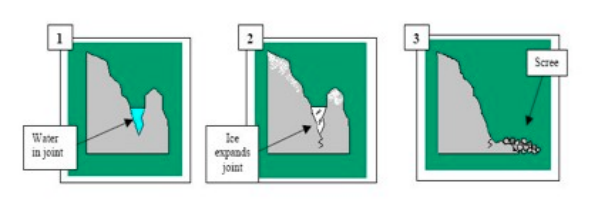
Freeze-thaw is the break up of rock by frost action. It occurs where there is precipitation and the temperatures rises above and falls below freezing point.
During the day, water seeps into cracks in the rock.
During the night, the temperature drops below the freezing point and water freezes and expands. This makes the crack bigger and puts strain (i.e. pressure) on the rock.
After repeated freezing and thawing, the roc split into sharp, jagged pieces called scree. They roll down the mountainside and collect in piles at the bottom of the slope.
Chemical Weathering
Chemical weathering occurs when rocks decay or dissolve because of a chemical change.
An example of chemical weathering is Carbonation.
Carbonation
Carbonation occurs when rain falls and takes in carbon dioxide as it passes through the atmosphere.
The carbon dioxide mixes with the rainwater, turning into a weak carbonic acid and limestone contains calcium carbonate.
The weak acid rain reacts with the carbon dioxide and slowly dissolves it.
The make-up of the limestone makes this easier as it is permeable
Karst Landscapes
Landscapes affected by carbonation are known as karst landscapes.
The Burren, Co. Clare is a great example of a karst landscape.
The large area of exposed limestone is called a limestone pavement. It generally takes the form of almost flat terraces but may have steep edges.
The joints or cracks in the limestone caused by carbonation are widened and deepened to form deep gashes called grikes.
The blocks of limestone that remain are called clints.
Caves & Caverns
When rivers flow onto a bare limestone surface, the water begins to dissolve the limestone by carbonation. The water widens the joints and bedding planes, opening them up. Soon the river disappears from the surface and begins to flow underground. The passage through which the river disappears is called a swallow hole.
As the river flows underground, the carbonic acid in the water dissolves the limestone to cut out long tunnels called caves. Sometimes the cave is enlarged to form a large chamber called a cavern.
Evaporation of water up to the ceiling where it freezes and becomes hard rock form pointy icicle-like objects on the ceiling called stalactites.
When drops of water fall to the floor and evaporate, they deposit some calcite which build up in a conical shape to form stalagmites.
If a stalagmite and stalactite grow and join together, they form a pillar.