Halogenoalkanes
Alkane + Halogen = ?
Initiation Step
The initiation step involves the formation of chlorine radicals.
It occurs when chlorine molecules (Cl2) are exposed to heat or ultraviolet light, causing them to dissociate into two chlorine radicals (Cl·)
Propagation Step
In the propagation step, the chlorine radicals react with alkanes to form alkyl radicals and more chlorine radicals, allowing the chain reaction to continue.
The general reaction can be summarized in two main steps:
A chlorine radical reacts with an alkane (R-H) to form an alkyl radical (R·) and hydrochloric acid (HCl)
CH4 + Cl· → ·CH3 + HCl
The newly formed alkyl radical then reacts with another chlorine molecule, producing a chlorinated alkane and regenerating a chlorine radical
·CH3 + Cl2 → CH3Cl + Cl·
Termination Step
The termination step occurs when two radicals combine to form a stable product, effectively stopping the chain reaction.
This can happen in several ways:
Two chlorine radicals can combine to form chlorine molecules
Cl· + Cl· → Cl2
An alkyl radical can react with a chlorine radical to form a chlorinated alkane, or two alkyl radicals can combine to form a dimer
·CH3 + ·CH3 → CH3CH3
·CH3 + Cl· → CH3Cl
CFCs and Chloroalkanes
Uses
Polar molecules, so they can be used as solvents and tend to be unreactive and good ad dissolving other polar organic compounds.
Ozone Depletion
Initiation
CF2Cl2 → CF2Cl + Cl-
Propagation
O3+ Cl· → O2 + ClO·
O3 + ClO· → 2O2 + Cl·
Overall
2O3 → 3O2
Bonding in Halogenoalkanes
Halogen atoms are much more electronegative than C (except iodine) and therefore the pair of electrons between the C-X bond is displaced towards the halogen. Therefor ethe bond is polarised and has ionic character.
As the halogen gets larger, bond strength decreases as there is a greater distance and shielding between nucleus and shared pair of electrons, therefore there is a weaker attraction.
Reactivity depends on bond strength. The weaker the C-X bond, the more reactive the halogenoalkane.
Nucleophilic Substitution Reactions of Halogenoalkanes
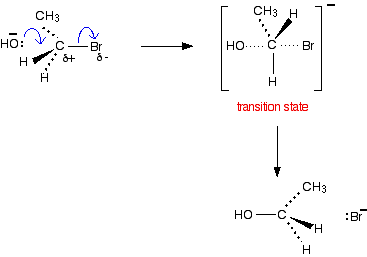
Warm, Aqueous NaOH
Hydrolysis is breaking a bond using water
Bromoethane + sodium hydroxide → ethanol + sodium bromide
The above reaction is only able to proceed as the C-Br bond is polar due to the electronegativity difference between C and Br

Cyanide Ions
Conditions: Reflux in ethanolic solution
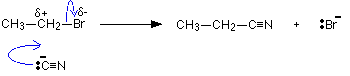
The :CN acts as a nucleophile and the mechanism shows that a C-CN bond is formed and simultaneously C-Br bond breaks.
Aqueous Ammonia
The halogenoalkane is heated with a concentrated solution of ammonia in ethanol. The reaction is carried out in a sealed tube. You couldn't heat this mixture under reflux, because the ammonia would simply escape up the condenser as a gas.
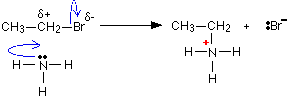
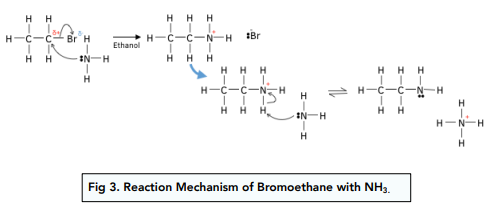
Reaction with ammonia is a poor method to make amines industrially. Further substitution occurs leading to a mixture of products forming which have to be separated
Excess ammonia minimises this chance. More efficient to produce amines in a 2-step process with a intermediate.
Nucleophilic substitution: CH3Br + KCN → CH3CN+ KBr
Reduction/Hydrogenation: CH3CN +2H2 → CH3CH2NH2
Uses of Propylamines
Pharmaceuticals, pesticides, and rubber chemicals.
Elimination Reactions of Halogenoalkanes
With HOT NaOH in ethanol; a different reaction takes place with OH ions acting as a proton acceptor (as a base).
For a given halogenoalkane, to favour elimination rather than substitution, use:
heat
a concentrated solution of sodium or potassium hydroxide
pure ethanol as the solvent
Production of elimination is ALWAYS an alkene

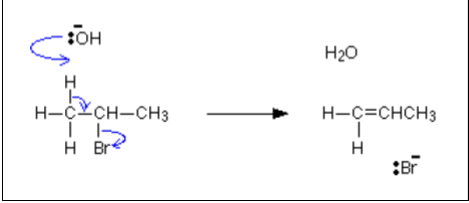
Lone pair on oxygen forms a coordinate bond with H+
The shared pair of electrons on C-H bond to form C=C
This repels electrons from C-Br bond onto Br and C-Br bond breaks.
Eliminate or Substitute?
In summary
For a given halogenoalkane, to favour elimination rather than substitution, use:
higher temperatures
a concentrated solution of sodium or potassium hydroxide
pure ethanol as the solvent
To favour substitution rather than elimination, use:
lower temperatures
more dilute solutions of sodium or potassium hydroxide
more water in the solvent mixture