periodic table trends
core charge
the attractive force of the nucleus of an atom on the valence electrons.
How tight the protons hold the valence electrons.
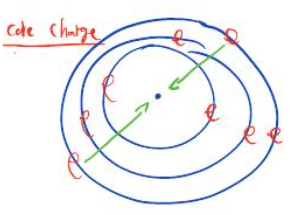
As positive (protons) and negative (electrons) attract, the more shells there are, the greater the distance ∴ less attraction.
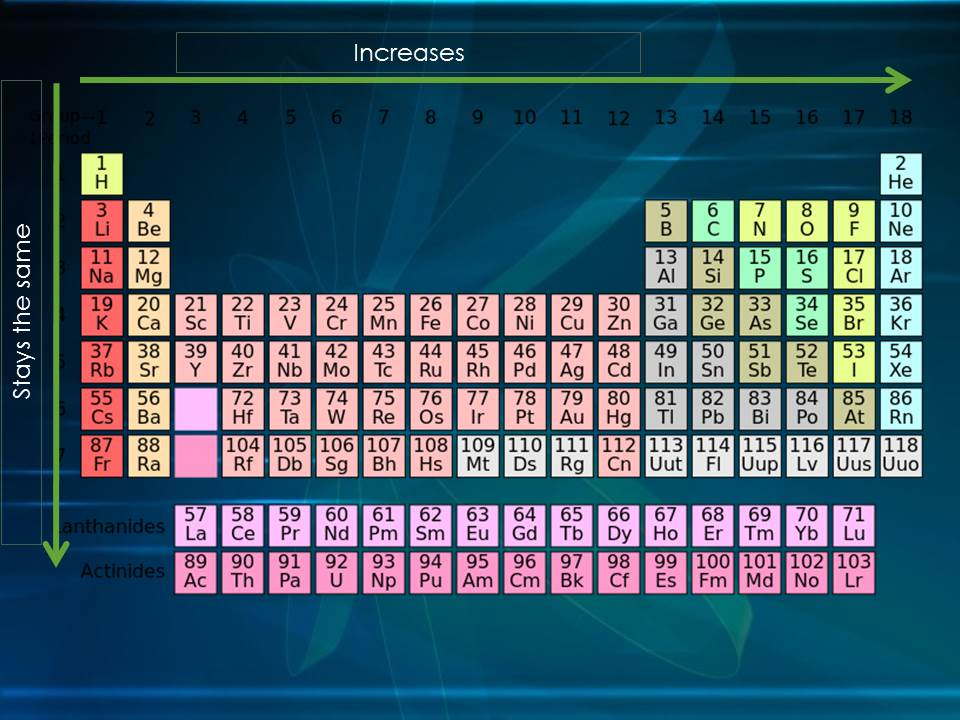
}}Core charge stays constant as you go down a group}}
- As # protons and the # shells increase going down a group, the core charge stays constant.
}}Core charge increases going across a period (↑ protons = ↑ core charge)}}
- As the #protons increase throughout a period, but the #shells stay the same, the core charge also increases.
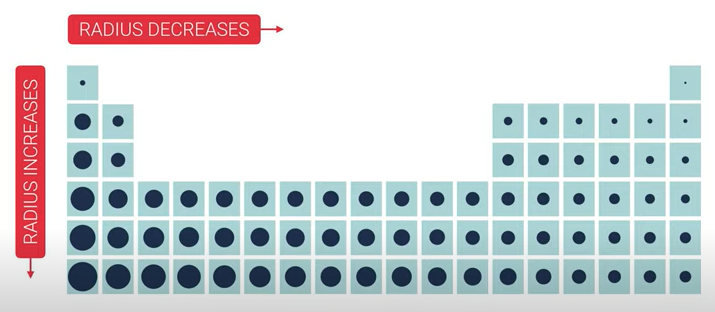
atomic radius
The radius of an atom. Distance of an atom's nucleus to its valence shell.
}}Atomic radius decreases across a period}}
As the core charge increases, the valence electrons are held closer to the nucleus, therefore the atom will have a smaller radius.
}}Atomic radius increases down a group}}
As the number of shells increases, the valence electrons are further away from the nucleus, therefore the atom will have a larger radius.
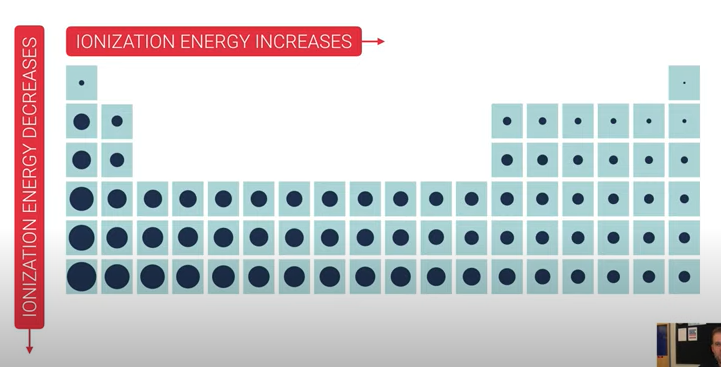
ionisation energy
the amount of energy needed to remove an electron from an atom.
}}Ionisation energy decreases going down a group}}
As the atomic radius increases, the attraction from the nucleus to the valence electrons is weaker, therefore, it will be easier to remove an electron from the atom. (LOW IONIZATION ENERGY)
}}Ionisation energy increases going across a period}}
As the core charge increases across a period, the electrons are held tighter towards the nucleus, making it harder to remove an electron from the atom. (HIGH IONIZATION ENERGY)
As the atomic radius decreases across a period, the energy ionisation energy required to remove the first valence electron is greater since the valence electrons are held tighter towards the nucleus.
electronegativity
How strong an atom attracts foreign electrons towards the valence shell.
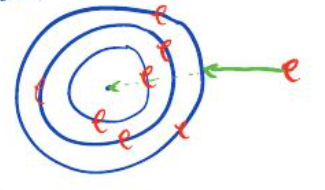
}}As the core charge ↑, the electronegativity also ↑}}
an increase in nuclear charge causes electron attraction with greater force.
}}Electronegativity decreases going down a group}}
As positive (protons) and negative (electrons) attract, the more shells there are, the less attraction there is since the distance (atomic radius) is greater.
If the atomic radius is greater, the atom finds it easier to lose an electron than gain one.
}}Electronegativity increases going across a period}}
As the core charge increases, the electronegativity increases.
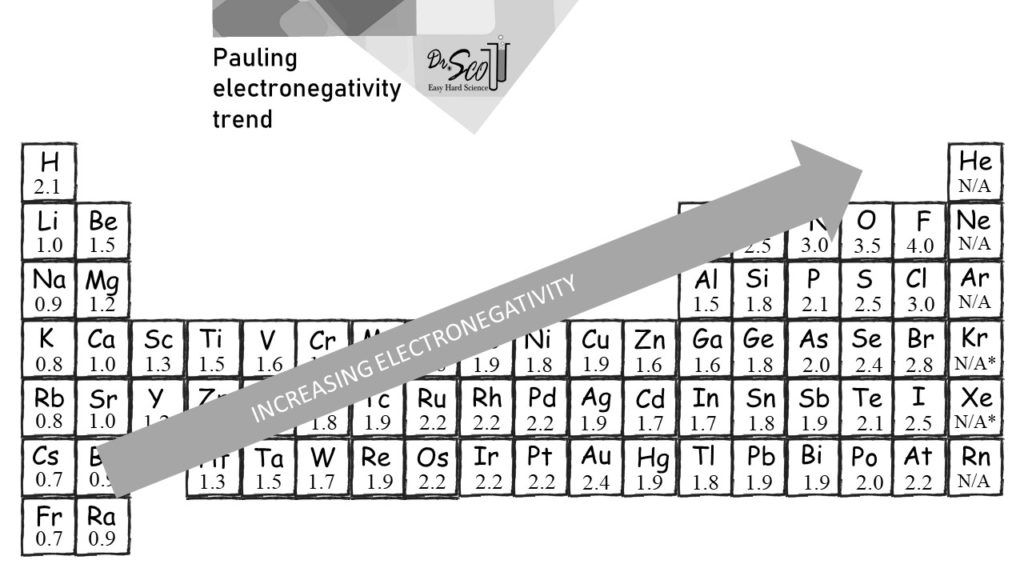
Noble gases are neglected in the eneg table as they have full valence shells and do not need to gain nor lose an electron.
reactivity
Element's reactivity: the tendency to lose or gain electrons
Depends on ionisation energy - Least ionisation energy means most reactive.
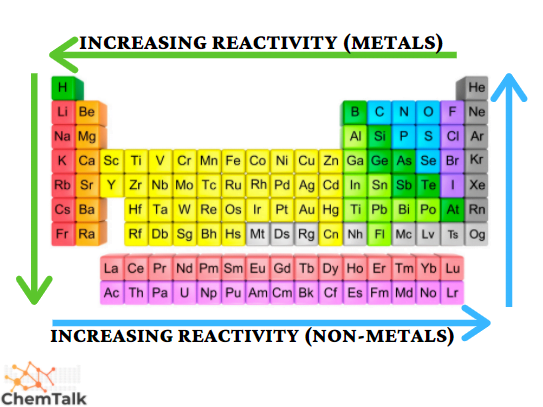
Alkali Metals (Group 1) most reactive metals group
They have the highest tendency to LOSE an electron.
WHY?
They only have 1 electron on the outer shell, losing it makes it stable.
The reactivity increases as you go ↓ bc there are more shells shielding the one electron from the nuclear charge ∴ less attracted
Reactivity decreases going across a period as
- there is the same number of shells but more protons ∴ a higher core charge and harder to lose an electron
- core charge increases going across ∴ harder to lose an electron
Halogens (Group 17) most reactive non-metals group
Have the highest tendency to GAIN an electron.
WHY?
They only need 1 electron added to the outer shell to fulfil the octet rule.
The reactivity increases as you go ↑ bc there are fewer shells shielding the nuclear charge (high electronegativity) ∴ easier to gain an electron.
Reactivity increases going across a period as
- there is the same number of shells but more protons ∴ higher electronegativity and can gain an electron.
- electronegativity increases ∴ easier to gain an electron
Noble gases (Group 18) least reactive group
least reactive bc they have full valence shells ∴ they do not want to gain or lose any electrons