Unit 1 - Periodic Table of Elements
#4d3800
#cbe2c4
#04453c
Introduction
Introduction
Elements are the simplest form of matter and can not be broken down further by chemical reactions. Elements differ in physical properties. There are 109 different elements known to man, and they are usually found in combination with each other to form molecular elements, like , . Elements that differ combine to form a compound, like or . Elements are grouped according to the number of protons that they possess, which is called the atomic number. They are fundamental substances composed of protons, neutrons, and electrons. Compounds are chemically uniform and composed of two or more elements linked by interatomic bonds.
Charges
Protons are positively charged subatomic particles, and electrons are negatively charged subatomic particles. Neutrons are subatomic particles with no charge. Ions are atoms or molecules with a net electrical charge. The charge of an electron is considered to be negative and is equal and opposite to the charge of a proton, which is considered to be negative. The net charge of an ion is never zero because its total number of electrons is always unequal to its total number of protons. A cation is a positively charged ion with fewer electrons, and an anion is a negatively charged ion with more electrons than protons.
Metals
75% of the known elements on Earth are metals, with aluminum being the most abundant one on the Earth’s surface. They exhibit properties such as strength, hardness, durability, ductility, and malleability. Many are also lustrous, meaning they reflect light when polished. They are good conductors of heat and electricity; however, not all metals have these characteristics. Their properties are variable depending on the type. Most metals are reactive and rarely exist in pure form, with the exception being gold and copper.
Alloys
Metals can be mixed to form very useful alloys. An alloy is a homogeneous mixture of elements (metals), like steel, which is iron and carbon. Nitinol is a nickel-titanium alloy that “remembers” a preset shape after it has been deformed; it can be made to return to its original shape by heating. It is used for things like artery repair!
Anatomy of the Periodic Table of Elements
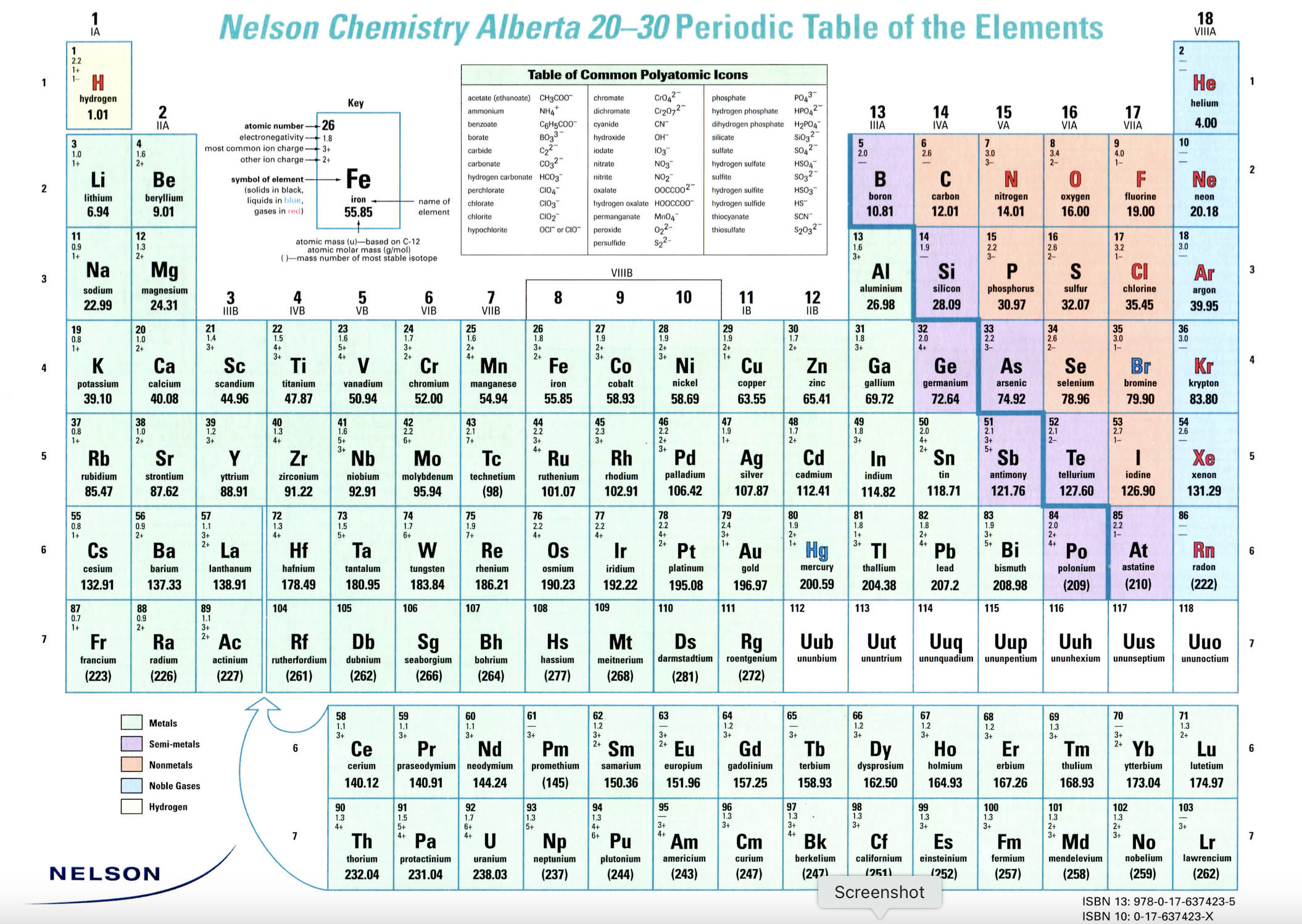
Groups or Families
Groups or families are groups of elements that share certain properties, and they are arranged in vertical columns numbered 1-18. Reactivity increases from top to bottom in groups 1-2. Reactivity of nonmetals decreases from top to bottom within groups 17-18 (eg., fluorine is the most reactive nonmetal known).
Periods
Periods are groups of elements that share certain properties, and they are arranged in horizontal rows. Period 1 contains two elements, periods 2-3 contain eight elements each, periods 4-5 contain eighteen elements each, and period 6 contains 32 elements. The Lanthanides (chemically, they all fit in element 57) are in a separate row at the bottom. The Actinide series, elements 89-103, all fit position 89, and are also in a separate row at the bottom. Chemical properties repeat themselves across the table within a period. Each new period repeats trends in reactivity, or periodicity (the tendency to recur at intervals).
Alkaline Metals / Alkali Metals
Group 1 metals that are very reactive. They are solid materials that are typically hard, shiny, malleable, fusible, and ductile. They also have good thermal and electric conductivity. Alkali metals are all shiny, soft, highly reactive metals at standard temperature and pressure and readily lose their outermost electrons to form cations with a charge of +1. They all have their outermost electron in an s-orbital, lie in the s-block of the periodic table, and constitute group 1. This family of elements is also known as the lithium family after its leading element.
Alkaline Earths / Alkaline Earth Metals
Group 2A metals. These elements have very similar properties: they are all shiny, silvery-white, somewhat reactive metals, and they are less reactive than the alkali metals at standard temperature and pressure. Alkaline earths have an outer s-orbital that’s full, meaning its orbital contains its full complement of two electrons, which the alkaline earth metals readily lose to form cations with charge +2.
Transition Metals
Groups 3-12, though elements of group 12, and occasionally group 3, are sometimes excluded. They are lustrous metals with good electrical and thermal conductivity; most are hard and strong. Transition metals form many useful alloys and are often employed as catalysts in elemental form or in compounds.
Non-Metals
Non-metals are elements that lack the properties of metals. They’re poor conductors of heat and electricity, and are non-lustrous. They occur in nature in all states (solids, liquids, and gases). About 15-20% of the 118 known elements are classified as nonmetals.
Fourteen elements are almost always recognized as nonmetals: Hydrogen, Nitrogen, Oxygen, Sulphur, Fluorine, Chlorine, Bromine, Iodine, Helium, Neon, Argon, Krypton, Xenon, and Radon. Five elements are less frequently so classified: carbon, aluminum, selenium, polonium and astatine.
Metalloids
The word metalloid comes from the Latin metallum ("metal") and the Greek oeidḗs ("resembling in form or appearance"). It’s a term which refers to elements that are intermediate between metals and nonmetals. It has been used for elements that exhibit metallic lustre and electrical conductivity, and that are amphoteric (meaning they can react both as an acid and a base).
However, there is no standard definition of a metalloid and no complete agreement on which elements are metalloids. Despite the lack of specificity, the term remains in use in the literature. The six commonly recognized metalloids are boron, silicon, germanium, arsenic, antimony and tellurium, but they are sometimes counted as nonmetals.
Three are more commonly classed as nonmetals, but some sources list them as metalloids; these elements are: Carbon, Phosphorus, and Selenium. They are metals very close to or on the “staircase” line, and exhibit properties of metals and nonmetals.
Halogens
Group 17, non-metals, highly reactive. The word “halogen” means salt former or “salt maker”; they’re called this because when they react with metals, they produce a wide range of salts. They’re the only group that contains elements in three of the main states of matter at standard temperature and pressure. They all form acids when bonded to hydrogen, and can be used as disinfectants and flame retardants (flame retardants are chemicals added to materials that are activated by the presence of an ignition source and prevent or slow the further development of flames).
They’re typically produced from minerals and salts, and in their elemental form they’re dangerous and can be toxic. They consist of six chemically related elements: fluorine, chlorine, bromine, iodine, and the radioactive elements of astatine and tennessine (?). All form diatomic molecules, which are molecules composed of only two atoms, of the same or different chemical elements.
Noble Gases
Group 18, generally unreactive. They were formerly called inert gases because they have a tendency (inertness) not to react with other chemical substances; this results from their electron configuration, as their outer shell of valence electrons is “full”. Under standard conditions, they tend to be odourless, colourless, monatomic (gas in which atoms are not bound to each other) gases. Noble gases are never found in naturally occurring compounds. They consist of: Helium, Neon, Argon, Krypton, Xenon, Radon, and occasionally Oganesson.
Questions:
how the fluck did we get the periodic table of elements?