MODULE 1: CARIBBEAN SOCIETY AND CULTURE
Locating and Defining the Caribbean
Geographical Locations
Mainland Territories: Guyana, Belize, Suriname, French Guiana
Greater Antilles: Jamaica, Cuba, Haiti, Dominican Republic, Puerto Rico
Netherlands Antilles: Aruba, Bonaire, Curacao, St. Martin, Saba, St. Eustatius
Lesser Antilles: (Windward- Grenada, St. Vincent, St. Lucia, Guadeloupe, Dominica, Martinique) (Leeward- Antigua and Barbuda, Virgin Islands, St. Kitts and Nevis, Montserrat, Anguilla)
Position of Territories
Definitions
Diaspora: A large group of people who share a cultural and regional origin but are living away from their traditional homeland. Diasporas come about through immigration and forced movements of people.
Geographical: This describes the area washed by the Caribbean Sea and is often described as the Caribbean basin. This concept comes from the central feature, being the Caribbean Sea rimmed by islands and the mainland territories of Central and South America.
Geological: There is another definition, which is not widely used, where the Caribbean is described by geologists and seismologists. The defining feature is the Caribbean plate, which has marked boundaries or margins where it meets other tectonic plates. These are plates, a part of the earth’s crust that undely land and ocean. This definition reveals the existence of deep structural features in Caribbean geology, which also highlight commonalities. Essentially, there are similar tectonic, seismic and volcanic features and processes.
Historical: This refers to the area that was impacted by European colonisation, slavery, the plantation system, and indenture. This refers to all the territories, and this is one means by which we can define the Caribbean, and that is by identifying those countries that experienced the rule of specific European countries, namely the English, French, Dutch and Spanish
Political: The Caribbean is defined by the countries that from the Caribbean Community (CARICOM). It is an intergovernmental organisation that is a political and economic union
The Caribbean is not a single political entity- it is a long-held dream
A mixture of entities at varying stages of political development/autonomy
Generally, made up of territories that are former colonies of European powers- French, British, Dutch and Spanish
CARICOM is sometimes used as a unifying feature in the definition- it does not include all territories
Diasporic: The Caribbean diaspore refers to the millions of people who originate from or are descendants of the region but who make their homeland in other parts of the world. For example, the United States- New York, Florida, Georgia. Britain- London. Canada- Toronto. China and Japan- exchange and employment programmes
The Historical Process
Migratory movements and the establishment of patterns of settlement by different groups within the Caribbean from pre-Columbian times to 1838.
The Pre-Columbian period refers to the time period preceding the arrival of Columbus in the Americas (i.e., before 1492). When Columbus landed in Hispaniola (modern-day Haiti and the Dominican Republic) in 1492, he mistakenly believed that he had landed in the East. This is the reason he called the region the Indies and referred to the indigenous people as “Indians”. The indigenous people, or Amerindians, that Columbus met in Hispaniola were called the Taino people. It was later discovered that in other islands in the Caribbean, there was another indigenous group called the Kalinagos (or Caribs).
Groups that have migrated
Indigenous Peoples
• They followed animals that were migrating, like the mammoth, and crossed the Bering Strait (a narrow bridge or tunnel between the peninsula of Siberia (in modern-day Russia) and the peninsula of Alaska (in modern-day USA), which was likely frozen at the time).
• They settled in different parts of the Americas.
• The groupings of Taino and Kalinago present in the Caribbean in 1492 were direct descendants of groupings from South America.
Europeans
Columbus arrived in the Americas in 1492 (his first voyage), believing it was India. The indigenous people treated him fairly, and were fascinated by the “pale”-skinned people
He left a group of his men in Hispaniola, while he returned to Europe
Believing that he had reached the East (India), he captured some of the indigenous people (by force) and took them back with him to Europe. Queen Isabella was so pleased that she made an order that none of these “Indians” were to be harmed because they were now subjects of the Spanish Crown.
Columbus returned to Hispaniola in 1493 (second voyage), with the sight of all his Spanish men executed by the Taino people. The exact reason is unknown, but it is said that they overstayed their welcome and started to harass the women.
His third voyage was in 1498, and his fourth in 1502
Spanish migrants came to satisfy a lust for riches, and in pursuit of it, they made war on the Tainos, enslaved them, took their possessions, killed off their leaders and exploited the mines until the metals were exhausted.
The indigenous peoples were vulnerable to all kinds of European diseases to which they had no immunity, increasing the death toll resulting from the presence of the Spaniards. The Spanish, more than any other European power, were responsible for the genocide of the native people of the Caribbean
Forced African migration
Plantation slavery lasted in the Caribbean from the late 1500s until 1838 (when slaves were granted freedom)
The Africans were imported to the Caribbean from as early as 1503, but this was in small numbers. They were imported in greater numbers by the 1520s due to the declining numbers of Indians.
When other European powers arrived, they started to import Africans because the number of indigenous labourers was insufficient.
Africans were forced to travel across the Middle Passage to the Americas, where they were sold to planters. (The Triangular Slave Trade, in which enslaved Africans were exchanged for raw materials between Europe, Africa and the Americas) The slave trade persisted in the Caribbean up to 1807.
Africans were emancipated in the British Caribbean in 1838, in the French Caribbean in 1848 and at various dates in the Spanish Caribbean.
Indentured workers
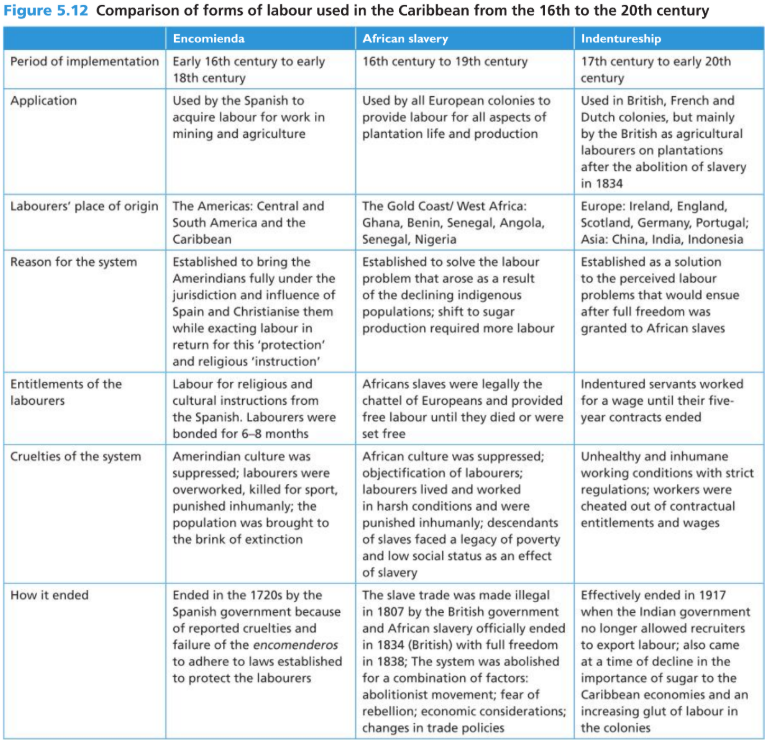
Indentured workers were introduced after slavery was abolished. Since many ex-slaves left the plantations, there was a labour shortage in countries such as Jamaica, Guyana and Trinidad and Tobago. The ex-slaves demanded high wages to return and work on the plantations
Many planters complained and insisted that the British Government import workers. Workers came from Europe (but they died easily and refused to work), Africa (but it was discontinued because it resembled slave trading) and then Asia.
The Chinese came in small numbers but did not like plantation work. They were also challenging, and plantation owners complained that they were able to abandon the plantations to create shops as soon as they were able to. They were also very expensive and were under the eye of the Chinese government.
The Indians were willing to work. They came in large numbers and were familiar with sugar planting in India. Since India was a British colony, it was very cheap to import them. Many Indians came to settle in the Caribbean after their contracts ended, which created a plural society. They took Black women as their wives, and their offspring were labelled 'Douglas'.
Tainos – Greater Antilles (Hispaniola, Cuba, Jamaica, The Bahamas and Puerto Rico.)
Kalinago - Lesser Antilles (Trinidad and Tobago, Barbados, Dominica, Grenada, St. Lucia)
Mayans – Belize
Migratory movements within and outside the region from 1838 to the present day: recognition of diasporic communities
Santo Domingo
Chinese migrated to the Spanish half of the island of Hispaniola.
Chinese residents originally from the United States moved onto the island. After some time, they started moving within the Caribbean, and the region saw intra-regional and inter-regional migration by the Chinese to countries such as Trinidad and Tobago, British Guiana and Jamaica
Panama
Residents of the different Caribbean territories started migrating to Panama around the time when the construction of the Panama Canal began in 1881
These migrants were on the French payroll until 1904, when the British took over the construction
United Kingdom (London)
People arriving in the UK between 1948 and 1971 from the Caribbean countries have been labelled the Windrush generation. It refers to the ship MV Empire Windrush, which docked in Tilbury on June 22, 1948, bringing workers from Jamaica, Trinidad and Tobago and other islands, to help fill post-war UK labour shortages.
Systems of Production
Production refers to their means of livelihood in obtaining resources for food, clothing and shelter, whether for themselves or for others.
All 3 groups of indigenous people were hunters, gatherers and farmers, but the Mayans were more advanced.
Slash and Burn: This was a method of cultivation in which forest areas were burnt and cleared for planting. These ashes provide the soil with nutrients and increase the soil's fertility. Burning trees was also an important way to clear land for the creation of fishing plots or housing
The Encomienda System
When the Spanish settled in the Caribbean, Columbus was the first to suggest that the indigenous people would make good labourers. The King and Queen of Spain, however, gave orders that the indigenous people were not to be enslaved because they were now considered subjects of the Spanish Crown. The Spanish settlers argued that the indigenous people were primitive and barbaric and that they could not protect themselves. As such, they devised the encomienda system.
The encomienda system was a system of labour when Spanish conquistadors were in charge of caring for the indigenous people.
The Spanish men in charge were to provide them with food, clothing, and training in Christianity. In return, the Indians were to provide the Spanish with gold, land and labour
In reality, the Amerindians were treated as slaves, abused by the Spanish men and forced to work in mines, searching caves for gold
Under the Encomienda system, the Indians were required to work for two generations and could be inherited.
Laws were implemented to protect the indigenous people. However, by the mid-1500s, the indigenous people dwindled in numbers and were on the verge of decimation.
With the decimation of the Indians in the mid-1500s, the Spanish started to import. Africans, because they were of the view that the strength of 1 African was of the strength of 4 Indians.
Other European colonies, such as the English, Dutch and French, started coming to the Caribbean to establish settlements. They settled on islands abandoned by the Spanish because they lacked mineral wealth and were afraid of the indigenous people
The other European colonies also started importing Africans to work on sugar and tobacco plantations
Responses and resistance to the encomienda system
The encomienda system came under pressure from high-profile colonisers such as Bartolome de la Casa, who recognised the abuse done to the Indians and reported it to the Spanish Crown. Reports of Indians being hunted for sport, punished for no reason, etc, causing them to die at rapid rates.
The Spanish government implemented the Laws of Burgos (1512-13) and the New Law of the Indies (1542), but they failed as they were met with resistance from colonists who did not want to be told what to do with their “labourers”
The Amerindians tried to fend for themselves by forming bands of rebel groups that hid away in the mountain regions of the Caribbean territories. The harsh interior conditions proved too difficult for most of these former coastal dwellers, and many died of starvation.
Many also succumbed to battles fought with the Spanish, and those who were captured died of the harsh punishments meted out. It is also reported that many opted to commit infanticide to save their children from the abuses before committing suicide themselves.
The system eventually came to a legal end in 1720 following the rapid decline of the indigenous population. By this time, many had died of European diseases or the hardships that came with the European colonisation.
Slavery
Plantation slavery was the main mode of production between the mid 1500s and early 1800s in the Caribbean. It formed the basis of a plantation society. The main people doing the work on the plantation were African slaves.
Africans were dehumanised and regarded as chattel (property like land or buildings) and were owned by the Europeans who paid for them. They also suppressed their social and cultural identity, crushing their sense of belonging. They did this by:
Giving them European names, as their original names were “too hard” to pronounce and forbidding them from practising their religion, customs and traditions, so any appearance of social and family life was discouraged
Choosing Africans from different tribal groups to minimise communication
Meting out harsh physical punishments, torture, and even death for minor infringments was designed to force Africans to submit to the will of the Europeans
They played a significant role in the manufacturing of sugar, rum and molasses. The slaves planted canes, cocoa and other crops.
The slaves were not compensated for their labour as they were forced. There is some evidence that some slaves were able to earn and buy their freedom
They could earn money by planting on land that was given to them by the planters. This land was given to them so that there was no burden to provide food for them.
Resistance to Slavery
Resistance to slavery was in many forms this include: Non-insurrectionary resistance (non-violent), insurrectionary resistance (violent) and maroonage (flight)
Non-insurrectionary resistance
Deliberate loss or sabotage of tools and machinery
Faking illnesses (for plantation too)
Pretending not to understand orders (for plantation too)
Mocking the whites and inducing abortions to avoid the plantation owners having future slaves
Slaves would create hybridised forms of religion and culture and retain their language as well as music traditions, where possible, to go against the restriction of their culture
Maroonage
Runaway slaves joined forces with pockets of indigenous people who had previously fled to remote areas to escape the early European colonisers
The establishment of “Maroon” communities, mainly located in Jamaica, Suriname, Haiti, Grenada, St. Lucia and Cuba, and were able to retain less-diluted African cultural influences than before on the plantation
Maroons engaged in guerrilla warfare, which was a major factor in the success of the Haitian Revolution and in other places, raided plantation estates, representing a beacon of hope for the slave community
Insurrectionary resistance
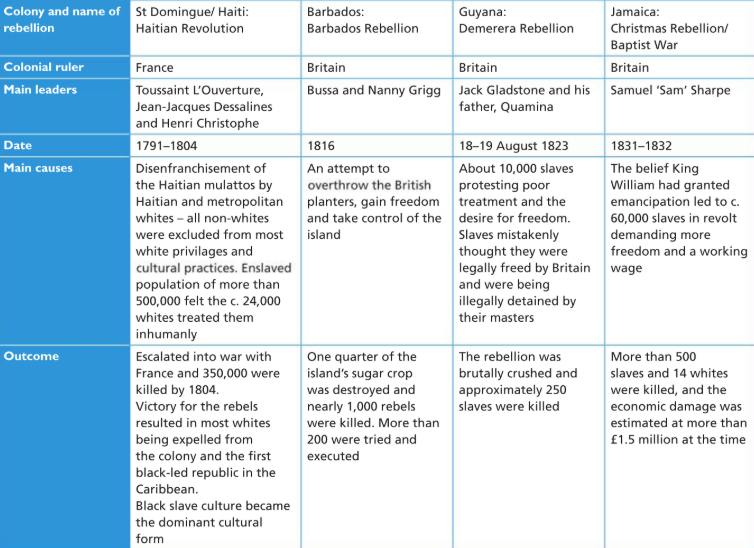
Forms of violent resistance resulted in severe punishment, but individual or plantation-level acts of violence against the white minority occurred. On occasion, but not often, resistance led to wider revolts and even whole revolutions, such as the Haitian Revolution in 1791.
The only successful uprising was in Haiti, which resulted in the country being governed by blacks from 1804.
The success of the Haitian revolution inspired later slave revolts, though those were unsuccessful. Though they failed, they added to the strength of the argument, and the Christmas rebellion in Jamaica is what finally convinced the British authorities that emancipation was necessary.
Other responses to slavery
With the Emancipation Act being instilled after the system ended in 1833, most colonies became free in 1834.
Some slaves continued to work on the plantation, under apprenticeship, which was an extended four-year period of partial enslavement. Full freedom was granted in all British colonies in 1838.
After full freedom was granted, the peasantry was introduced, as many blacks refused to remain on the plantations. They earned money through small-scale farming, fishing and hunting. Peasant groups are bands of ex-slaves who cooperated in various ways to achieve independence from the plantations by creating small farms outside the plantations to raise animals and grow crops for subsistence and small-scale commerce.
Peasant groups used illegal ways to obtain land by squatting on unoccupied land that belonged to previous estate owners.
The Plantation System
The plantation was a system of production that Europeans devised to maximise profits in certain types of agricultural business. In the Caribbean, it was mainly used for the production of sugar.
European governments brought different ethnic groups to work and live on the plantation, and they were encouraged to distrust each other and trust the Europeans.
Labour was coloured, and the whites were the owners, supervisors and managers.
When coupled with slavery as a total institution (determining all aspects of life, social, economic and political), the Caribbean's culture and society were dominated by the plantation system, which developed into an elaborate economic system that locked it into European economies.
It was so powerful that Navigation Laws were implemented by Britain in 1651, where only English ships could trade with English colonies, preventing other European colonies from getting a share.
Resistance to the Plantation System
After slavery was abolished, many ex-slaves found ways to avoid working on the plantation. In Jamaica, Guyana and Trinidad, more land was available for them to set themselves as peasant farmers, growing food for subsistence and sale.
Similar to slavery, non-violent resistance
Indentureship
The introduction of Indentureship came after slavery was abolished in 1834.
Indentureship was still related to slavery, despite the new rules. Indians, a non white group, were at the bottom of the social ladder in comparison to whites, just like during slavery, Africans and indians were encouraged to stay apart, continuing disunity. Although this was a new group of workers and system, the plantation system still influenced social and economic affairs.
Planters needed to replace the ex-slaves who left the plantation with new workers to keep operations going.
They first employed poor whites, but they quickly died out due to not being able to manage the workload
Resistance and Responses to the Indentureship system
Many labourers who were a part of the scheme became frustrated over time with the strained relationship they had with the planters. They abandoned their contracts prematurely to work for their peers who had settled and started their own businesses. For example, Chinese labourers started shops and would employ fellow Chinese people.
It was the planters’ policy to segregate Asian and African workers under the principle of divide and rule. Asians and Africans were housed separately, given different jobs (Africans overseeing Asians) and experienced different working restrictions. This, along with the arrival of the East Indians, contributed to lower wages.
Reports of abuses and comparisons to slavery did nothing to promote the system in the eyes of potential migrants or their governments. The Chinese government withdrew its endorsement of the scheme relatively early on, and the scheme effectively ended in 1917 when the Indian government also pulled out
Movement Towards Independence
In other parts of the Caribbean. Many territories achieved independence through revolution, e.g, Haiti or wars of independence. In the British Caribbean, independence was achieved through a gradual process of decolonisation, resulting from the efforts of Caribbean people to push for greater rights and freedoms
Political Enfranchisement
Political Enfranchisement refers to the right of a people or nation to determine their own affairs. The ideas around this included:
Migration within and outside the Caribbean from around the turn
of the 20th century, which exposed people to new and different
experiences, philosophies and ideas.
The emergence of the trade union movement was a means to highlight all that was wrong within the colonial workforce, including racial disparities in the distribution of jobs, improving health and education, and ruling white disinterest. Trade union leaders included Norman Manley, Alexander Bustamante, and Uriah Butler (Trinidad).
The development of ideological currents in the 1920s and 1930s promoted anti-colonialism, black consciousness and black pride. A major proponent of this was Marcus Garvey through his UNIA, which had chapters throughout the Caribbean, and his newspapers, such as Negro World and the Blackman. There were also movements for independence in the diaspora, such as the Jamaica Progressive League in New York.
Universal Adult Suffrage
With widespread unrest in the 1930s, colonial authorities were forced to be reinstated. The unrest had mainly economic roots, but many felt that better political representation would allow them to press necessary issues. Across the English-speaking Caribbean between 1934 and 1938, workers came out on strike, held protests and rioted, while the unemployed took part in hunger marches
The authorities took military action against protesters and strengthened their armed forces, but they also appealed to the government in London for a commission of enquiry. The West India Royal Commission (Moyne Commission) was sent out in 1938, but its main findings were withheld until after the Second World War. When it was finally published, it recommended social and political reform.
Political reform had already begun to occur, and gradually, in the 1930s, unrest and from 1944 onwards Caribbean territories were granted Universal adult sufferage under British colonial control. This refers to the right to vote granted to adults over the age of 21, regardless of race, sex or social class. (Placed into effect in 1944 for Jamaica, Trinidad and Tobago in 1945).
This contributed to the development of political parties such as the PNP (formerly National Workers Union) and the JLP (formerly Bustamante Industrial Trade Union) in Jamaica
Internal Self-Government
Territories remained under British control, being overseen by a governor-general. Now, the chief minister and members of the legislature were elected from the ranks of Caribbean people. This limited self-government could be viewed as a period of transition to full independence, with no European in a position of control.
The traditional makeup of the legislative bodies comprised people who were the planter class. Since trade union leaders took an interest to be represented in the government, the idea that they could get elected to office they could go from self-government to full independence.
Economic Enfranchisement
Although under colonialism, the economy was largely organised by the European power, Caribbean people also tried to resist and develop their own ways of making a living. The goal was economic enfranchisement, which is the condition whereby a country or nation achieves the right to determine how it will develop its systems of production.
Entrepreneurial Activities
Plantation economies were based on large quantiies of cheap, unskilled, manual labour and monoculture(the prodcution of one cash crop which was cane sugar). Since all the earnings were sent back to Europe, ex-slaves started growing fruit and vegetables for subsistence.
During the 19th century, prices of sugar started to deplet, which introduced peasants to start planting different cash crops such as cocoa, bana, coffee, etc. They also grew food crops and reared animals, which created a diversified local economy. Peasant groups and free villages were set away from plantation land.
A diversified local economy grows different types of cash crops, food crops and livestock. This made them less dependent on planters and the low wages they offered. More entrepreneurial activities include
migrating and seeking jobs outside their home states to send home remittances;
the establishment of small family businesses, such as shops and laundries;
their involvement in savings societies and partner plans to acquire the financial means to set themselves on the path to economic enfranchisement.
The impact of the historical process on Caribbean society and culture
Impact of the slave trade on the Caribbean
Created a new race of mulattos (African and white mixed)
Impact of the Plantation system on Caribbean societies and economies
George Beckford (1972) created the theory of “plantation society” to portray Caribbean society. His work focused on the legacy of slavery and indentured servitude. He describes the Caribbean society as a stratified one.
Turned the Caribbean into a melting pot. This is from the different cultures that came with the people who arrived. Aspects of culture such as food, clothing, values, norms, etc. Combined different cultures with our own, e.g, curry (syncretism)
created a new class structure
Society and Culture
Society: A group of people that originates from a common place or a group that calls a particular location home. A society is also referred to as people living in the same geographical area over a long period of time. For example, Jamaican society, Cuban society, etc.
The term ‘society’ is also used to refer to people who share a similar historical background, culture and interests. E.g, the Jamaica society for the blind, etc.
Culture: The similarities in lifestyles, practices, products, values and beliefs are collectively known as culture. The arts, customs and habits that characterise a particular part of society/ nation.
Common beliefs or practices of a group of people
The integrated pattern of human knowledge, belief and behaviour that depends on man’s capacity for learning and transmitting knowledge (characteristic) to succeed in generations.
Culture is the accumulated (changes over time) store of symbols, ideas and material products associated with a social system, whether it be an entire society or a smaller social group (can be in a smaller or larger group)
Quality in a person or society that arises from a concern for what is regarded as excellent in arts, letters and scholarly pursuits.
Characteristics of Society
Shared Common Purpose
A Defined Territoral Space
A basic characteristic of society is the sharing of a physical space by a group of people who have a similar cultural identity. This physical or territorial space can be used to define the area where a society exists. For example, Caribbean society is often identified on a map as those countries that are washed by the Caribbean Sea
Citizenship within a space
This aspect of society identifies the group of people native to a state or country, of which they are citizens or nationals. This is a political characteristic of society. Nationals are part of a society through their birthright. They were born in the territory in which the society exists and have government-issued documentation to verify this.
Citizens do not necessarily live within the ‘space’, however. Some may have migrated for work or study. Also, some reside within the ‘space’ but are not citizens of it.
Continuity over time and space
The existence of a group and the most permanent aspects of their culture within a space over a particular period of time is also a characteristic of societies. For example, Mexico is a physical space or society where specific forms of language, dance and cuisine have been identifiable in that space of Central America since the coming of the Spanish.
Characteristics of Culture
Culture is Learnt: Culture shapes our behaviour, and culture is learnt. Enculturation is the process by which culture is passed on from one generation to the next, and from one society to another.
The teaching of basic, socially accepted behaviours such as not cursing in public, sitting upright in a chair, and even proper grooming and hygiene practices are all things we mostly learn through primary socialisation (behaviour learnt through the family)
Culture is Shared
Culture is symbolic: Culture is symbolic through material and non-material culture. Non-material culture comprises folklore, language, etc. Cultural symbols such as language and general behaviours can be used to express ideals and ideas that a society thinks are important. For example, language, which is probably the most important cultural symbol, is used to pass on the history of a society, communicate the laws of a society and even the religious beliefs of a society.
Language can also be used to show a society’s disapproval of certain traits that deviate from accepted normal behaviour and values. Traditional dress or meals, national flags showing specific colours, a history syllabus, feasts and celebrations, gestures such as the giving of gifts, hugging and kissing, and even the drinking of alcohol at certain events such as wakes are all examples of Caribbean cultural symbols
Culture exists over time and space
Culture satisfies human needs
Identity and Social Formation
Cultural Diversity
The positive and negative effects
Social Stratification
Creolisation and Hybridisation
Hybridisation: The processes of cultural and ethnic mixing to produce new forms.
Creolisation: Any kind of fusion of people, ideas, customs, culture and beliefs to create a different form. a process of change and adaptation that occurs over time.
Acculturation: This is the forced imposition of one culture upon another, usually by a powerful group upon a weaker one.
Racial Hybridisation:
During the period of conquest and slavery, new groups of people were created from the sexual unions between Europeans, Amerindians and Africans. These groups include: Douglas, mulattoes, etc.
Cultural Hybridisation:
Syncretism refers to the mixing of cultural practices from different ethnic groups to create a different entity that fused aspects of the original practices, e.g. religion, language, culinary arts, etc.
Religions such as Voodoo, Kumina, and Rastafarianism are some syncretic religions with Christian traditions and African input
Languages in the Caribbean contain mixed elements of African and European vernacular
Edward Kamau Braithwaite states that Caribbean society began’ on the slave ships and plantations, ' creating the creole society theory which focuses on creolisation
Impact of Geographical Phenomena
Plates: Huge slabs of rock whose movement can fold mountains and influence the occurrence of earthquakes and volcanoes
Types of plate margins
Divergent: move away from each other
Transform: move alongside each other
Convergent: move towards each other
Convergent and Transform margins are mainly seen in the Caribbean
Social and Economic impact of plate tectonics on the Caribbean
Positive
Tourist attractions, for example, Sulphur Springs in St. Lucia, generate income
Access to valuable minerals such as gold, silver, bauxite, etc
Source of geothermal energy
Negative
Poisonous gases from volcanic vents cause acid rain and prevent plant growth
Earthquakes shake the ground, causing buildings to collapse through landslides
Disruption of the economy as businesses and markets may close
Geological Hazards
Earthquakes: A major natural hazard caused by a sudden release of slowly accumulated strain energy along a fault in the Earth’s crust
Volcanoes: Perforations in the Earth’s crust through which molten rock and gases escape to the surface. Volcanic activity can trigger other natural hazards events when lakes are breached.
St. Vincent and Montserrat are the Caribbean countries with the most volcanic activity
Transform Plate margins in the Greater Antilles- only extinct volcanoes are along this area
Convergent plate margins along the area of the Lesser Antilles means that there are several volcanic islands
Tsunamis: A tsunami is a mighty wall of water travelling at great speeds from the site of an undersea earthquake
Coral Reefs: Coral reefs are living communities. Coral polyps, tiny marine creatures, secrete a calcium carbonate (limestone) shell around their bodies, which remains when they die
Fringing reefs- Most Caribbean islands have this kind of reef in smaller areas along the coastline
Atolls- Small coral islands formed around a receding volcano usually have a lagoon in the middle (volcanic crater). This is not common in the Caribbean
Meteorological Hazards
Hurricanes
Hurricanes are tropical depressions which develop into severe storms characterised by winds directed inward in a spiralling pattern towards the centre
They are generated over warm oceans at low latitudes and are particularly dangerous due to their destructive potential
Storm surges are caused by hurricanes as they make landfall, intensifying the danger to coastal lowlands
A storm surge occurs when a high dome of water forms due to a combination of high winds and high tides
Flooding
Flash floods are caused by heavy rainfall, clouds bursting over a small drainage area. Most likely to happen in mountainous areas
Riverine, likely with heavy rainfall where rivers are
Tidal flood, where water bodies dump water on land. Caused by high tides
The general causes of these are heavy rainfall, poor garbage disposal, deforestation, etc.
Social Erosion
The removal of the topsoil from the land by heavy rainfall or wind
Social and Economic Impacts of Meteorological Hazards
Social and Political
Loss of life
Potential breakdown of social order, causing a rise in crime and stealing
Health risks (polluted water, lack of water, food shortage)
Migration across communities (leading to overcrowding in urban areas)
Conflict over scarce resources
Cultural
Loss of cultural practices
Loss of important artefacts, monuments and heritage sites
Cultural diffusion (practices will spread with people moving)
Economic
Economic displacement (loss of jobs, capital, raw materials, equipment, etc)
Damage to property
Decrease in agricultural produce
Tourism industry affected
Mitigation Strategies
Mitigation is a term used to describe strategies undertaken to prevent or reduce death, damage or hardship, either for a hazard that has already occurred or for one that is likely to occur in the future.
The focus of mitigation is to reduce risk and even modify the hazard where possible.
Government
Legal- building and settlement restrictions
National disaster preparedness plan
Establishment of National Disaster Management Agencies
Important Agencies: ODPEM (Office of Disaster Preparedness Emergency Management), CDEMA (Caribbean Disaster Emergency Management Agency)
Individual
Emergency Kits
Evacuation routes/ plans
Securing personal belongings
Communities
Designating and organising shelters
Identify flood-prone areas
Work alongside the local government
Post Disaster
Relief- food, clothing, medicine
Protection of citizens
Rebuilding assistance
Restoration of utilities
Impact of Societal Institutions on Caribbean People
Social institutions are said to be the building blocks of society. The foundation of a society rests on the most valued ideas and beliefs it has about how life should be organised.
Ideas and beliefs about how to bring the young and teach them what they should know from the basis of the institution of education in a country.
The Family
The family is responsible for the rearing of children and the socialisation of young members into society
The Historical Context
African people during slavery preserved family life through an extended network of support, but not necessarily based on marriage. The family life was centred around the mother, which introduced matrifocal families in the Caribbean
Europeans brought to the Caribbean the dominant idea of the nuclear family—two parents who were legally married with children of that union living together as a household. Their concept became entrenched in society through colonial rule
Indians and Africans brought the extended family to the Caribbean
Impact on Caribbean society
Impacts girls who face gender stereotypes from their families. If she lives in a patriarchal family (most Indian families), even if that girl acquires higher education, she will still be expected to have respect for her father and brothers
Education
Education plays an important role in the socialisation process. It transmits norms, values and knowledge. It does this through the process of teaching.
Historical Context
Education was mainly for Europeans.
The Spanish did not want to educate the slaves, as they were afraid they would rebel against them
After Emancipation, elites felt that education would help the ex-slaves to make the transition to a free society.
Reading, writing and arithmetic were offered. The Bible was the main text, and the curriculum was steeped in British values, etc. Only elementary school was offered, as the planters feared it would disrupt social order (social stratification, as if the blacks became educated, they would move up the social ladder)
Few secondary schools charge fees. They were modelled in English grammar schools and a classical curriculum. Some Caribbean scholars (mostly males) were able to attend British universities such as Oxford.
Dominant Ideas
The secondary school curriculum was steeped in European values and customs. Africans, Indians or Amerindians’ history and culture were not regarded as legitimate topics for Caribbean children.
Education was a means of social mobility for the poor. Parents wanted their children to get an education to increase their wealth by getting respectable jobs. This is still seen in today’s society.
Impact on Caribbean society
Education played an important role in social mobility. Many Caribbean students moved from the 3 levels of education to secure professional occupations, such as doctors. Those with lower-level qualifications were able to get technical or industrial jobs and gained respect to move up in society.
A negative impact is that the importance and status placed on these credentials cause individuals who failed to acquire them to have low self-esteem. Education demoralises these individuals who failed to achieve them.
Access to education improved socio-economic conditions
Religion
Impact on Caribbean society
Many individuals experience religion as a comfort, as it provides an outlet.
It can be a source of oppression. For example, a woman of Roman Catholic belief often plays a conservative role where religious laws may affect her reproductive health
Used as a tool for social control
Helps groups to maintain solidarity and keep their traditions as the world is adapting to Western societies. Different practices help groups to distinguish themselves and preserve their cultural uniqueness
The Justice System
The justice system is the interaction of societal institutions that are identified with social control and regulation.
Impacts on the Caribbean society
The system of compulsory retirement at age 65
Arts and Popular Culture
Popular culture – mainstream culture based on the tastes of ordinary people, or the masses,rather than elite culture
Caribbean Art Forms
Music: