Lecture 11: Sedimentary Rocks
Sedimentary Rocks
Sediment vs. Sedimentary Rocks
Lithification: loose sediments are cemented together to form a cohesive rock (sand → sandstone)
Clastic sedimentary rocks
made from broken pieces of older rocks and minerals that have been transported and deposited (gravel, sand, mud)
3 main clastic sedimentary rocks
conglomerate
gravel
>2 mm
high energy required to move sediment
depositional environments: glacial till, mountain stream
sandstone
sand
2-0.063 mm
medium energy required to move sediment
depositional environments: beaches, riverbeds, desert dunes
mudstone
mud
<0.063 mm
low energy required to move sediment
depositional environments: lakes, floodplains, deep ocean
Energy of the depositional environment
energy matters because a higher energy environment can transport larger sediments away
in order for sediment to be deposited, the energy must be low enough so it can “settle out”
water must be almost perfectly still for fine-grained mud to be deposited
Sediment transport fluids
wind
capable of suspending fine grained particles (mud sized)
only in arid environments, and pushed sand sized sediment along the ground (building dunes)
windblown sediments referred to as “dust” or “loess” can travel faster
water
water flowing in rivers can carry vast amounts of sediment (sand and mud)
it can be redistributed by shallow currents and waves when these rivers enter larger bodies of water like lakes or oceans before settling out in calmer water
conglomerates can be found in steeper streams (higher energy) that occasionally flow fast
gravel in a stream bed is what is left behind (sorting)
river overflow → water spreads and slows down → fine grained mud deposited
ice
not only to glaciers flow but they can carry sediments of all grain sizes
glaciers are great at eroding sediments and carrying fine grained mud alongside huger boulders

when ice melts at the end of the glacier, all the sediment is dropped as poorly sorted glacial till
much of ohio is underlain by glacial till
(Bio)chemical sedimentary rocks
formed when biology or other chemical processes cause minerals to precipitate and then become deposited (shells, organics, salts)
Coal
contains 40-90% carbon, in large, complex organic molecules
terrestrial peat bogs
Oil shale
contains clay and 15-75% organic material called herogen
deep oceans or lakes
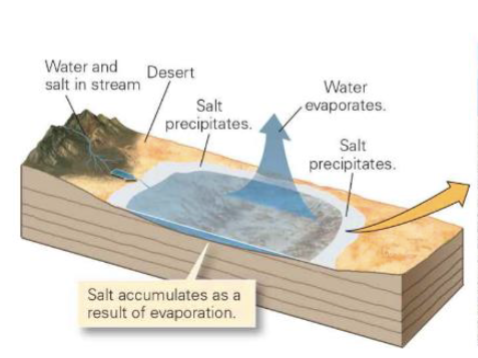
Evaporites
form when dissolved salts precipitate from water
gypsum and halite are evaporates
Carbonate rocks
most common chemical rock
mostly limestone (CaCO3)
20-25% of sedimentary rocks
primary reservoir of carbon within the geosphere
important marine habitats (coral reefs)
geohazards (sinkholes)
important resource (cement)
Biology drives carbonate production
biomineralization
crystal growth, composition, and morphology is completely controlled by an organism
Can be microscopic
Not all carbonates
other organisms make their shells out of silica instead of carbonate
their shells eventually turn into chert, a cryptocrystalline form of quartz (also called flint)
Cross-Stratification
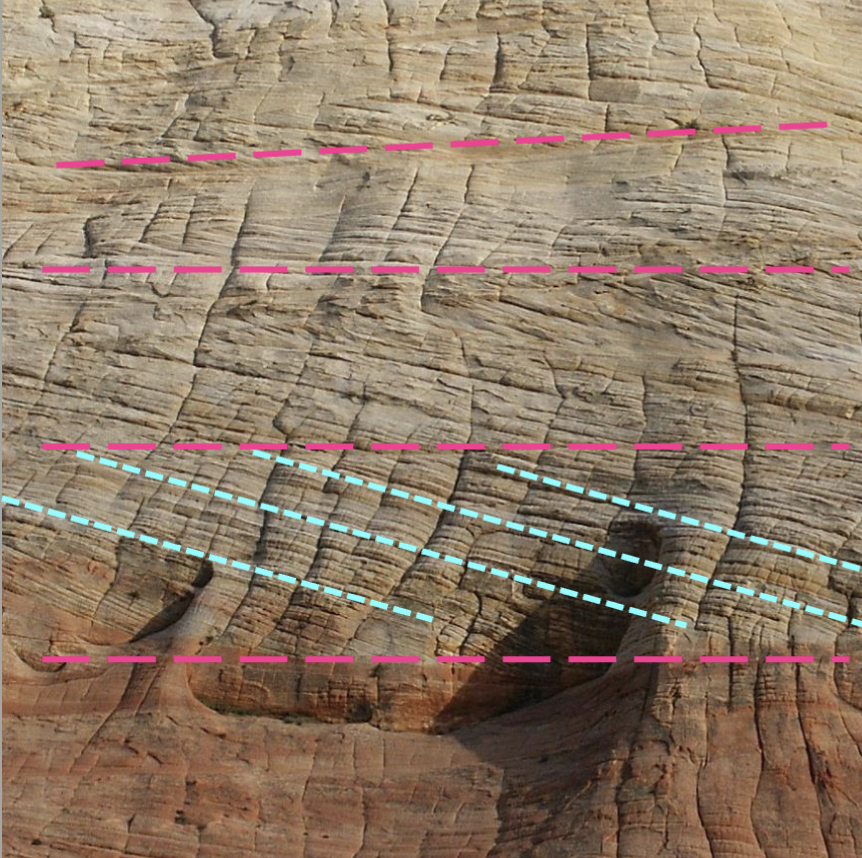
like ripples on a stream bed created by a current, in rocks we are looking at the side view

Cross-bedding
sedimentary structures, which are features in the sedimentary rocks that indicate the past environments
there are beds within this rock outcrop that have horizontal planes, with beds within it that are at an angle (Cross-bedding)
Modern Cross-Straification
in the modern world, only really seen with sand moved by a current
can be formed in huges desert sand dunes
smaller sediments (mud) can’t settle out in a current
stream flow and channel size would need to be insanely fast and huge to form ripples made out of gravel