Chapter 13: Parties, Party Systems, and Party Competition: An Encyclopedic Guide
Foundations of Political Parties and Party Systems
Definition of a Political Party:
A political party is formally defined as a group of people that includes both those who hold public office and those who help get and keep them there.
Core Functions and Purposes of Political Parties:
Structuring the Political World: Parties provide informational shortcuts to voters, synthesize complex policy choices, and coordinate collective decision-making across legislative and executive branches.
Recruitment and Socialization of the Political Elite: Parties act as gatekeepers for public office, identifying prospective candidates, vetting their capabilities, and indoctrinating them in political procedures and party norms.
Mobilization of the Masses: Parties organize electoral campaigns, register citizens, stimulate turnout, and actively engage the broader public during elections.
Link Between Rulers and the Ruled: Parties operate as bi-directional communication channels through which societal demands are voiced to governing authorities, and government policies are justified to the electorate.
Typology of Party Systems:
Nonpartisan Democracy: A democratic political system characterized by the total absence of official political parties.
Single-Party System: A regime in which only one political party is legally permitted to hold government power.
One-Party Dominant System: An institutional setup where multiple parties are legally allowed to operate and contest elections, but only one specific party possesses a realistic opportunity to obtain power.
Two-Party System: A configuration in which only two major political parties retain a realistic prospect of winning and holding government power.
Multiparty System: A system in which more than two political parties have a realistic chance of winning and holding executive power, either independently or through governing coalitions.
Quantifying Party System Size:
Effective Number of Parties (ENP): A statistical metric designed to capture both the absolute number and relative size of political parties within a polity, weighting larger parties more heavily than smaller parties.
Effective Number of Electoral Parties (): Measures the number of parties that compete and win votes in an election, defined by the formula: where denotes the fractional vote share received by the -th political party.
Effective Number of Legislative Parties (): Measures the number of parties that secure representation in the legislature, defined by the formula: where denotes the fractional seat share obtained by the -th political party in parliament.
Origins of Political Parties and Social Cleavages
Theoretical Approaches to Party Emergence:
Primordial (Bottom-Up) View:
Treats political parties as the natural, organic representatives of societal groups sharing underlying interests.
Parties develop as structural manifestations of pre-existing divisions, cleavages, and demographic groupings embedded within society.
Instrumental (Top-Down) View:
Frames political parties as coalitions or teams of office-seeking political elites and political entrepreneurs.
Parties are deliberately fabricated by entrepreneurs who utilize informational advantages to identify, mobilize, and politicize previously unrepresented interests.
Entrepreneurs actively cultivate awareness among citizens regarding the presence and political relevance of these latent interests.
Traditional Societal Cleavages:
Urban-Rural Cleavage: Arises from structural conflicts over food prices, tariffs, trade policy, agricultural subsidies, and resource allocation between agricultural communities and industrializing cities.
Confessional Cleavage: Represents divisions between distinct religious denominations competing within a common jurisdiction (e.g., Protestants versus Catholics).
Secular-Clerical Cleavage: Centers on conflicts between religious authorities and secular state builders regarding state control over vital social institutions, particularly education, marriage laws, and church taxation.
Class Cleavage: Emerges from economic divisions between capital and labor, pitting owners of the means of production against wage laborers over progressive taxation, welfare redistribution, and market regulation.
Post-Materialist Cleavage: Manifests in advanced industrial societies between generations prioritizing physical/economic security versus those prioritizing individual autonomy, environmental sustainability, and civil liberties.
Ethnic and Linguistic Cleavages: Divides populations according to ancestral, cultural, and linguistic identities, often exacerbated by geographic concentration and unequal resource distribution.
Populism in Party Politics
Defining Components of Populism:
Populism is conceptualized through three necessary defining attributes:
People-Centrism: The fundamental premise that the pure, sovereign "people" form the exclusive legitimate basis of political power.
Anti-Pluralism: The rejection of societal diversity, treating "the people" as a single, homogenous entity whose collective will is indivisible and superior to procedural checks.
Moralized Politics: A Manichean worldview dividing the political landscape into a cosmic struggle between the virtuous, pure people and the corrupt, malicious political/economic elite.
Populism as a Discursive Wrapper:
Populism lacks programmatic or substantive policy content of its own; it operates as a discursive, rhetorical "thin-centered" ideology or "wrapper."
It must be attached to a substantive "host" ideology across the left-right spectrum to acquire concrete policy substance:
Right-Wing / Exclusionary Populism: When attached to nationalism or nativism, populism targets immigrants, ethnic minorities, and cosmopolitan institutions as malevolent enemies of the native people.
Left-Wing / Inclusionary Populism: When attached to socialism or environmentalism, populism frames large corporations, global financial capital, and oligarchs as the exploitative class undermining the welfare of the working masses.
Strategic Adoption Across Party Families:
Populism does not constitute an exclusive, standalone ideological party family.
Parties spanning conservative, liberal, socialist, or Christian democratic families adopt or discard populist rhetoric strategically, assessing whether moralized, anti-elite appeals optimize electoral expansion in specific electoral climates.
Social Attributes and Identity Categories
Attributes Versus Identity Categories:
Attribute: A given, self-evident, and objectively identifiable characteristic (e.g., race, language, gender, religion, region of origin) that qualifies an individual for group membership.
Identity Category: A socially constructed social group in which individuals place themselves or are categorized by others.
Every citizen possesses an individual repertoire of multiple attributes.
A Formal Hypothetical Model of Latent Identity Categories:
Consider a hypothetical polity defined by two salient ancestral attributes: ancestral geographic region ( vs. ) and ancestral language ( vs. ).22
Distribution Matrix of Attributes:

where , , , and represent the proportion of the population embodying each pairwise combination of attributes. *
Nine Latent Social Groups (Potential Identity Categories):

Cross-Cutting Versus Reinforcing Attributes:
Cross-Cutting Attributes:
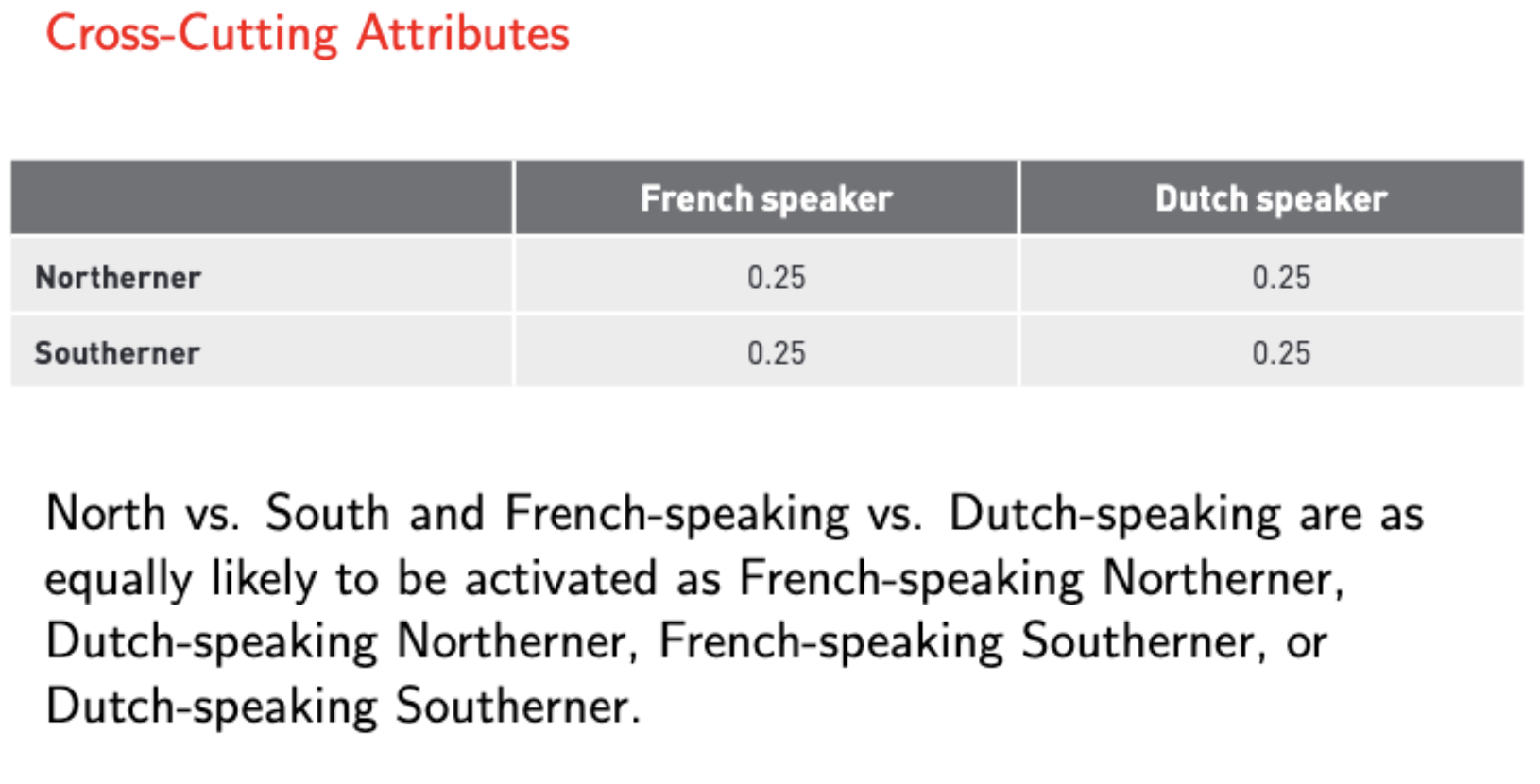
Occur when attributes are uncorrelated within the population.
Example distribution:
*Knowing an individual's region gives zero predictive information regarding their language.
*All latent dimensions (, , or the four-way intersectional combinations) are equally distinctive and equally capable of activation.
* **Reinforcing Attributes:**
* Occur when attributes are strongly correlated within the population.
* Example distribution:
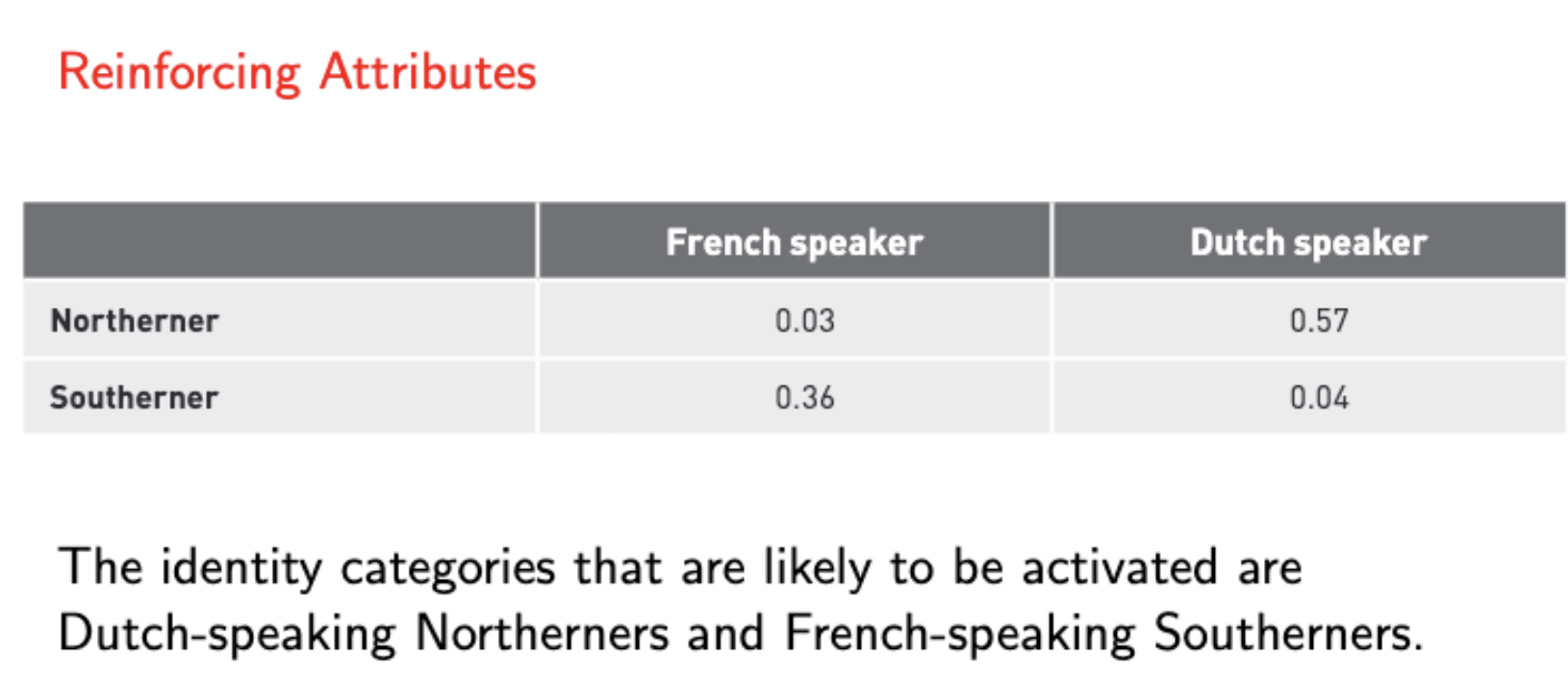
* Knowing someone is from the North permits a high-probability inference () that they speak Dutch; knowing someone is from the South indicates they almost certainly speak French ().
* The effective number of societal attribute combinations contracts, naturally activating compound identities: "Dutch-speaking Northerners" and "French-speaking Southerners."
* **Historical Empirical Parallel:**
* Belgium displays highly reinforcing cleavages between Dutch-speaking Flanders in the north and French-speaking Wallonia in the south.
* This regional-linguistic divide traces back to the northernmost boundary of the Roman province of Gaul established in the fourth century.
Institutional Mediation of Cleavage Politicization
Causal Structure of Cleavage Activation:
Societal diversity does not mechanically determine which political divisions become salient.
Electoral institutions mediate between latent societal divisions and politicized social cleavages by defining the winning thresholds required to capture state power:

Coalition Logic and Winning Thresholds:
Consider a population structured across four latent categories:
| Region / Language | French speaker | Dutch speaker | | :--- | :--- | :--- | | Northerner | | | | Southerner | | |
* **Scenario 1: Country A (Electoral Threshold = of the vote):**
* According to least minimal winning coalition logic, French-speaking Northerners () have an incentive to forge an alliance with Dutch-speaking Northerners () to secure precisely of the national vote.
* French-speaking Southerners () correspondingly partner with Dutch-speaking Southerners () to reach the competing threshold.
* Because political parties compete based on who builds cross-linguistic regional solidarity, they cement regional differences, making the primary politicized cleavage **Regional (North vs. South)**.
* **Scenario 2: Country B (Electoral Threshold = of the vote):**
* Under identical population distributions, a regional coalition () falls short of the required threshold.
* To gain office, French-speaking Northerners () must unite with French-speaking Southerners (), amassing an cross-regional linguistic coalition that comfortably exceeds .
* Consequently, the primary politicized cleavage becomes **Linguistic (French vs. Dutch)**.
* **Scenario 3: Distribution Sensitivity under Constant Thresholds ( required):**
* In Country C, with the above distribution, the linguistic cleavage dominates.
* In Country D, suppose the population distribution shifts to:
| Region / Language | French speaker | Dutch speaker | | :--- | :--- | :--- | | Northerner | | | | Southerner | | |
* Northerners total , which satisfies the threshold exactly.
* French speakers total only , falling short of .
* Hence, in Country D, the dominant politicized cleavage flips back to **Regional (North vs. South)**.
Ethnic Politicization in Africa: Chewas and Tumbukas in Zambia and Malawi
The Comparative Puzzle (Daniel Posner, 2004):
The Chewa and Tumbuka ethnic communities straddle the national boundary separating Malawi and Zambia.
Two-thirds () of all Chewas and Tumbukas reside in Malawi, while one-third () reside in Zambia.
In Malawi, Chewas and Tumbukas are fierce, antagonistic political adversaries.
In Zambia, Chewas and Tumbukas are close political allies.

Fieldwork and Research Design Controls:
Research surveyed paired communities situated on direct sides of the international border:
Tumbuka settlements: Mwase Lundazi (Zambia) and Kapopo (Malawi).
Chewa settlements: Mkanda (Zambia) and Mkanda (Malawi).
Both nations share identical institutional and colonial backgrounds: former British colonies, identical post-colonial borders, equivalent party systems, and single-member district plurality (SMDP) electoral institutions.
Cultural differences across the two groups are objective and invariant across borders:
Linguistic: Chewas speak Chichewa; Tumbukas speak Chitumbuka.
Traditional Rituals: Chewas perform the nyau dance; Tumbukas perform the vinbuza dance.
Norms (Bride Wealth): Chewa parents traditionally request a chicken for their daughter's marriage; Tumbuka parents expect seven cows.
Empirical Measures of Inter-Ethnic Hostility:
Willingness to vote for a presidential candidate from the other ethnic group:
Zambia: Only expressed refusal ("No").
Malawi: A substantial expressed refusal ("No").
Opposition to inter-ethnic marriage with the other group:
Zambia: Only expressed opposition ("No").
Malawi: A majority of expressed opposition ("No").
The Demographic-Institutional Explanation:
Malawi:
Chewas constitute of the national population; Tumbukas constitute .
Because each group is sufficiently large to serve as a viable independent base for winning or denying power under SMDP, politicians have strong electoral incentives to mobilize them separately against one another.
Political parties mobilized along these lines: the Malawi Congress Party (MCP) established itself as the Chewa party, while the Alliance for Democracy (AFORD) emerged as the Tumbuka party.
Zambia:
Chewas comprise only of the national electorate; Tumbukas comprise only .
Neither group can form a viable electoral coalition on its own to compete for national power.
Political elites instead aggregate regional coalitions: Chewas and Tumbukas mobilize jointly as "Easterners" to compete against Northerners, Westerners, and Southerners.
To win power, Chewas and Tumbukas are structurally compelled to cooperate as political allies.
Duverger's Theory and Party System Determinants
Fundamental Postulate of Duverger's Theory:
Social cleavages act as the primary underlying "engine" or demand-side force driving party formation.
Electoral institutions operate as the institutional filter or supply-side "brake" determining whether societal demand for representation translates into actual political parties.
Societal Cleavages and the Demand for Parties:
The total demand for political parties expands with the absolute number of social cleavages and the degree to which they are cross-cutting.
Cross-Cutting Society (High Demand):
| Wealth / Religion | Catholic | Protestant | | :--- | :--- | :--- | | Rich | | | | Poor | | |
    *   Wealth and religious identities are completely independent.
    *   Voters demand representation across four distinct groups: rich Catholics, rich Protestants, poor Catholics, and poor Protestants.
    *   Social forces generate powerful structural pressure toward a multiparty system.
*   **Reinforcing Society (Low Demand):**
| Wealth / Religion | Catholic | Protestant | | :--- | :--- | :--- | | Rich | | | | Poor | | |
    *   Wealth and religion correlate perfectly; all Protestants are rich, and all Catholics are poor.
    *   Only one unified axis of division exists in society.
    *   Social forces generate structural pressure toward a two-party system.
The Dual Mechanisms of Electoral Institutions:
Mechanical Effect of Electoral Laws:
The direct mathematical process by which votes are translated into legislative seats.
Disproportional systems (like SMDP) systematically under-represent small, geographically dispersed parties and confer an "electoral bonus" on large parties.
Often generates a "manufactured majority"—awarding a single party an absolute majority of legislative seats despite obtaining only a plurality of the popular vote.
Strategic Effect of Electoral Laws:
The forward-looking adaptation of political actors in response to the anticipated mechanical effect of electoral rules.
Strategic Voting: Voters abandon their most preferred candidate or party if they have no viable chance of winning, casting their ballot for a less preferred but viable alternative to prevent the worst outcome.
Strategic Entry: Political elites, prospective candidates, and financial donors refuse to create, join, or fund minor parties lacking a realistic path to victory, instead entering races under the banner of large, viable parties.
Empirical Demonstration: United Kingdom General Election (1992):
District-Level Behavior (St. Ives Constituency):
| Candidate | Party | Votes | Vote Percentage | | :--- | :--- | :--- | :--- | | David Harris | Conservative | | (Elected) | | Andrew George | Liberal Democrat | | | | Stephen Warr | Labour | | | | Graham Stevens | Liberal | | |
* A voter with preference order faces a strategic dilemma:
* **Sincere Vote:** Casting a ballot for Labour (), resulting in a "wasted" vote that facilitates a Conservative victory.
* **Strategic Vote:** Voting for the Liberal Democrat candidate (), who has a realistic probability of defeating the Conservative.
* **National-Level Mechanical Disproportionality:**
| Party | National Vote Share () | National Seat Share () | | :--- | :--- | :--- | | Conservative | | | | Labour | | | | Liberal Democrats | | | | Others | | | | Total | | |
* Both major parties (Conservatives and Labour) captured approximately more seats than their vote proportions warranted.
* The Conservative Party transformed a plurality of votes into an absolute majority () of parliamentary seats (a manufactured majority).
* The third-party Liberal Democrats secured of the vote but won only of the legislative seats.
Duvergerland Model of Electoral Systems:
In a hypothetical electorate divided among three parties (Business, Labor, Green):

*   Under SMDP, small third parties (e.g., Green) suffer from wasted votes and donor desertion, collapsing competition into two dominant parties (Business and Labor).
*   Under Proportional Representation (PR), seat shares reflect vote shares accurately, enabling all three parties to sustain viable legislative representations.
Interaction of Heterogeneity and Permissiveness on Party System Size:
The size of a national party system is governed by the joint interaction between social diversity and electoral permissiveness:
| Social Heterogeneity / Electoral Permissiveness | Low Permissiveness (SMDP) | High Permissiveness (PR) | | :--- | :--- | :--- | | High Heterogeneity | Few parties | Many parties | | Low Heterogeneity | Few parties | Few parties |
* A multiparty system requires both conditions simultaneously: high social heterogeneity (demand) and high electoral permissiveness (supply).
Party System Nationalization:
Duverger's Law operates strictly at the individual electoral district level.
A nation can have two parties per district, but if different pairs compete across districts, the national party system will contain many parties.
A party system is nationalized when the effective number of parties at the national level converges toward the average effective number of parties competing within local districts.
Historical US data () demonstrates progressive national convergence between district-level and national-level party counts.
Drivers of nationalization include:
Fiscal Centralization: Shifting tax and budgetary control to the national capital.
Political Centralization: Consolidating regulatory authority in central executive and legislative organs.
Concurrent Presidential Elections: Nationalizing voter attention around high-stakes executive contests.
National Cleavage Patterns: Diffusion of standardized ideological and economic conflicts across all geographic subunits.
Programmatic Party Competition: Policy, Issues, and Valence
Core Tenets of Programmatic Politics:
Parties formulate coherent, ideologically structured policy manifestos.
Parties attempt to implement their stated platforms upon obtaining office.
The delivery of state goods, services, and regulatory decisions is governed by transparent, formalized, and publicly publicized rules.
Resource distribution is administered by an impersonal, professional, and nonpartisan civil service.
Access to public goods and welfare services is universal or entitlement-based, completely non-contingent on individual electoral support.
Policy Competition and Spatial Modeling:
Proximity Voting: Voters cast ballots for the party positioned closest to their individual ideal point in the policy space.
One-Dimensional Space (Median Voter Theorem):
In a two-party system with single-peaked voter preferences across a single left-right axis, both parties converge upon the policy position of the median voter.
In a multiparty system, parties disperse across the policy spectrum, presenting distinct ideological alternatives to preserve niche voter blocs.
Multidimensional Spatial Competition:
Extends competition across multiple issue axes (e.g., economic redistribution versus social-cultural values).
"Distance" calculation incorporates the relative salience or weighting that voters assign to each distinct policy dimension.
Parties compete not merely by repositioning their coordinates, but by attempting to alter the relative importance that voters assign to each dimension.
Issue Competition:
Parties avoid direct head-to-head confrontations over identical issues, focusing campaigns on shaping the relative salience of issues favorable to their record.
Yield Categorization:
High Yield Issues: Issues on which a party is internally unified and its preferred stance is widely shared by the general electorate.
Low Yield Issues: Issues on which a party suffers from internal factional divisions and its position enjoys minority electoral support.
Parties aggressively emphasize high-yield issues while suppressing low-yield issues.
Issue Ownership Theory:
Parties selectively publicize issues they "own"—topics where voters perceive them as possessing superior credibility, history, and managerial competence (e.g., defense for conservatives, healthcare/welfare for social democrats).
Issue Entrepreneurship:
Challenger parties introduce and politicize novel issues previously neglected by established elites to destabilize the party system.
Mainstream Party Strategic Responses:
Dismissive Strategy: Ignoring the novel issue entirely to prevent it from acquiring public salience.
Accommodative Strategy: Co-opting the challenger's issue stance to capture or repatriate drifting voters.
Adversarial Strategy: Explicitly attacking the challenger party's position, thereby actively raising the issue's salience in public discourse.
Valence Competition:
Voters evaluate parties on non-policy attributes where universal societal consensus exists regarding desired outcomes (e.g., economic prosperity, low crime, efficient healthcare, high educational standards).
Valence attributes comprise competence, integrity, administrative trustworthiness, executive leadership qualities, and institutional experience.
When competing parties converge on identical policy platforms, electoral competition transitions into valence competition, with each party attempting to convince the public that it possess superior capability to execute the consensus goals.
Nonprogrammatic and Clientelistic Party Competition
Core Tenets of Nonprogrammatic Politics:
Public goods, services, and private favors are distributed at the political discretion of incumbents rather than through transparent, objective public criteria.
Parties forgo detailed ideological platforms, instead mobilizing voters through targeted material patronage, individualized favors, and club goods distributed to specific groups.
Structure of Clientelistic Exchange:
Clientelism constitutes an institutionalized personalized exchange (quid pro quo) wherein parties supply targeted material benefits strictly contingent upon recipient political support.
Vote Buying: The direct distribution of private consumption goods (e.g., cash, food, building supplies) immediately prior to an election in exchange for a citizen's ballot.
Turnout Buying: The targeted distribution of resources to pre-existing, confirmed party partisans to ensure they bear the logistical costs of showing up to vote.
The Critical Role of Political Brokers:
Parties lack the granular information required to monitor individual compliance and community needs across diverse electorates.
Parties hire local community leaders and notables—termed political brokers—who hold central structural positions within local social networks.
Brokers mediate the exchange: they receive central party funds and discretionary resources, distribute them to local clients, and extract political compliance (rally attendance, campaign labor, loyal voting).
Brokers compete to build and maintain the largest, most dependable networks of clients to demand greater institutional resources from central party elites.
Inherent Pathologies and Commitment Dilemmas:
Principal-Agent Problem:
A structural divergence of interests exists between central party elites (the principals) and local brokers (the agents).
Parties want resources concentrated on uncommitted swing voters whose behavior determines electoral victory.
Brokers preferentially divert resources to established loyalists, who are cheaper to satisfy, easier to monitor, and essential for preserving the broker's personal local patronage network.
Credible Commitment Dilemma:
Under institutionalized secret ballots, voters cannot credibly commit that they voted as purchased once inside the voting booth.
Brokers adapt by shifting strategy from vote buying to turnout buying, or by actively propagating beliefs that secret ballots can be surveilled through technological or administrative means.
Structural Dependence and Institutional Lock-In:
Parties distribute public sector jobs and employment contracts where tenure is tied to the incumbent's continued hold on office.
Recipients support the ruling party out of existential economic fear that an incoming regime will purge them in favor of its own client networks.
Macro-Developmental Trajectory:
Both programmatic and clientelistic strategies entail operational transaction costs and structural inefficiencies.
As economic modernization, income per capita, and bureaucratic capacity advance, vote buying becomes prohibitively expensive, raising the relative efficiency and electoral returns of programmatic politics.