Self and Society Exam #2
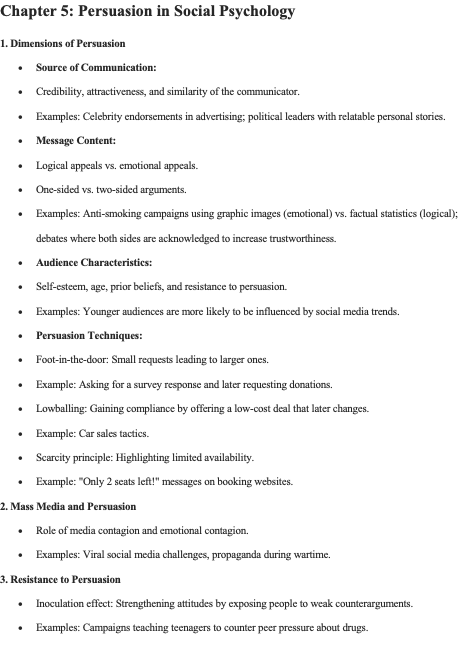
Chapter 5: Persuasion in Social Psychology
1. Dimensions of Persuasion
Source of Communication:
Credibility, attractiveness, and similarity of the communicator.
Examples: Celebrity endorsements in advertising; political leaders with relatable personal stories.
Message Content:
Logical appeals vs. emotional appeals.
One-sided vs. two-sided arguments.
Examples: Anti-smoking campaigns using graphic images (emotional) vs. factual statistics (logical); debates where both sides are acknowledged to increase trustworthiness.
Audience Characteristics:
Self-esteem, age, prior beliefs, and resistance to persuasion.
Examples: Younger audiences are more likely to be influenced by social media trends.
Persuasion Techniques:
Foot-in-the-door: Small requests leading to larger ones.
Example: Asking for a survey response and later requesting donations.
Lowballing: Gaining compliance by offering a low-cost deal that later changes.
Example: Car sales tactics.
Scarcity principle: Highlighting limited availability.
Example: "Only 2 seats left!" messages on booking websites.
2. Mass Media and Persuasion
Role of media contagion and emotional contagion.
Examples: Viral social media challenges, propaganda during wartime.
3. Resistance to Persuasion
Inoculation effect: Strengthening attitudes by exposing people to weak counterarguments.
Examples: Campaigns teaching teenagers to counter peer pressure about drugs.
Chapter 6: Human Aggression
1. Definitions and Types of Aggression
Physical Aggression: Intentional harm through physical means.
Example: Fighting or domestic abuse.
Relational Aggression: Harm through damage to relationships.
Example: Gossiping, exclusion in social groups.
2. Theories of Aggression
Biological Influences:
Role of testosterone and genetic predisposition.
Examples: Studies on twin aggression and brain injuries affecting aggression.
Social and Environmental Influences:
Frustration-Aggression Hypothesis:
Aggression stems from blocked goals.
Example: Increased aggression in traffic jams.
Structural Strain Theory:
Social inequality breeds aggression.
Example: Riots in economically disadvantaged areas.
3. Cultural Dimensions of Aggression
Cultures of Honor:
Societies where aggression is justified to defend honor.
Example: Honor killings in patriarchal societies.
Catharsis Myth:
The idea that venting reduces aggression, debunked in studies.
Example: Hitting a punching bag does not necessarily decrease anger.
4. Escalation and Overkill
Retaliatory aggression tends to escalate conflicts.
Example: Road rage incidents turning into violent confrontations.
Chapter 7: Prejudice, Discrimination, Stereotyping, and Scapegoating
1. Definitions:
Prejudice: Negative attitudes toward a group.
Discrimination: Unequal treatment based on group membership.
Stereotyping: Generalized beliefs about a group.
Scapegoating: Blaming an out-group for problems.
2. Theories of Prejudice
Social Identity Theory:
In-group favoritism and out-group bias.
Example: Rivalries between sports fans.
Realistic Conflict Theory:
Competition for scarce resources fosters prejudice.
Example: Anti-immigrant sentiments during economic downturns.
3. Implicit Bias
Unconscious associations influencing behavior.
Examples: Implicit Association Test (IAT) revealing racial or gender biases.
4. Examples of Prejudice and Discrimination
Racial Discrimination:
Examples: Segregation laws, redlining in housing policies.
Gender Discrimination:
Examples: Wage gaps, glass ceiling in corporate structures.
Religious Discrimination:
Examples: Islamophobia post-9/11.
5. Stereotype Threat
Fear of confirming stereotypes leads to decreased performance.
Example: Women performing worse in math tests when reminded of gender stereotypes.
6. Scapegoating
Historical examples:
Blaming Jews during the Black Death in Europe.
Immigrants blamed for unemployment during recessions.
Psychological mechanisms: Displacement of frustration onto vulnerable groups.