P1
Scalars vs Vectors
Scalar quantities only have magnitudes (size)
(distance, speed, time, mass, energy and temperature.)
Vector quantities have magnitude and direction
(force, weight, velocity, acceleration, gravitational field strength)
Motion
Speed - Distance travelled per unit time.
Speed = distance/time (m/s)
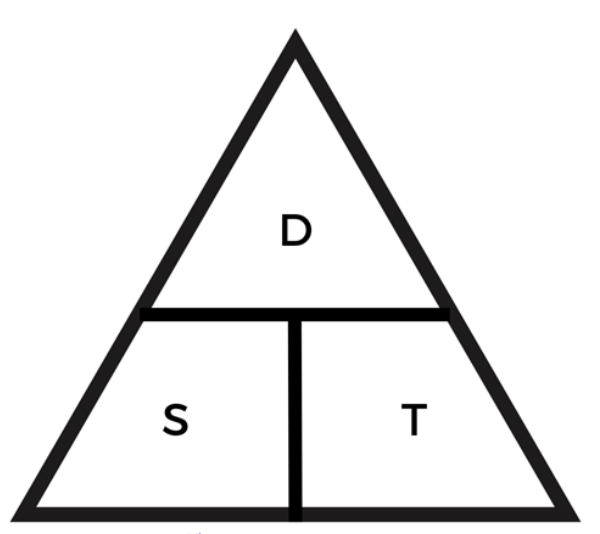
Average speed = total distance travelled/total time taken (m/s)
Velocity - Speed in a given direction.
Velocity = displacement/time (m/s)
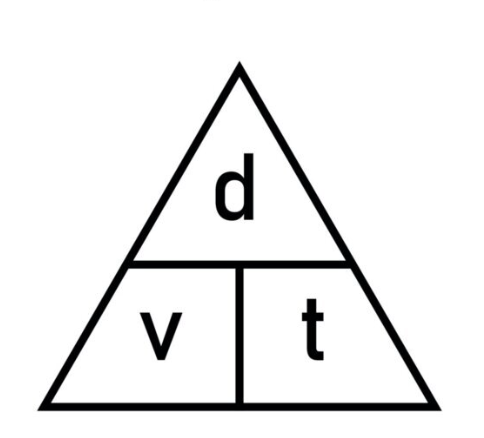
Acceleration - A change in velocity per unit time
Acceleration = v-u/ change in time (m/s²)
An object with increasing speed is accelerating
An object with decreasing speed is decelerating
Deceleration = Negative acceleration
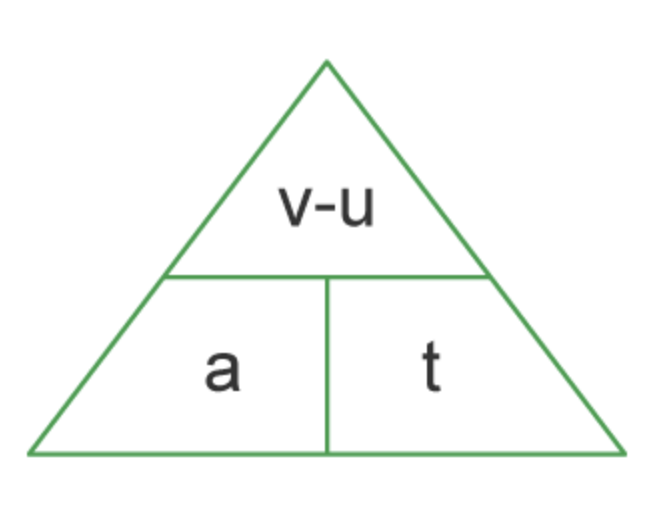
v - u = final velocity - starting velocity
Speed Time Graphs
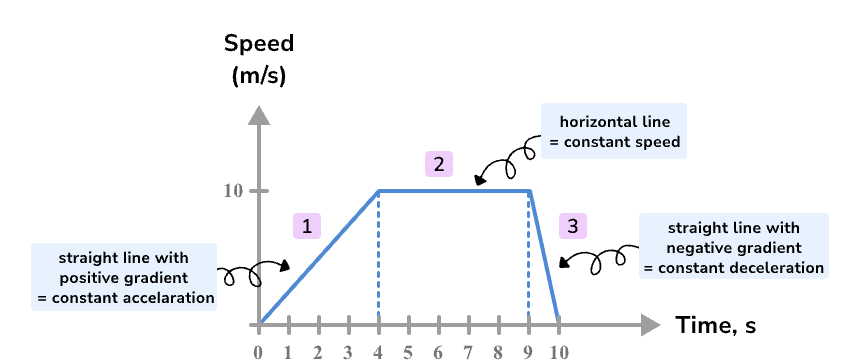
Used to represent the change of motion over time.
Axes
The x axis represents time
The y axis represents speed
Lines
Straight line
Upwards sloping - Accelerating at constant speed
Downwards sloping - Decelerating at constant speed
Steeper slope = Greater acceleration
Shallower slope = Less acceleration
Horizontal line - (above x axis) Gradient = 0 → No change in acceleration (moving at a steady pace)
Horizontal line at 0 - (at x axis) Object is at rest
Curved line - Changing acceleration
Steeper curve = acceleration
Flattening curve = deceleration
Calculations
Speed - Read of y axis
Time - Read of x axis
Acceleration - Calculate the gradient
rise/run (change in speed/change in time) and give in m/s² units
Acceleration of a curved line - Draw a tangent at the point of the curve and calculate the gradient.
Distance travelled - The area under the line.
Area of a square/rectangle - L x W
Area of a triangle - ½ B x H
Distance Time Graphs
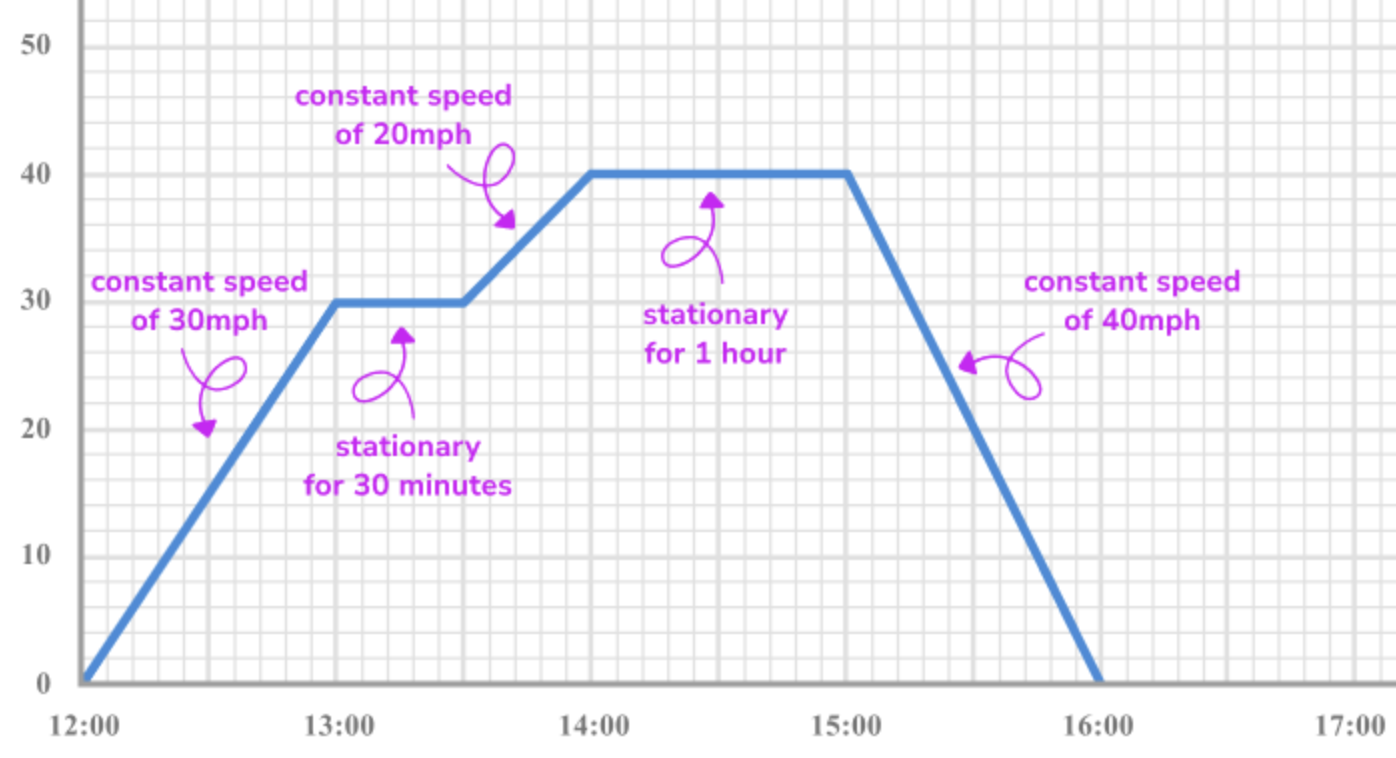
Used to represent the change in distance traveled over time.
Axes
The y axis represents distance
The x axis represents time
Lines
Straight line (up or down) - Moving at a constant speed
Constant slope = Same speed
Steeper slope = Faster speeed
Horizontal line - Gradient = 0 ⟶ Object is at rest
Curved line - Acceleration
Curve getting steeper = accelerating
Curve getting shallower = decelerating
Calculations
Distance - Read of x axis
Time - Read of y axis
Speed - Calculate the gradient
rise/run (change in distance/change in time) and give in m/s
The acceleration of a free - falling object approaching the surface of the earth is approximately constant and is 9.8 m/s²
Mass and Weight
Mass - The amount of matter in an object
(“Mass cannot be created or destroyed” Law of conservation of mass)
Mass is a scalar quantity.
It is the same everywhere in the universe, on moon and on earth.
Weight - The gravitational force on an object that has mass
(It is the effect of gravity on a mass)
Weight is a vector quantity (size+direction) because the direction of weight is always downwards
Weight depends on the object’s mass and the gravitational field strength. (it will change on the moon and earth)
Gravitational Field Strength - Force per unit mass
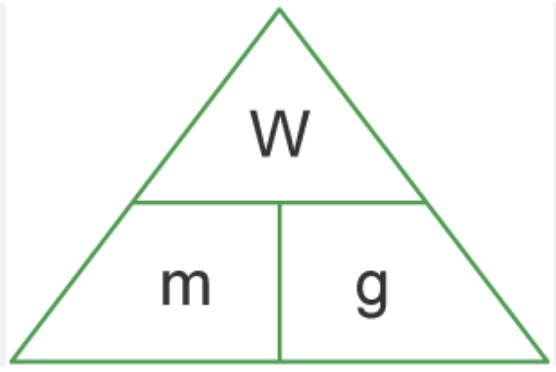
Gravitational field strength = weight/mass (N/kg)
Close to the earth’s surface, gravity is 9.8 N/kg.
Gravitational field strength = acceleration of a free fall
Density - Mass per unit volume
Density (p) = mass/volume
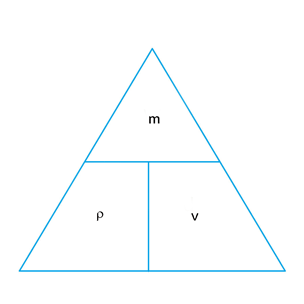
Calculating density
Liquid
Measure the mass of a measuring cylinder using a scale and record it.
Pour the liquid into the cylinder and record the amount (e.g - 50 mls of water)
Then, measure the mass of the cylinder filled with water and record it.
Calculate: Mass of cylinder containing liquid - Original mass of cylinder.
Calculate: Mass/Volume = Object’s density.
The larger the mass → The more accurate the density
You can also take multiple measurements and calculate the mean.
Irregular object
Measure the mass of the object using a scale and record it.
Fill a measuring cylinder with an amount of water and record it. (e.g - 20 mls)
Then, place the object inside and record the new volume of liquid inside the cylinder.
Calculate: New cylinder volume - Original volume. This difference is the object’s volume.
Calculate: Mass/Volume = Object’s density.
OR
Place the object into a Eureka can and fill it up with water until the outlet.
Place a measuring cylinder next to the Eureka can and let me the water drain out.
The volume of water is the volume of the object.
Measure the object’s mass using a scale.
Calculate: Mass/Volume = Object’s Density
Regular object
Measure the object’s mass and record it.
Then measure the object’s volume by using the correct formula and record it.
Cube: side length³
Cuboid: length x width x height
Cylinder: π x (radius)² x height
Cone: 1/3πr²h
Calculate: Mass/Volume = Object’s density
Liquid and Density
If an object’s density is less than a liquid’s, it will float.
If an object’s density is more than a liquid’s, it will sink.
This is because of the buoyant force: Liquid exerts an upward force on an object. If this force is greater than the density of an object, it will float.
Forces - A push or pull that acts on an object due to an interaction with another object.
A force is a vector quantity.
Effects of forces on an object:
Speed
Direction
Shape
Size
Force = mass x acceleration
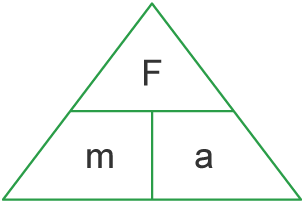
Examples:
The thrust of a car’s engine can effect the car’s speed.
Squashing a spring can alter it’s shape.
The effects of a force depend on the type of force acting.
Resultant force - A single force that describes all forces acting on a body.
When multiple forces are acting on an object at once, we can calculate the resultant force, which is a net force describing the combined action of all of the forces.
(e.g - 2 children pushing a toy car in opposite directions (forward and backward) the forces combined = the car’s resultant force)
The resultant force tells us:
The direction in which the object will move
The magnitude of the net force experienced by the object.
Unbalanced and Balanced Forces
Forces are balanced if the multiple forces in different directions have the same magnitude.
The effects of the forces balances out.
There is no resultant force in that plane of direction.
Forces are unbalanced if the effects of the forces do not cancel out (forces in different directions are weaker/stronger)
There is a resultant force on one or more planes of direction.
Example:
A book is at rest on table.
The gravitational force pulling the book (weight) is acting in a downwards direction.
The push force of the table (contact force) on the book is acting upwards.
The forces are equal in magnitude and act in opposite directions.
They are therefore balanced, so there is no resultant force acting on the book.
Calculating resultant force
When adding forces together, make sure one value is - and the other +
(e.g - 5N force to the left and 5N force to the right. -5 + 5 = 0 → Resultant force = 0)
Here, the forces are of the same magnitude so the resultant force is = 0.
If two people are pushing a box with the same force from each side, the box will not move.
If two people push a box from the same side in the same direction, one with a 3N force and another with a 4N force, the resultant forces will add together in the same direction (10N).
An object is either at rest or moving at a constant speed unless there is a resultant force on the object.
Friction - A force that works in opposition to the motion of an object.
Frictional forces slow down the motion of an object.
When friction occurs, energy is transferrred by heating (caused by the work done)
Solids
Friction is caused by imperfections on surfaces moving against each other. When two surfaces come into contanct, the bumps ‘interlock’ causing friction.
Rough surfaces → More friction
Smooth surfaces → Less friction
The heavier the object, the more friction (the surfaces are pressed together more strongly)
Some materials naturally have higher friction.
To reduce friction: Make surfaces smoother or lubricate the surfaces.
Fluids (gasses and liquids)
Friction acts on objects moving through fluids as the particles colide with the object.
This is called a drag.
Air resistance is a type of friction that slows down the motion of an object moving through air.
Air particles bump into the object as it moves through the air.
It decreases the speed of the object.
It increases the temperature of the object and the sorrounding air.