Cranial Nerves
The 12 pairs of cranial nerves bring information to the brain. Most cranial nerves innervate structures of the head & neck. Ten of the twelve cranial nerves originate from the brainstem, anywhere on the midbrain, pons, or medulla oblongata. While two of the twelve cranial nerves originate from the cerebrum which travels via tracts in the cerebral cortex. Cranial nerves can be categorized as either a sensory, motor, or mixed (both sensory & motor) nerves. Note that:
3 cranial nerves are sensory nerves whose axons have purely sensory functions only (I, II, VIII)
4 cranial nerves are mixed nerves that contain both sensory & motor axons (V, VII, IX, X)
5 are motor nerves that contain primarily motor axons only (III, IV, VI, XI, XII)
Each nerve are given two names:
A sequential Roman numeral in order of its attachment to the brain
A name that describes the nerve’s location or function
For example: Cranial nerve III is the third cranial nerve that attaches to the brain. It is also called the oculomotor nerve because one of its functions is to provide motor axons to some of the muscles that move the eyeball.
When naming cranial nerves it needs to have these 4 parts to be considered a complete answer:
1. The term "CN" at the beginning; CN stands for Cranial Nerve
2. Its Roman Numeral value
3. The name of the nerve itself
4. The term "nerve" at the end
For example: CN IV Trochlear nerve
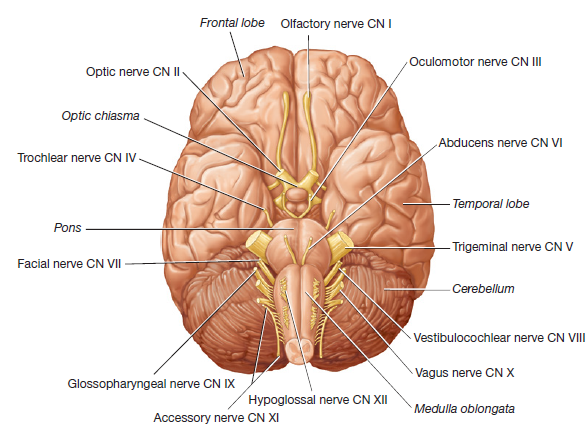
Figure 4.36 Cranial nerves, shown from the inferior view of the brain
The 12 Pairs of Cranial Nerves
Remember, there are 12 pairs of cranial nerves & not 12 cranial nerves only. The following is an overview of facts, main functions, origin, & passage in & out of the skull of each cranial nerve:
Note: One way to remember whether a cranial nerve originates from the cerebrum or brainstem, is to remember the order of cranial nerves starting from the superior to inferior portion of the brainstem.
Note: One way to remember where the cranial nerve enter/exit out of the skull (passage), is to track the different openings from the anterior side of the of the skull to its posterior side.
Originates from the Cerebrum:
CN I Olfactory Nerve
It is a purely sensory nerve that innervates the olfactory mucosa in the superior nasal cavity, where it provides for the special sense of smell
Once the signal travels from the olfactory nerve it then synapses with the olfactory bulb, which then sends the impulses down the axons of the olfactory tract to the olfactory cortex
Origin: It is located superior to the midbrain & CN II Optic Nerve. It originates from the cerebrum, not the brainstem
Passage: It passes through the cribriform foramina of the ethmoid bone
CN II Optic Nerve
This is also a purely sensory nerve that provides for the sense of vision
Its axons emerge from the retina of the eye & meet at the optic chiasma, where the nerves partially exchange axons before diverging to form the optic tracts
Origin: It is located superior to the midbrain. It originates from the cerebrum, not the brainstem
Passage: It passes through the optic canal of the sphenoid bone
Originates from the Midbrain:
CN III Oculomotor Nerve
This is a motor cranial nerve, that innervates:
4 out of the 6 extrinsic (outside) eye muscles that move the eyeball
Inferior oblique, medial rectus, inferior rectus, & superior rectus muscles
The muscle that opens the eyelid
Levator palpebrae superioris muscle
The muscle that constricts the pupil
Iris sphincter muscles
The muscle that changes the shape of the lens for near vision, an adjustment called accommodation
Ciliary muscle
Origin: This nerve originates from the medial portion of the midbrain, just above the pons
Passage: It's the 1st of 4 cranial nerves to pass through the superior orbital fissure
CN IV Trochlear Nerve
This is a small motor nerve that innervates:
1 out of 6 extrinsic eye muscles that moves the eyeball called superior oblique muscle, which is responsible for rotating the eyeball towards the nose
This muscle is located superior, anterior & medial in the orbit
This muscle is held in place by a fibrous loop called the trochlea, hence its name
Origin: It originates from the posterolateral portion of the midbrain, just above the pons; take note that this is the only cranial nerve that originates posteriorly
Passage: It's the 2nd of 4 cranial nerves to pass through the superior orbital fissure
Originates from the Pons:
CN V Trigeminal Nerve
This is a large mixed (both) nerve named for its three divisions:
Mnemonic: MOM (not in same order as below)
Ophthalmic, Maxillary, & Mandibular
They provide sensory innervation from the face & motor innervation to the muscles of mastication
It is also known as the largest cranial nerve
Origin: It originates from the lateral side of the pons
Passage: It enters through the:
Mnemonic:Super-RiO
Superior Orbital Fissure for its ophthalmic division
Foramen Rotundum for its maxillary division
From the foramen rotundum, the maxillary division exits through the infraorbital foramen of the maxilla bone
Foramen Ovale for its mandibular division
Also, it is the 3rd of 4 cranial nerves to pass through the superior orbital fissure
CN VI Abducens Nerve
This is a small motor nerve that innervates:
The final extrinsic eye muscle called lateral rectus muscle
This muscle is involved in the abduction movement of the eye, hence it's name
Origin: It originates from the inferior & medial side of the pons, just above the medulla oblongata
Passage: It is the 4th of 4 cranial nerves to pass through the superior orbital fissure
CN VII Facial Nerve
The mixed (both) fibers of this cranial nerve innervate many structures & provide for the following:
Motor to the muscles of facial expression
Taste from the anterior two-thirds of the tongue
Motor to the glands that produce tears (the lacrimal glands), mucus, & saliva
Sensory from part of the face & mouth
It has 5 branches: temporal, zygomatic, buccal, mandibular, & cervical
(Mnemonic:The Zit By My Chin)
Origin: It originates from the inferior & lateral side of the pons; next to CN VIII
Passage: It is 1st of the 2 cranial nerves that enters through the internal acoustic meatus, but it is the only one that exits through the stylomastoid foramen of the temporal bone
CN VIII Vestibulocochlear Nerve
The final sensory cranial nerve. It innervates the structures of the inner ear & provides for the senses of hearing & equilibrium. It will split into two nerves:
Vestibular Nerve that targets the vestibule & semicircular canals for equilibrium
Cochlear Nerve that targets the cochlea for hearing
Origin: It originates from the inferior & lateral side of the pons; next to CN VII
Passage: It is 2nd of the 2 cranial nerves that enter through the internal acoustic meatus
Originates from the Medulla Oblongata:
CN IX Glossopharyngeal Nerve
The small mixed (both) cranial nerve provides:
Glosso function: Sensory fibers from the posterior one-third of the tongue for taste sensation
Pharyngeal function: Motor axons to the muscles of the pharynx (throat) involved in swallowing
Origin: It originates from the superior & lateral side of the medulla oblongata, superior to CN X
Passage: It's 1st of the 3 cranial nerves that passes through the jugular foramen
CN X Vagus Nerve
This mixed (both) nerve is the only cranial nerve that “wanders” outside of the head & neck (“vagus” means “wanderer”)
In the head & the neck, it provides:
Some sensory innervation from the skin of the head & the pharynx
Motor axons to muscles involved in speech & swallowing
Motor axons to certain salivary glands
Outside the head & neck it:
Innervates most of the thoracic & abdominal viscera as the main nerve of the parasympathetic (rest & digest) nervous system
It is also known as the longest cranial nerve
Origin: It originates from the lateral portion of the medulla oblongata & inferior to the CN IX
Passage: It's 2nd of the 3 cranial nerves that passes through the jugular foramen
CN XI Accessory Nerve
It is a motor nerve the only cranial nerve that has both:
A cranial component originating from the brainstem
A spinal component originating from the spinal cord
Its motor axons innervate the muscles that move the head & the neck, such as the trapezius & sternocleidomastoid muscles
Origin: It originates from the lateral portion of medulla oblongata (cranial component) & from C1-C6 of the spinal cord (spinal component)
Passage: It's 3rd of the 3 cranial nerves that passes through the jugular foramen
CN XII Hypoglossal Nerve
It is a small motor nerve that innervates:
The muscles that move the tongue
It does not provide any taste sensation to the tongue
Origin: It originates from the anterior & inferior portion of the medulla oblongata
Passage: It enters through the hypoglossal canal found in the occipital bone