chemical energy
Catalyst
Something that speeds up a reaction without being used up
Activation energy
The minimum energy needed to start a reaction
Energy level diagrams
An energy level diagram for a chemical reaction shows the relative amounts of energy stored in the reactants and products. An energy level diagram for a physical change shows the relative amounts of energy in the substance before and after the change. In an energy level diagram, if the horizontal line of the left is lower, the reaction is endothermic.
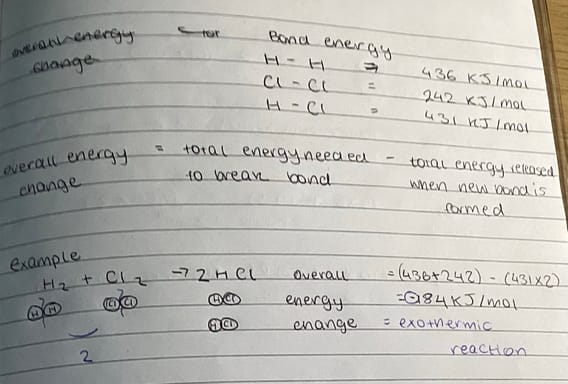
REACTANTS (energy is taken in to break bonds(endothermic process)) —> PRODUCTS (energy is released when new bonds are formed ( exothermic process))
Overall energy charge = total energy needed to break bond - total energy released when new bond is formed
Breaking chemical bonds example
Fuel
A substance that stores energy in a chemical store. When a fuel burns it transfers energy to the surrounds as heat (useful energy).
Copper carbonate
Copper carbonate —> Copper oxide + carbon dioxide
Most fuels contain hydrocarbons - word equation for when hydrocarbons react with oxygen?
hydrogen + carbon + oxygen —> water + carbon dioxide
Methane complete combustion
Methane + oxygen —> carbon dioxide + water
CH4 + 2O2 —> CO2 + 2H2O
Propane combustion
Propane + oxygen —> carbon dioxide + water
C3H8 + 5O2 —> 3CO2 + 4H2O
Carbon monoxide
A colourless, odourless, poisonous gas - you can’t see it, or smell it, but it can kill.
Combustion of hydrocarbons produces useful energy. The hydrogen from the hydrocarbons combines with oxygen to form water (H2O). The carbon combines with oxygen to form carbon monoxide (CO - for an incomplete combustion) or carbon dioxide (CO2 complete combustion).
Exothermic reactions
•
heat is given out during the reaction
•
temperature increases
Endothermic reactions
•
heat energy is removed from the environment
•
temperature decreases