intro to marketing communications
Introduction to Marketing Communications
Definition of Marketing Communications
Definition:
The process by which a supplier of goods, services, values, and/or ideas engages in exchanges with its target audience aiming to stimulate dialogue.
It is concerned with the methods, processes, meanings, perceptions, and activities that audiences (both consumers and organizations) perform regarding products, services, and brands.
The goal is to prompt audience engagement and promote conversations.
Development and presentation of relevant messages aim to encourage specific attitudinal, emotional, or behavioral responses.
Definition of Marketing
Definitions:
1935: The performance of business activities that direct the flow of goods and services from producers to consumers.
1948: Business activities directed toward and incident to, the flow of goods and services from producer to consumer or user.
1985: Process of planning and executing conception, pricing, promotion, and distribution of ideas, goods, and services to create exchanges satisfying individual and organizational goals.
2004: Organizational function and processes for creating, communicating, and delivering value to customers, managing customer relationships to benefit the organization and stakeholders.
2017: Activity, set of institutions, and processes for creating, communicating, delivering, and exchanging offerings of value for customers, clients, partners, and society.
Evolution of Marketing
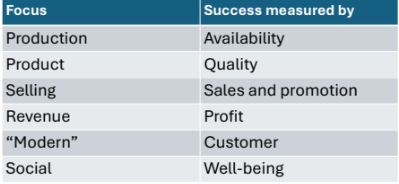
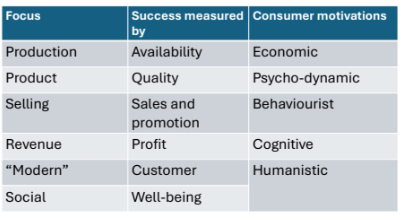
Evolution of Consumer Behavior
Developments in Marketing Communications
Table 1.2:
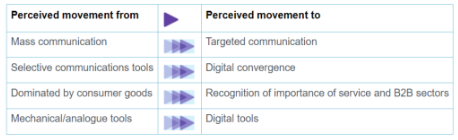
Transition from mass communication to targeted communication
Shift from mechanical/analogue tools to digital convergence
Importance of service and B2B sectors recognized
Adoption of digital tools
Purpose of Marketing Communications
Purpose:
To create dialogue with key stakeholders
Communication as a process for individuals to share meanings and interpretations
Transmission of information is necessary for effective communication to occur.
Communications Theory
Basic Model (Shannon, 1916):
Key Components:
Source
Receiver
Medium
Message
Feedback
Noise
Semiotics
Definition:
The study of meaning, meaning-producing events, and meaning transfers.
Explained by Shimp (1997) as the norms process by which people learn cultural values, form beliefs, and recognize physical cues.
Implicit & Explicit Meanings in Marketing
Examples of Applications:
Subliminal messaging
Emotional associations in marketing
Lifestyle marketing considerations
Use of environmental cues
Product placement techniques
Tutorial Preparation Guidelines
Preparation Tips:
Start conceptualizing brand ideas for discussion.
Prepare one or two tangible ideas before the first tutorial.
Collect examples of integrated marketing communications (both online and offline) that are noteworthy.
Suitable examples include direct mail, newspaper advertisements, TV commercials, radio advertisements, or online advertisements.