Air Pollution Notes
Air pollution refers to the presence of harmful chemicals, particulate matter, or microorganisms in the atmosphere at concentrations sufficient to cause harm to plants, animals, and materials, or to alter ecosystems.
It is a global system, meaning it can start in one place and be transported to another. But it also many be a local system, meaning its local to a city (like how you can physically see smog from NJ)
Outdoor Pollution
Sources: Traffic, industry, waste disposal, etc.
Control: Use of technology, regulations, and monitoring.
Monitoring: Measured via Air Quality Index (AQI), which indicates levels of concern based on pollutant concentrations.
Pollutants include:
Sulfur dioxide (SO2)
Nitrogen oxides (NOx)
Carbon oxides (CO and CO2)
Particulate matter (PM)
Methane
Indoor Pollution
Sources: Household products, cooking fuels, lack of ventilation.
Control: Improved ventilation and use of cleaner fuels.
Major Air Pollutants
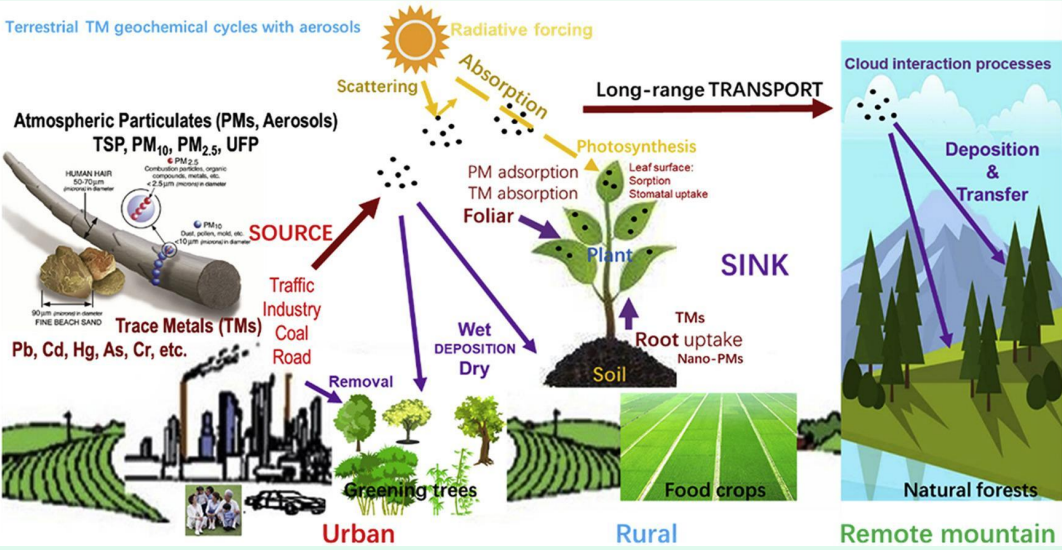
Particulate Matter (PM):
Not filtered by the respiratory system and can penetrate deeply into the lungs.
Categories:
PM10: Dust, pollen, mold (size <10 μm)
PM2.5: Combustion particles, organic compounds, metals (size <2.5 μm)
Volatile Organic Compounds (VOCs):
Organic chemicals that evaporate at room temperature; contribute to ozone formation.
Ozone (O3):
Ground-level ozone formed from VOCs and nitrogen oxides in sunlight.
Health Effects of Major Pollutants
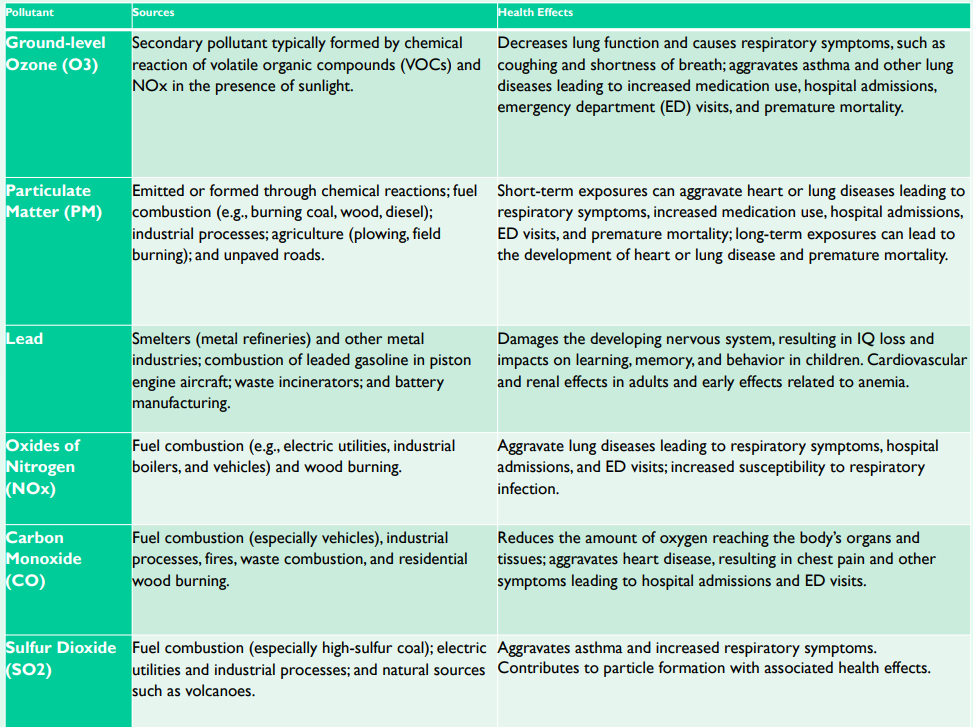
Ground-level Ozone (O3):
Reduces lung function; exacerbates respiratory diseases, asthma.
Particulate Matter (PM):
Causes respiratory and cardiovascular health issues, leading to premature mortality.
Sulfur Dioxide (SO2):
Aggravates asthma and lung diseases; contributes to particle formation.
Nitrogen Oxides (NOx):
Aggravates lung diseases and increases susceptibility to respiratory infections.
Carbon Monoxide (CO):
Reduces oxygen delivery to organs; can be fatal in high concentrations.
Primary and Secondary Pollutants
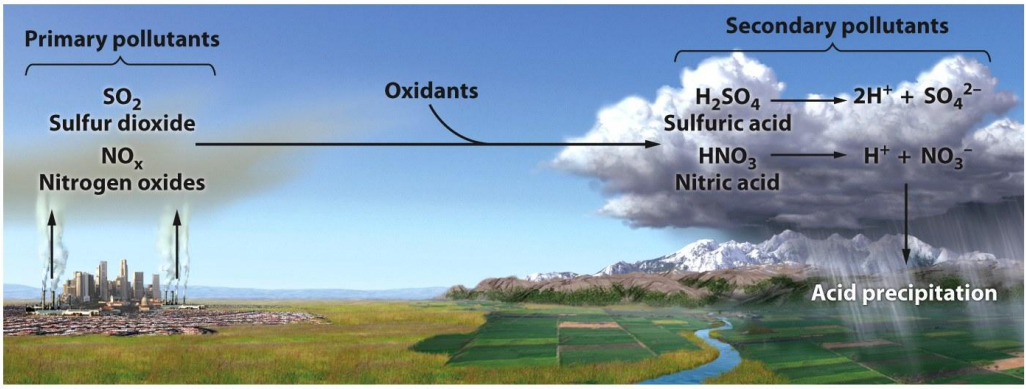
Primary Pollutants- Emitted directly from sources (e.g., CO, SO2, NOx).
exhaust pipe
chimney
Secondary Pollutants- transformed by sunlight, water, oxygen, etc
ozone, sulfate, nitrate
Natural and Anthropogenic (Human) Sources
Natural Sources:
Volcanoes, forest fires, lightning, and plant emissions.
Anthropogenic Sources:
On-road vehicles, power plants, industrial processes, and incineration of waste.
Smog
Smog occurs when sunlight, nitrogen oxides (NOx), and VOCs are present, leading to ozone and other secondary pollutants as components.
Photochemical Smog (brown smog): VOCs + NOx + sunlight.
Sulfurous Smog (gray smog): predominately involves sulfur compounds.
Thermal Inversions
Thermal Inversions- A warm air layer traps colder air and pollutants under it, leading to increased pollution concentrations.
Historical Events: Examples include the Donora smog of 1948 and the Tianjin incident in 1998.
Acid Deposition
Acid Deposition- Nitrogen oxides and sulfur oxides combine with water in the atmosphere, forming nitric and sulfuric acid.
Lowers water pH, damages aquatic ecosystems, and erodes buildings and materials.
Acid deposition becomes secondary pollutants nitric and sulfuric acid.
Effects of Acid Deposition:
lowers lake water pH
decreased aquatic species diversity
mobilizes metals into surface water
damages monuments and structures
Prevention and Control Measures
Technological Solutions:
Catalytic converters on vehicles, scrubbers on stacks, and electrostatic precipitators.
Policy Measures: Regulations on emissions and air quality standards.
Sustainable Practices: Adoption of renewable energy sources and reduction in fossil fuel dependency.
Ozone Layer Depletion
Stratospheric Ozone:
Absorbs harmful UV radiation; its depletion occurs due to chemicals like CFCs.
Formation and Breakdown:
Ozone forms from UV radiation breaking oxygen molecules, and breaks down upon absorbing UV.
Chlorine is a major contributor, as one atom can catalyze the breakdown of as many as 100k ozone molecules.
Indoor Air Pollutants
Indoor air pollutants are common in developing countries: smoke from cooking with wood/fossil fuels; volatile cleaning products in developed countries.
asbestos
carbon monoxide
radon
VOC
Major Concerns:
Exposure to pollutants like radon, asbestos, and VOCs can lead to serious health problems.
Mitigation Strategies: Ensuring proper ventilation and use of air quality monitoring systems.
Global ozone concentrations have decreased by more than 10%.
Depletion is greatest at the poles.
Decreased stratospheric ozone has increased the amount of UV-B radiation that reaches the surface of Earth.