7.1 Haemoglobin
Haemoglobin
- @@Globular proteins@@ with a @@quaternary structure@@
- Adapted for the loading and unloading of oxygen
- All @@4 polypeptides are linked in the centre by a spherical molecule@@
- @@Each polypeptide is associated with a haem group which contains a ferrous (Fe2+ ion)@@
- Each ferrous ion @@can combine with a single O2 molecule@@
- Making a @@total of 4O2 being able to carried by 1 haemoglobin protein@@
Loading and Unloading of Oxygen
- Haemoglobin with @@high affinity for oxygen will load oxygen easily and unload oxygen with less ease@@
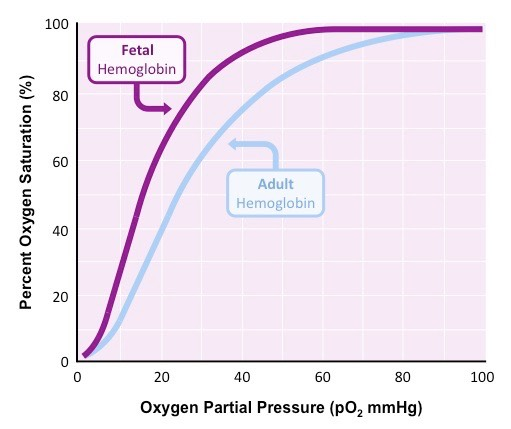
- e.g. foetal haemoglobin has high affinity for oxygen as it only has access to oxygen provide by the mother so needs to be efficient at loading from a limited supply and the foetus does very little action so requires it to be unloaded at a slower rate
Oxygen Dissociation Curves
- When haemoglobin is @@exposed to different partial pressures of oxygen, it dissociates at different rates@@
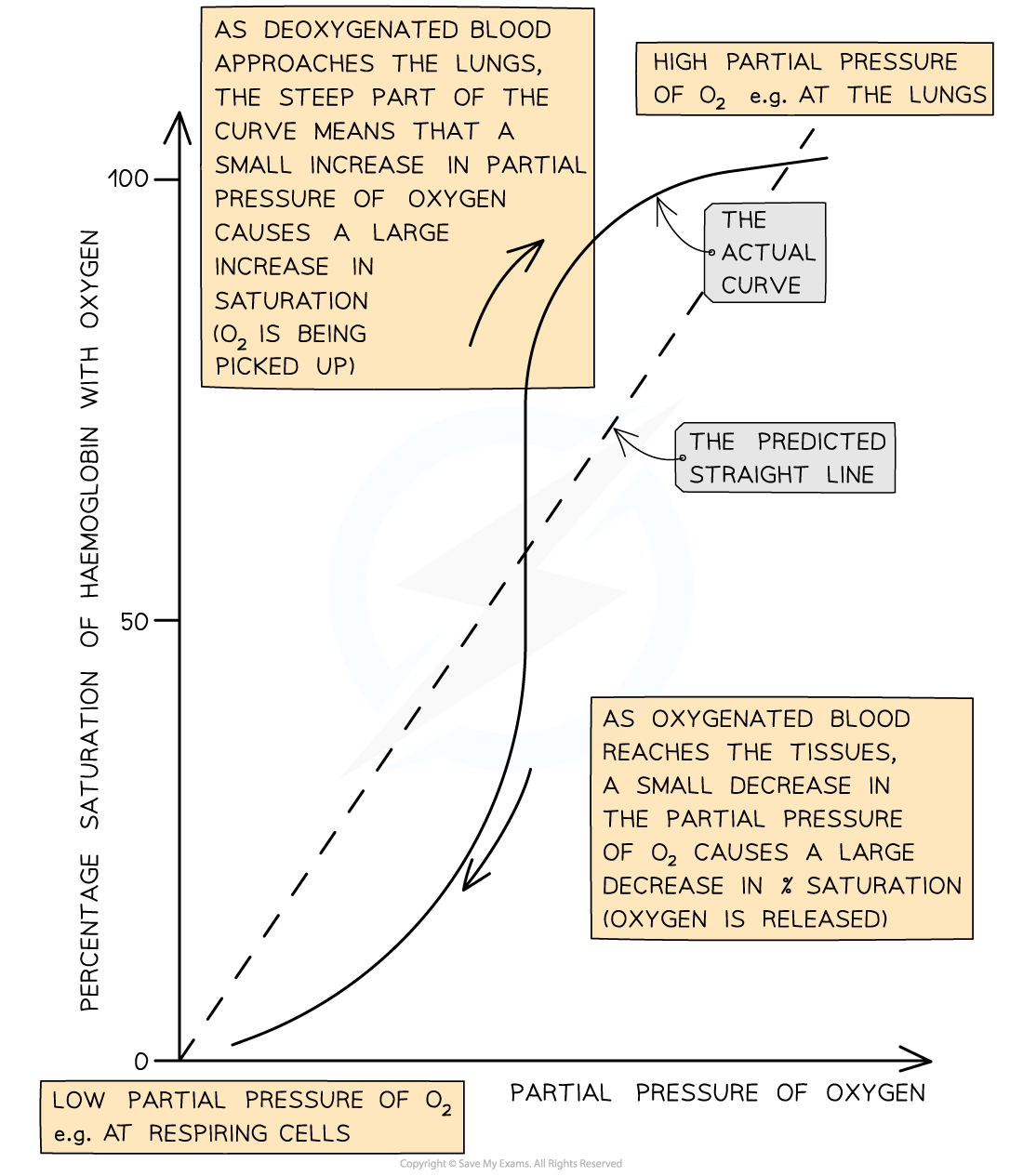
- The shape of the haemoglobin molecules @@before binding to the 1st oxygen makes it difficult for oxygen to bind as all 4 binding sites are closely united@@, this is why the curve is shallow at the start
- After binding of 1st molecule, the @@shape of haemoglobin changes so it is easier for the next oxygen to bind@@, so the graph becomes steeper. Essentially the 1st oxygen makes it easier for other subunits to bind. This is called @@cooperative binding@@
- However, @@after binding of 3rd oxygen it becomes harder for the last oxygen to bind.@@ Whilst in theory it should be easier, in practice it is not. This is due to probability. @@If all of the other 3 sites are filled, it is less probable for the last oxygen to bind to the free site@@. Gradient of the curve reduces and plateaus
- The @@further the curve is to the left, the higher its affinity to oxygen@@ (loads oxygen easily, unloads with less ease)
- The further to the right the curve is, the lower the affinity to oxygen
Effects of Carbon Dioxide Concentration
- Haemoglobin has a @@reduced affinity to oxygen in the presence of CO2@@
- The greater the conc. of CO2 the more readily haemoglobin unloads its oxygen
- This is called the @@Bohr effect@@
- @@At gas exchange surfaces e.g. lungs, the conc. of CO2 is much lower@@ as it diffuses across exchange surfaces and is excreted from the organism
- @@The affinity for oxygen is therefore increased@@, allowing the organism to load oxygen at a quicker pace
- @@In rapidly respiring tissue, the conc. of CO2 is much high@@er and thereby the haemoglobin has a lower affinity for oxygen
- In order to prevent anaerobic respiration and promote aerobic respiration, it is necessary for the haemoglobin to unload the oxygen with more ease
Loading, Transport and Unloading of Oxygen
- At gas exchange surfaces, CO2 is always being removed
- @@The pH is slightly raised due to low CO2 conc.@@
- @@The higher pH changes the shape of haemoglobin slightly so it can load oxygen with more ease@@
- This shape change also @@increases the affinity for oxygen so it will not unload the oxygen in the bloodstream@@
- In tissues, @@CO2 is produced by respiring tissues@@ as a waste product
- This will @@decrease the pH slightly@@
- Lower pH changes shape of haemoglobin so @@it has a lower affinity for oxygen@@
- Therefore it unloads all the needed oxygen to the respiring tissue
- @@The higher the rate of respiration → the more CO2 tissues produce → the lower the pH → the greater the haemoglobin shape change → the more readily oxygen is unloaded → the more oxygen is available for respiration@@
- In humans, the haemoglobin becomes saturated with oxygen as it passes through the lungs however in reality not all the haemoglobin is saturated
- When the haemoglobin reaches the respiring tissue @@only 1 molecule of oxygen is unloaded so haemoglobin returns to the lungs about 75% saturated@@
- If tissue is very active, then @@3 molecules of oxygen may be unloaded such as in exercising tissue@@
- Different organisms have different dissociation curves e.g. lugworms
- Lugworms are not very active and spend most of their time covered in sea water
- The oxygen from the seawater diffused through the lugworms’ skin and so @@has higher affinity for oxygen as it needs to extract the scarce supply of oxygen@@