Enzymes
are proteins that act as a biological catalyst to speed up the rate of a chemical reaction without being changed.
They are biological because they are made in living cells
Enzymes are necessary to all living organisms as they allow all metabolic reactions to occur at a rate that can sustain life.
The mechanism of enzyme action
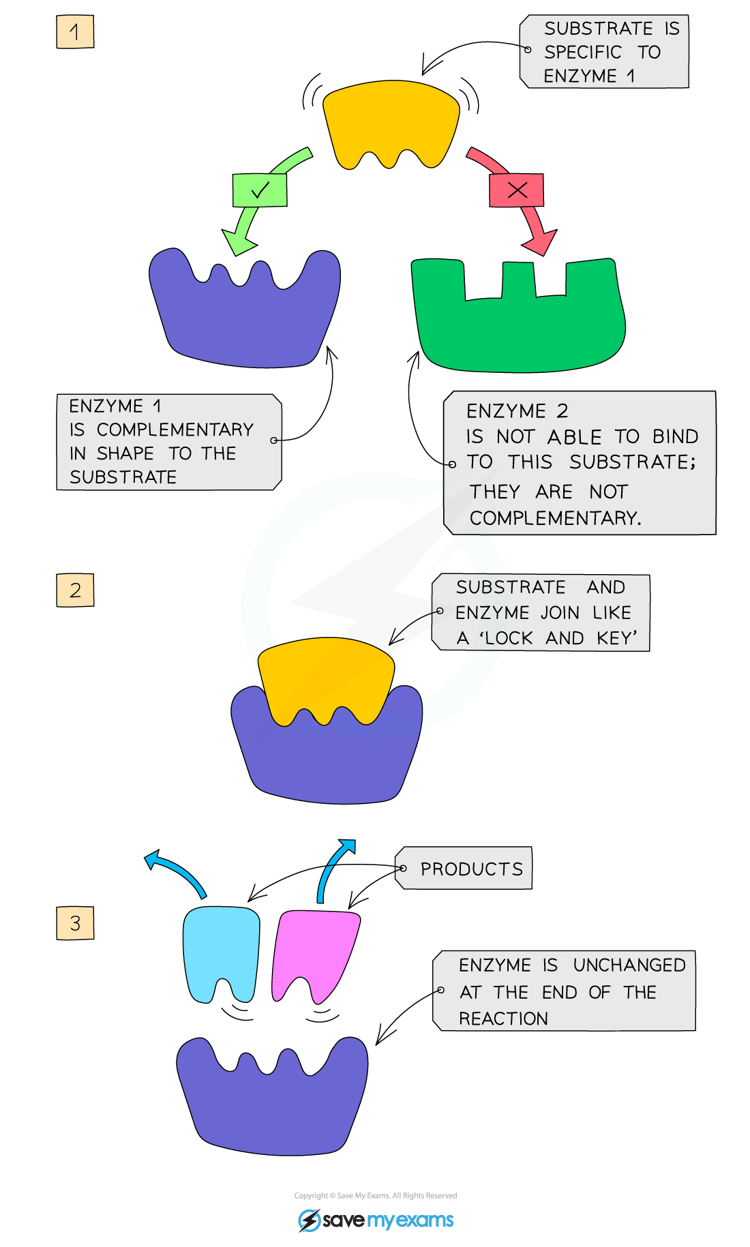
Enzymes are specific to 1 particular substrate(s) as the active site of the enzyme, where the substrate attaches, is a complementary shape to the substrate
When the substrate moves into the enzyme’s active site, the enzyme-substrate complex is formed
After the reaction has occurred, the products leave the enzyme’s active site, which is then free to take up another substrate
Enzymes and substrates randomly move about in solution
When a complementary substrate collides with an enzyme - it forms an enzyme-substrate complex and the reaction occurs
A product/s forms (from the substrate) and is then released from the active site. The enzyme is unchanged and will go on to catalyse further reactions
Denaturing of enzymes
Denaturation - when the bonds holding the enzyme are disrupted/broken and the active site loses its shape.
it’s irreversible - they can’t regain their proper shape and the reaction that is catalysing will stop
It can happen due to high temperatures or extreme pH
Temperature
Enzymes work fastest at their optimum temperature.
Heating to high temperatures (beyond the optimum) will break the bonds that hold the enzyme together and the active site will lose its shape
The enzyme has been denatured
As the temperature increases (towards the optimum) = the activity of enzymes increases - this is because the molecules have more kinetic energy, move faster and have more successful collisions with the substrate molecules so there’s a faster rate of reaction
This means that low temperatures do not denature enzymes, they just make them work more slowly due to a lack of kinetic energy
Factors Affecting Enzyme Action: pH
The optimum pH for most human enzymes is pH 7
Some enzymes that are produced in acidic conditions, such as the stomach, have a lower optimum pH (pH 2)
Some that are produced in alkaline conditions have a higher optimum pH (pH 8 or 9)
If the pH is too far above/below the optimum, the bonds that hold the amino acid chain together to make up the protein can be disrupted/broken
This will change the shape of the active site, so the substrate can no longer fit into it, reducing the rate of activity
Factors Affecting Enzyme Action: Substrate Concentration
The greater the substrate concentration, the greater the enzyme activity and the higher the rate of reaction:
As the number of substrate molecules increases = enzyme-substrate complex formation increases
If the enzyme concentration remains fixed but the amount of substrate is increased past a certain point, however, all available active sites eventually become saturated and any further increase in substrate concentration will not increase the reaction rate
When the active sites of the enzymes are all full, any substrate molecules that are added have nowhere to bind in order to form an enzyme-substrate complex
For this reason, in the graph below there is a linear increase in reaction rate as substrate is added, which then plateaus when all active sites become occupied
At this point (known as the saturation point), the substrate molecules are effectively ‘queuing up’ for an active site to become available
Investigating the Effect of pH on Amylase
Amylase breaks down starch, which can be detected using iodine solution.
Measuring reaction time
Put one drop of iodine solution into each well of the spotting tile.
Set up a water bath at 35°C.
Add 2 cm³ of amylase solution, 2 cm³ of starch solution, and 1 cm³ of your chosen pH buffer solution into separate test tubes to warm up.
Mix the three solutions together in one test tube, start the stopwatch, and place the tube back into the water bath.
Every 10 to 20 seconds, take a drop of the mixture using a pipette and place it into a fresh well of iodine on the spotting tile.
Repeat the testing process until the iodine solution no longer turns blue-black and stays orange-brown, meaning all starch is digested.
Record the total time taken for the starch to disappear.
Repeat the entire experiment using different pH buffer solutions
Breakdown large food molecules
The digestive enzymes catalyse (speed up) the breakdown of large, insoluble food molecules into smaller, soluble (can be dissolved) molecules that are then small enough to be absorbed into the bloodstream.
Digested molecules can be used to construct new carbohydrates, proteins and lipids in the body.
Some glucose produced by digestion is used for respiration.
Enzymes in digestion
The 3 main digestive enzymes are:
Amylase
is a type of carbohydrase that breaks down starch in our bodies
Production
Amylase is produced in:
Small intestine
Pancreas
Salivary glands
Purpose
Amylase breaks down starch into its constituent simple sugars (predominantly maltose).
Starch → Maltose (+ other sugars).
Action sites
The small intestine
The mouth
Protease
digestive enzymes that break down proteins into amino acids.
Production
produced in the:
small intestine
pancreas
stomach
Purpose
Proteases break down proteins into amino acids.
Protein → Amino acids.
Action sites
small intestine
stomach
Lipase
breaks down lipids into glycerol and fatty acids.
Production
Small intestine
Pancreas
Purpose
Lipase breaks down lipids into a molecule called glycerol and fatty acids.
Lipid → Glycerol + Fatty Acids.