4. Behavioural regulation and change
Course Details
Course Codes: PS20720 / SC20720
Subject: Health Psychology / Seicoleg Iechyd
Focus: Theories of Health Behaviour and Behaviour Change
Lecture Outline
Understand the difference between stage and social cognition models of behaviour.
Outline, compare, and evaluate key models to explain behaviour change and regulation including:
Transtheoretical Model
Theory of Planned Behaviour
Understanding Behaviour Change
Determinants of Behaviour
Understanding determinants aids in:
Targeting interventions to make them appealing.
Identifying optimal times for intervention.
Choosing effective strategies for behaviour change.
Models of Behaviour Change
Types of Models
Social Cognition Models:
Specify cognitive and social cognitive determinants at a static point.
Stage Theories:
Assume behaviour change requires moving through distinct stages.
Social Cognition Models
Characteristics
Individual-level approach to understand behavioural choices.
Assumes rational decision-making processes.
Focus on internalized thoughts impacting decisions.
Key Theories
Social Cognitive Theory (Bandura, 1986, 1997)
Focuses on the role of observational learning, social experiences, and reciprocal determinism in behaviour change. It suggests that personal factors, environmental influences, and behaviour all interact to influence actions.
Theory of Reasoned Action (Ajzen & Fishbein, 1980)
Proposes that individual behaviour is driven by behavioural intentions, which are influenced by attitudes towards the behaviour and subjective norms.
Theory of Planned Behaviour (Ajzen, 1991)
An extension of the Theory of Reasoned Action, it adds perceived behavioural control as a factor influencing intentions and behaviour. It asserts that if individuals feel they have control over the behaviour, they are more likely to engage in it.
Health Belief Model (Strecher & Rosenstock, 2002)
Suggests that health decisions are influenced by personal beliefs about health conditions, perceived susceptibility to the condition, perceived severity, benefits of taking action, and barriers to taking that action.
Protection Motivation Theory (Rogers, 1983)
Focuses on how people are motivated to protect themselves based on their perceptions of the threat (severity and vulnerability) and the efficacy of the recommended protective behaviour.
Self-Determination Theory (Deci & Ryan, 1985)
Emphasizes the role of intrinsic and extrinsic motivation in behaviour change. It posits that for individuals to be motivated to engage in a behaviour, their basic psychological needs for autonomy, competence, and relatedness must be met.
Theory of Planned Behaviour (TPB)
Overview
Developed from the Theory of Reasoned Action.
Proposes rational and goal-directed decisions influenced by social context.
Determined by a person’s beliefs about the behaviour in asocial context, social perceptions and expectations
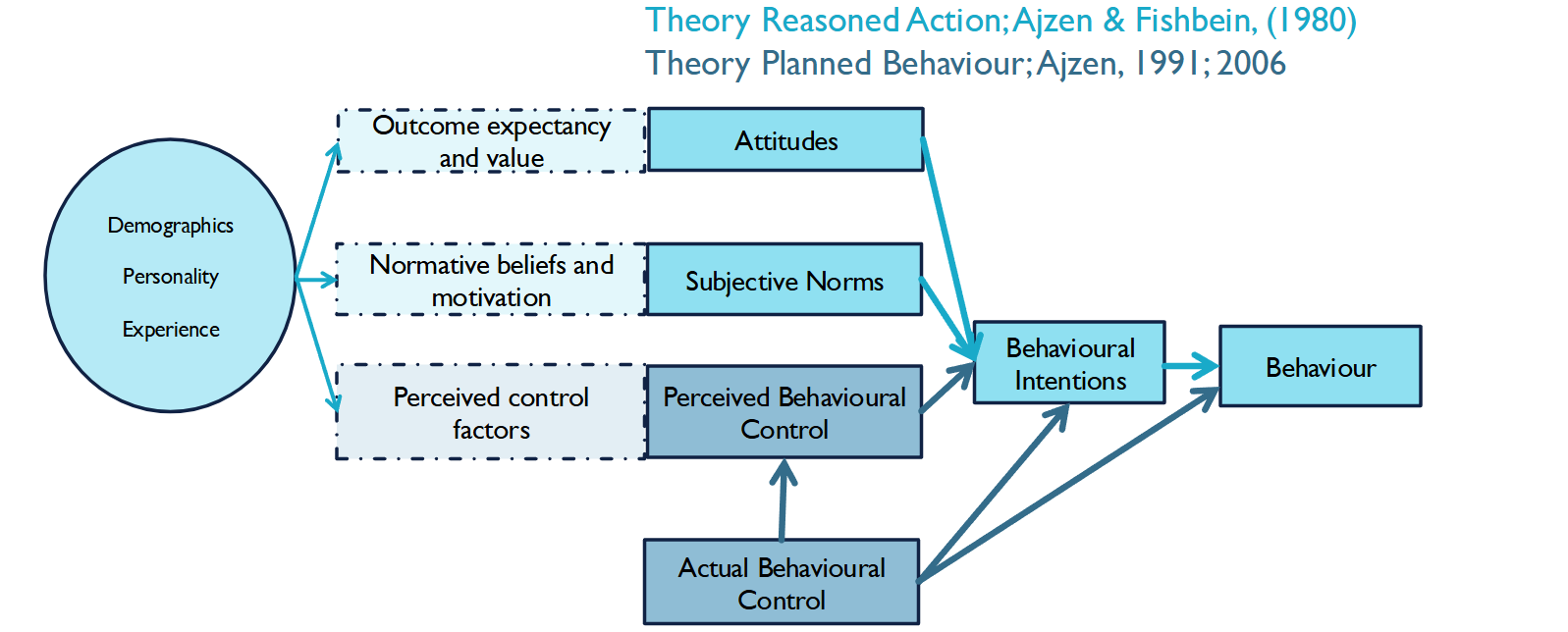
Components of the Theory of Planned Behaviour (TPB)
Attitudes
Definition: Attitudes are individuals' evaluations of a particular behaviour, encompassing positive or negative feelings associated with engaging in that behaviour.
Influence: Positive attitudes towards a behaviour increase the likelihood of engaging in that behaviour, while negative attitudes decrease it.
Determining Factors: This may include beliefs about the outcomes of the behaviour (costs vs benefits) and how these beliefs are shaped by personal experiences and social influences.
Perceived Behavioural Control (PBC)
Definition: PBC refers to an individual's perception of their ability to perform a behaviour, which includes their beliefs about the resources and opportunities available to them.
Influence: Higher perceived control leads to greater behavioural intentions, as individuals are more likely to act when they feel capable of doing so. It also reflects confidence in overcoming barriers to change.
Components: PBC is influenced by both internal factors (skills and self-efficacy) and external factors (resources and opportunities).
Subjective Norms
Definition: Subjective norms are the perceived social pressure to engage or not engage in a behaviour. This pressure stems from beliefs about whether important others think they should perform the behaviour.
Influence: If individuals believe that key people (friends, family, colleagues) approve of a behaviour, they are more likely to intend to engage in that behaviour. Conversely, if they believe others disapprove, their intentions may decrease.
Behavioural Intentions
Definition: Behavioural intentions are an individual’s readiness or plan to engage in a specific behaviour. These intentions are the immediate predictors of behaviour as they reflect the motivation to act.
Influence: Intentions are derived from attitudes, subjective norms, and perceived behavioural control. A strong intention typically leads to a higher likelihood of completing the behaviour.
Actual Behavioural Control: This refers to whether individuals can indeed enact the behaviour, which can be influenced by logistics, barriers, or facilitating factors, and is an important aspect that can affect whether intentions turn into actual behaviours.
Additional Factors
Demographics: Age, gender, education, and socio-economic status can affect attitudes, perceived control, and ultimately behaviour.
Personality: Individual traits (like conscientiousness or risk-taking) can influence how people perceive norms or control regarding a specific behaviour.
Experience: Past experiences with a behaviour can shape future beliefs and confidence in performing that behaviour, influencing all other components of TPB
Research Application
Hassandra et al. (2011)
Explored TPB variables predicting adolescent smoking intentions influenced by parental attitudes and behaviours.
Sample: 763 Greek students aged 10-18 and their parents.
Results of TPB Research
Findings
Negative attitudes towards smoking increased with age.
PBC and attitudes predicted smoking intentions across age groups, stronger for seniors (16-18 years).
Subjective norms showed no significant impact on smoking intentions.
Evaluation of TPB
Successfully predicts a range of health behaviours (40-50% variance in intention, 19-38% in behaviour).
The role of social norms less conclusive; may overlook diverse social group influences.
Indicates a need for additional variables to connect intention to behaviour.
Stage Models of Behaviour Change
Characteristics
Identify distinct stages during behaviour change.
Helps in determining appropriate intervention points.
Individuals usually occupy one stage at a time.
Properties of Stage Theories
Classification system defining stages.
An ordered progression of stages.
Common barriers and different challenges at each stage.
Examples of Stage Models
Transtheoretical Model (TTM)
Developed by James Prochaska and Carlo DiClemente in the early 1980s, the TTM is one of the most recognized frameworks for understanding how individuals progress through stages of change when adopting new health behaviours.
Stages of Change: The model includes five distinct stages:
Pre-contemplation: Individuals are not yet considering change and may be unaware of the need for it.
Contemplation: Individuals are aware of the benefits of change but are ambivalent and not ready to take action.
Preparation: Individuals intend to take action soon and may start making small changes.
Action: Individuals actively engage in behaviour change and adopt new practices.
Maintenance: Individuals work to sustain the behaviour change over time and prevent relapse.
Additionally, some variations include Relapse and Termination stages, which address the challenges of returning to previous behaviours and achieving long-term success, respectively.
Processes of Change: The TTM identifies cognitive and behavioural processes that facilitate movement through the stages, including strategies such as consciousness raising, self-liberation, and reinforcement management.
Precaution Adoption Process Model (PAPM)
Developed by Weinstein (1988), the PAPM differentiates between the stages of contemplating a new health behaviour (e.g., getting vaccinated) versus adopting it.
Stages: It consists of stages from being unaware of a health risk to adopting preventive behaviour, including:
Unaware of the issue: Individuals have no knowledge of the risk.
Unengaged: Individuals are aware of the issue but not personally engaged.
Deciding about acting: Individuals consider the costs and benefits of taking preventative actions.
Deciding not to act: Individuals may understand the risk but choose not to adopt the behaviour.
Deciding to act: Individuals move to engage in recommended protective actions.
Rubicon Model of Action Phases
Proposed by Heckhausen and Gollwitzer (1987), this model focuses on the transition from motivation (intention) into action.
Stages: The model consists of different phases, including:
Predecisional Phase: Considering whether to take action, leading to intention formation.
Wishing Phase: Individuals express a desire to perform the behaviour.
Intention Phase: Individuals formulate a clear intention to perform the behaviour.
Action Phase: Actual behaviour is enacted.
The model emphasizes the importance of self-efficacy and planning in successfully translating intentions into actions.
Health Action Process Approach (HAPA)
Developed by Schwarzer (2008), HAPA distinguishes between the motivational and volitional phases of health behaviour change.
Phases: It outlines these stages:
Motivational Phase: Where individuals form intentions based on risk perception, outcome expectancies, and self-efficacy beliefs.
Volitional Phase: Where individuals translate intentions into actions through planning, maintenance, and recovery from setbacks.
This model emphasizes the role of planning in practice and identifies barriers that may arise in the transition from intention to action
Transtheoretical Model of Behaviour Change
Components
Stages of Change:
Pre-contemplation, Contemplation, Preparation, Action, Maintenance.
Relapse and Termination stages also included.
Processes of Change:
Ways to help individuals progress through stages.
Temptation:
Urges to revert to previous behaviours.
Movement Through Stages
Not necessarily linear.
Varying time spent between stages.
Key Factors for Progression
Decision Balance:
Identification of barriers and facilitators to behaviour change.
Self-Efficacy:
Confidence in ability to perform behaviours effectively.
Processes of Change
Cognitive Processes
Consciousness Raising:
Seeking information to increase understanding.
Dramatic Relief & Environmental Re-evaluation:
Emotional reactions and assessment of behaviour impact.
Behavioural Processes
Social Liberation & Helping Relationships:
Finding supportive environments and relationships.
Counterconditioning:
Identification of substitute behaviours.
Evaluation of TTM
Widely applied yet criticized for limitations.
Acknowledges individual differences.
Issues with cross-sectional research affecting cause-and-effect relationships.
Inconsistencies in research regarding processes of change.
Summary
Discussed the need for predicting health behaviour.
Evaluated the Theory of Planned Behaviour and the Transtheoretical Model.
Preparation for Seminars
Upcoming seminars will focus on applying theoretical models in health promotion.
Preparation tasks include reviewing and comparing models of behaviour.