L10a - El Niño and Southern Oscillation (ENSO)
Mean State of the Ocean and Atmosphere in the Tropical Pacific
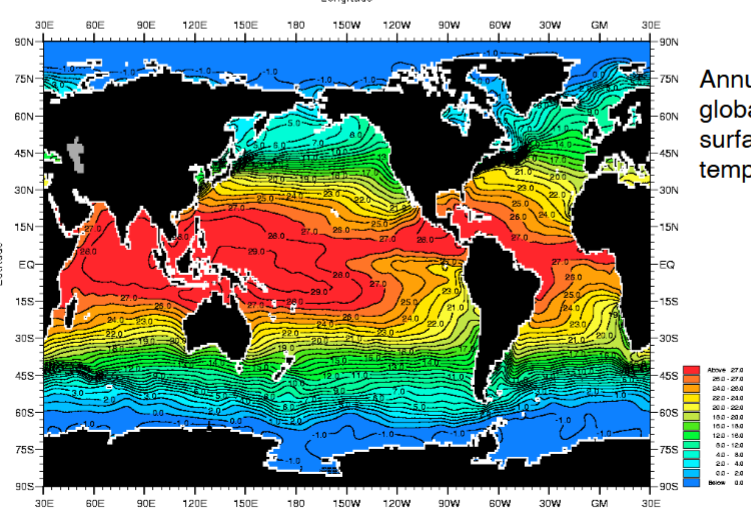
There is a significant zonal gradient in sea surface temperature along the equator.
Warm waters are located in the western half of the Pacific.
The equatorial cold tongue is in the east.
Strong atmospheric convection and heavy rainfall are observed across Indonesia and the western tropical Pacific.
This is associated with low-level easterly flow and upper-level westerly flow in the atmosphere, known as the equatorial Walker Circulation.
A deep layer of warm water exists in the western tropical Pacific.
The equatorial thermocline, which separates the warm water from the colder water below, shallows to the east.
Sea level is high in the west and low in the east.
Impact of SST and Tropical Rainfall
Sea surface temperatures and tropical rainfall affect the distribution of atmospheric heating.
This influences the strength and location of the jet stream over the Pacific in both hemispheres via the equator-to-pole temperature gradient.
El Niño and La Niña
Anomalously warm conditions in the eastern equatorial Pacific are known as El Niño.
They typically last 9-12 months.
They are strongest during December to April, having the biggest impact on the atmosphere.
Anomalously cold conditions are known as La Niña.
El Niño occurs every 2-7 years, with an average period of 4 years but with irregular timing.
The Southern Oscillation
Anomalous sea surface temperatures in the tropical Pacific are accompanied by large-scale fluctuations in atmospheric pressure, known as the Southern Oscillation.
Negative Phase:
Unusually high pressure over Indonesia and the western Pacific.
Unusually low pressure over the eastern tropical Pacific.
There is strong coupling between the atmosphere (Southern Oscillation) and ocean (El Niño) on inter-annual timescales.
Characteristics of an El Niño Event
Weakened atmospheric pressure gradient.
Weakened easterly trade winds along the equator.
The Pacific warm pool spreads east, with the thermocline deepening in the tropical east Pacific.
Atmospheric convection also moves east.
Coastal and equatorial upwelling is suppressed.
Large parts of the global atmosphere are affected.
Reduced biological productivity along the equator.
Rise in sea level in the eastern tropical Pacific.
Rainfall and thunderstorm activity diminishes over the western equatorial Pacific and increases over the east.
This leads to wildfires and droughts in Australia and Indonesia, while the Pacific islands and Ecuador suffer flooding.
El Niño has an influence on weather patterns over much of the globe.
During an El Niño event, upwelling along the equator is suppressed, and chlorophyll concentrations are low.
Characteristics of a La Niña Event
La Niña episodes are characterized by:
A stronger-than-usual Walker Circulation.
A steeply sloping thermocline.
Cold SST anomalies in the eastern tropical Pacific.
Atmospheric convection and rainfall confined to the west tropical Pacific.
During a La Niña event, upwelling is enhanced, and there are widespread phytoplankton blooms.
Current Conditions in the Tropical Pacific
La Niña conditions are emerging in the equatorial Pacific and are expected to persist until spring.
Sea surface temperatures are slightly below average across the central and east equatorial Pacific.
Based on current observations, conditions are expected to return to ENSO-neutral by spring.
Summary of Key Points
ENSO is a mode of coupled climate variability resulting from strong coupling between the tropical ocean and the tropical atmosphere.
In the atmosphere, the Southern Oscillation describes a large-scale see-saw in sea-level pressure across the tropical Pacific.
Changes in the trade winds lead to upper ocean temperature anomalies in the eastern tropical Pacific.
Warm events are referred to as El Niño, and cold events as La Niña.
The anomalous sea surface temperatures feed back on atmospheric pressure and wind and influence tropical rainfall distributions.
Atmospheric heating anomalies give rise to extreme weather conditions across the globe.
ENSO events occur every 2 to 7 years and usually last for 9 to 12 months.
Neutral-to-La-Niña conditions currently exist in the tropical Pacific.