Generation Z for british pop
Generation Z.
The Post Millennials. iGeneration. Founders. Plurals. The list is endless. Gen Z is the first to be born into an era of smartphones. Most won’t even remember a life before social media. They’re less focused Gen Z are living in a world of continuous updates. They process information faster than other generations thanks to apps like Snapchat and Vine. Thus you won’t blame them if their attention spans are significantly lower. Typically, they have shorter attention spans, due to the rise of videos and easy access information. With the rise of social media and the ability to connect with anyone around the world, they value personal engagement and transparency in companies and brands, something businesses and organsiations are needing to adapt to. Cultural influences: London Olympics, social media, online streaming. Technology: The tech revolution has had the biggest impact on Generation Z.
Unlike previous generations, they were born into rapid technology advances. They’re the first generation to be spending longer online on their mobiles each day than on all other devices combined. Generation Z are the least likely generation to remain loyal to a particular brand. They prefer their brands to reach them on social media, and are more inclined to buy products online as opposed to going to a shop.
As the oldest among Generation Z enter their mid-twenties, become powerful consumers and begin to vote, attempts to understand this cohort are gathering pace. In recent years, the field of generational research has experienced a backlash and it is common for people to question its usefulness and validity. Some elements of this critique are accurate: our identities are not tied solely to bland age cohorts based on when we were born, we share stronger connections with many different types of people based on factors like gender, religion, taste in music and our political views. However, the timing of a person’s birth does influence their life experience. The Baby Boomer generation forms a part of an observable surge in the UK’s birth rate in the two decades after the Second World War. This experience, as part of a large cohort, is the background that has shaped their experiences with schooling, politics, employment and now retirement. Later generations may not be as easily identifiable with hard metrics like births, but they do line up with key political and cultural events that have shaped the UK overall and may have greater influence still on those growing up at the time.
The generational cohorts give researchers the tools to analyse changes in views over time. They can provide a way to understand how different formative experiences such as economic, political, and technological social shifts are interacting with their lifespan and shaping their lived experiences.
How are Generation Z different? Generation Z exists in the UK – but their identity is more fluid than older groups. The research concludes that they have the weakest cohort (group) identity of the four main generations, with many also identifying as Millennials. However, those who do identify tend to do so strongly. This means those who use the cohort name to communicate with young people will be speaking to a motivated subset rather than a wider audience.
Generation Z show signs of greater financial optimism than Millennials. There are also signs that generational income inequalities are weaker than they were in the 2000s. However, this greater sense of optimism will collide with an economic environment that may prove to be as disruptive for Gen Z as it was for Millennials. This clash is something governments and companies should be aware of as the generation continues to age.
According to the report, Generation Z and Millennials share similar views on politics and policy. Gen Z are more politically interested than Millennials were at a similar age – however, this is a by-product of living in a more politicised time. Politically, Gen Z and Millennials are similarly aligned to the UK’s left-of-centre Labour party, following the powerful age-based divide in UK politics. While there are some signs of uniqueness in their views of redistribution, with a more pro-welfare view than Millennials, it is too subtle to justify political campaigns that target Gen Z specifically.
Generation Z is the most progressive with significantly more liberal values. Overall, Gen Z hold more socially and politically progressive attitudes than Millennials at a similar age and are more liberal in areas including prison sentencing, censorship, and the importance of 'traditional values'. While some of these attitudes (for instance, views on the death penalty) are driven by societal shifts, others reveal clear signs of generational differences. For example, Gen Z are half as likely to agree that censorship of films and magazines is necessary to uphold moral standards than Millennials were when they were the same age.
As important is the need to say where Generation Z are not different. There are cases where we see no difference, or the difference is entirely due to the cohort’s age rather than their specific circumstances. Environmentalism is a good example: there is a lot of writing about how younger people are more environmentally concerned, or more likely to be activists on the topic. Yet there is little to distinguish Generation Z here – we have seen a period effect with all cohorts becoming similarly more caring about the environment, and more likely to say climate change is a concern than a decade or so ago. While Generation Z are commonly considered the greenest generation, so far the data does not support this hypothesis. This picture of Generation Z is incomplete. This is not just because the cohort is still – literally – in its infancy (some may be just ten years old), it is also because this generation has the greatest plasticity in its values, with many having changed their opinions more recently than older cohorts.
What does this mean for generational analysis? This report confirms that cohort analysis can tease out generational differences – but often they will be more subtle than many headlines would have us believe. A key point to make is that any assertion about generations should be considered carefully. Cohort names are often used as a more exciting version of age brackets, but the term 'Millennial' carries a lot more implicit baggage than '27-42-year-olds'. When we use cohort names rather than age groups, we are making a subliminal statement that we believe what we are describing is a characteristic which is an enduring feature of the generation under question. When used widely they also suggest a level of uniformity of thought among the group which is rarely accurate. The report also confirms that generational analysis is not easy. Conducting rigorous generational analysis is difficult as it relies on the availability and analysis of long-term data. One of the important findings here is that the evidence required to prove many of the statements that are made about Generation Z is missing – often because the issues that are said to matter to young people now were not considered important ten or twenty years ago. However, generational analysis is worth the effort. Where we can see generational differences, they help us to understand what is going on now – but they also shine a light on how change happens in our society and unlock our ability to plan for the future.
The consensus view in the UK is that there are six key generations in the adult population, ranging from the eldest 'Pre-War' generation, down to 'Generation Alpha', the temporary label applied to people likely aged under ten at present.
Ipsos (information provided in this handout is based on Ipsos data) definitions are provided here. Different organisations can vary in where precisely they draw the lines: Millennials can start a few years earlier or end a few years later, for instance. But, to get lost in the margins is to miss the wider analytical point that people’s views can differ dependent on the economic, cultural and political environment in which they grew up.
Meet the generations- Pre-War: born before 1945 ; Baby Boomers: born 1945 – 1965 ;Gen X: born 1966 – 1979;Millennials: born 1980 – 1995; Gen Z: born 1996 – 2012? Gen Alpha: born after 2012?
Once young people reach their teenage years, however, it is open season: as in past iterations of our generational research we have found that people tend to hold the most negative stereotypes about younger people, regardless of the generational cohort they are in. By some margin, people are most likely to say that Gen Z are not prepared to work hard to get ahead in life and are too easily offended by the things people say – as well as being self-centred. However, we also see some positive traits for the youth: Gen Z are considered to be most open to people from different backgrounds and also most willing to make big lifestyle changes to reduce their carbon emissions.
Peak Generation Z is at 22. Looking at how people assign themselves to generational cohorts unprompted shows in greater detail how Generation Z’s identity is weaker than others. The chart below shows a 5-year rolling average of the number of people in a new survey who assign themselves to each generation.
Within the 16-26 age bracket there are significant numbers of Generation Z members who put themselves in the Millennial and Generation X cohorts. The modal age for identification in Generation Z is 22 and identification as a member of this cohort drops off sharply in the late twenties: very few people over 30 put themselves into this category. This contrasts strongly with the Millennial cohort, whose trend line resembles a large mountain with its foothills deep within the Gen Z age bracket and its peak at 32 years of age. As was shown on the chart, a significant minority of those in Gen Z (especially those in their mid-twenties) identify as Millennials.
Is there a Gen Z politics? Blair’s babies? Recent generations in the UK line up surprisingly well with changes in the political weather: the Millennial generation begins around the same time as Margaret Thatcher first took office as Prime Minister, and ends in the twilight of John Major’s administration. Gen Z starts just ahead of the 1997 New Labour landslide and ends around the time that Gordon Brown lost the 2010 election. An argument could be made that growing up under different political administrations has affected how these generations view different matters: here we explore the extent that they show differences in politics. The report finds less evidence for a specific Generation Z politics. In common with all younger people, this generation appears more left-leaning and pro-redistribution – but even this must be caveated. Gen Z are more interested in politics than Millennials or Gen X were at a similar age. It remains the case that the youngest generation are the most disengaged, however, the level of disengagement is lower than comparable cohorts. But they live in an environment which is simply more politicised. Political interest and party affiliation rose generally in the aftermath of the Brexit referendum and General Elections of the second half of the 2010s. Gen Z and Millennials are party political kindred spirits. Both are similarly closer to the Labour party and further from the Conservatives, obeying the age-based logic of UK politics. There are visible nuances in attitudes to redistribution, welfare, and the role of government. Gen Z are least likely to want to increase taxes to pay for more spending on health, education, and social benefits – yet they are the most likely to agree that government should redistribute income from the rich to the poor. Gen Z appear notably more pro-welfare than Millennials. They are closest to Boomers on agreeing the government should spend more on welfare benefits for the poor, even if it means higher taxes – and far from Millennials. Are Gen Z the activist generation? It is often said that Gen Z are an activist generation who will overturn existing politics. But this assertion runs into one of the longest-established life stage ffects in politics: younger people are always less engaged in politics than older people. Analysis of Nat Cen’s long-running British Social Attitudes survey shows this at work: between 1983 and 2010, the proportion of each cohort with a great deal of interest in politics stays level, with the generations ranking in order of age. But we see a strong period effect in the 2010s, which played host to referendums on the Alternative Vote, Scottish Independence and Brexit, as well as four General Elections. Political interest among all generations has risen in more recent years, particularly in the second half of the decade.
The overall effect of these forces is a partial reversal of the trend for younger generations to be less interested in politics: where we are able to compare the cohorts when they were at the same age, Baby Boomers are more likely to have a great deal of interest in politics than the Pre-War generation at a similar age, Millennials have more interest than Gen X, Gen Z are more interested when we compare with Millennials. Gen X are the odd ones out here, closely following the level of political interest displayed by Baby Boomers when they were the same age.
The data supports the statement that Gen Z are a more politically engaged generation, at least compared with previous generations when they were also in their twenties. However, the context to this finding is important: all generations have become more engaged, likely as a result of the UK’s politically tumultuous decade. Despite Gen Z’s rising interest, they remain among the least political generations in Britain. As far as political interest is concerned, period and lifecycle effects are more likely to explain the patterns we see than a cohort effect of a more politicised youth. In addition to rising political engagement, there is evidence to suggest that support of political parties has been rising. Gen Z remain among the least likely generation to say they feel close to any political party and despite affiliation rising across the board, younger generations remain the least likely to profess an identification.
Gen Z values and worldview
The concept of values lies at the heart of the logic of generational analysis: the deep-set views that shape our opinions and attitudes are established as we grow up, making them an important part of what makes generations different. When we start to consider generational values we see some of the biggest differences between Generation Z and older cohorts.
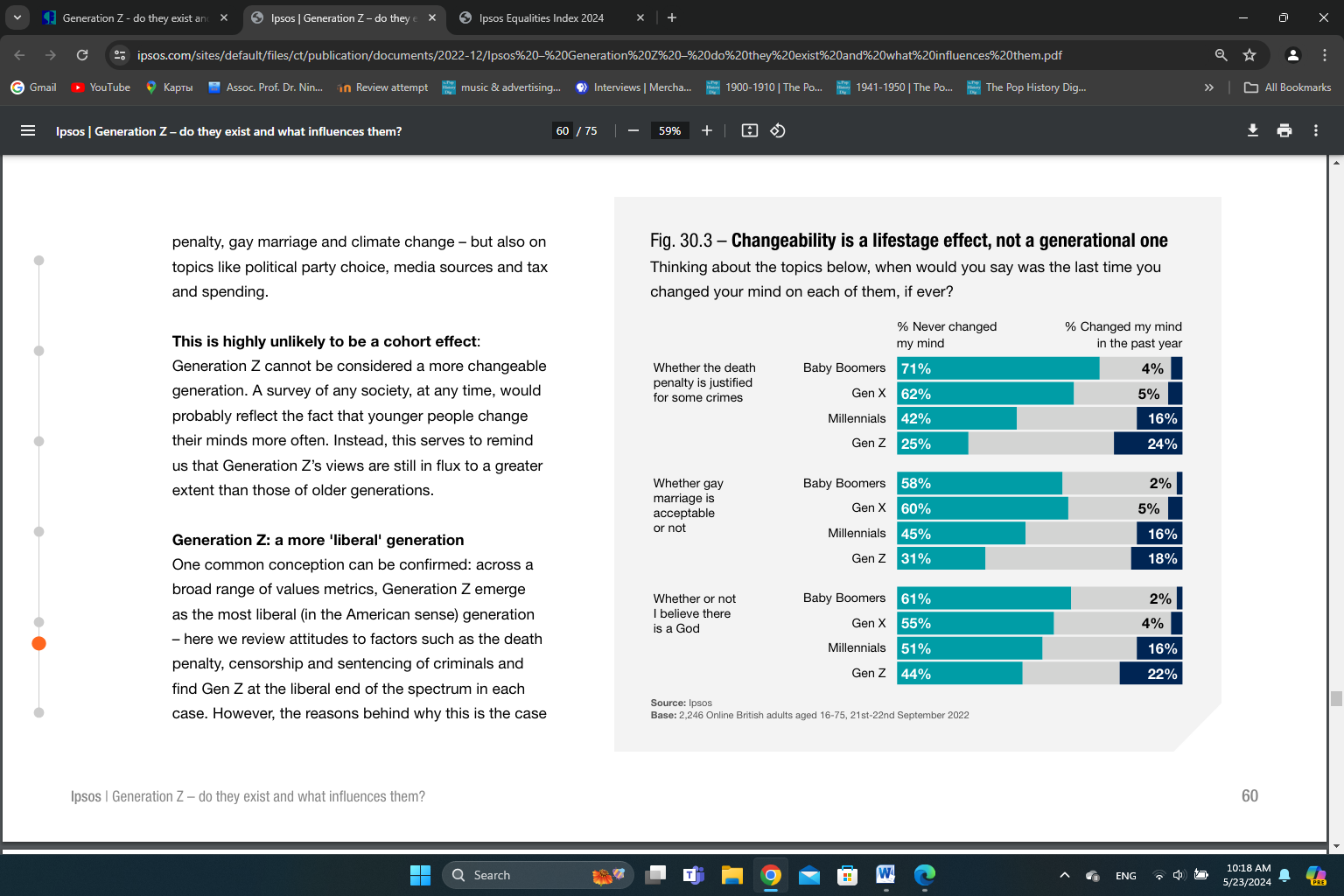
Generation Z’s values are the most plastic. This new research shows that Gen Z – being the youngest – remain more likely to have changed their views on a variety of topics, ranging from the most mundane to some of the biggest questions in life. Figures 30.1 to 30.3 shows the proportion of each generation who say they have changed their mind in the last year on a set of topics, arrayed against the proportion who say they have never changed their mind.
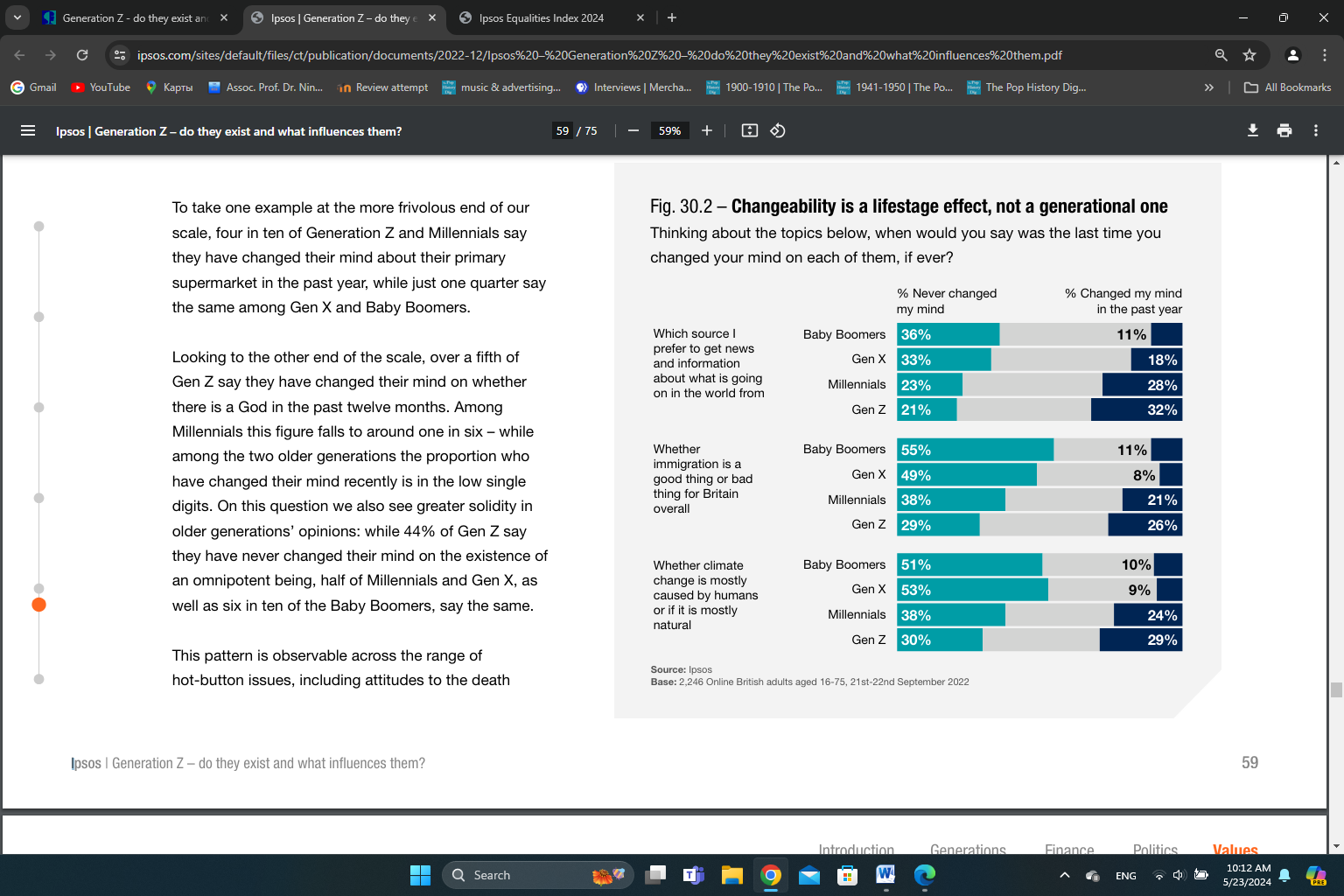
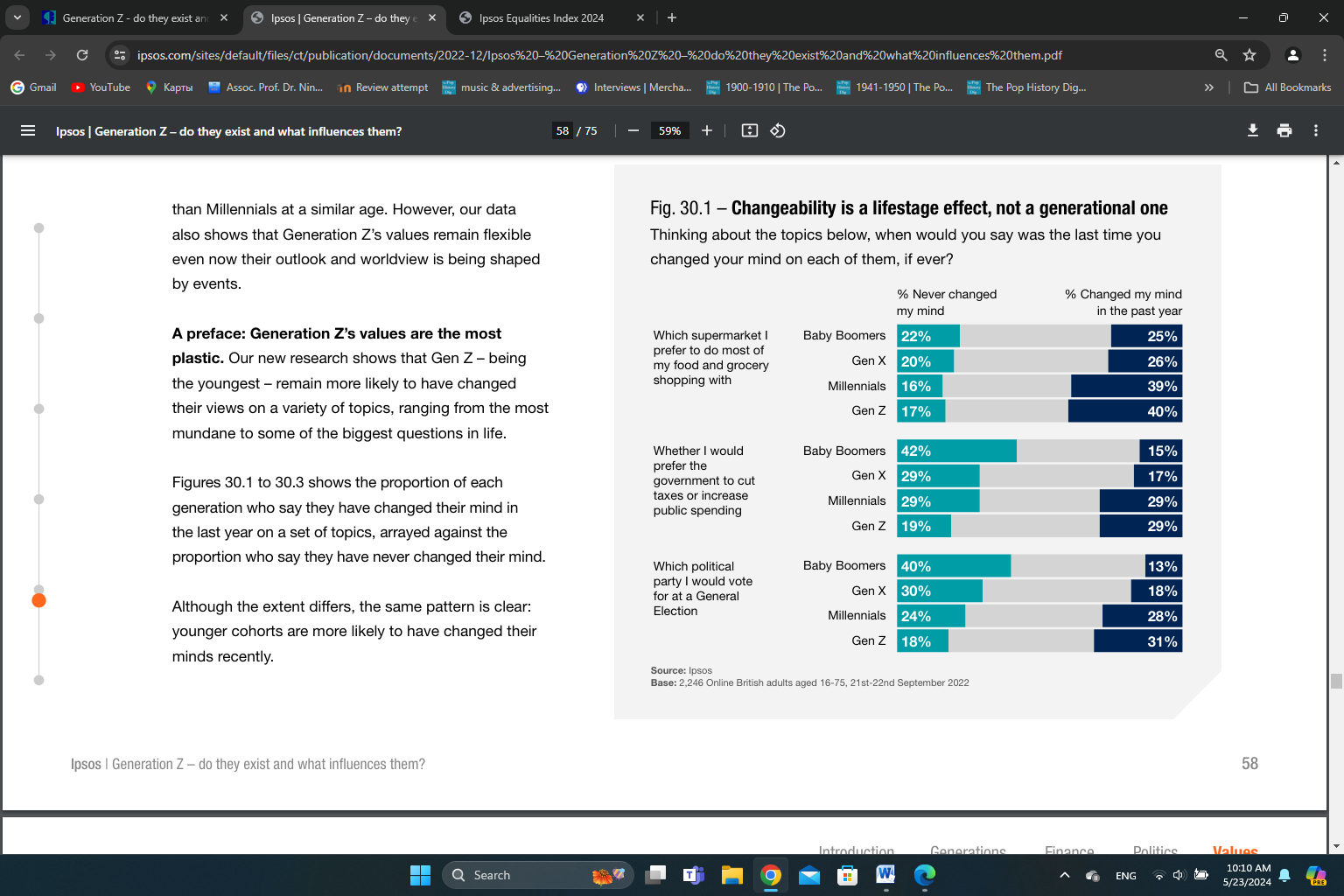
Although the extent differs, the same pattern is clear: younger cohorts are more likely to have changed their minds recently. To take one example at the more frivolous end of our scale, four in ten of Generation Z and Millennials say they have changed their mind about their primary supermarket in the past year, while just one quarter say the same among Gen X and Baby Boomers. Looking to the other end of the scale, over a fifth of Gen Z say they have changed their mind on whether there is a God in the past twelve months. Among Millennials this figure falls to around one in six – while among the two older generations the proportion who have changed their mind recently is in the low single digits. On this question we also see greater solidity in older generations’ opinions: while 44% of Gen Z say they have never changed their mind on the existence of an omnipotent being, half of Millennials and Gen X, as well as six in ten of the Baby Boomers, say the same.
This pattern is observable across the range of hot-button issues, including attitudes to the death penalty, gay marriage and climate change – but also on topics like political party choice, media sources and tax and spending.
This is highly unlikely to be a cohort effect: Generation Z cannot be considered a more changeable generation. A survey of any society, at any time, would probably reflect the fact that younger people change their minds more often. Instead, this serves to remind us that Generation Z’s views are still in flux to a greater extent than those of older generations.
 Generation Z: a more 'liberal' generation. One common conception can be confirmed: across a broad range of values metrics, Generation Z emerge as the most liberal (in the American sense) generation – here we review attitudes to factors such as the death penalty, censorship and sentencing of criminals and find Gen Z at the liberal end of the spectrum in each case. However, the reasons behind why this is the case vary between the different values examined here: in the case of media censorship, we see each generation building on the last to become less in favour; changes in views of the death penalty are driven by a societal shift; while we see the emergence of a novel values orientation for Generation Z on sentencing. Each of these trends is built on a different combination of life stage, period, and cohort effects, which we explore further in this chapter.
One 'meta' finding is the importance of tradition to Generation Z. The British Social Attitudes survey has been exploring how far people think young people respect traditional British values since 1986. Where people are less likely to agree, this suggests that upholding these values is less important to them, hinting at a less tradition-bound outlook on life. There has been clear generational layering over the life of this question but also evidence of period effects, with the appeal of this statement rising in the 2000s. This means that Generation Z are far more liberal on this measure than Millennials were when they were a similar age.
This research shows that overall, society has become less worried about young people’s respect for traditional values: from a high point of 77% agreeing overall in 2007, this has fallen to 46% in 2021. Therefore, Gen Z are the most liberal generation of a society that is increasingly liberal on this measure. In fact, it is Gen X who appear to have been furthest from the mainstream: in 1990 when 40% of this generation agreed, this placed them almost thirty points from an overall average of 67%.
The acceptability of censorship is another area where there is evidence of a social shift: between 1986 and 2009 views on this topic changed by just 4 percentage points. As a result, Gen X and Millennials were equally supportive at similar ages in 1990 and 2007. Since then however, attitudes have shifted: the gap between Millennials and other cohorts has widened. Generation Z have started at the most liberal position mapped out by Millennials and appear likely to move further still. This may be an example of a ratchet effect; whereby successive generations build on each other’s movements to stretch social values in a certain direction. What was once considered liberal has become mainstream, so the new liberal position is even further from the starting point.
Environmental concern is often touted as an area where Generation Z are different; the importance of young activists and the 'Fridays for Future' movement are cited as examples of this generation being more environmentally-minded than others. We find this perception in our data: Gen Z are considered most likely to be the ones who will make big life changes to reduce their emissions. It also appears to be important to self-perception: 45% of Generation Z members who are aware that they fit within this cohort feel they are the group most willing to make lifestyle changes for the environment. Yet finding evidence to support this assertion quickly runs into trouble. The data tends to suggest that (in the UK at least) generations are similarly likely to see climate change as a big concern, while this issue is too new an area of focus for long-term data to cast further light.
The data that does exist hints that caring about the environment was not something previous generations of younger people considered especially important, and we see in new polling that younger cohorts are more likely to feel guilty about their impact on the environment. This suggests that while topline concern about climate change is similar across the generations, there may be more disagreement in what the right steps are to deal with the problem.
Generation Z appear to live up to their 'liberal' billing – they are less tied to tradition and their views on topics including the necessity of censorship, the death penalty and criminal justice are the most liberal of any generation. In some cases, such as the death penalty, this is due to the entirety of UK society moving in a more liberal direction, however, in others, especially on sentencing criminals, we see a uniquely liberal attitude emerging. However, in one area where there is a lot of coverage – environmentalism – we find no evidence that Generation Z hold unique views, especially from Millennials. Society overall has become more likely to care about the environment, and few people of any age do not agree that it is a worry. Whilst there are differences on the types of action different generations might think are needed to meet the climate change challenge: Generation Z are the most likely to be identified as the generation most willing to make lifestyle changes and younger generations are also far more likely to feel guilty about their impact on the environment. The most important consideration, however, is that Generation Z’s values are the least set of any generation, meaning there is scope for them to change in the face of large-scale period effects over the coming few years. This diversity of views means that companies and organisations seeking to lean into or define a set of Generation Z values may find it difficult to draw a significant number for this generation under any single banner.