7 battle of bosworth
Video Questions
Wars of the Roses — Video Comprehension Questions (Year 13)
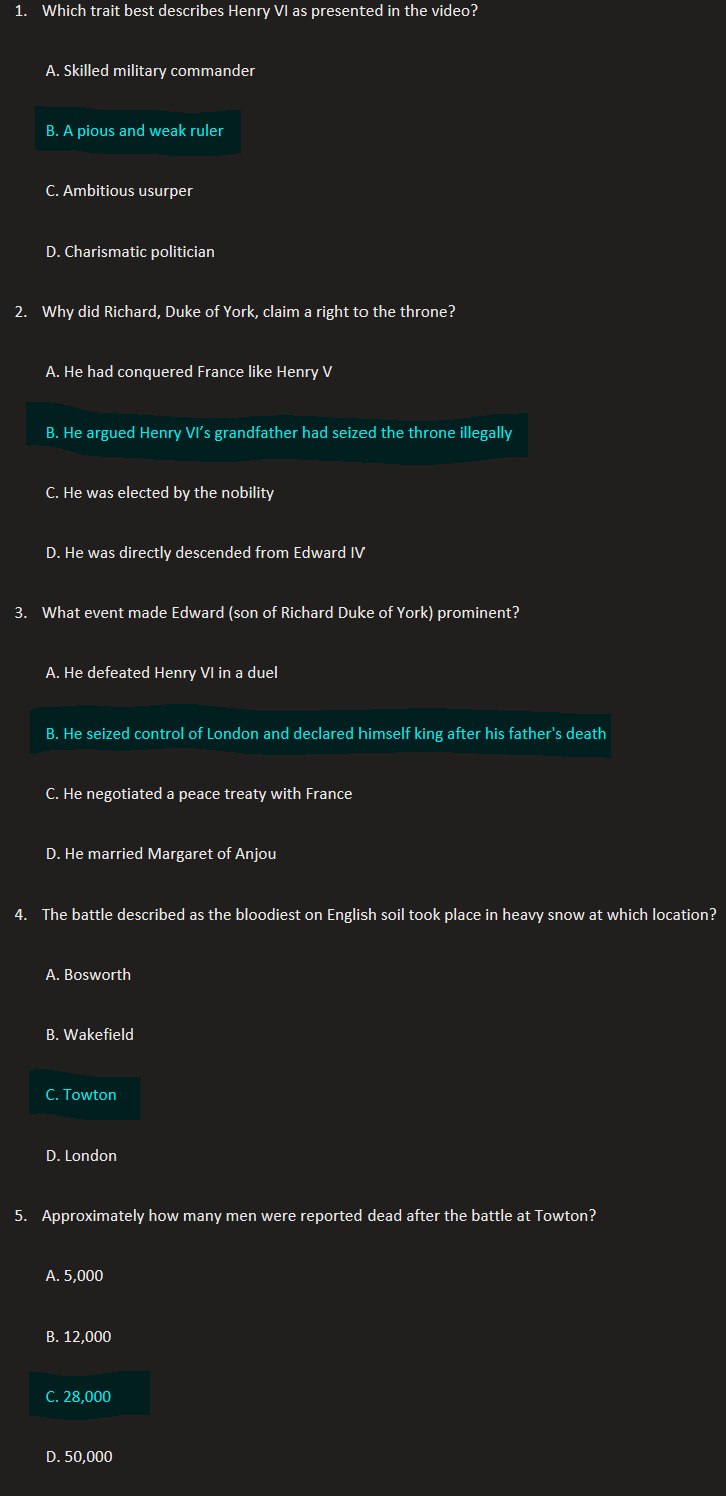
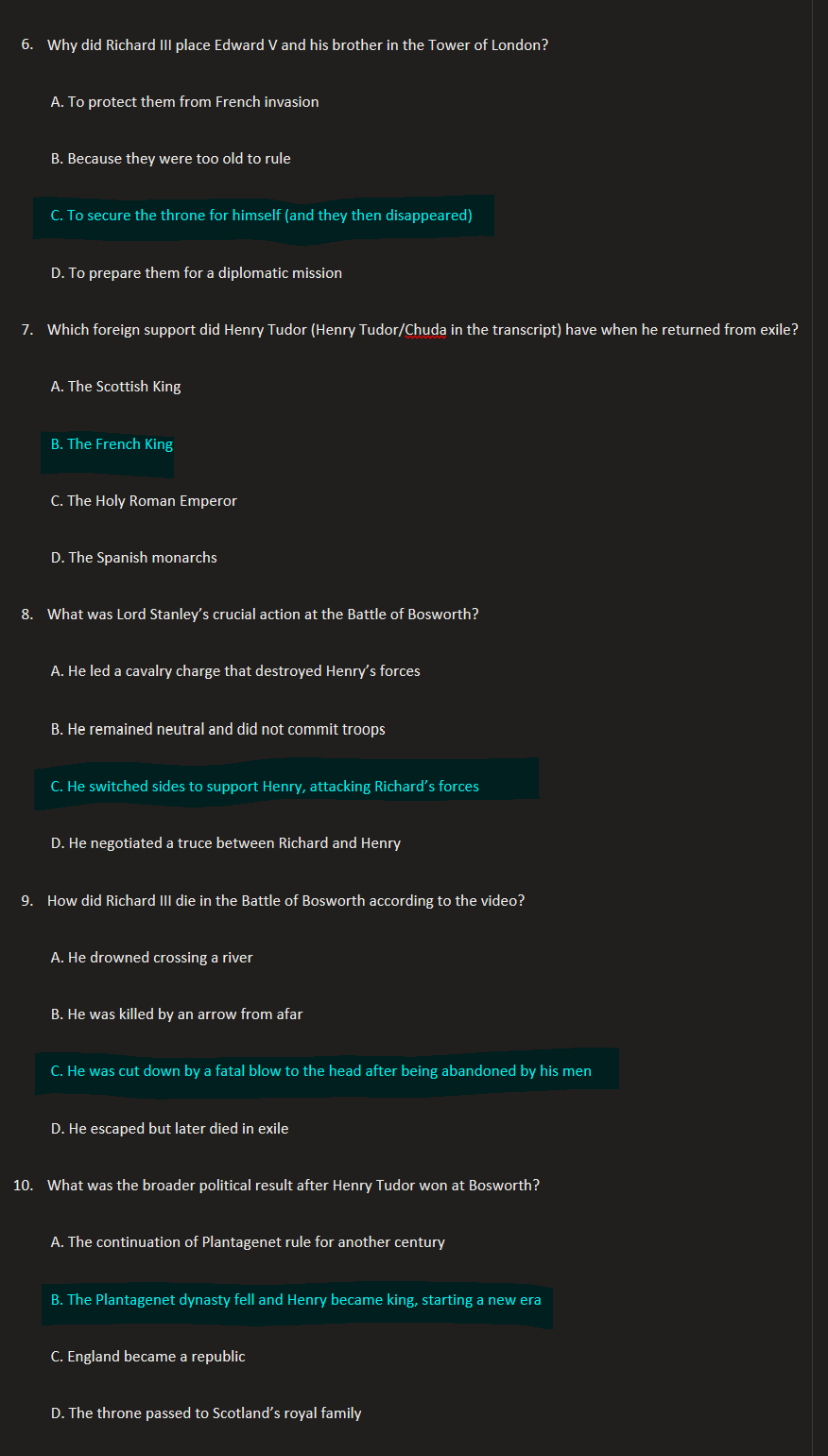
The Battle of Bosworth, 1485
Build-up, Events, and Consequences
The Battle of Bosworth Field (22 August 1485) marked the decisive end of the Wars of the Roses and the fall of Richard III, the last Yorkist king. It resulted in the accession of Henry Tudor (Henry VII) and the beginning of the Tudor dynasty.
The Build-up to the Battle
By 1485, Richard III faced growing political instability and declining support among the English nobility. His reputation had been damaged by:
His seizure of the throne from his nephew Edward V
Suspicion surrounding the disappearance of the Princes in the Tower
Rebellions such as the Buckingham Revolt (1483)
Meanwhile, Henry Tudor, a Lancastrian claimant living in exile in France, gathered support from disaffected English nobles. He secured financial and military backing from France and planned an invasion of England to challenge Richard’s rule.
Henry landed in Wales in August 1485, marching eastwards and gaining supporters along the way. Richard moved to intercept him, assembling a larger royal army but facing uncertainty over the loyalty of key nobles—most importantly Lord Stanley and Sir William Stanley, whose forces remained uncommitted at the outset of the battle.
The Events of the Battle
The battle took place near Bosworth Field in Leicestershire.
Richard III initially held the numerical advantage, but his army suffered from weak coordination and uncertain loyalty. During the fighting:
The Earl of Northumberland, commanding part of Richard’s forces, failed to engage effectively, weakening the Yorkist position.
The Stanley forces delayed committing to either side, waiting to see which faction appeared likely to win.
Richard launched a bold cavalry charge directly toward Henry Tudor in an attempt to kill him and end the battle decisively.
However, this decision left Richard isolated. At a crucial moment, Sir William Stanley intervened on Henry’s behalf, turning the tide. Richard was surrounded and killed in combat, becoming the last English king to die on the battlefield.
Immediate Consequences
Richard’s death ended Yorkist rule. His body was reportedly humiliated after death, reinforcing the perception of his defeat and political isolation.
Henry Tudor was proclaimed King Henry VII on the battlefield. His victory:
Ended the Wars of the Roses
Marked the start of the Tudor dynasty
Allowed Henry to strengthen legitimacy by marrying Elizabeth of York, uniting the rival houses
Led to the consolidation of royal authority, reducing the power of overmighty nobles
The battle became a turning point in English political history, shifting England away from dynastic civil war toward stronger central monarchy.
Key Reasons Why Richard III Lost the Throne
Lack of noble loyalty, especially from Northumberland and the Stanleys
Poor reputation and legitimacy, weakened by controversy over the princes
Tactical risk-taking, particularly Richard’s reckless final charge
Henry Tudor’s foreign support and ability to attract disaffected Yorkists
Richard’s political isolation and declining authority
TASKS
Task 1 — Chronology Check
Create a timeline showing five key events that led to the Battle of Bosworth.
the Buckingham revolt in 1483 showed how weak Richards rule was and how he was losing the support of nobles
Henry Tudor came to Wales in 1485 with French support and took Richard to battle at Bosworth
Lord Stanleys army was not committing to a side until they turned against Richard
Richard made a rush towards Henrys army and was cut down and killed
Henry was crowned king as Richards body was humiliated
Task 2 — Reflection
Explain why the Stanley family’s actions were crucial to the outcome of the battle.
(150–200 words)
the Stanley family were crucial to the outcome of the battle, as Henry had less men than Richard which meant that Richard was winning, until Stanley committed to Henrys side and his men started to attack Richard. This meant that Henry now had more men than Richard which gave him the upper hand, as he not only had French support but also noble support. This also meant that there were more men to attack Richard and cut him down when he charged at them, which lead to his death. Henry likely wouldn't have won without the extra support from Stanley and with Richard losing Stanleys support, which makes the Stanley family's actions absolutely vital in this scenario as it is what turned the tide of the battle.
Task 3 — Battle Analysis
Identify three military or political mistakes made by Richard III and explain how each contributed to his defeat.
making himself obvious to the enemy by wearing a crown and clearly marking himself, creating a target
Going into battle with the support of undecisive armies who could turn on you
Task 4 — Judgement Question
“Richard III lost the throne mainly because of his own failures.”
How far do you agree?
Write a mini-essay (300–400 words) considering:
Richard’s leadership
Noble loyalty
Henry Tudor’s strengths
Chance and battlefield decisions
Richard III’s loss of the throne in 1485 can be explained largely by his own failures, but it would be misleading to ignore the importance of noble loyalty, Henry Tudor’s strengths, and chance on the battlefield. Overall, I mostly agree that Richard’s downfall was mainly self-inflicted, though external factors played a significant supporting role.
Richard’s leadership weakened his position as king. Although he was an experienced soldier, his rule was marked by poor political judgement. His seizure of the throne in 1483, following the disappearance of the Princes in the Tower, seriously damaged his legitimacy. Many nobles suspected Richard of murder, whether justified or not, and this reputation made it difficult for him to rule with trust. Additionally, his reliance on northern supporters alienated southern nobles, reinforcing the perception that he governed for a narrow group rather than the realm as a whole.
Noble loyalty was therefore fragile. Richard struggled to secure the consistent support of powerful magnates, and several key figures wavered or betrayed him. The Stanley family is a clear example: despite being essential to Richard’s army at Bosworth, they delayed their involvement and ultimately supported Henry Tudor. This lack of loyalty was partly beyond Richard’s control, but it stemmed from his own failure to unite the nobility or inspire confidence in his kingship.
Henry Tudor’s strengths also contributed significantly to Richard’s defeat. Henry presented himself as a unifying alternative after decades of civil war, promising stability and reconciliation. His claim to the throne was weak, but his marriage plans to Elizabeth of York appealed to both Lancastrians and Yorkists. Henry also benefited from foreign support and careful planning, avoiding unnecessary risks before the battle.
Finally, chance and battlefield decisions played a crucial role. At Bosworth, Richard’s decision to launch a direct charge at Henry was bold but reckless. When the Stanleys intervened against him, Richard was left isolated and killed. While bravery was evident, this moment shows how tactical misjudgement sealed his fate.
In conclusion, Richard III mainly lost the throne because of his own failures in leadership and judgement, which undermined noble loyalty. However, Henry Tudor’s political skill and the unpredictable nature of battle were also decisive factors in his downfall.
Task 5 — Extension (Challenge)
Compare the Battle of Bosworth with another decisive battle in English history.
How did leadership and loyalty shape both outcomes?