B2.1 Membranes and Membrane Transport
Exam Overview
Theme: Form and Function
Level of Organization: Cells
Focus: Membranes and Membrane Transport
Content Levels
Combined Content: SL (Standard Level) and HL (Higher Level)
Focus: Power of Science - emphasizing how scientific principles underpin biological processes.
Guiding Questions
Lipid and Protein Assembly: How do lipid and protein molecules form biological membranes?
Substance Passage: What factors determine if a substance can pass through a biological membrane?
Sections under B2.1:
Channel proteins: Exploring their function in facilitated diffusion and how they discriminate between molecules.
Pump proteins: Their role in active transport across the membrane, using ATP to move substances against their concentration gradient.
Selectivity in membrane permeability: Understanding how specific structural characteristics dictate the passage of ions and molecules.
Structure and function of glycoproteins and glycolipids: Their crucial involvement in cell communication, recognition, and immune response.
Fluid mosaic model: A detailed examination of the dynamic nature of cell membranes, highlighting the movement and interaction of various components within the lipid bilayer.
Key Terms
Phospholipid Bilayer: The core structure of cellular membranes, consisting of hydrophilic phosphate heads and hydrophobic fatty acid tails.
Phospholipids: Molecules that form the essential dampness of the bilayer that shields the cell's interior from the external environment.
Polar, Nonpolar, Hydrophobic, Hydrophilic, Amphipathic: Important properties that dictate the behavior of molecules within the membrane.
Kinetic Theory: Understanding molecular motion and its implications for diffusion and transport processes in cell biology.
Osmosis: The specific diffusion of water across a selectively permeable membrane that is essential for biological function.
Transport types: Differentiating between simple diffusion, facilitated diffusion, and active transport based on energy requirements and concentration gradients.
Additional Key Terms
Channel Proteins: Integral membrane proteins that allow specific ions to cross the membrane.
Protein Pumps: Specialized proteins that move substances across membranes using ATP.
Aquaporins: Channel proteins specifically dedicated to the transport of water molecules, facilitating rapid movement.
Solution, Solute, Solvent: Definitions relating to the composition and behavior of substances in biological systems.
Active Transport: How cells expend energy to transport molecules against a gradient for optimal cellular function.
Fluid Mosaic Model: A concept which illustrates the complexity and dynamic nature of biological membranes, integrating diverse components for function.
Lipid Bilayers
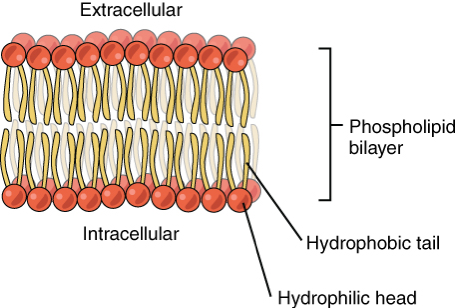
Formation: Phospholipids and amphipathic lipids spontaneously form continuous bilayers when in aqueous solutions, a fundamental aspect of cell membrane architecture.
Phospholipid Structure
Components:
Hydrophilic Phosphate Head: Attracted to water, facing outward toward the aqueous environment.
Hydrophobic Fatty Acid Tails: Repelled by water, oriented inward, creating a barrier that compartmentalizes the cell.
Amphipathic Nature: Characteristic that enables phospholipids to self-assemble into bilayers, crucial for membrane integrity and functionality.
Phospholipid Bilayers
Arrangement: In an aqueous environment, phospholipids orient themselves so that hydrophilic heads face the water while hydrophobic tails are sequestered away, leading to bilayer formation.
Membrane Composition: Notably, all cellular membranes share this phospholipid bilayer structure, forming the foundation for cellular integrity.
Drawing Phospholipids
Procedure:
Instructions on how to accurately draw a phospholipid molecule to enhance understanding of its structure and function.
Drawing Phospholipid Bilayers
Structure:
Guidelines on illustrating the orientation of phospholipids and the significance of their arrangement in biological membranes.
Lipid Bilayers as Barriers
Understanding:
Membranes exhibit low permeability to large molecules and hydrophilic particles, effectively functioning as barriers between diverse aqueous environments and critical for cellular survival.
Hydrophobic Nature of Membranes
Function:
The hydrophobic core of plasma membranes acts as a selective barrier, enabling the separation of cytoplasm from external environments, thus regulating molecular passage and maintaining homeostasis.
Simple Diffusion Example
Gas Exchange:
Examining how the movement of oxygen and carbon dioxide illustrates principles of simple diffusion across biological membranes, essential for respiratory functions.
Kinetic Theory
Principle:
An exploration into how the kinetic theory explains the motion of particles, facilitating understanding of the passive processes of diffusion and osmosis that occur within cellular systems.
Simple Diffusion Defined
Process:
Characterizing simple diffusion as a vital form of passive transport where substances move across membranes from areas of higher concentration to lower concentration without energy expenditure.
Permissible Molecules
Examples:
Identifying small, uncharged particles, such as oxygen and carbon dioxide, that can diffuse across membranes, while larger and hydrophilic molecules require specialized transport mechanisms.
Membrane Proteins and Structures
Integral Proteins: Understanding their role as embedded components within the lipid bilayer; they facilitate various functions such as transport, signaling, and enzyme activity.
Peripheral Proteins: Their attachment to the membrane surface and interaction with integral proteins supports an array of cellular functions including signaling and structural stabilization.
Characteristics of Integral Proteins
Attachment:
Integral proteins are permanently anchored in membranes; they possess both hydrophobic regions that interact with the lipid bilayer and hydrophilic regions that interface with the aqueous environments, facilitating diverse functions such as ion transport and cellular communication.
Peripheral Proteins Defined
Parameters:
Describing peripheral proteins as temporally attached components that do not penetrate the bilayer; they play critical roles in cellular signaling pathways or as parts of the cytoskeleton.
Drawing Protein Types
Illustration:
Guidance on how to accurately depict the structure and arrangement of peripheral and integral proteins within biological membranes, enhancing visual understanding.
Osmosis Explained
Concept:
Exploring how osmosis is governed by solute concentration gradients and the necessity of aquaporins for facilitating efficient water transport across cellular membranes.
Defining Osmosis
Osmosis:
Further clarification of osmosis as the passive transport of water through a semipermeable membrane, with movement directed from regions of lower solute concentration to areas of higher solute concentration, which is fundamental for maintaining osmotic balance.
Low solute concentration refers to a solution that contains a relatively small amount of solute particles compared to the amount of solvent (usually water). It signifies that there are fewer dissolved substances in the solution, leading to a higher concentration of solvent.
High solute concentration, on the other hand, describes a solution that contains a large number of solute particles compared to the solvent. It indicates a higher proportion of dissolved substances, resulting in a lower concentration of solvent.
Water Movement Characteristics
Molecule Requirements:
Acknowledging how water's ability to traverse bilayers, despite the large size of charged solutes, is restricted without appropriate channel proteins.
Aquaporins Role
Function:
Illustrating how aquaporins serve as integral proteins that facilitate rapid water movement across membranes, a critical process for maintaining cellular hydration and homeostasis.
Integral Channel Proteins vs. Aquaporins
Integral Channel Proteins:
These are integral membrane proteins that allow specific ions and molecules to cross the membrane.
They function in facilitated diffusion, enabling ions to selectively pass through membranes based on size and charge.
Integral channels can be gated, opening or closing in response to various signals, which helps regulate the flow of substances based on cellular needs.
Examples include sodium ions, potassium ions, and calcium ions channels.
Aquaporins:
Aquaporins are a specific type of integral channel protein dedicated solely to the transport of water molecules.
They facilitate rapid water movement across cell membranes, which is critical for maintaining cellular hydration and homeostasis.
Unlike general channel proteins, aquaporins are selective for water, allowing it to pass through while preventing the flow of ions or other molecules.
They are essential in various physiological processes, including urine concentration and the movement of water in plant roots.
Channel Proteins for Selective Permeability
Mechanism:
Analyzing how channel proteins enable the selective diffusion of specific ions and how their gating mechanisms respond to changes in environmental conditions.
Facilitated Diffusion Role
Definition:
Detail on facilitated diffusion, which refers to the passive transport of molecules through specific channel proteins across cell membranes, a vital process that does not require energy and is crucial for maintaining cellular function.
Structure of Channel Proteins
Design:
Describing channel proteins as having a central pore lined with hydrophilic R groups that allow for the passage of specific particles; adaptability through gating mechanisms plays a significant role in cellular dynamics.
Drawing Channel Proteins
Representation:
Instructions on how to accurately represent channel proteins as transmembrane proteins with a central pore, crucial for highlighting their role in transport mechanisms.
Active Transport Mechanism
Overview:
Providing an in-depth exploration of active transport, emphasizing how cells utilize ATP to move ions and molecules against their concentration gradients, facilitating essential physiological processes.
Role of ATP in Active Transport
Adenosine triphosphate (ATP) serves as the primary energy currency in cells, enabling the phosphorylation of transport proteins that actively transport substances across the membrane. This process is crucial for maintaining cellular homeostasis, allowing cells to regulate ion concentrations and remove waste products efficiently. In addition to ions, active transport also plays a significant role in the uptake of nutrients, such as glucose and amino acids, ensuring that cells have the necessary building blocks for metabolism and growth.
Energy Provision:
Clarifying the mechanism by which ATP provides the energy necessary to alter protein conformation, allowing for the efficient transfer of particles across membranes.
Active Transport Steps
Sequence:
A systematic breakdown of the steps involved in active transport: the binding of the specific particle to the pump, ATP hydrolysis to ADP leading to a shape change, movement of the particle, and restoration of the pump's original configuration post-release.
Movement of particles from low concentration to high concentration - opposite so more enegry is needed.
Active Transport Process
Methodology:
Analyzing the intricate interactions that take place between protein pumps and translocated particles, underscoring the energy-intensive and directionally specific nature of this transport method.
Passive Transport vs. Active Transport
Passive Transport
Definition: The movement of molecules across cell membranes without the expenditure of energy.
Types: Includes simple diffusion, facilitated diffusion, and osmosis.
Mechanism: Molecules move from areas of higher concentration to areas of lower concentration (down the concentration gradient).
Energy Requirement: Does not require ATP.
Examples:
Simple Diffusion: Movement of small, uncharged particles like oxygen and carbon dioxide.
Facilitated Diffusion: Uses specific channel proteins for larger or charged molecules.
Osmosis: The diffusion of water across a selectively permeable membrane.
Active Transport
Definition: The movement of molecules across cell membranes against their concentration gradient, which requires energy.
Mechanism: Molecules move from areas of lower concentration to areas of higher concentration (against the concentration gradient).
Energy Requirement: Requires ATP to function.
Examples:
Protein Pumps: Such as sodium-potassium pumps that move sodium out of cells and potassium into cells.
Endocytosis & Exocytosis: Mechanisms for transporting large particles into and out of cells.
Key Differences
Direction of Movement: Passive transport moves with the gradient, while active transport moves against it.
Energy Use: Passive transport requires no energy, while active transport requires energy (ATP).
Membrane Selectivity Dynamics
Characteristics:
Highlighting how both active and facilitated transport processes contribute to membrane selectivity, thereby enabling cells to maintain internal environments distinct from external conditions.
Key Differences in Transport
Comparative Overview:
Distinguishing between the modalities of passive transport (simple and facilitated diffusion) and active transport, focusing on energy requirements, movement direction, and selectivity to illustrate the complexities of membrane dynamics.
Glycoproteins and Glycolipids Overview
Structure and Functions:
Detailing the structural intricacies of glycoproteins and glycolipids, which are integral to membrane functions like hormone reception, cell adhesion, recognition, and communication, reflecting their biological significance.
Glycoproteins Overview
Structure and Functions: Glycoproteins are integral to membrane functions such as hormone reception, cell adhesion, recognition, and communication, reflecting their biological significance.
Cell Adhesion Functions: Glycoproteins act as adhesion molecules, forming extracellular matrices that provide structural stability and facilitate tissue formation and integrity.
Recognition of Cells: Specific carbohydrate shapes linked to glycoproteins play a crucial role in distinguishing between self and non-self cells, contributing to immune recognition and cellular interactions.
Glycolipids Overview
Structure and Functions: Glycolipids are essential components of cell membranes that contribute to cell recognition and communication.
Cell Adhesion Functions: Similar to glycoproteins, glycolipids help in forming extracellular matrices that provide structural stability and facilitate tissue formation and integrity.
Role of Carbohydrates: The carbohydrate portions of glycolipids are involved in distinguishing between self and non-self cells, which plays a significant role in immune recognition and cellular interactions.
Cell Adhesion Functions
Mechanisms:
Exploring how glycoproteins act as adhesion molecules, forming extracellular matrices that provide structural stability and facilitate tissue formation and integrity.
Recognition of Cells
Role of Carbohydrates:
Discussing how specific carbohydrate shapes linked to glycoproteins and glycolipids play a pivotal role in distinguishing between self and non-self cells, contributing to immune recognition and cellular interactions.
Fluid Mosaic Model Basics
Representation:
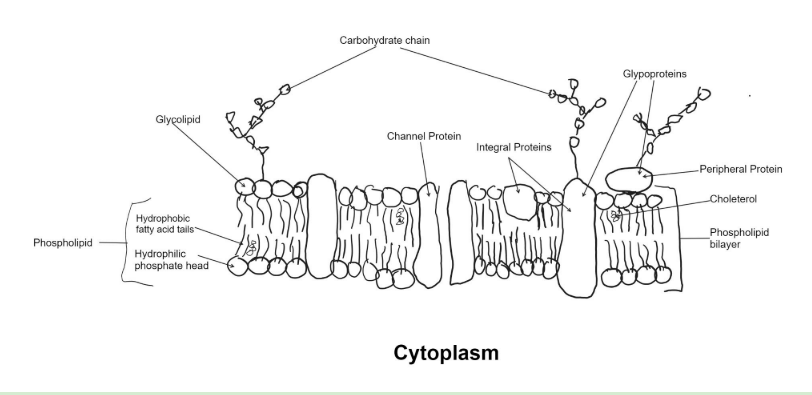
Describing the components of the fluid mosaic model, including the arrangement of peripheral and integral proteins, glycoproteins, and cholesterol, and their implications for membrane functionality and fluidity.
Components are floating around
Part of phospholipid is polar and the other non polar, which contributes to the amphipathic nature of the membrane, allowing it to maintain a barrier between the internal and external environments while facilitating selective permeability.
This selective permeability is crucial for regulating the movement of ions and molecules, ensuring that essential nutrients enter the cell while waste products are expelled.
Cholesterol - sits between the tail of the phospolipids, is important in the cell membrane, connect phospholipds by stabilizing the membrane structure and influencing its fluidity, allowing it to remain flexible under varying temperatures. Additionally, membrane proteins play a vital role in transport processes, acting as channels or carriers that enable specific substances to cross the membrane more efficiently.
Cholesterol in Membranes
Function:
Understanding the role of cholesterol in modulating membrane fluidity, helping to stabilize membrane structure at varying temperatures and maintaining the integrity of cellular functions.
Endocytosis and Exocytosis
Processes:
Elaborating on endocytosis as a mechanism through which large particles enter cells via membrane wrapping, and exocytosis as the process through which large particles are expelled from cells through vesicles, both pivotal for cellular transport.
Gated Ion Channels in Neurons
Mechanisms:
Discussing the role of integral proteins in neuron function, particularly how gated ion channels facilitate selective ion passage necessary for nerve impulse transmission, integrating signaling and electrical activity.
Functionality of Voltage Gated Channels
Operation:
A deeper look into how voltage-gated channels operate, highlighting their responsiveness to changes in membrane potential and their essential role in generating and propagating action potentials in neurons.
Importance of Sodium-Potassium Pumps
Functionality:
Analyzing the critical role of sodium-potassium pumps in actively transporting sodium out of cells while bringing potassium in, essential for maintaining the resting membrane potential and overall cellular homeostasis.
Sodium-Potassium Pump Steps
Process Breakdown:
Providing a detailed account of the steps involved in sodium-potassium pump function: the sequential attachment and release of sodium and potassium ions, the involvement of ATP, and the resulting conformation changes in the pump protein.
Glucose Transport Mechanisms
Methods:
Investigating methods such as facilitated diffusion and sodium-dependent cotransporters working in synergy for efficient glucose absorption in cells, emphasizing their roles in metabolic processes.
Epithelial Glucose Transport Dynamics
Interaction:
Examining how sodium ions facilitate glucose movement against its concentration gradient, representing a core mechanism of glucose transport in intestinal absorption.
Cell Adhesion in Tissues
Functionality:
Emphasizing the importance of cell adhesion molecules (CAMs) in maintaining cellular integrity and communication, showcasing their roles in signaling pathways and tissue organization.
Overview of Cell Junctions
Types of Junctions:
Tight Junctions: Prevent leakage and maintain cell polarity.
Gap Junctions: Allow for the passage of small molecules and electrical signals for intercellular communication.
Adherens Junctions: Connect cells, providing structural integrity and anchoring the cytoskeleton.
Desmosomes: Strengthen connections between cells to prevent separation under mechanical stress, crucial for tissue integrity.