B55-week1
“What the brain does, the mind is.”
How does one study the brain/mind? There are a few approaches:
Introspection: The study of one’s own mental thoughts and processes. (making educated, thoughtful inferences of what occurs when you’re thinking.)
This method is founded via Structuralism: Breaking down complex stuff to simpler parts, for better understanding.
Behaviorism: The mind is unobservable and cannot be scientifically inquired.
This notion dominated the 1910s-50s, the “dark ages” of psychology as no other view was as widely accepted.
Cognitivism: Rejected the notion that only behavior should be studied.
This time also marked the beginning of a shift towards the cognitive revolution, which emphasized the study of internal mental processes and challenged behaviorist assumptions.
Around this time period, complex models of cognition were being developed: serial and parallel distributed processing (1986).
Serial Processing

Parallel Distributed Processing

But, you can’t use a process, to study that process.
So, a separation of brain and mind may be required.
The earliest records of scientific study of the brain was from ancient Egypt, where medical treatments for traumatic injury to the brain was recorded. The treatment, albeit crude, brought about the concept of localization of function (LoF).
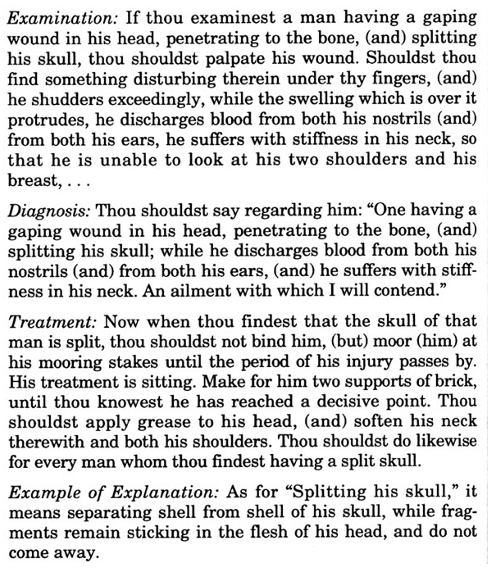
Ultimately, the brain was removed as the heart was determined to be the seat of intelligence AKA the cardiac hypothesis
Galen put forth the “Brain hypothesis”, arguing the brain was the center of sensation and cognition.
Rene Descartes founded Rationalism: “Thoughtful reflection of how things are thought to work”.
The brain is physically present, but how to study the mind?
Descartes identified the mind to be separate from the brain, and put forth the idea of
Dualism: The mind and brain are too different to be the same
Around this time, the theory of monism was also present.
Monism: Mind comes from brain.
Descartes attempted to support dualism and mind-body interaction by saying that the brain talks to mind via the pineal gland. His reasoning was that there was only 1 pineal gland in the brain where structures were present bilaterally, so, this structure must be important.
There was another idea to support the connection between mind and body, by Angelo Mosso
Mosso identified (using a homemade, ‘beta’ version of a blood pressure monitor) that changes in aspects of the environment (sight, sound etc.) could lead to changes in the amount of blood flow to certain regions of the brain. This suggested that mental states could influence physiological changes, providing a physiological basis for the interaction between mind and body. This early experiment also helped create the fMRI!
Scientists turned to further investigation of the brain, particularly exploring how the brain was “organized”.
It was noted that neurodevelopment began from the bottom, and progressed to finish at the top, or outer layers.
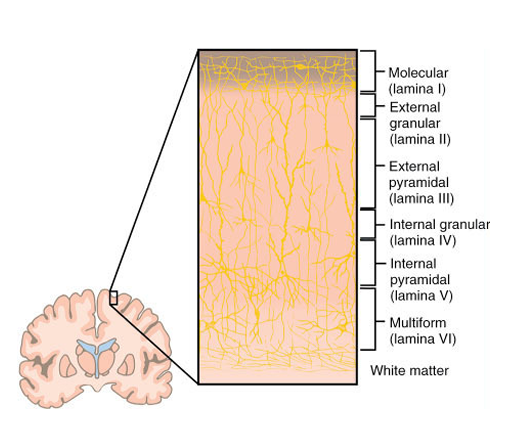
More broadly, two more theories about the organization of the brain developed:
Aggregate field theory: The brain operates as a whole, where every region and part of the brain participates in every mental process and functioning.
Localization of function (LoF): Specific regions/parts of the brain are more involved in particular cognitive functions.
From LoF developed Phrenology: a pseudoscience suggesting the location and height of “bumps” across the skull could determine personality traits and mental abilities.
Due to its inconsistencies, it motivated the scientific community to critically assess and challenge the validity of phrenology (crap science motivates good science, i.e. ragebait works!)
Around this time, Korbinian Brodmann was part of a growing neuroanatomy movement, inspired by Carl Wernicke and Paul Broca.
Based on cytoarchitecture, Brodmann mapped out 52 regions of the brain, where each region’s neuron arrangements differed from other numbered regions.
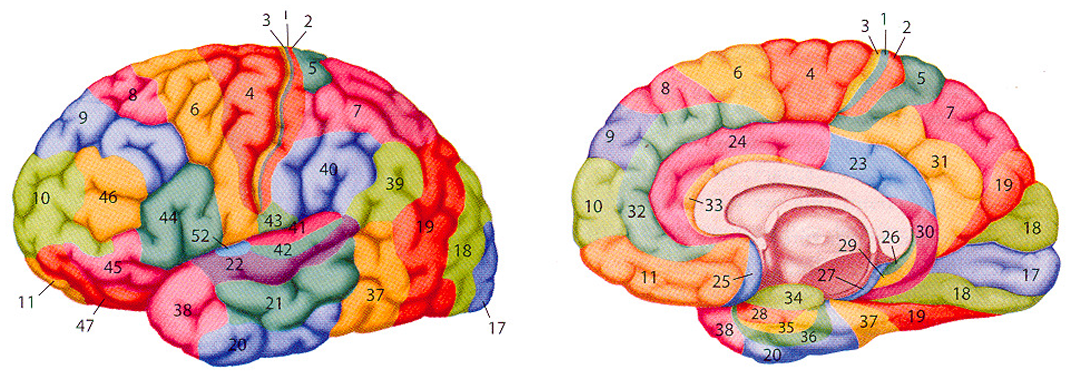
Paul Broca and Carl Wernicke further strengthened the LoF theory.
Broca: Studied patients with damage to the inferior frontal gyrus of the left frontal lobe. Damage here caused speech production difficulties, known as Broca's aphasia. Comprehension of speech is intact.
Wernicke: Studied patients with damage to the superior temporal gyrus in the temporal lobe. Damage here caused impaired comprehension capability, known as Wernicke’s aphasia. Normal, fluent speech output remains intact.
What was learnt about cognition?
Usage and Utility
Cognitive resources are limited
Cognition is important for good functioning.
Variability
Within-subject: differences within one person (for eg: I perform at math than at physics)
Between-subject: Differences between two persons (for eg: I perform better at math than physics, and my friend does better at physics than at math)
Flexibility
Cognitive abilities can change (can get better or worse) with development/dysfunction (or damage).
Most cognitive abilities may be malleable to some degree.
Sources: Lecture recording, Lecture slides
NOTE: This week’s notes is not fully complete, please cross-check with the slides and the lecture recording