Motivation
- “Movere”: both “emotion” and “motivation” are derivations of this Latin word (to move)
Motivation
- The forces within a person that affect the direction, intensity, and persistence of effort extended at work, and the external factors that encourage action
- Direction: an individual’s choice when presented with a number of possible alternatives (e.g., whether to pursue quality, quantity, or both in one’s work)
- Intensity: refers to the amount of effort a person puts forth (e.g., to put forth a lot or very little)
- Persistence: refers to the length of time a person sticks with a given action (e.g., to keep trying or to give up when something proves difficult to attain)
Categories of Motivation Theories
- Content Theories
- Focus on ^^individual needs^^ -- that is, physiological or psychological deficiencies that we feel a compulsion to reduce or eliminate
- Includes Maslow’s hierarchy of needs, Alderfer’s ERG Theory, McClelland’s acquired needs theory, the four-drive theory, and Herzberg’s two-factor theory
- Process Theories
- Focus on the ^^thoughts, or cognitive processes^^, that take place within the minds of people and that motivate their behavior
- Include equity theory, expectancy theory, and goal-setting theory
Intrinsic and Extrinsic Rewards
- Intrinsic Rewards: are valued outcomes ^^received directly through task performance^^ and do not require the participation of another person or source (e.g., a feeling of achievement after completing a challenging task)
- Extrinsic Rewards: are valued outcomes ^^given by some other person or source^^ (e.g., sincere praise for a job well done, symbolic tokens of accomplishment, pay and benefits)
- Self-Determination Theory (SDT): a theory of motivation that is concerned with the beneficial effects of intrinsic motivation to the harmful effects of extrinsic motivation
- Cognitive Evaluation Theory
- A version of SDT that holds that allocating extrinsic rewards for behavior that had been previously intrinsically rewarding tends to decrease the overall level of motivation ^^if the rewards are seen as controlling^^
- When people are paid for work, it feels like something they ^^want^^ to do and more like something they ^^have^^ to do
- A recent meta-analysis confirms that intrinsic motivation contributes to the quality of work, while incentives contribute to the quantity of work (e.g., if a computer programmer values writing code because she likes to solve problems, a bonus for writing a certain number of lines of code everyday could feel coercive and her intrinsic motivation would suffer
- Premack Principle
- The idea that reinforcement is relative both within an individual and between individuals
- States that a high-probability behavior can be used to reinforce a low-probability behavior
- Remember Grandma’s Rule: ^^work before play^^
- Reinforcement Hierarchy: a rank-ordered list of reinforcers for an individual
Needs Theories of Motivation
- Managers should be able to understand their employees’ individual needs and to create work environments that respond positively to these needs.
- Employee Drives and Needs
- Drives/Primary Needs/Innate Motives
- ^^Hardwired characteristics of the brain^^ that correct deficiencies or maintain an internal equilibrium by producing emotions to energize individuals (e.g., drives for social interaction, understanding the environment, competence or status, and defense of oneself against physiological or psychological harm
- Needs
- ^^Motivational forces of emotions^^ channeled toward particular goals to ^^correct deficiencies or imbalances^^
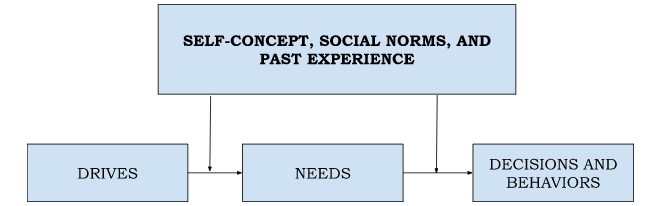
The Four-Drive Theory
- Developed by Harvard Business School professors ^^Paul Lawrence and Nitin Nohria^^, the four-drive theory recognizes the fact that human beings have several hardwired drives
- Drive to Acquire
- The drive to seek, take, control, and retain objects and personal experiences
- Includes ^^relative status and recognition in society^^
- Foundation of competition
- Insatiable -- to achieve higher position than others
- Drive to Bond
- The drive to ^^form social relationships^^ and ^^develop mutual caring commitments^^
- Forming ^^social identities^^ by aligning with social groups
- Lack of social contact prone to serious health problems
- Cooperation is ^^fundamental to organization’s success^^
- Drive to Learn
- The drive to ^^satisfy our curiosity^^, to know and understand ourselves and the environment
- Studies revealed that people who are removed from any new information will crave even boring information
- Related to the higher-order needs of growth and self-actualization
- Drive to Defend
- The drive to ^^protect ourselves physically and socially^^
- Probably first to develop, creates ^^“fight or flight” response^^ in the face of personal danger
- Including protecting our relationships, our acquisitions, and our belief system
- Features
- The four drives are ^^innate and universal^^ -- they are found in all human beings
- Independent of each other: no hierarchy or drive , so no one drive is neither dependent on nor inherently superior or inferior to another drive
- ^^Complete set^^ - there are no fundamental drives excluded from the model
- The three drives (to acquire, to bond, to learn) are ^^proactive^^ -- we regularly try to fulfil them. The drive to defend is ^^reactive^^ -- it is triggered by a threat
- Evaluating the Theory
- (+): Based on a deep foundation of research, drives were identified from ^^psychological and anthropological studies on emotions and neural processes^^
- (-): Far from complete -- there could be other drives
- Implications of the Theory
- Ensure that individual jobs and workplaces provide a balanced opportunity to fulfil the drives to acquire, bond, learn, and defend
- Fulfilment of the drives must be kept in balance (not too much, not too little) because the four drives counterbalance each other
Maslow’s Hierarchy of Needs
- The most widely known theory of motivation, developed by psychologist ^^Abraham Maslow^^
- Identifies 5 levels of individual needs
- Lowest unmet needs has the strongest effect
- When lower need is satisfied, next higher need becomes the primary motivator
- The ^^bottom 4 groups are deficiency needs^^ because they become activated when unfulfilled
- Self actualization is a ^^growth need^^ because it continues to develop even when fulfilled
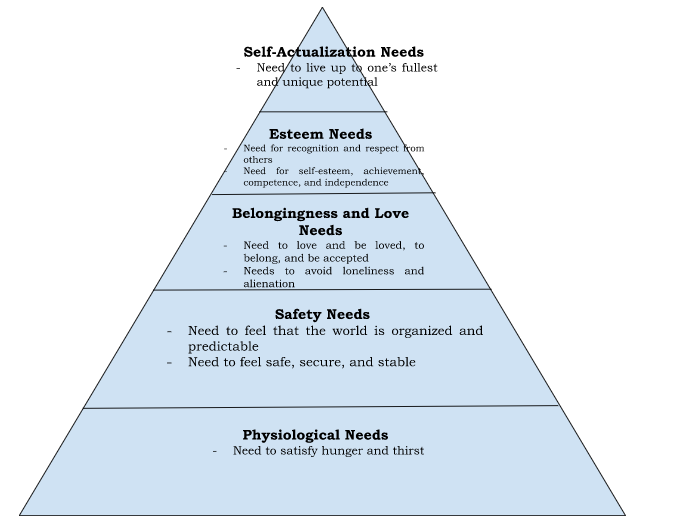
- Physiological Needs: e.g., jobs that pay the bill
- Safety Needs: e.g., work safety, job security
- Belongingness and Love Needs: e.g., working with others, developing friendships, feeling needed
- Esteem Needs: e.g., praise, awards, promotions, salary increases, publicity, etc.
- Self-Actualization Needs: e.g., “being all one can be”; new challenges, task variety
- Positive:
- More holistic: integrative view of needs and drives
- More humanistic: influence of personal and social dynamics; not just instincts; motivation is shaped by human thoughts
- Most positivistic: paid attention to strengths, not just deficiencies
- Negative:
- Lack of empirical support for theory
- People have different hierarchies: don’t progress through needs in the same order
- Needs change more rapidly than Maslow stated
- Wrongly assumed that everyone has the same needs hierarchy (i.e., universal). Instead, it is likely that each person has a unique needs hierarchy (shaped by their self-concept)
Alderfer’s ERG Theory of Motivation
- ^^Clayton’s Alderfer’s ERG Theory^^ is also based on needs but collapses Maslow’s 5 needs into 3:
- Existence Needs: ^^desires for physiological and material well-being^^
- Relatedness Needs: ^^desires for satisfying interpersonal relationships^^
- Growth Needs: ^^desires for continued personal growth and development^^
- Frustration-Regression Component: an already satisfied lower-level need can become activated when a higher-level need cannot be satisfied
- Contends that more than one need may be activated at the same time
- (+/-): with some encouraging supporting evidence
- (+): allowance for regression to lower-level needs is valuable
- (+): more flexible
McGregor’s Theory X and Y
- ^^Douglas McGregor^^ differentiated 2 ways of thinking about the motivation of people, ^^Theory X (negative) and Theory Y (positive)^^. He suggests that ^^Theory Y^^ should be the ^^basis of any successful management system.^^
- Theory X (Negative): Managers believe employees inherently dislike work and must therefore be directed or even coerced into performing it.
- Theory Y (Positive): Managers assume employees can view work as being as natural as rest or play, and therefore the average person can learn to accept, and even seek, responsibility
Herzberg’s Two-Factor Theory
- One of the most influential names in business management, American psychologist ^^Frederick Herzberg^^, started the approach to motivation by asking workers to ^^report times they felt exceptionally good about their jobs and the times they felt exceptionally bad about them.^^
- Herzberg explained the results using the 2-factor, aka ^^motivation-hygiene theory^^, because this theory identifies 2 different factors as primary causes of job satisfaction and job dissatisfaction
- Hygiene Factors: Factors that, when adequate, ^^placate (appease)^^ workers
- Motivator Factors: Factors that, when adequate, motivate workers
- Job dissatisfaction results when hygiene factors are poor; improving the hygiene factors only decreases job dissatisfaction
- Presence or absence of motivators is the key link to satisfaction
- To improve job satisfaction, Herzberg suggests, ^^“If you want people to do a good job, give them a good job to do .”^^
| HYGIENE | MOTIVATOR |
|---|---|
| policies | achievements |
| salary | recognition |
| supervision | Meaningful work |
| Work conditions | responsibility |
| relationships | advancement |
| status | growth |
- (+): Influential theory, with few managers unfamiliar with its recommendations
- (-): Questionable Methodology: relied on self-reports that may be biased
- (-): Relied on raters to make interpretations who may have contaminated the findings
- (-): Assumed a relationship between satisfaction and productivity, be he looked only at satisfaction
McClelland’s Acquired Needs Theory
- In the 1940s, psychologist ^^David I. McClelland^^ and his co-workers began experimenting with the ^^Thematic Apperception Test (TAT)^^ as a way of measuring human needs. McClelland identified themes in the TAT stories that he believed correspond to needs that are acquired over time as a result of life experiences
- Premise: We project our unconscious needs through pictures
- Need for Achievement (nAch)
- A need in which people want to ^^accomplish reasonably challenging goals and desire unambiguous feedback and recognition for their success^^
- Success entrepreneur tend to have a high nAch, possibly because they establish challenging goals for themselves that thrive on competition
- Need for Affiliation (nAff)
- A need in which ^^people seek approval from others^^, conform to their wishes and expectations, and avoid conflict and confrontation
- High nAff generally work well in ^^coordinating roles to mediate conflicts^^ and in sales positions where the main task is cultivating ^^long relations^^. The ^^best managers^^ are ^^low^^ in their ^^need for affiliation.^^
- Need for Power (nPow)
- A need in which people want to control their environment, including people and material resources, to benefit themselves (^^personalized power^^) or others (^^socialized power^^)
- Effective leaders should have a high need for socialized power rather than personalized power.
- (+): McClelland’s research supported this theory that needs can be learned (strengthened or weakened)
- In the achievement motivation training program he developed, trainees write achievement-oriented stories and practice achievement-oriented behaviors in business games
- Participants attending a need-for-achievement course in India subsequently started more new businesses, had greater community involvement, invested more in expanding their business, and employed twice as many people as nonparticipants did.
- These programs attempted to alter the individual’s self-concept or experiences such that they amplify or suppress related drive-generated emotions.
Consistency Theory of Motivation
- Managers should help employees feel good about themselves so that they will be motivated to perform better at work
Korman’s Consistency Theory
- ^^Abraham K. Korman^^ theorized that employees high in self-esteem are more motivated to perform and will perform better than employees low in self-esteem.
- Self-Esteem: the extent to which a person views himself as valuable and worthy. Research has shown that employees with high self-esteem are motivated, perform better, and rate their performance as being higher than employees with low self-esteem.
- 3 Types of Self-Esteem
- Chronic Self-Esteem: The positive or negative way in which a person views himself or herself ^^as a whole^^
- Situational Self-Esteem/Self-Efficacy: The positive or negative way in which a person views himself ^^in a particular situation^^
- Socially Influenced Self-Esteem: The positive or negative way in which a person views himself/herself based on the ^^expectations of others^^
- Self-Esteem Workshop
- Participants are given insights into their strengths, discover their positive traits through positive thinking, and share these positive traits with others
- Outdoor activities can laos be done, such as ropes course, where participants learn that they are emotionally and physically strong enough to be successful and meet challenges
- A meta-analysis results indicate that such programs increase both self-esteem and self-efficacy
- Experience With Success: ^^an employee is given a task so easy that she will certainly succeed^^
- Self-Fulfilling Prophecy: People behave in ways consistent with their self-image. An individual will perform poorly as well as he expects to perform.
- Galatea Effect: When self-expectations result in higher levels of performance
- Supervisor Behavior: ^^Train supervisors to communicate a feeling of confidence in an employee.^^ If an employee feels that a manager has confidence in him, his self-esteem will increase, as will his performance
- Pygmalion Effect: if people believe that something is true, they will act in a manner consistent with that belief.
- Golem Effect: When negative expectations of an individual cause in that individual’s performance.
Expectancy Theory of Motivation
- Managers should always try to intervene actively in work situations to meet employees’ expectations of success
Vroom’s Expectancy Theory
- Yale School of Management professor ^^Victor H. Vroom^^ posits that motivation is a result of a rational calculation -- people will do what they can do when they want to do it. Most of the evidence supports the theory.
- This theory says that ^^the strength of a tendency to act in a certain way depends on the strength of an expectation that the act will be followed by a given outcome and on the attractiveness of that outcome to the individual.^^
- Expectancy is the probability assigned by an individual that work effort ^^will be followed by a given level of achieved task performance^^
- Expectancy would equal to zero if the person felt it were impossible to achieve the given performance level; it would be equal to one if a person were 100% certain that the performance could be achieved.
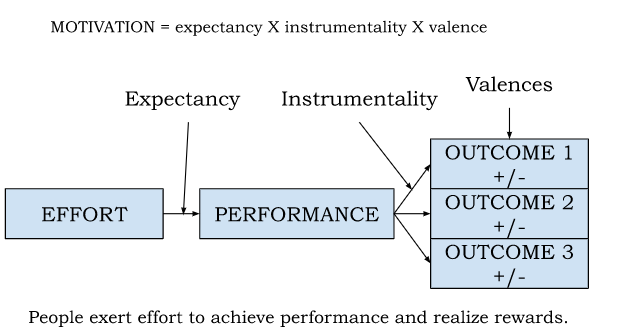
- Instrumentality is the probability assigned by an individual that a given ^^level of achieved task performance will lead to various work outcomes.^^
- Can also vary from 0 to 1
- Valence is the ^^value^^ (i.e., satisfied/dissatisfied) ^^attached by an individual to various work outcomes^^
- ^^Valences form a scale from -1 (very undesirable outcome) to +1 (very desirable outcome)^^
- Practical Applications: Expectancies
- Objectives: to increase the belief that employees are capable of performing the job successfully
- ^^Select people with required skills and knowledge^^
- Provide required ^^training and clarify job requirements^^
- Provide sufficient time and resources
- ^^Assign simpler or fewer tasks until employees can master them^^
- Provide examples of similar employees who have successfully performed the task
- ^^Provide coaching to employees who lack self-confidence^^
- Practical Applications: Instrumentalities
- Objective: to increase the belief that good performance will result in certain valued outcomes
- ^^Measure job performance accurately^^
- Clearly explain the outcomes that will result from successful performance
- ^^Describe how the employee’s rewards were based on past performance^^
- Provide examples of other employees whose good performance has resulted in higher rewards
- Practical Applications: Valences
- Objective: to increase the expected value of outcomes resulting from desired performance
- Distribute rewards that employee value
- ^^Individualize rewards^^
- Minimize the presence of countervalent outcomes (e.g., peer pressure not to perform well)
- (+): Empirical studies published in the JAP during the 1950s through the early 1970 were generally supportive of expectancy models
- (-): Decision making is not necessarily rational
Goal-Setting Theory of Motivation
- Managers should be able to channel the energies of their people towards the attainment of well-stretched goals
Goal-Setting Theory
- Goal setting is ^^a theory that says that specific and difficult goals, with feedback, lead to higher performance^^. The theory was proposed by ^^Locke and Latham (1990)^^.
- Potentially improves employee performance in 2 ways
- By amplifying the intensity and persistence of effort
- By giving employees clearer role perceptions so that their effort is channeled toward behaviors that will improve work performance
- Specific, Difficult, and Feedback
- Specific: specific goals increase performance (e.g., “To sell 6 computers a day” is more motivational than “do your best.”
- Difficult: Difficult goals, ^^when accepted^^, result in higher performance than do easy goals. Once a hard task has been accepted, we can expect the employee to exert a high level of effort to try to achieve it.
- Feedback: Feedback leads to higher performance than does non feedback. It guides behavior by helping employees identify discrepancies between what they have done and what they want to do next.
- Management by Objectives (MBO)
- ^^A program that encompasses specific goals, participatively set, for an explicit time period, with feedback on goal progress^^
- Emphasizes participatively set goals that are tangible, verifiable, and measurable
- Balanced Scorecard (BSC)
- ^^Goal-setting^^ and reward system that translates the organization’s vision and ^^mission into specific^^, measurable performance goals related to financial, customer, ^^internal, and learning or growth^^ (i.e., human capital process)
- Strength-Based Coaching
- ^^A positive organizational behavior approach to coaching and feedback that focuses on building and leveraging the employee’s strengths^^ rather than trying to correct his/her weaknesses
- The employee describes areas of work where he/she excels
- The coach guides this discussion by asking exploratory questions and by helping the employee to discover ways of leveraging his/her strengths
Meanings of Money
- A Form of Exchange: employees provide their labors, sills, and knowledge in return for money from the organization
- “Pay”: In Malaysian and Slovak means “to replace a loss”; “making equal” in Hebrew and Swedish
- A symbol of ^^achievement and status^^
- A ^^reinforcer and motivator^^
- A source of ^^enhanced and reduced anxiety; security^^
- Only ^^food and sex are its close competitors^^
- A source of ^^evil^^
- Considered ^^taboo^^ in many social settings
- A “tool”: an instrument for acquiring other things of value
- A “drug”: money is an object of addictive value in itself
- Generates a Variety of Emotions: anxiety, depression, anger, and helplessness
- Strong “money ethic”: when seen as not evil but must be budgeted carefully
- A symbol of power and status for men: a large scale study in 43 studies revealed that men attaches more importance or value to money than women
- Highly prioritized in high power distance cultures (such as China and Japan)
- Discouraged as topic in strong egalitarian cultures (such as Denmark, Austria, and Israel)
- Swiss culture values ^^saving^^ money more, while Italian culture values ^^spending^^ it
- Money is not just a means of exchange between employer and employee. ^^It fulfills a variety of needs, influences emotions, and shapes or represents a person’s self-concept.^^
Equity Theory of Motivation
- Managers should be able to ensure that the distribution of resources are fair and are perceived as fair.
- Based on the writings of workplace and behavioral psychologist ^^John Stacey Adams^^, the equity theory argues that ^^people will act to eliminate any felt inequity in the rewards received for their work in comparison with others^^
- What is fair?
- Equality Principle: Everyone in the group should receive the same outcomes
- Need Principle: Those with the greatest need should receive more outcome than others with less need
- Equity Principle: People should be paid in proportion to their contribution

- Output/Input Ratio: The value of the outcomes you receive divided by the value of the inputs you provide in the exchange relationship
- Inputs: Include such things as skill, effort, reputation, performance, experience, and hours worked
- Outcomes: What employees receive from the organization in exchange for the inputs, such as pay, promotions, recognition, preferential treatment, or preferred jobs in the future
- Comparison Other: person or people against whom we compare our ratio
- Felt Positive Equity: exists when an individual feels he/she has received relatively ^^more^^ than others have in proportion to work inputs
- Felt Negative Equity: exists when an individual feels he/she has received relatively ^^less^^ than others have in proportion to work inputs
- Common Responses to Feelings of Negative Equity
- Reduce the Inputs: Perform the work more slowly, give fewer helpful suggestions, engage in less OCBs.
- Increase the Outcomes: Ask for a pay increase directly or through a labor union; make unauthorized use of company resources
- Increase the Comparison Other’s Inputs: Subtly ask the better-off co-worker to do a larger share of the work to justify his/her higher pay or other outcomes
- Reduce the Comparison Other’s Outcomes: Ask the company to reduce the co-worker’s pay
- Change One’s Perceptions: Believe that the co-worker really is doing more (e.g., working longer hours) or that the higher outcomes (e.g., better office) he/she receives really aren’t so much better that what one gets
- Change the Comparison Others: Compare oneself to someone else closer to one’s situation (job duties, pay scale)
- Leave the Field: Avoid thinking about the inequity by keeping away from the work site where the overpaid co-worker is located, take more sick leave, move to another department, or quit the job
- Individual Differences in Equity Sensitivity
- Equity Sensitivity: refers to ^^an individual’s outcome/input preferences and reaction to various outcome/input ratios^^
- “Benevolents”: people who are tolerant of situations where they are under rewarded
- “Equity Sensitives”: people who want their outcome/input ratios to be equal to the outcome/input ratio of the comparison other
- “Entitleds”: people who feel more comfortable in situations where they receive proportionately more than others, they prefer receiving more than others performing the same work
- Steps for Managing Equity Dynamics
- Recognize that equity comparisons are inevitable in the workplace
- Anticipate felt negative equities when rewards are given
- Communicate clear evaluations of any rewards given
- Communicate the performance reason for the reward
- Communicate comparison points appropriate for the situation
- Evaluating the Theory
- (+): Widely studied and quite successful at predicting various situations involving feelings of workplace injustice
- (-): Difficult to put into practice because it
- Doesn’t identify comparison other
- Doesn’t indicate which input/outcomes are most valuable to each employee
- (-): The theory accounts only for some of our feelings of justice in the workplace -- procedural justice is as important as distributive justice
Organizational Justice
- An overall perception of what is fair in the workplace, composed of distributive, procedural, informational, and interpersonal justice
- Distributive Justice: perceived fairness of the amount and allocation of rewards among individuals
- Looks at ^^what^^ outcomes are allocated
- Procedural Justice: the perceived fairness of the process used to determine the distribution of rewards
- Looks at ^^how^^ outcomes are allocated
- Interactional Justice: reflects the degree to which people are treated with politeness, dignity, and respect in executing procedures or determining outcomes
- Procedural Justice
- Higher procedural fairness with
- Voice
- Unbiased decision maker
- Decision based on all information
- Existing policies consistently applied
- Decision maker listened to all sides
- Those who complained are treated respectfully
- Those who complain are given full explanation
- 2 Types of Procedural Justice
- Informational Justice: The degree to which employees are provided truthful explanations for decisions
- Interpersonal Justice: The degree to which employees are treated with dignity and respect