Week 9 Pre-work Fluids
Phases of Matter, Density, and Pressure
Phases of Matter: The three common phases are solid, liquid, and gas.
Solids have a definite shape and size.
Liquids have a fixed volume but can take any shape.
Gases can take any shape and are easily compressed.
Liquids and gases are both fluids because they can flow.
Density and Specific Gravity
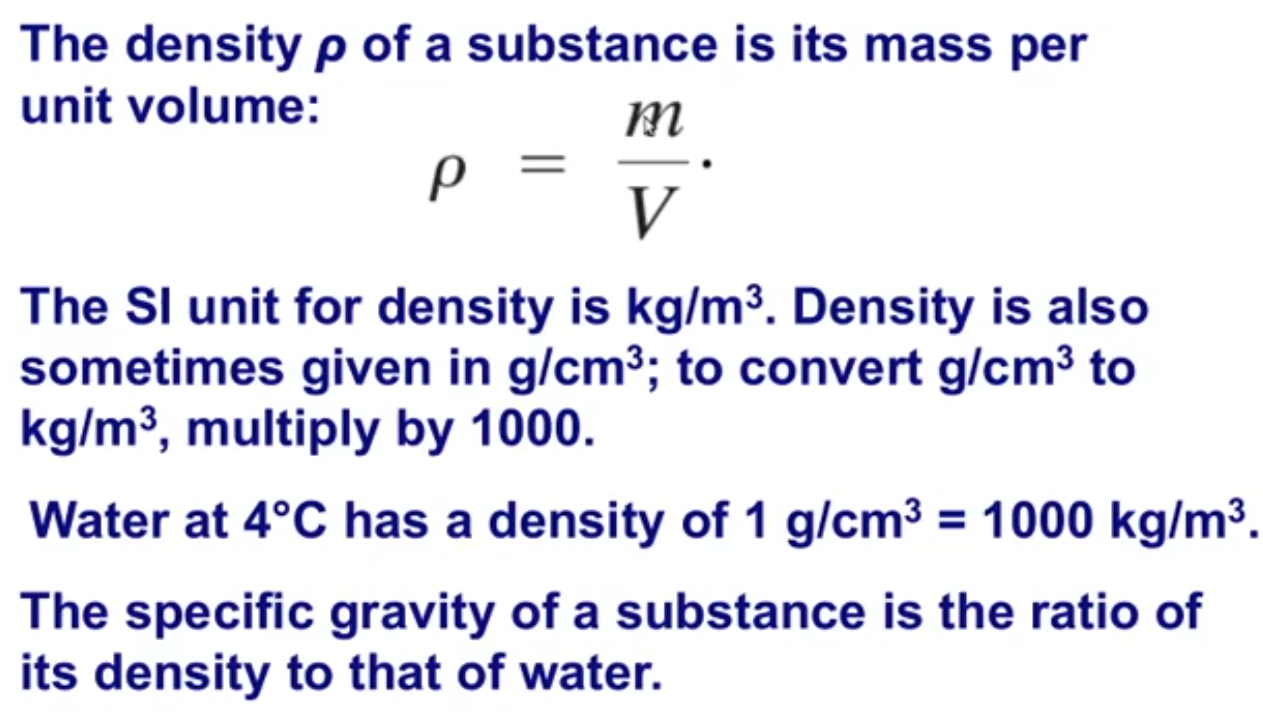
Density: Defined as mass per unit volume.
Formula: where is density, is mass, and is volume.
SI unit: kg/m³
Sometimes given in g/cm³; conversion: 1 g/cm³ = 1000 kg/m³
Water at 4°C has a density of 1 g/cm³ = 1000 kg/m³
Specific Gravity: The ratio of a substance's density to that of water.
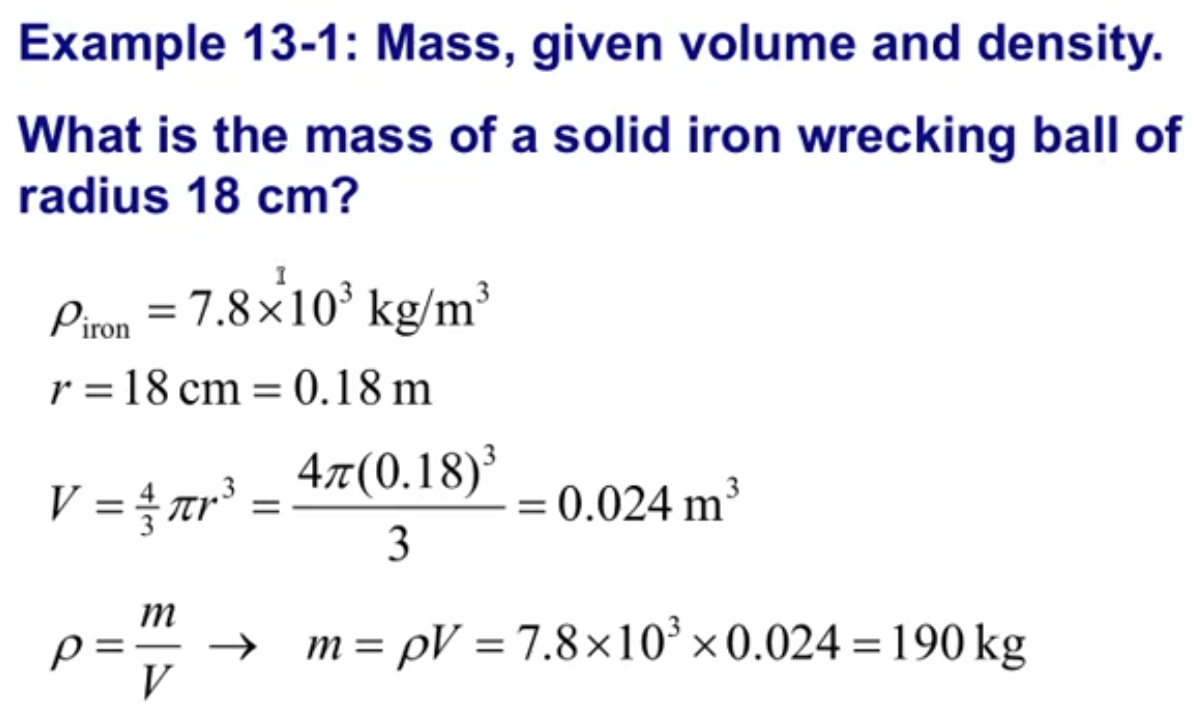
Example 13-1: Mass, Given Volume and Density
Problem: Find the mass of a solid iron wrecking ball with a radius of 18 cm, given the density of iron is .
Solution:
Convert radius to meters: 18 cm = 0.18 m.
Calculate volume:
Calculate mass:
Pressure in Fluids
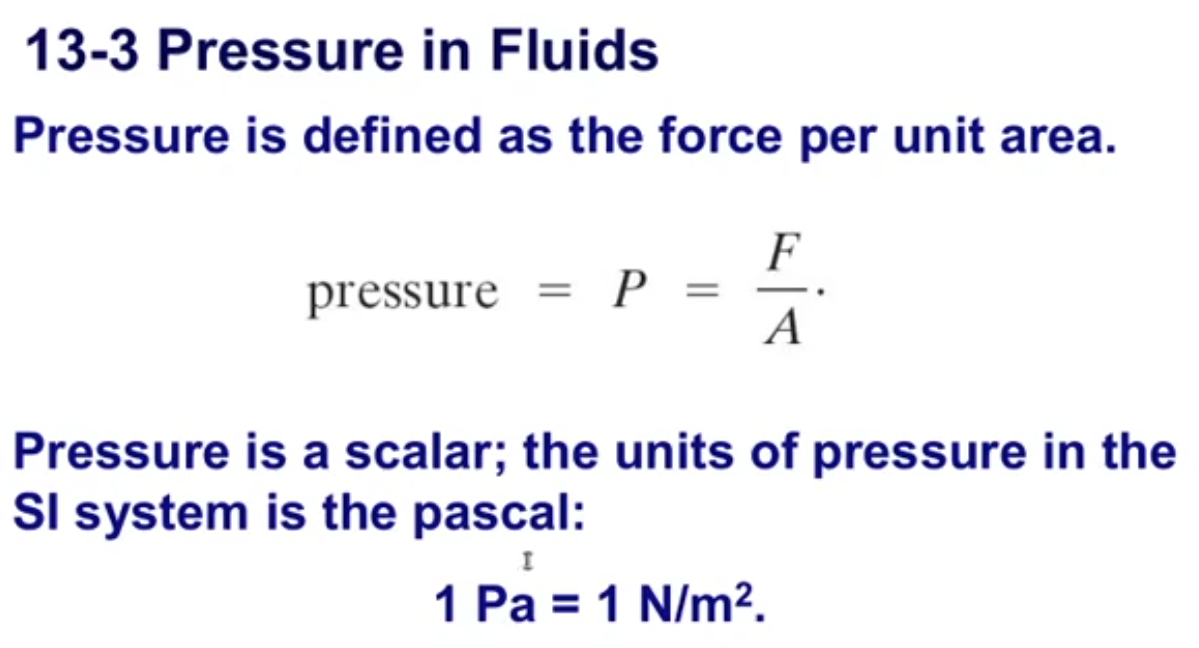
Pressure: Defined as force per unit area.
Pressure is a scalar quantity.
SI unit: Pascal (Pa), where 1 Pa = 1 N/m²
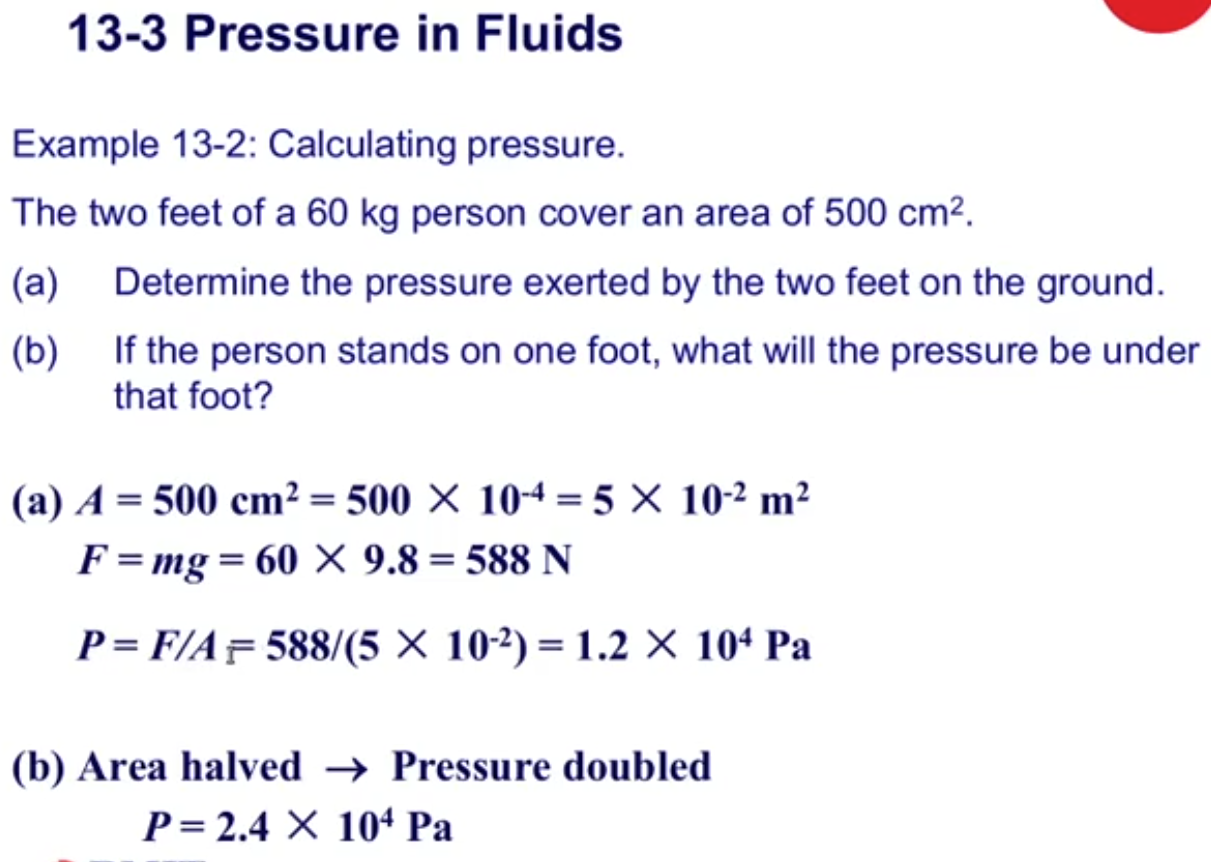
Example 13-2: Calculating Pressure
Problem:
(a) A 60 kg person's two feet cover an area of 500 cm². Determine the pressure exerted on the ground.
(b) If the person stands on one foot, what will the pressure be under that foot?
Solution:
(a) Convert area to m²:
Calculate force:
Calculate pressure:
(b) If the area is halved, the pressure doubles:
Pressure in Static Fluids: Pressure is the same in every direction at a given depth. If it were not, the fluid would flow.
Force on Solid Surfaces: There is no component of force parallel to any solid surface in a static fluid. The force is perpendicular to the surface.
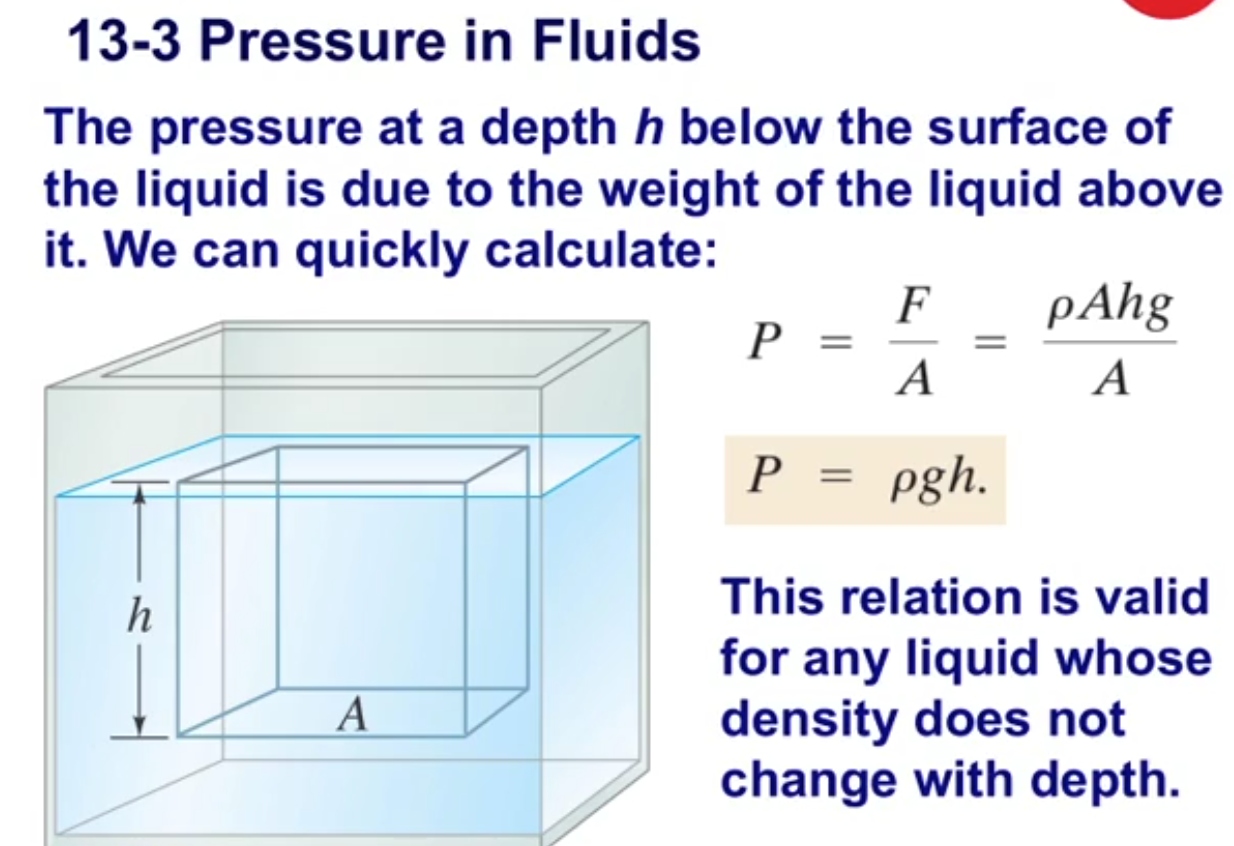
Pressure and Depth
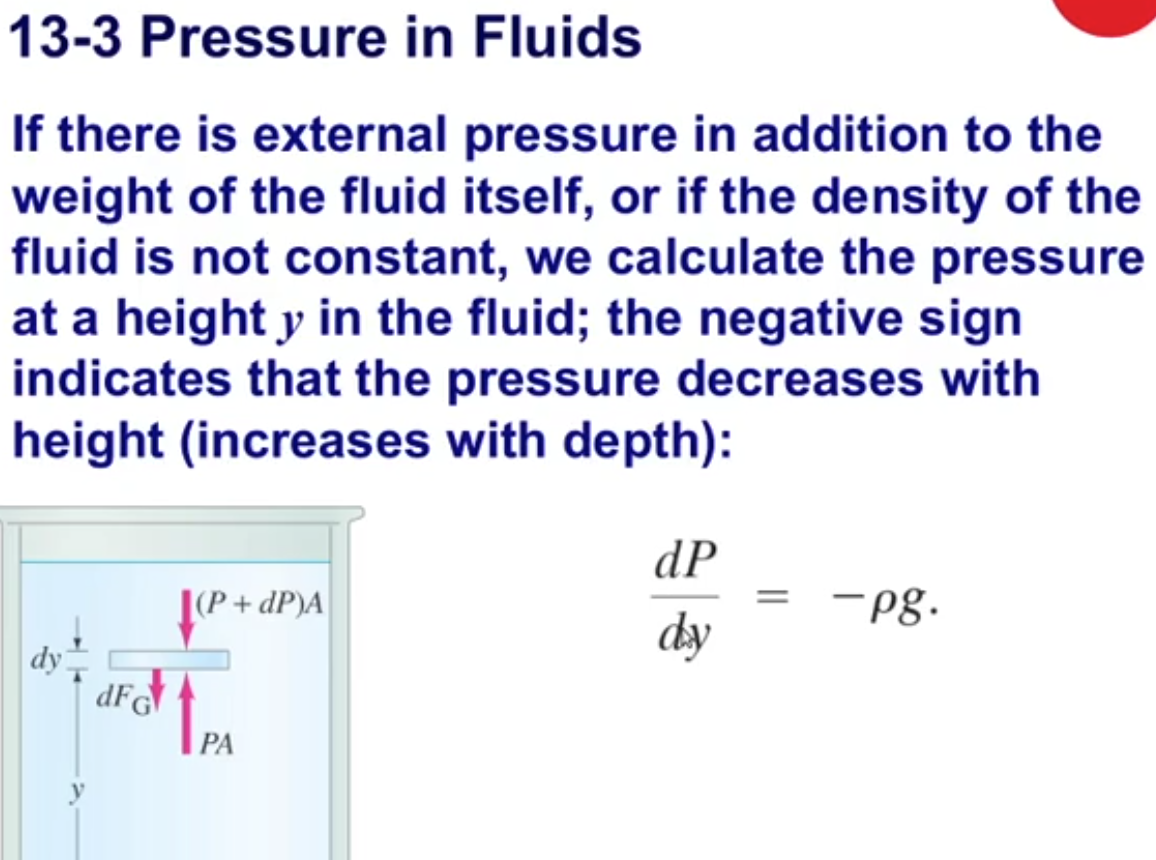
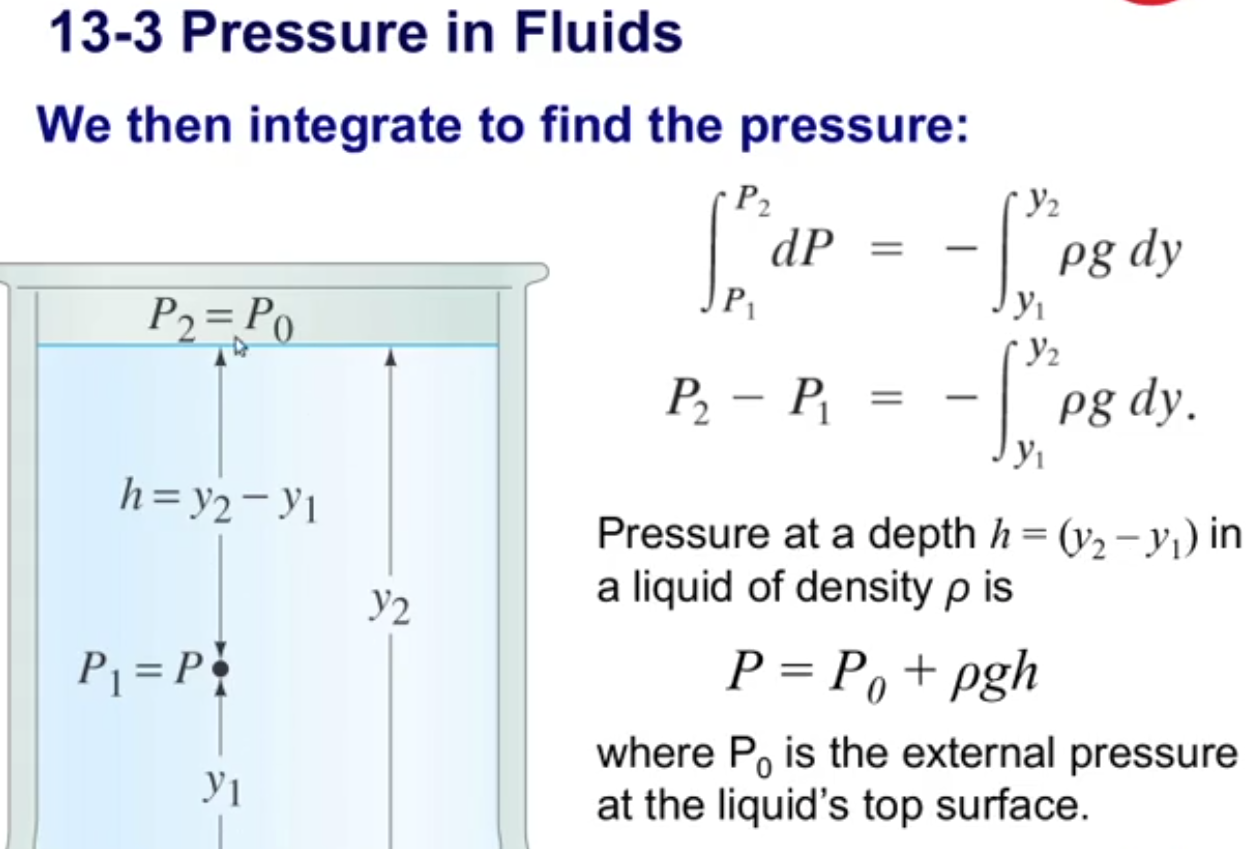
The pressure at a depth below the surface of a liquid is due to the weight of the liquid above it.
This relationship is valid for any liquid whose density does not change with depth.
If there is external pressure or the density of the fluid is not constant, we calculate the pressure at a height in the fluid.
The negative sign indicates that pressure decreases with height (increases with depth).
Pressure at a depth in a liquid of density is given by:
where is the external pressure at the liquid’s top surface.
Example 13-3: Pressure at a Faucet
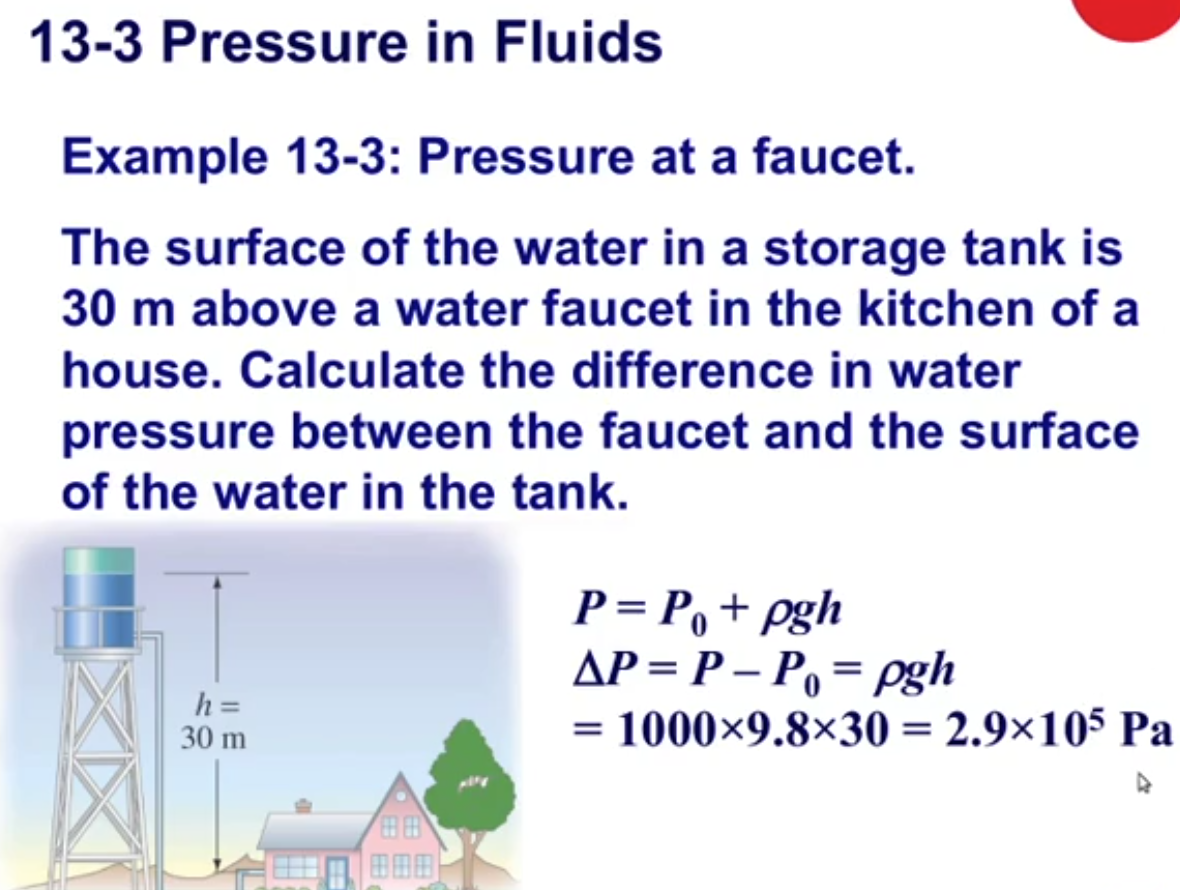
Problem: The surface of the water in a storage tank is 30 m above a water faucet in a kitchen. Calculate the difference in water pressure between the faucet and the surface of the water in the tank.
Solution:
Atmospheric Pressure and Gauge Pressure
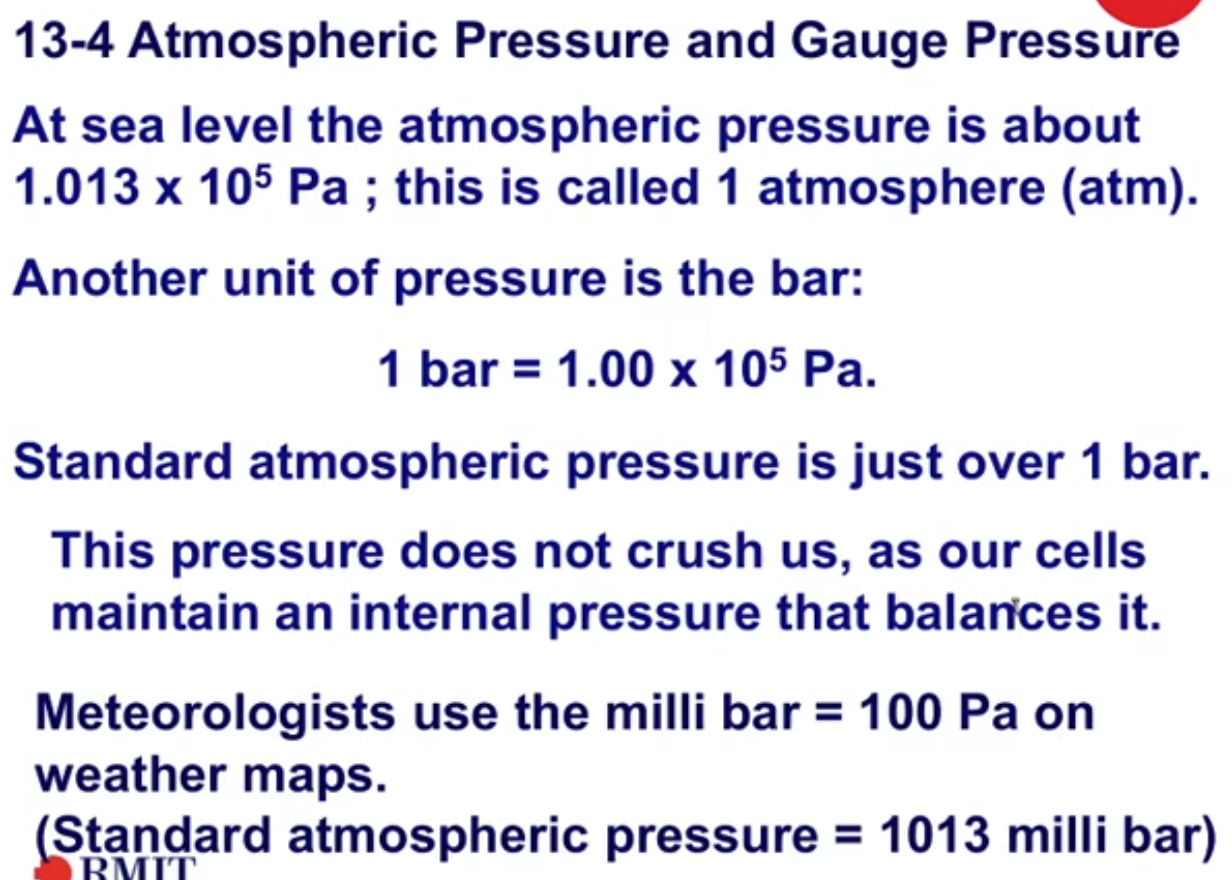
Atmospheric Pressure: At sea level, atmospheric pressure is about , which is called 1 atmosphere (atm).
Bar: Another unit of pressure; 1 bar = . Standard atmospheric pressure is just over 1 bar.
Our cells maintain an internal pressure that balances atmospheric pressure.
Meteorologists use the millibar (1 mb = 100 Pa) on weather maps. (Standard atmospheric pressure = 1013 mb)
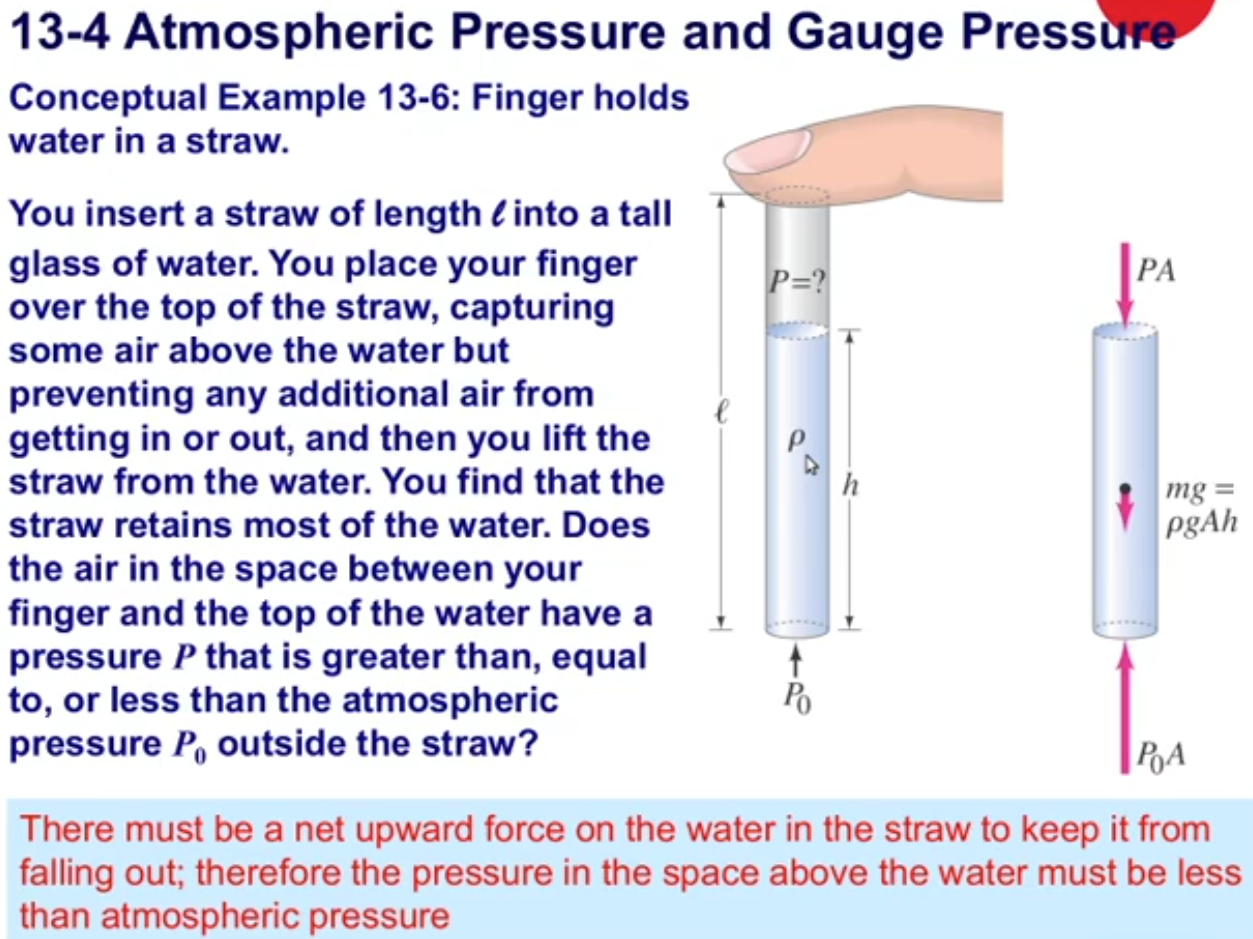
Conceptual Example 13-6: Finger Holds Water in a Straw
When a straw is inserted into water, the top is sealed, and the straw is lifted, the water stays in the straw.
The air in the space between the finger and the top of the water has a pressure that is less than the atmospheric pressure outside the straw.
There must be a net upward force on the water in the straw to keep it from falling out; therefore the pressure in the space above the water must be less than atmospheric pressure.
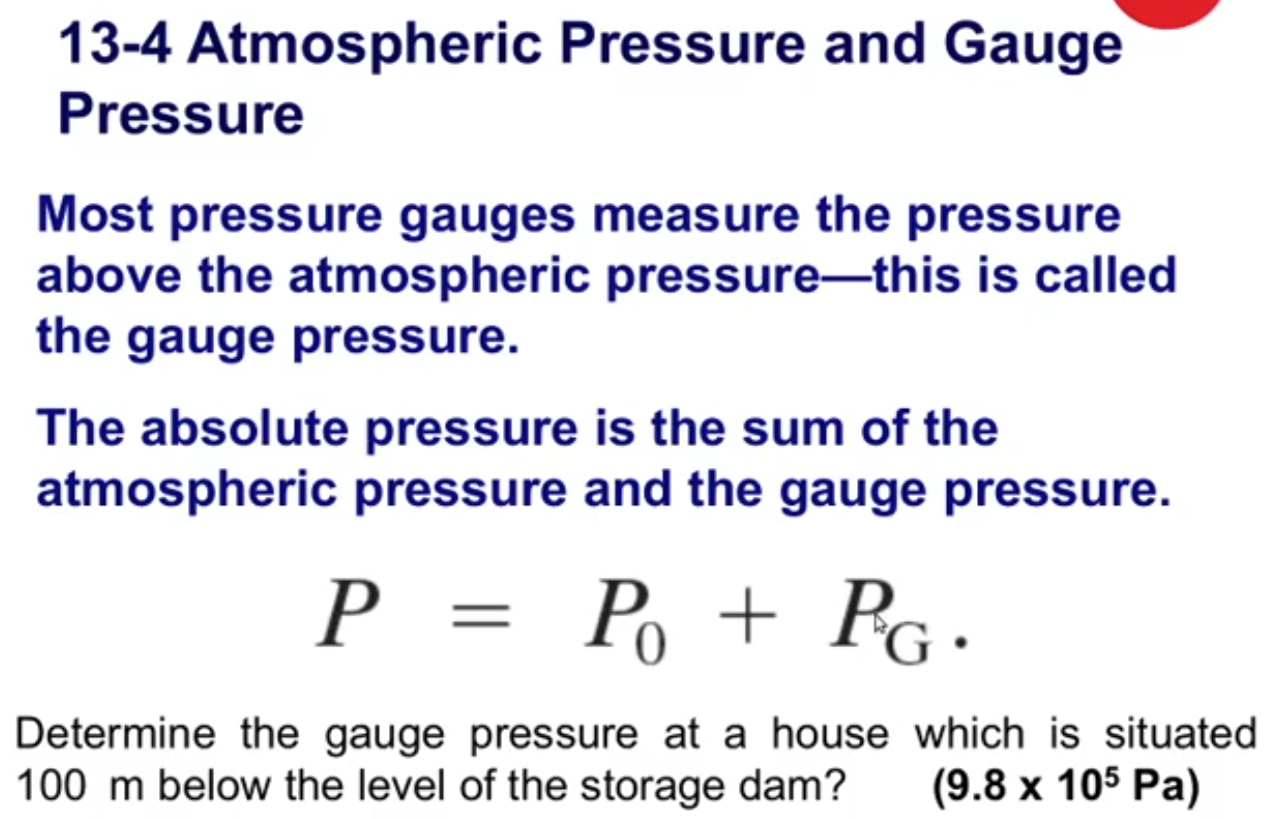
Most pressure gauges measure the pressure above atmospheric pressure—this is called the gauge pressure.
The absolute pressure is the sum of the atmospheric pressure and the gauge pressure.
Determine the gauge pressure at a house which is situated 100 m below the level of the storage dam? . (Use )
Pascal’s Principle
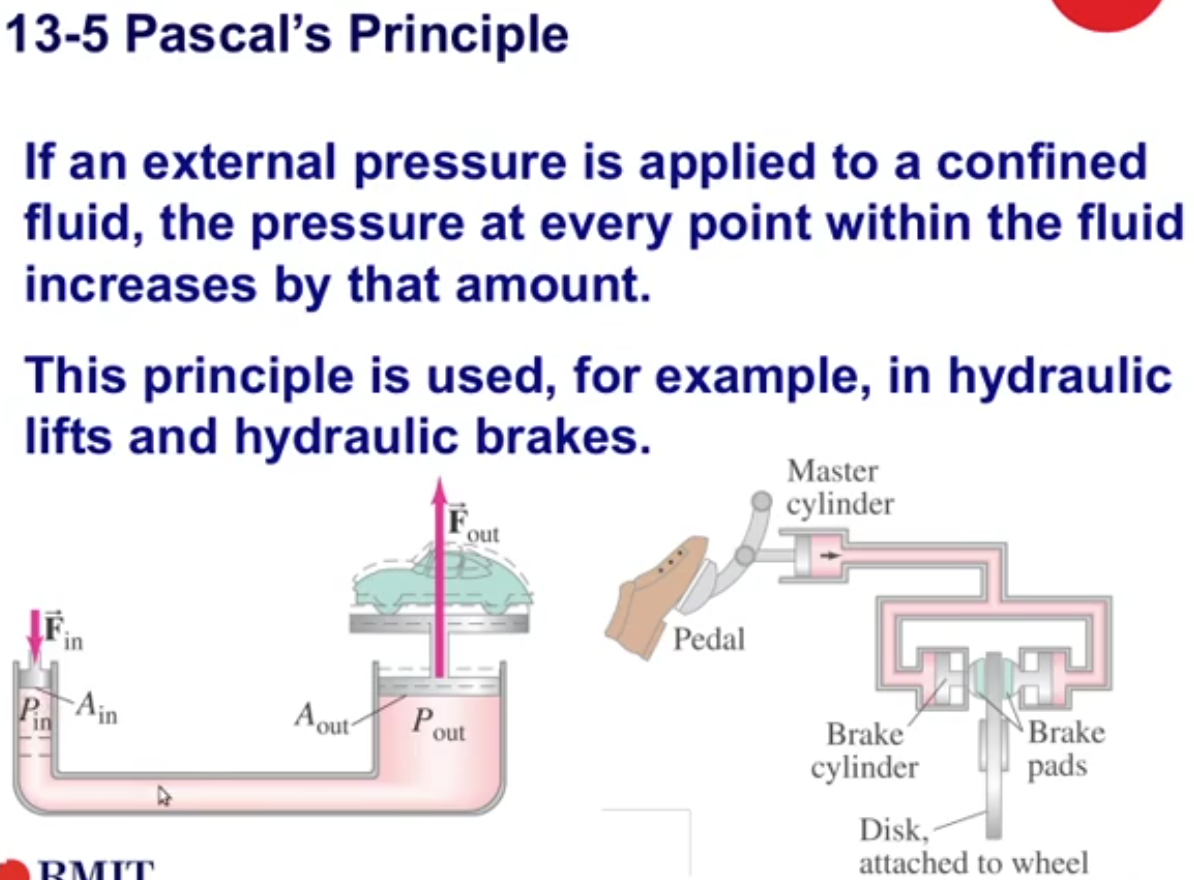
If an external pressure is applied to a confined fluid, the pressure at every point within the fluid increases by that amount.
This principle is used in hydraulic lifts and hydraulic brakes.
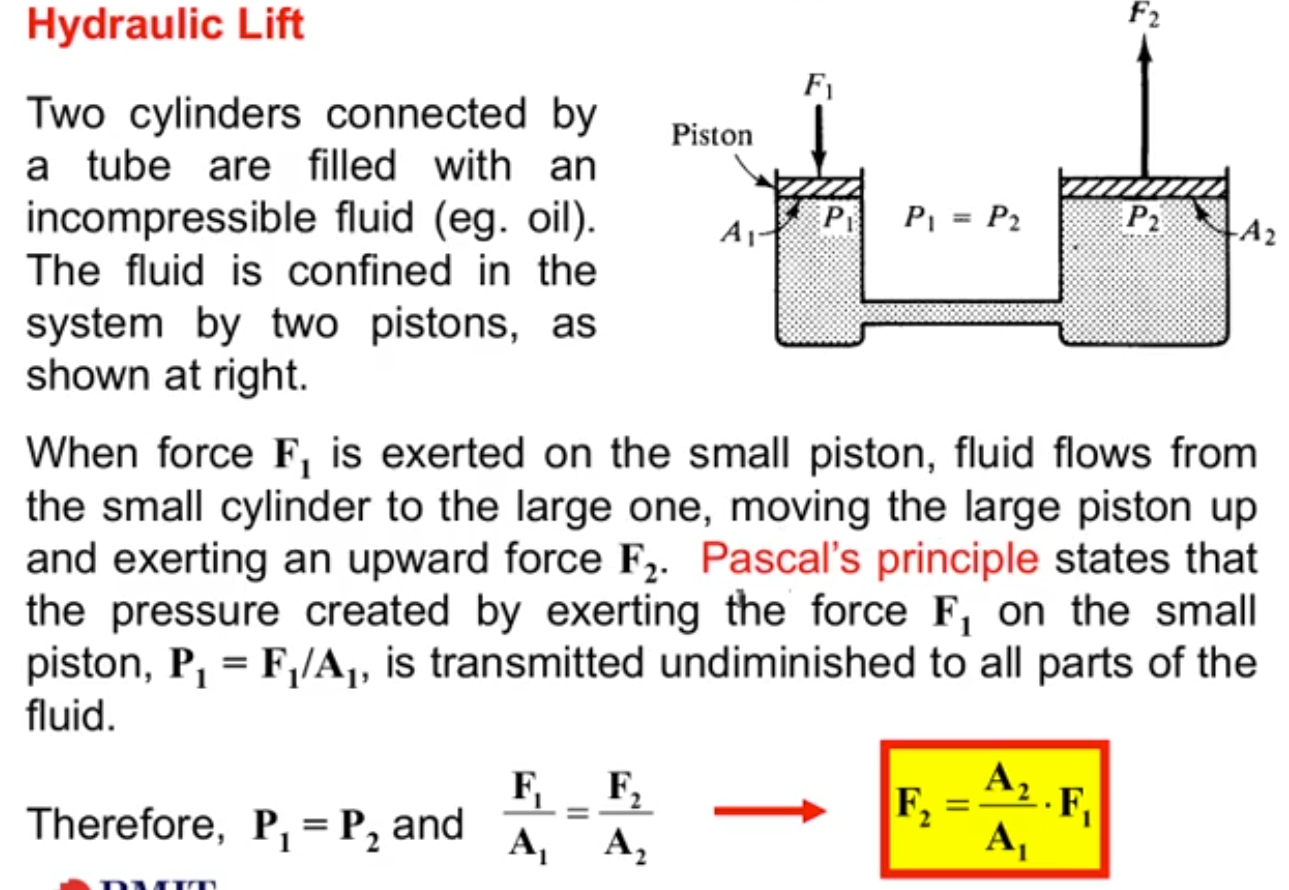
Two cylinders connected by a tube are filled with an incompressible fluid (e.g., oil).
The fluid is confined in the system by two pistons. When force is exerted on the small piston, fluid flows to the large one, moving the large piston up and exerting an upward force .
Pascal’s principle states that the pressure created by exerting the force on the small piston, , is transmitted undiminished to all parts of the fluid.
Therefore, and
The force is magnified by the ratio of the areas.
Often, a lever is used to magnify the force even further so that very small forces can lift heavy objects (e.g., a hydraulic car jack).
Problem
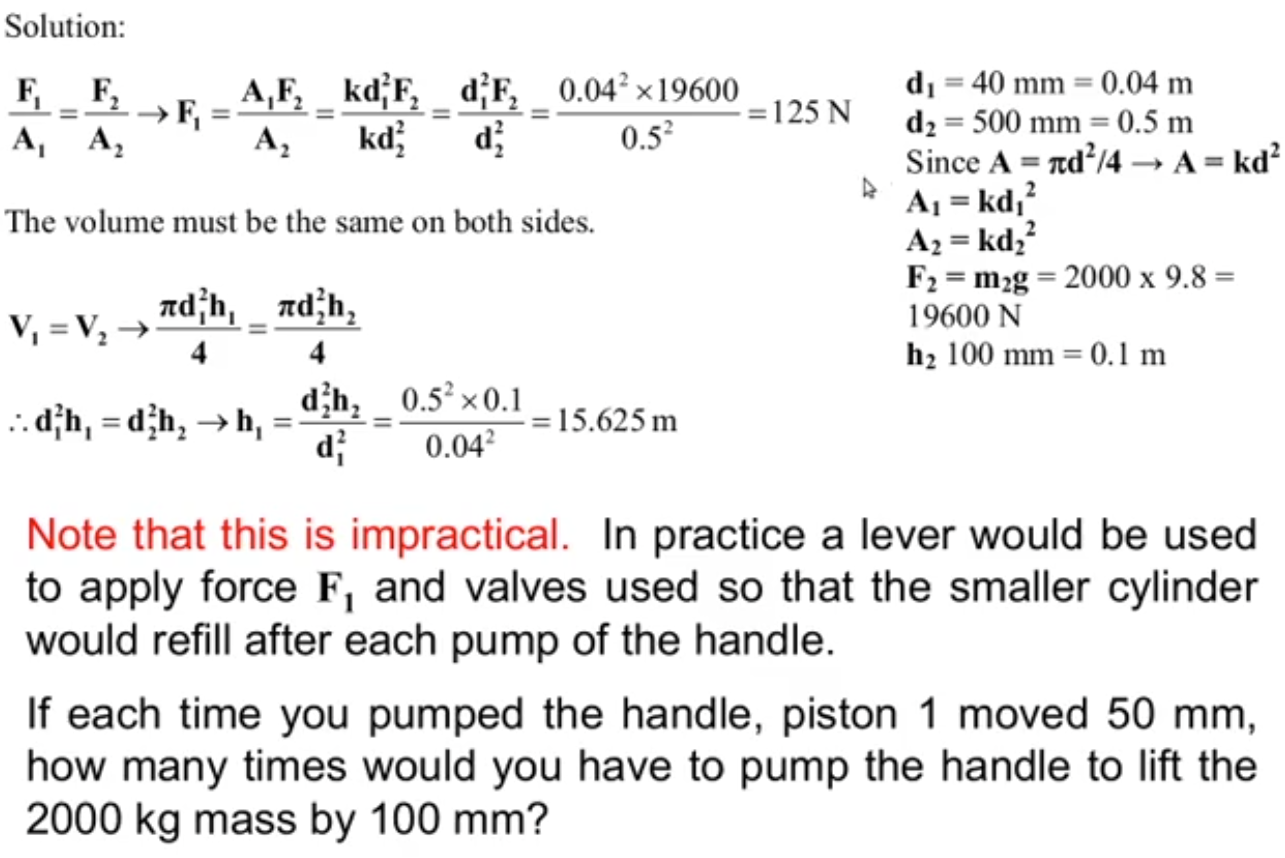
In a hydraulic press, the smaller piston has a diameter of 40 mm, and the larger piston has a diameter of 500 mm. What force must be applied to the smaller cylinder to lift a mass of 2000 kg?
If it is required to lift the 2000 kg mass 100 mm, how far must the small piston move?
Solution:
The volume must be the same on both sides:
Volume equation:
implying Area is proportional to the diameter squared.
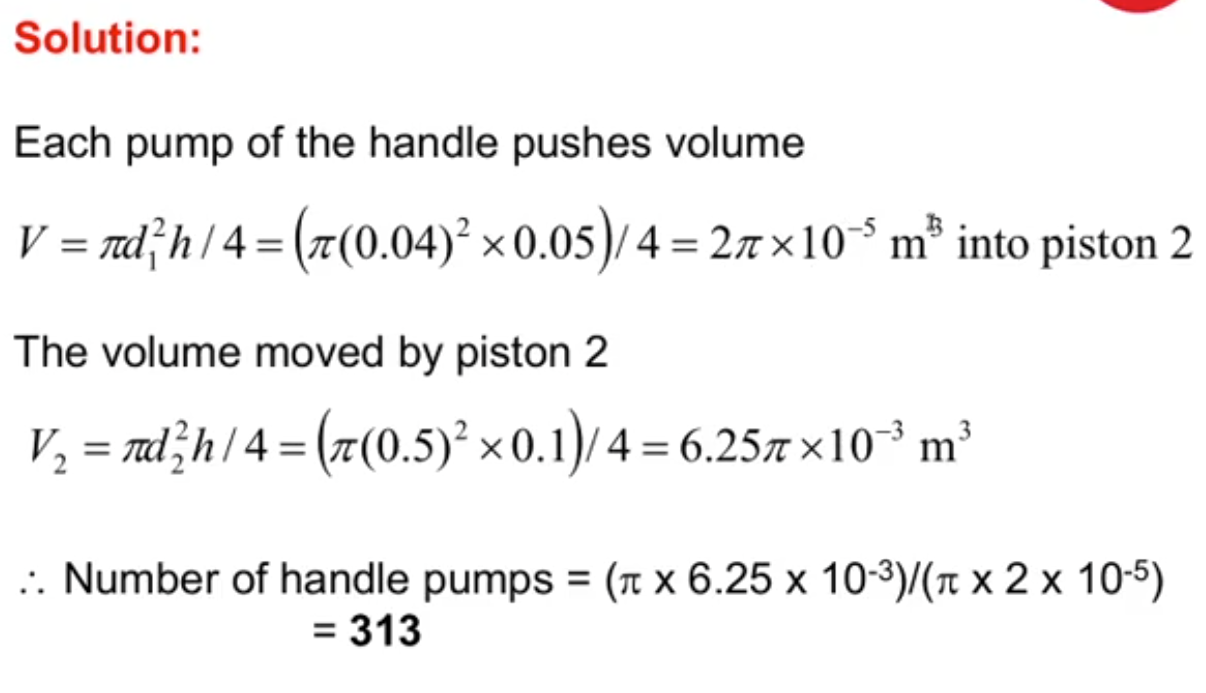
If each time you pumped the handle, piston 1 moved 50 mm, how many times would you have to pump the handle to lift the 2000 kg mass by 100 mm?
Each pump of the handle pushes volume into piston 2
The volume moved by piston 2
Number of handle pumps =
Measurement of Pressure: Gauges and the Barometer
Open-Tube Manometer: One end is open to atmospheric pressure; the pressure being measured causes the fluid to rise until the pressures on both sides at the same height are equal.
Aneroid Gauge and Tire Pressure Gauge: Two more devices for measuring pressure.
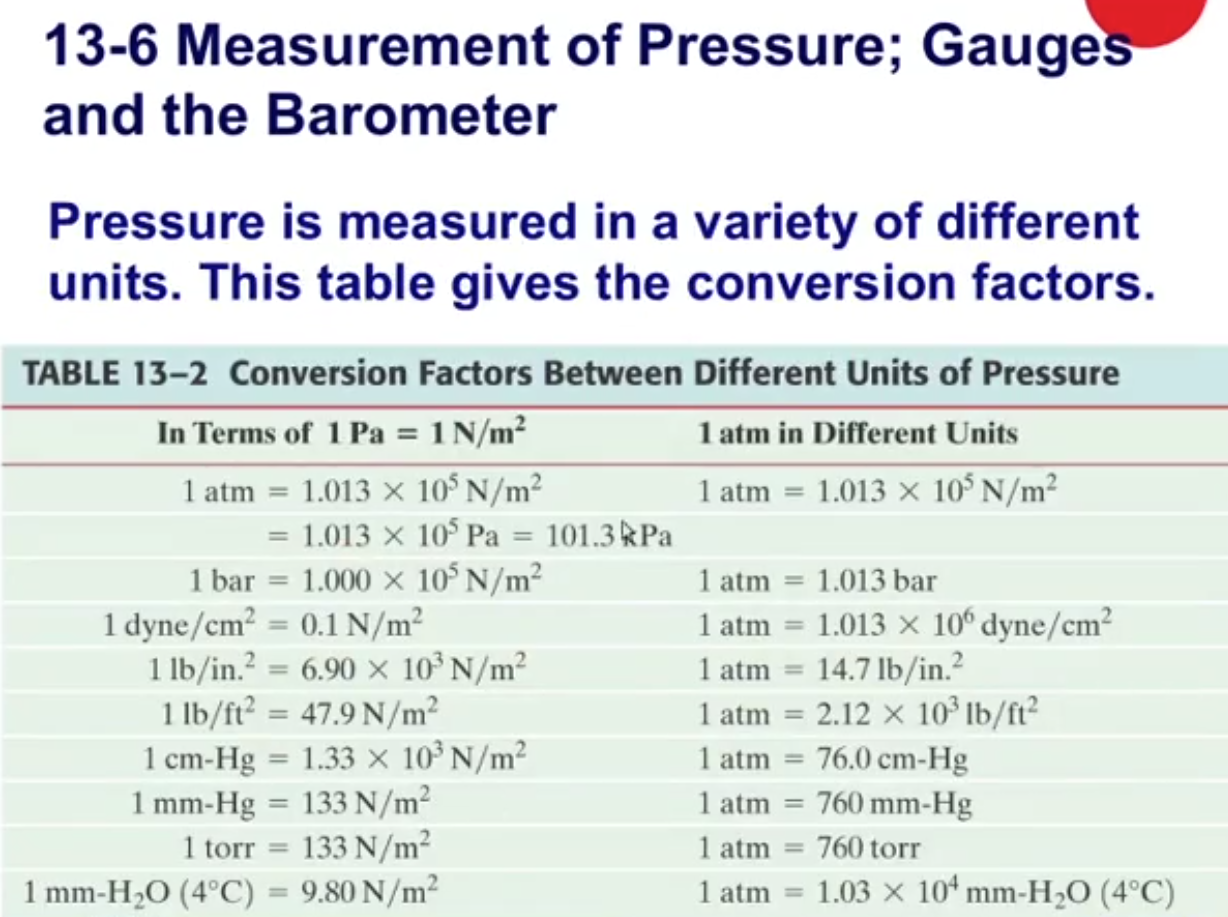
Pressure is measured in a variety of different units. Conversion factors are available in tables.
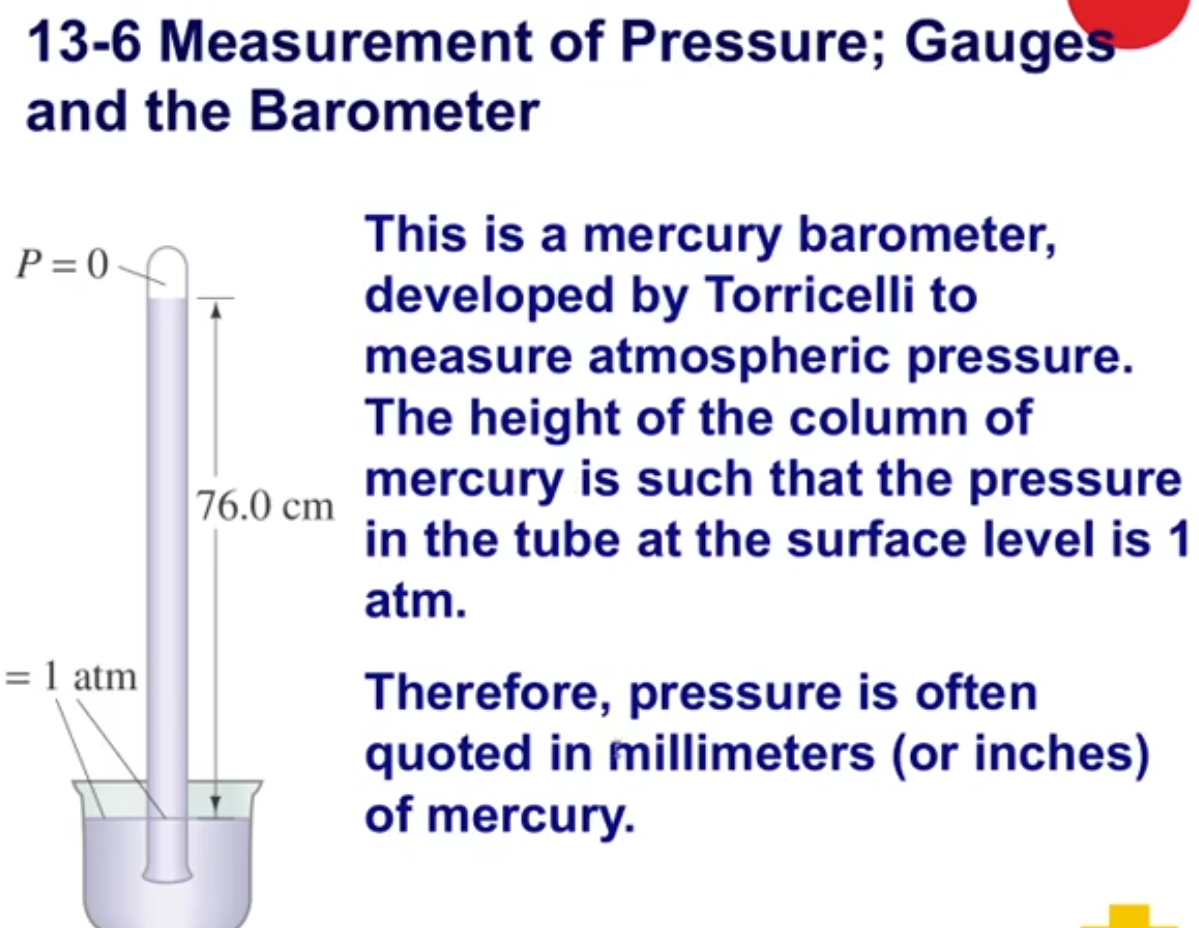
Mercury Barometer: Developed by Torricelli to measure atmospheric pressure. The height of the mercury column is such that the pressure in the tube at the surface level is 1 atm. Often, pressure is quoted in millimeters (or inches) of mercury.
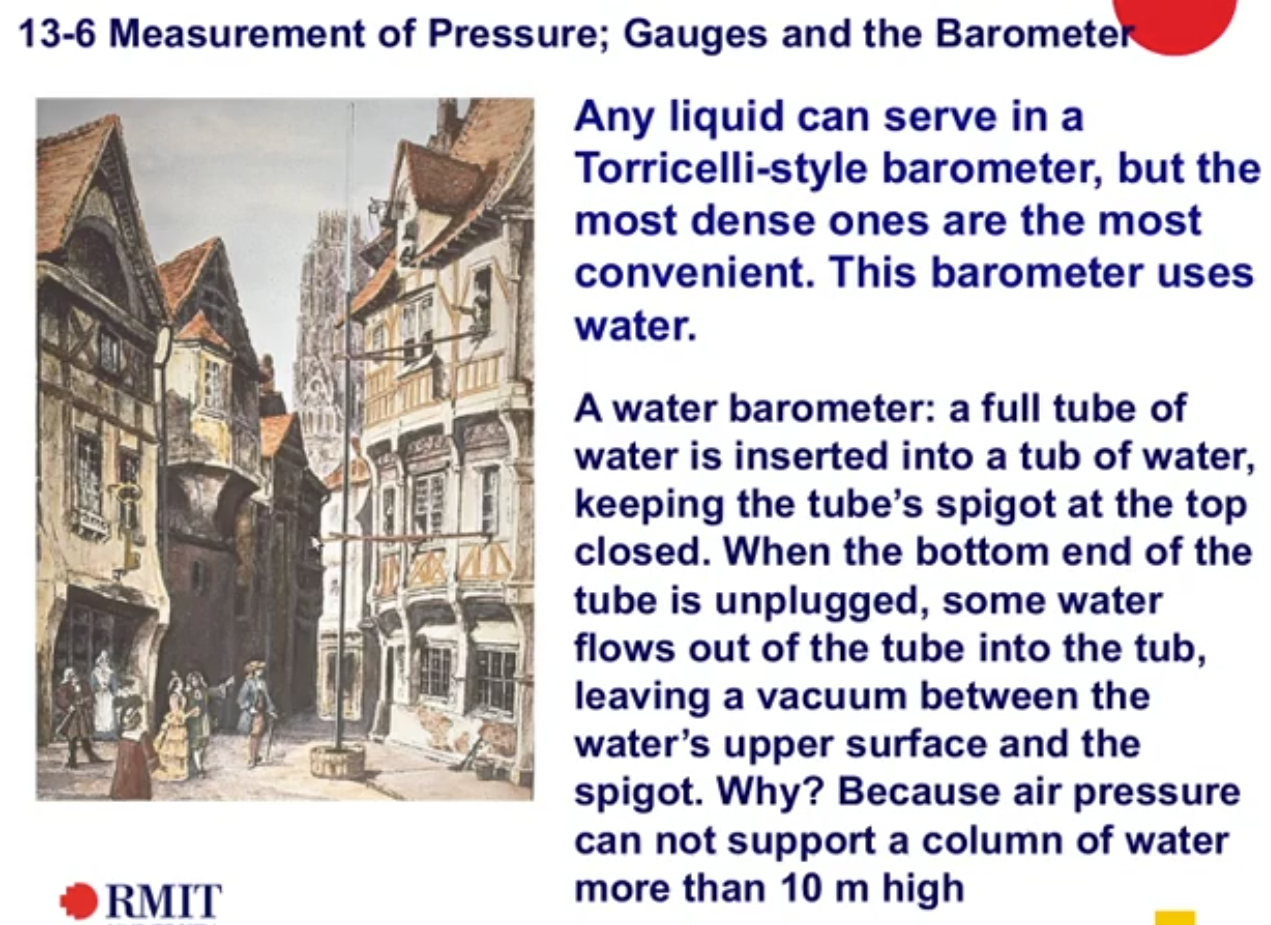
Any liquid can serve in a Torricelli-style barometer, but the most dense ones are the most convenient.
Water Barometer: A full tube of water is inserted into a tub of water, keeping the tube’s spigot at the top closed. When the bottom end of the tube is unplugged, some water flows out of the tube into the tub, leaving a vacuum between the water’s upper surface and the spigot. Air pressure cannot support a column of water more than 10 m high.
Buoyancy and Archimedes’ Principle
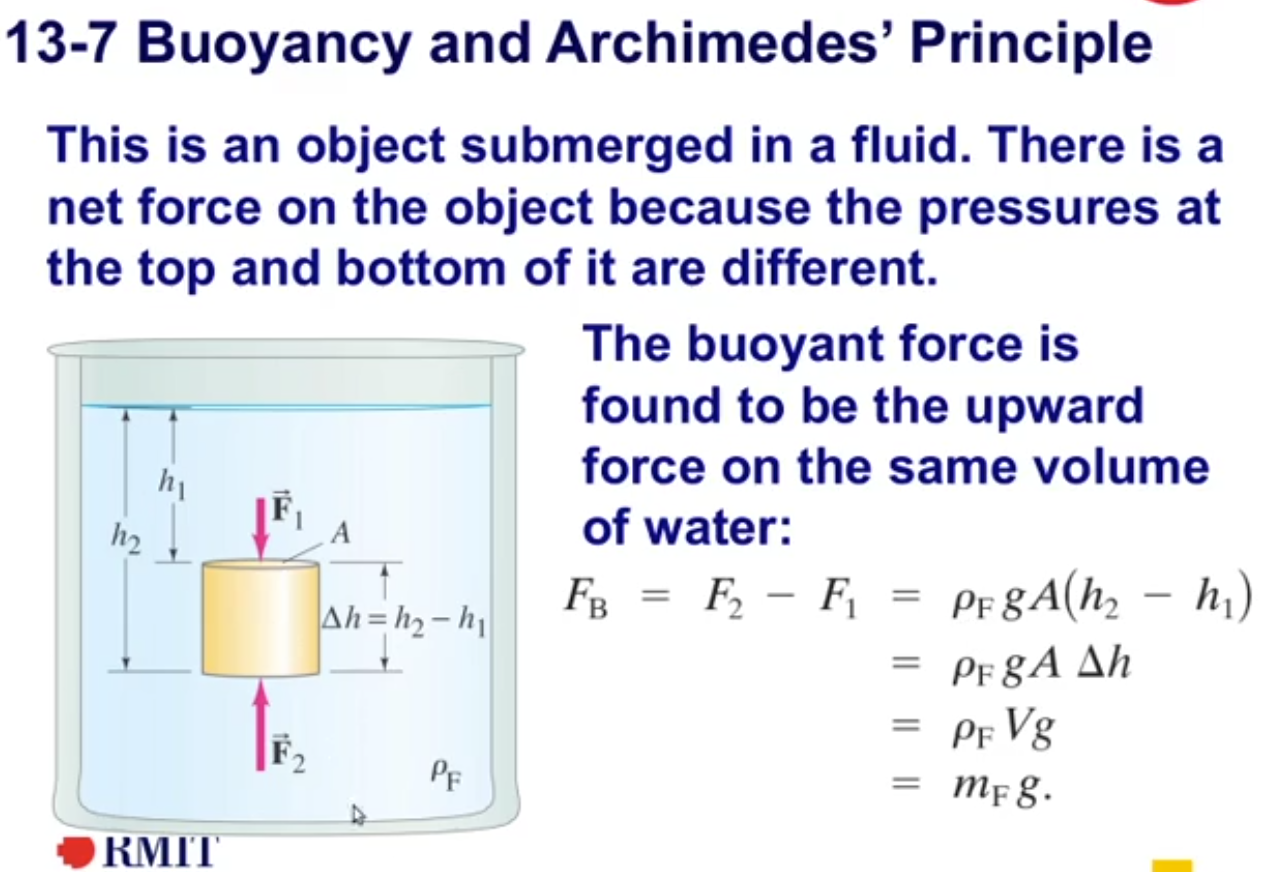
When an object is submerged in a fluid, there is a net force on the object because the pressures at the top and bottom of it are different.
The buoyant force is found to be the upward force on the same volume of water.
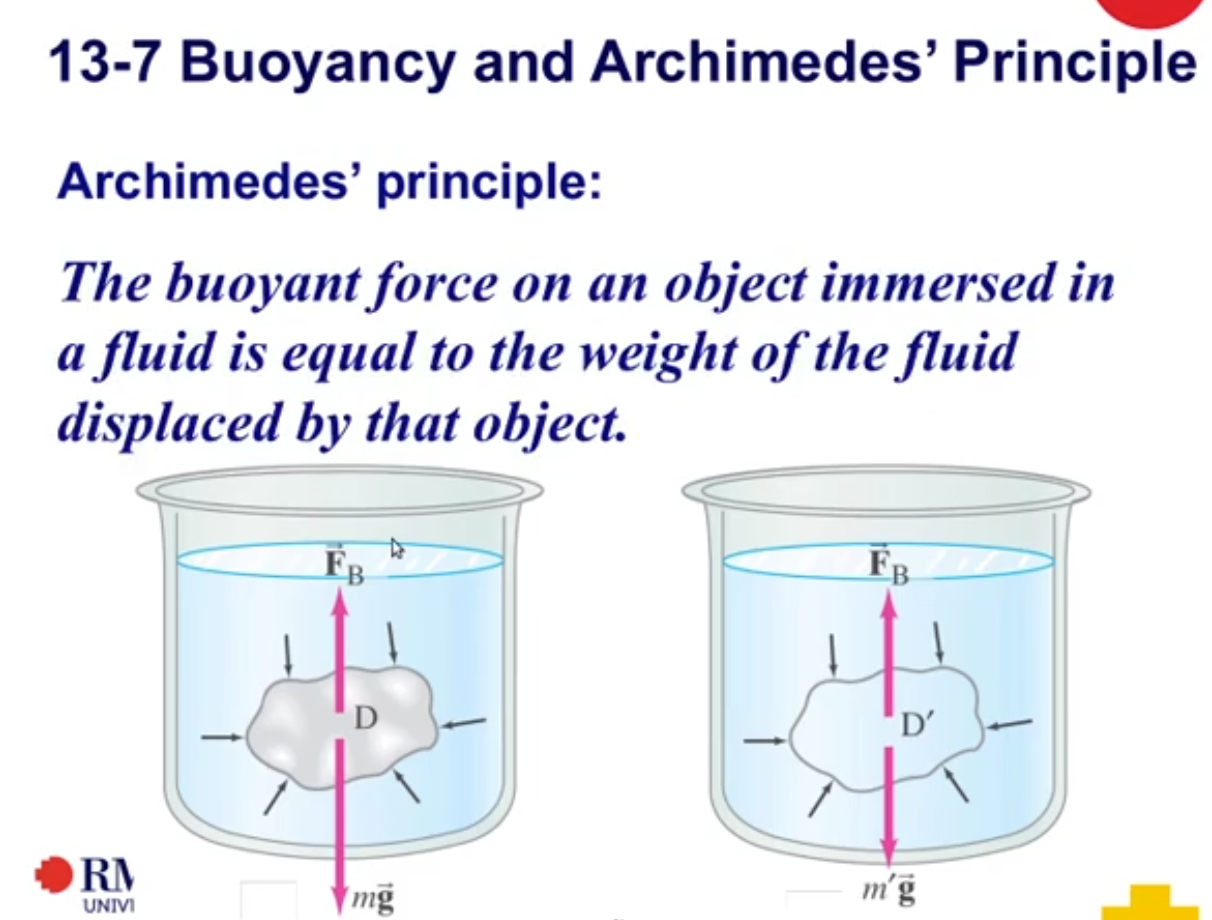
Archimedes’ Principle: The buoyant force on an object immersed in a fluid is equal to the weight of the fluid displaced by that object.
Conceptual Example 13-8: Two Pails of Water
Consider two identical pails of water filled to the brim. One pail contains only water; the other has a piece of wood floating in it. Which pail has the greater weight?
Both weigh the same because if both pails were full to the brim before the wood was put in, some water will have spilled out.
Example 13-9: Recovering a Submerged Statue
Problem: A 70 kg ancient statue lies at the bottom of the sea. Its volume is . How much force is needed to lift it?
Solution:
Convert volume to m³:
Calculate the buoyancy force, which is equal to the weight of the displaced water
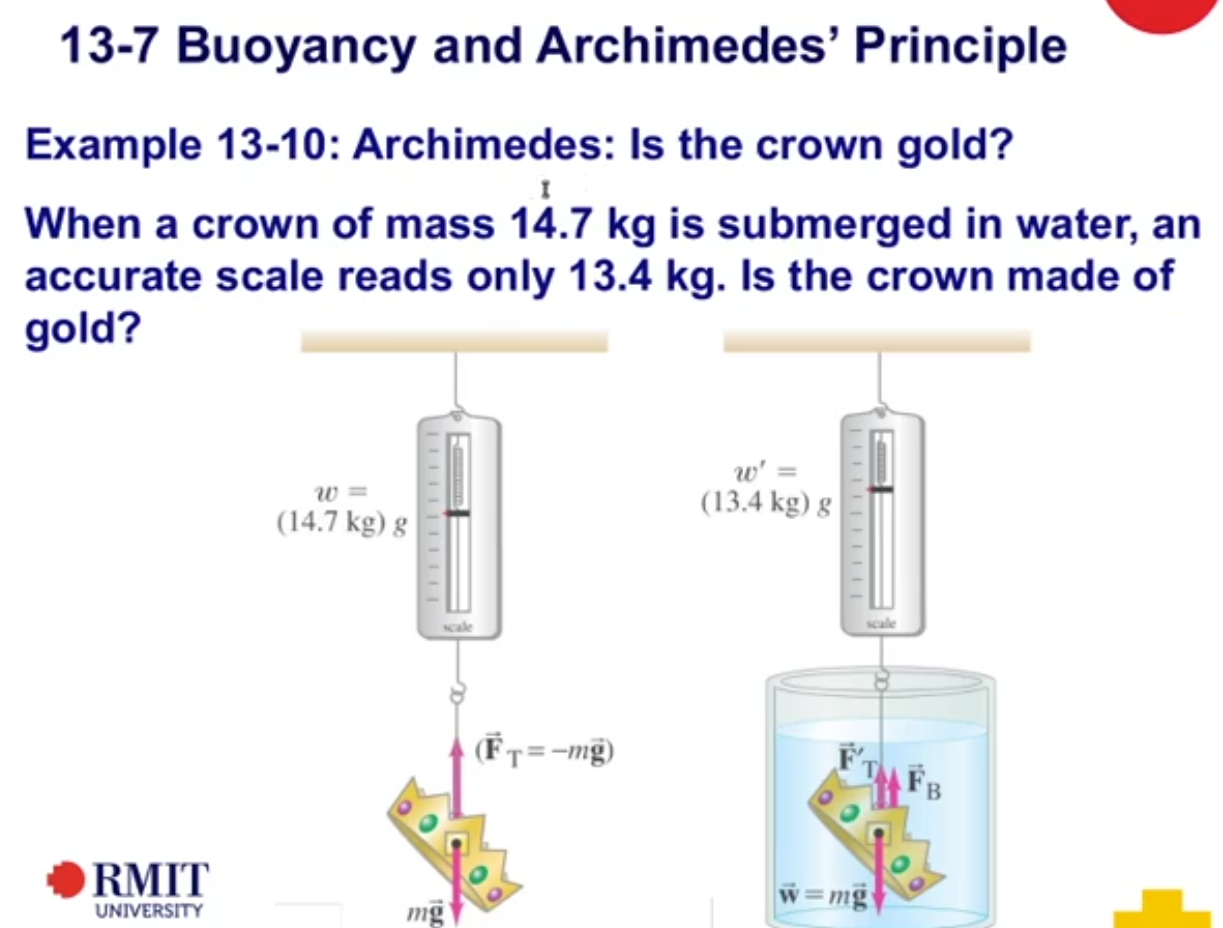
Example 13-10: Archimedes: Is the Crown Gold?
Problem: When a crown of mass 14.7 kg is submerged in water, an accurate scale reads only 13.4 kg. Is the crown made of gold?
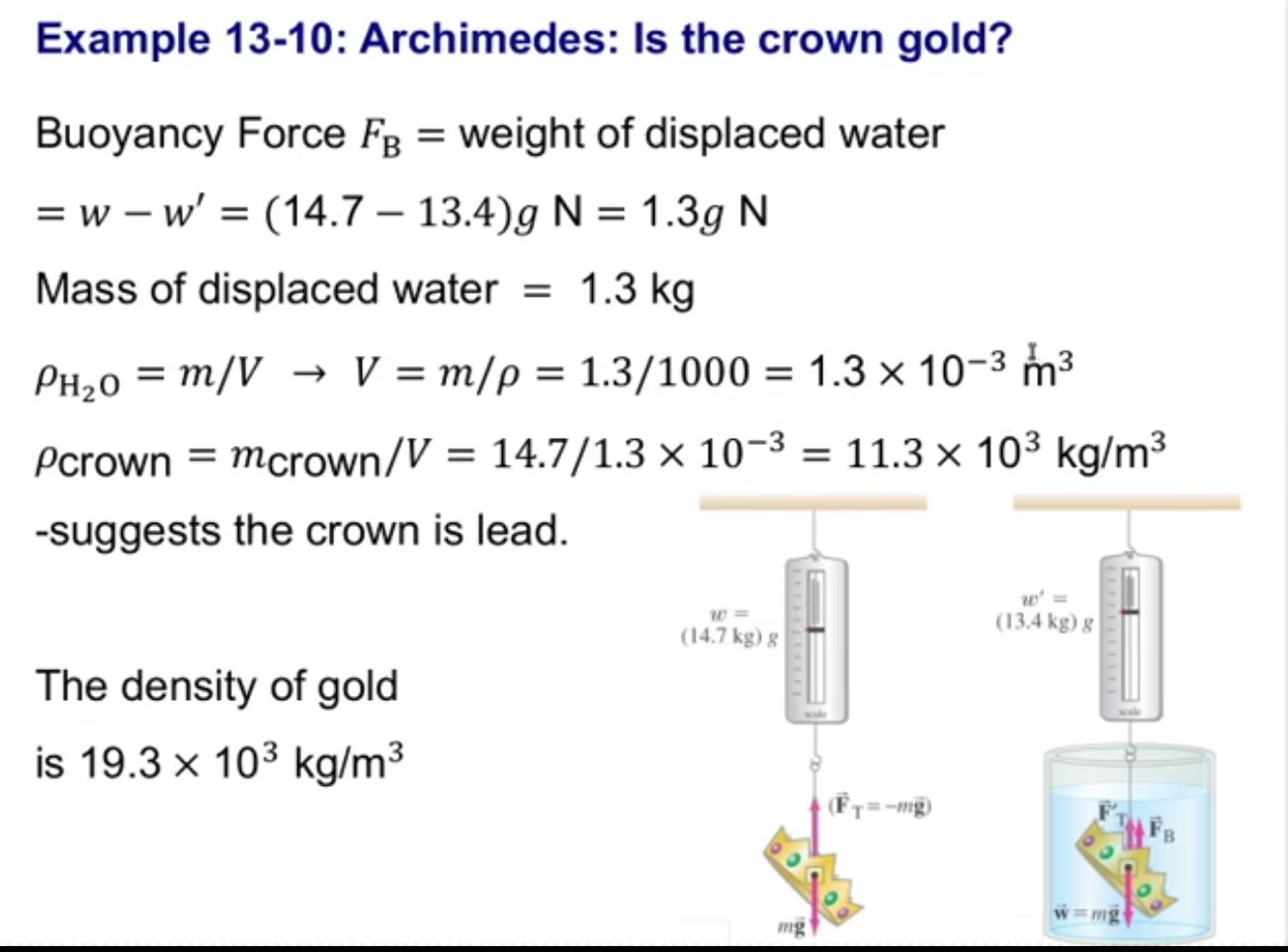
Buoyancy Force = weight of displaced water = = N = N
Mass of displaced water = 1.3 kg
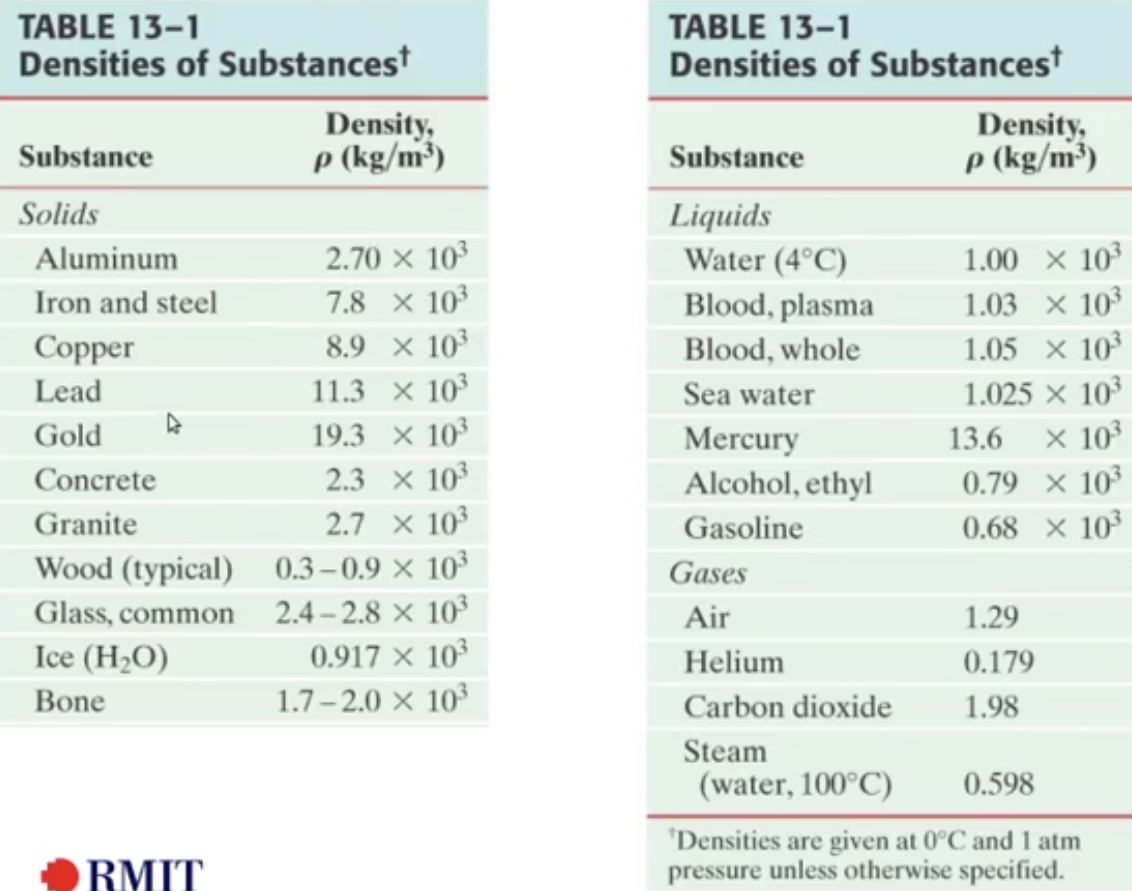
This suggests the crown is lead.
The density of gold is