Cyclones
Formation of Tropical Cyclones
Tropical storms form over water that is 26.5oC or warmer and when there's a small difference in wind speeds between the upper and the lower atmosphere.
These temperatures are favourable because they mean there's lots of warm, moist air to cause extreme rain. Energy from warm water intensifies cyclones.
Lots and lots of energy is released when air evaporates, rises or cools. This increases the speed and energy of a storm.
The strength of a storm falls as they move further away from warm water (so when storms are above land or above cooler parts of the ocean). This is called dissipation.
Spin
The rotation of the Earth causes the Coriolis effect, which makes tropical storms spin by deflecting winds.
Source areas
The source area for most cyclones is between 5o and 30o north and south because the water is below 26.5oC further from the equator.
Most cyclones form when sea temperatures are warmest, which is June-November = northern hemisphere, and November-April = southern hemisphere.
Features: circular , 100s of km wide, Last 1-2 weeks
Structure
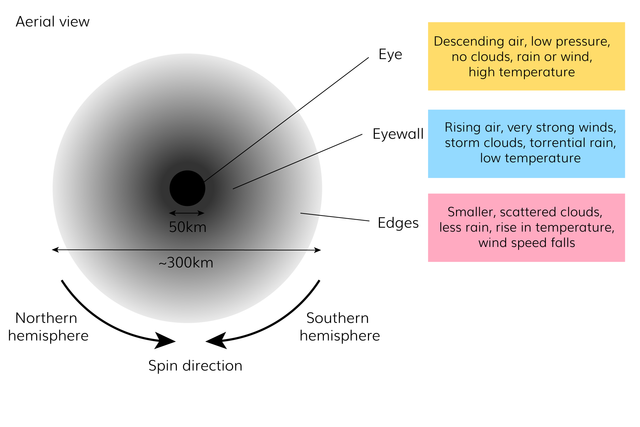
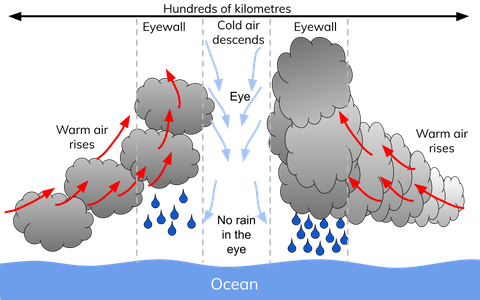
A cyclone's centre is known as the eye of the cyclone.
Cool air descending from the eyewall creates the eye of the cyclone, which can be 50km wide. In the eye, there is no rain and low pressure (and a warmer ground temperature).
The eyewall surrounds all sides of the eye of the cyclone.
In the eyewall, hot air rises, winds are very strong and there is a lot of rain.
At the edges of cyclones, conditions are intermediate: wind speeds, rain intensity and temperatures are moderate, and clouds = small and scattered
Hazards:
high winds
intense rainfall
storm surges - large sea level rises caused by high winds