Transport (part of Cell Biology)
Diffusion
net movement of particles from an area of high concentration to an area of low concentration. occurs due to the kinetic energy of particles as they move
passive (no energy used) as you’re moving with the concentration gradient (basically difference in concentrations). there are 3 main factors that affect rate of diffusion, and that come up time and time again when thinking about cells adapted to support diffusion.
concentration gradient - larger difference means diffusion occurs quicker
temperature - increased temperature means particles are moving with more kinetic energy i.e. faster, so the random movement and mixing occurs faster
surface area (of cell membrane) - larger surface area means more space for particles to move through and into the cell
surface area to volume ratio
smaller objects have a larger surface area to volume ratio. this means that they lose heat and water faster than larger objects would, but also can carry out diffusion much faster
single celled organisms have relatively large surface area to volume ratios, which is fine for them as it allows for sufficient transport of molecules in and out of the organism to meet its low metabolic demands
multicellular organisms, however, are much larger, so have a smaller surface area to volume ratio. this means that diffusion alone would be too slow to meet the metabolic demands of all of our cells. we have thus implemented various adaptations over time to allow for sufficient amounts of transportation to take place. these include:
a large surface area, meaning more space for particles to move through
a thin membrane, providing a short diffusion pathway
efficient blood supply/ventilation in animals, creating a steep concentration gradient that means diffusion occurs faster
there are a few examples you need to know for diffusion.
example | purpose | adaptation |
|---|---|---|
lungs | oxygen transferred to blood and carbon dioxide to the lungs across alveoli, covered in capillaries, that supply blood (see organisation notes for more detail) | alveoli are small, with a large surface area to volume ratio. they’re thin and are constantly oxygenating blood |
small intestine | intestine lining has villi that digest food over their membranes | villi are projections into the small intestine, increasing surface area. only a single cell thick |
gills | where gas exchange takes place in fish | tiny lamellae on the gills increase surface area to volume ratio. water flows in one way and blood the other |
roots | take up minerals and ions via root hair cells (see organisation notes for more detail) | root hair cells have large surface areas with a shape that projects out into soil |
leaves | where gas exchange takes place in plants | flat shape increases surface area. air space in the leaf gives oxygen and carbon dioxide room to move, making diffusion faster |
Osmosis
osmosis is the movement of water from a dilute solution to a concentrated one over a partially permeable membrane
passive (no energy used) as you’re moving with the concentration gradient.
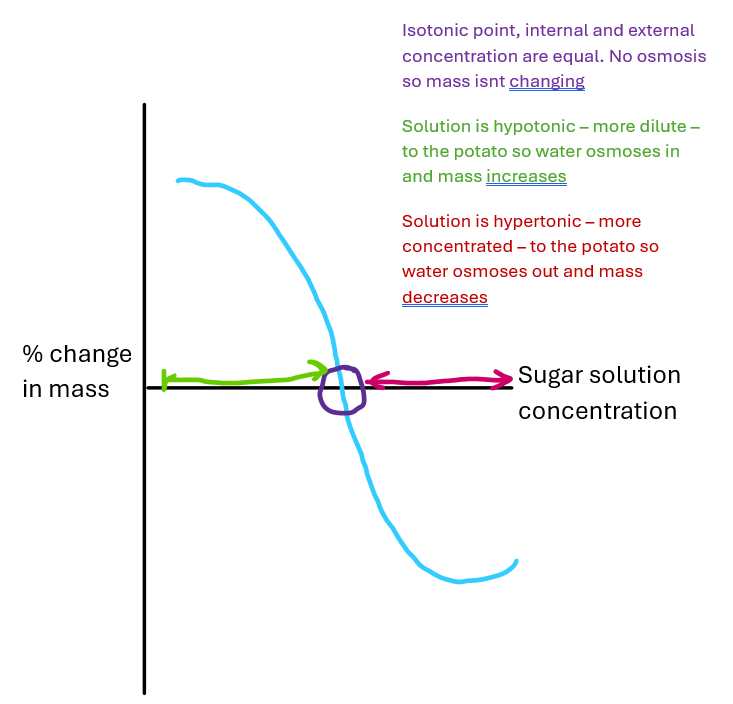
concentration of solution = internal concentration then the solution and cell are isotonic to one another
concentration of solution greater than internal concentration (the solution is more concentrated) then the solution is hypertonic to the cell (and the cell is hypotonic to the solution)
concentration of solution smaller than internal concentration (the solution is more dilute) then the solution is hypotonic to the cell (and the cell is hypertonic to the solution)
solution to cell | affect on an animal cell | affect on a plant cell |
|---|---|---|
hypertonic - more concentrated | water moves out the cell and it shrivels | water moves out of cell, vacuole and cytoplasm shrink, cell membrane shrinks too |
isotonic | cell functions as normal | cell is flaccid |
hypotonic - more dilute | water enters the cell, it swells and may lyse (burst) | water enters cell and it becomes turgid. cell functions best like this. |
required Practical: potato cells and osmosis
method
cut up and weight chunks of potato so they are all around the same mass and surface area
add around 30 cm cubed of a sugar solution of different concentrations to different boiling tubes
place the potatoes in the boiling tubes
remove them from the boiling tubes
dry them with a paper towel towel to remove any excess water weight on the surface and reweigh them.
calculate the percentage change for each potato from start to end
plot this on a graph. you should get a vaguely S shaped graph.
variables
independent: concentration of sugar solution
dependent: % change in mass
controls: amount of solution used, ideally potato mass
Active Transport
movement of a substance from an area of high concentration to an area of low concentration.
this is done against the concentration gradient, so requires energy and is not a passive process - it’s an active one. the process, by extension, requires oxygen (because oxygen is used in aerobic respiration which produces energy)
it’s seen in root hair cells, where minerals move from the concentrated soil to the dilute cells.
it’s also seen in the gut, where sugar and amino acids need to move into the bloodstream. it may happen that there’s a lower concentration of them in the gut, so they need to move by active transport into the blood to then be used in respiration.