Autonomic Nervous System
the system for involuntary subconscious functions. It controls internal environment to maintain homeostasis.
{{Autonomic Ganglia{{
the site of physiological contact between pre and post synaptic fibers. 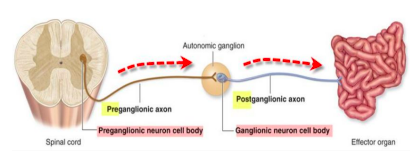
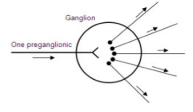
- diversion center
- may have multiple post-ganglionic axons
}}Types of Autonomic Ganglia}}
- Lateral/ paravertebral
- Terminal
- Collateral
}}Lateral/ paravertebral}}
- close to spinal cord
- sympathetic
- 3 cervical
- 12 thoracic
- 4 lumbar
- 4 sacral
}}Terminal}}
- at the wall of the organ with no or very short post-ganglionic fibers
- parasympathetic
}}Collateral/ prevertebral}}
- around the major branches of the abdominal aorta
- sympathetic
{{ Systems{{
Reciprocal and complementary relationship between sympathetic and parasympathetic system
==pre-ganglionic neurotransmitter:== Acetylcholine
==pre-ganglionic receptor:== Nicotinic receptors
]]Sympathetic]]
Thoraco-lumbar (T1-T12, L1, L2, L3)
Stress (fight and flight)
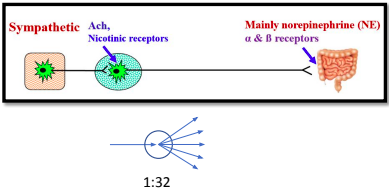
@@Degree of diversion@@: 1:32 (wide spread)
@@Neurotransmitters@@: mainly norepinephrine (NE)
@@Receptors@@: α & β receptors
<<Parasympathetic<<
Cranio-sacral (III-VII, IX, X S2, S3, S4)
Relax (rest and digestion) 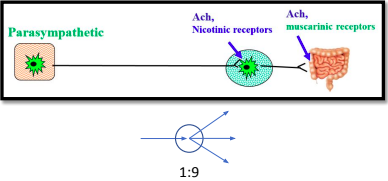
^^Degree of diversion:^^ 1:9 (localized response)
^^Post-ganglionic Neurotransmitters:^^ Acetylcholine
^^Post-ganglionic Receptors:^^ muscarinic receptors
}}Relationship}}
Reciprocal and complementary relationship between sympathetic and parasympathetic system.
Example: defecation and micturition (urine expelled from the body)
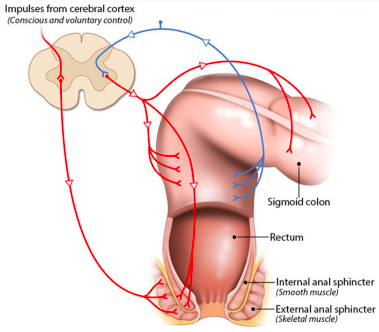
External sphincter muscles are voluntarily controlled (by somatic nervous system)
==Sympathetic== :
No defecation or micturition
Relaxation of rectal muscles
Contraction of internal sphincter muscles
^^Parasympathetic^^
Defecation and micturition
Contraction of rectal muscles
Relaxation of internal sphincter muscles