Chemical Changes
metals react with oxygen to produce metal oxides. these are oxidation reactions, because the metal gains oxygen and loses electrons, becoming a positive ion. this is seen in all chemical reactions
most metals are found in the earth as compounds, so a chemical reaction is required to extract the metal. metals like zinc, iron and copper can be extracted from their metal oxides by reacting with carbon.
metal oxide + carbon → metal + carbon dioxide
in this reaction, the metal is reduced, as it loses oxygen. this is a displacement reaction
The Reactivity Series
a metal’s reactivity is based on its tendency to form positive ions, thus their ability to lose electrons. that’s why the first 5 are group 1 metals - these get more reactive down the group and only have 1 electron in their outer shells, which is easy to lose in a reaction. the metals can be arranged based on their reactivity
most → least reactive:
potassium
sodium
lithium
calcium
magnesium
carbon
zinc
iron
hydrogen
copper
silver
gold
potassium → calcium react with water
potassium → iron react with dilute acids
the ones in bold are gases, not metals, but are commonly included. this is especially useful when considering aqueous electrolysis.
a more reactive metal can displace a less reactive metal from a compound, similar to the halogens. for example:
silver nitrate + copper → copper nitrate + silver
because copper is more reactive than silver, it displaces it in this nitrate compound.
reactions of acids and metals
acid + metal → salt + hydrogen
this is a redox reaction, meaning one substance is reduced and another is also oxidised. the metal is oxidised (think about the positive ion thing) and the hydrogen is reduced. e.g:
sulfuric acid + magnesium → magnesium sulphate + hydrogen
the pH scale
acids (pH lower than 7) produce H+ ions when dissolved in aqueous solutions (so water)
alkalis (pH greater than 7) produce OH- ions when dissolved in water
bases are insoluble, reacting with acid to produce a salt and water
alkalis are soluble in water, and form alkaline solutions
all alkalis are bases but not all bases are alkalis.
pH 7 is neutral
universal indicator can be added to a solution. it will change its colour according to the pH.
there’s two types of litmus paper - red and blue.
red litmus paper turns blue in alkaline solutions, else stays the same
blue litmus paper turns red in acidic solutions, else stays the same
these are more general identification techniques.
neutralisation
acids get neutralised by metal carbonates, which are basic. in exact quantities, this can produce a neutral solution with pH 7.
acid + metal carbonate → salt + water + carbon dioxide
acids and neutralised by alkalis/bases by the equation:
acid + alkali/base → salt + water
in this reaction, the hydrogen ions in the acid react with the hydroxide ions in the alkali/base to produce water. that can be given by the equation:
H++ OH- → H2O
the salt depends on what the acid is and also what the metal is. there are 3 acids to know:
salt formed | acid | acid formula | ion |
chloride | hydrochloric acid | HCl | Cl- |
sulphate | sulphuric acid | H2SO4 | SO42- |
nitrate | nitric acid | HNO3 | NO3- |
when you’re naming salts, the first part is the metal and the second part is the acid. remember to swap and drop where the ions for a metal are more than a single positive charge.
Required Practical: titrations
titrations are used to accurately measure how much acid is needed to react completely with a known amount of alkali or vice versa.
the point at which the reaction is complete (neutralisation has occured and a salt + water has formed) is the end point. it’s determined using an indicator
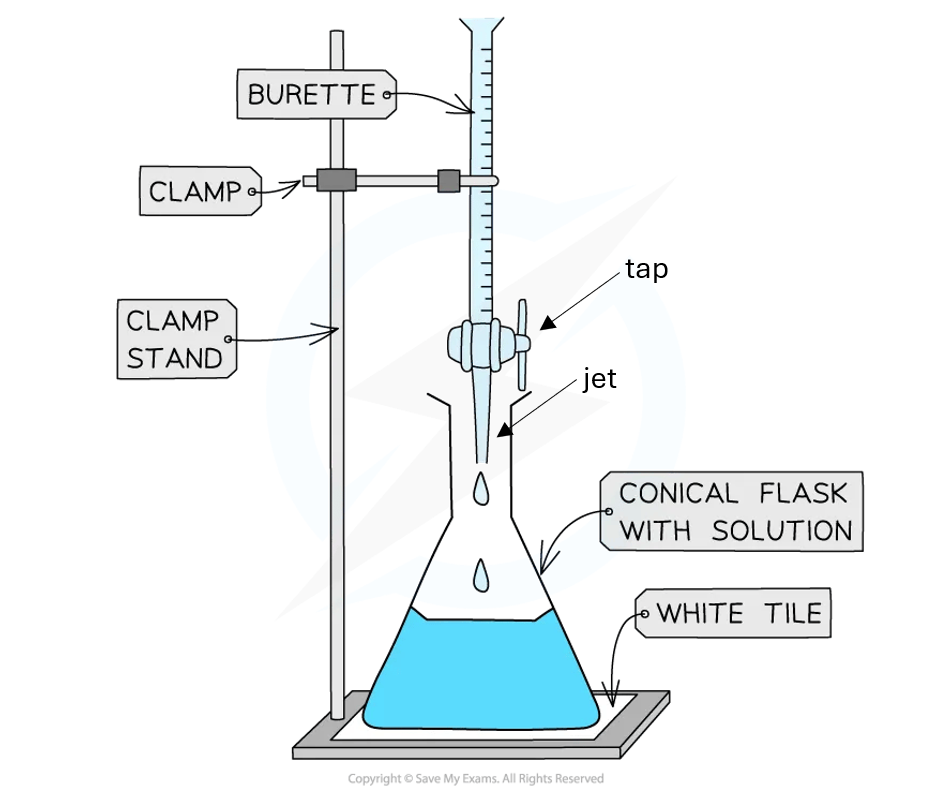
Equipment
Example results table
1 | 2 | 3 | |
final burette reading (cm3) | 24.65 | 25.10 | 25.10 |
initial burette reading (cm3) | 0.00 | 0.05 | 0.15 |
titre (cm3) | 24.65 | 25.05 | 24.95 |
titrations 2 and 3 are concordant. mean titre is average of CONCORDANT RESULTS
Method
ensure the tap is closed and use a funnel to add about 2cm3 of the acid (HCl in req prac) you’ll be using to the burette to rinse it. open the tap over the sink and empty the burette of this acid.
why rinse? acid may get diluted by water/react with substances from prior titration, reducing concentration and increasing titre
fill the burette with the acid using a funnel past the 0 cm3 mark then let acid run out until the bottom of the meniscus is around 0 cm3 (though this isn’t necessary) and record this value in results table. MOST IMPORTANTLY make sure the jet is full of acid.
make sure you remove the funnel after filling as small drops may drip into the burette and give a lower titre volume
if the jet has air in it it will fill during the titration, causing a larger titre volume
record initial burette reading in table above
measure 25cm3 of the alkali using a measuring cylinder. empty this into conical flask
add a drop of phenolphthalein indicator into the alkali, which will turn it pink. this indicator is used as NaOH (standard to be in conical flask) is a strong alkali
you can also use methyl orange indicator. in alkali it’s yellow, in acids it’s red and at the end point it’s orange.
you wouldn’t use universal indicator as it has a range of colour changes - it’s hard to determine exact end point.
open the tap to slowly add the acid into the flask and swirl the flask as you do so
as you approach what you think will be end point (same reading on burette as volume of alkali in flask) add the acid in dropwise (drop by drop by closing tap most of the way) to maximise accuracy.
when the alkali changes from pink to COLOURLESS - not clear (this is why you have the white tile - easier to observe change) close the tap.
read the burette from the top down. record final titre in table.
when you’re reading the burette, you should read .x0 if the meniscus is exactly on a marking and .x5 if it’s between marking x and marking x+1
repeat until you acheive concordant results (2 within 0.10 cm3 of each other)
for titration calculations, see quantitative chem notes.
Required Practical: soluble salts
soluble salts are made by reacting acids with solid insoluble substances, e.g. bases.
Method
measure 25cm3 of sulphuric acid using a measuring cylinder. pour this into a beaker
heat the acid gently with a bunsen burner
add 1 spatula of copper oxide as the acid heats and mix carefully
continue to add copper oxide until it stops dissolving because the solution is fully saturated
turn the bunsen burner off and let it cool
filter it using filter paper and a funnel. the salt solution will drip into the conical flask and the excess, unreacted solid is left behind on the filter paper
heat the solution in an evaporation basin. the water in it will start evaporating, until shiny crystals start to form
leave for about a day. pat the crystals dry in filter paper or put them in an oven to dry them.
Strong and weak acids
strong acids get completely ionised in aqueous solutions
weak acids only get partly ionised
as pH decreases by one unit, hydrogen ion concentration increases by a factor of 10.
strong and weak is NOT THE SAME as concentrated and dilute. strong and weak refers to hydrogen ion concentration, white concentrated and dilute refers to the amount of a substance in a given volume, usually because there’s water content.
Electrolysis
electrolysis involved breaking an ionic compound down into its ions using electricity. the flow of current through a conducting liquid causes chemical changes.
the compound being broken down is known as the electrolyte
discharged ions are the ones that gain/lose electrons - become oxidised/reduced.
if nothing else, remember PANIC at the OILRIG:
oxidation | reduction |
loss of electrons | gain of electrons |
gain of oxygen | loss of oxygen |
loss of hydrogen | gain of hydrogen |
electrolysis of molten ionic compounds
molten = melted. need to be melted because otherwise ions in ionic compounds cannot move freely and carry their charge to conduct electricity.
PANIC:
anions move to the positive cathode, where a non-metal is oxidised and produced
cations move to the negative cathode, where the metal is reduced and produced
because negatives attract.
this occurs because electrons in a metal aren’t bound to their atoms. so during electrolysis, they are free to move through the power supply, and cause the electrodes to become charged, causing them to them attract the ions in the electrolyte.
the electrodes need to be made of a material that’s inert and that conducts electricity.
electrolysis of aluminium oxide
aluminium is more reactive than carbon and thus can’t be extracting from aluminium oxide by reduction with it. we thus electrolyse it.
dissolved in molten cryolite to reduce its melting point and thus the energy cost. aluminium oxide has a high melting point due to the ionic bonding between molecules.
positive anodes are suspended in the cryolite-aluminium oxide mixture and the container is lined with the negative cathode.
aluminium is produced at the cathode, falling to the bottom of the container because it’s denser than cryolite.
oxygen is produced at the anodes but reacts with the graphite the anodes are made of (which is essentially carbon, used because it’s cheap and abundant) to form carbon dioxide and erode them over time, meaning anodes must be replaced often.
electrolysis of aqueous solutions
because you’re dissolving in water, H2 O, you need to consider the OH- and H+ ions that will be present.
at the anode:
if the non-metal is in group 7, it gets oxidised and produced. else, hydroxide gets oxidised.
at the cathode:
if the metal is less reactive than hydrogen (copper, gold, silver, platinum - think jewellery materials) then the metal is reduced and produced. else, hydrogen is reduced.
half equations
required practical: electrolysis
Method
add a drop of copper II chloride solution to a raised plastic channel within a petri dish
add a piece of blue litmus paper
thread the carbon fibre electrodes through the holes in the petri dish and into the channel with the copper II chloride. make sure they don’t touch
add crocodile clips to the electrodes and connect to a power supply. turn on the power supply
after a few minutes, turn the power supply off and observe the results
you should see copper formed at the cathode in the form of a red or brown coating, discharged because it’s less reactive than hydrogen
the litmus paper will bleach white due to the presence of chlorine, discharged at the anode because it’s a halogen