industrialization and immigration
1. Describe (in your own words) what the “Gilded Age” means.
Mark Twain came up with the term, “Gilded Age” for the period in US History between 1870 to around 1900. The era was called this because although life in the US looked great, there was truly a lot of poverty and corruption. Several groups like Native Americans, African Americans, farmers, immigrants, women, and children all suffered during this era.
2. What is Vertical Integration? (describe it)
Vertical Integration is when a company owns or controls all parts of the production process. For example, Carnegie’s steel company bought coal mines, limestone quarries, and iron ore fields, so they didn’t have to pay other companies for these materials. This helped them cut costs and control the entire process of making steel.
3. What is Horizontal Integration? (describe it)
Horizontal Integration is when a company grows by buying out its competitors. For example, John D. Rockefeller bought out competing oil companies, allowing him to dominate the oil industry and reduce competition.
4. What does Free Enterprise mean?
Free Enterprise is an economic system where people are free to run their businesses without government interference. Based on the laissez-faire theory, it allowed the U.S. to become an industrial giant in the late 1800s, leading to many new inventions.
5. What does Laissez-faire mean?
Laissez-faire means that businesses operate with little to no government interference, allowing them to succeed or fail on their own.
6. What does Social Darwinism mean?
Social Darwinism is the belief that only the strongest individuals or businesses will survive, while those that can't adapt to their environment will eventually fail or die out. It's based on the idea of "survival of the fittest."
7. Andrew Carnegie was the captain of the steel industry. He was known for using vertical integration as a part of his business practices.
8. John D. Rockefeller was the captain of the oil industry. He was known for using horizontal integration as a part of his business practices.
9. What is a Monopoly? (Explain)
A monopoly is having exclusive control of a commodity or service in a particular market, or a control that makes possible the manipulation of prices. *Rockefeller
10. What is the “Gospel of Wealth”? (Explain it)
The Gospel of Wealth is the philosophy that wealthy individuals have a responsibility to give back to society. Andrew Carnegie, a strong believer in this idea, donated millions to various charities.
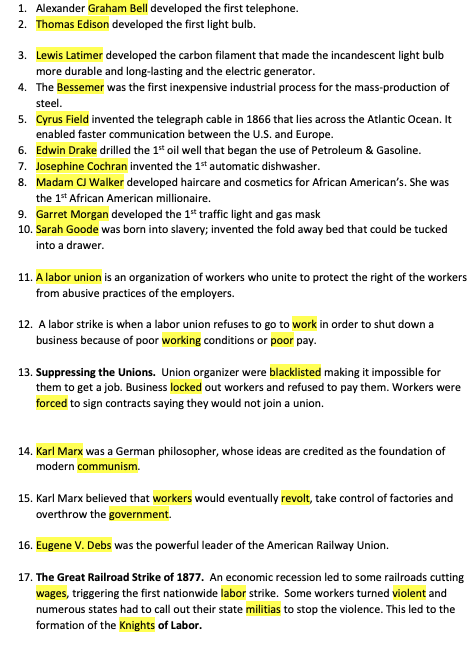
1. Alexander Graham Bell developed the first telephone.
2. Thomas Edison developed the first light bulb.
3. Lewis Latimer developed the carbon filament that made the incandescent light bulb more durable and long-lasting and the electric generator.
4. The Bessemer was the first inexpensive industrial process for the mass-production of steel.
5. Cyrus Field invented the telegraph cable in 1866 that lies across the Atlantic Ocean. It enabled faster communication between the U.S. and Europe.
6. Edwin Drake drilled the 1st oil well that began the use of Petroleum & Gasoline.
7. Josephine Cochran invented the 1st automatic dishwasher.
8. Madam CJ Walker developed haircare and cosmetics for African American’s. She was the 1st African American millionaire.
9. Garret Morgan developed the 1st traffic light and gas mask
10. Sarah Goode was born into slavery; invented the fold away bed that could be tucked into a drawer.
11. A labor union is an organization of workers who unite to protect the right of the workers from abusive practices of the employers.
12. A labor strike is when a labor union refuses to go to work in order to shut down a business because of poor working conditions or poor pay.
13. Suppressing the Unions. Union organizer were blacklisted making it impossible for them to get a job. Business locked out workers and refused to pay them. Workers were forced to sign contracts saying they would not join a union.
14. Karl Marx was a German philosopher, whose ideas are credited as the foundation of modern communism.
15. Karl Marx believed that workers would eventually revolt, take control of factories and overthrow the government.
16. Eugene V. Debs was the powerful leader of the American Railway Union.
17. The Great Railroad Strike of 1877. An economic recession led to some railroads cutting wages, triggering the first nationwide labor strike. Some workers turned violent and numerous states had to call out their state militias to stop the violence. This led to the formation of the Knights of Labor.
18. The Haymarket Riot was the disturbance that took place on May 4, 1886 in Chicago, it began as a rally in support of striking workers.
19. The Homestead Strike occurred in 1892 when workers of Andrew Carnegie’s U.S. Steel went on strike after a tense labor dispute led to a lockout. This was one of the most violent strikes in U.S. history and a major setback for unions.
20. The Pullman Strike refers to a nationwide conflict between labor unions and railroads that occurred near Chicago in 1894. Following the firing of union workers, Eugene Debs organized a strike that shut down the nation’s railroads and threatened the economy.
21. The Impact of Unions Strikes. Union membership declined as many people saw unions as being Un -American and violent.
22. The American federation of Labor was the union of over 20 trade unions. The American Federation of Labor (AFL) was the unions 1st leader. He believed that unions should stay out of politics and they should negotiate rather than go on strike.
23. IWW Wobblies, the International Workers of the World is the union created in 1905 that was made up primarily of socialists and anarchists They called for workers to united as “one big union.” They were considered radicals.
24. Mary Harris “Mother” Jones was one of the nation’s most prominent women’ union leaders during the American Industrial Revolution. She became an organizer for the United Mine Workers. She traveled to numerous mining camps to see conditions miners had to endure. She gave fiery speeches for miners to unite to fight for better working conditions and better pay.
25. Women’s Trade Unions League (WTUL) was the first union organized to address women’s labor issues.
1. Where is Angel Island located? What happened there? Who had access to Angle Island?
Angel Island is located in San Francisco Bay. It was an immigration processing center, mostly for Asian immigrants. It was the main entry point into the US for people arriving from Pacific routes. More than 1 million people were processed at the station. Immigrants weren’t welcomed and struggled.
2. Where is Ellis Island located? What happened there? Who had access to Ellis Island?
Ellis Island is located in New York Harbor. It was mostly for European immigrants. It welcomed immigrants, and the vast majority were processed immediately.
3. What is Nativism?
Nativism is an extreme dislike for foreigners by native-born people and a desire to limit immigration.
4. Why did nativists oppose Immigrants?
Nativists felt threatened. They thought immigrants contributed to rising crime rates and took jobs from native-born Americans.
5. What was the Chinese Exclusion Act? What did it do?
The Chinese Exclusion Act was the law passed by Congress that greatly reduced the number of Asian immigrants coming to America in the late 1800s. The law barred Chinese immigration for 10 years and prevented the Chinese from becoming U.S. citizens.
6. What was the Gentleman’s Agreement? What did it do?
The Gentlemen's Agreement was an informal agreement between the United States and Japan the San Francisco Board of Education for all Chinese Japanese and Korean children to attend racially segregated oriental schools Theodore Roosevelt agreed to place a limit on Japanese immigration if the school board would rescind its segregation order.
7. Who was Jacob Riis? What did he do?
Jacob Riis was a journalist whose books vividly described the lives of ethnic groups in New York City's tenement slums.
8. What happened at the Triangle Shirt Waist Factory?
The Triangle Shirtwaist Factory fire in New York City in 1911 was the largest industrial disaster in the history of New York City. When a fire broke out in the factory workers were locked in with no way out.
9. What happened as a result of the tragedy at the Triangle Shirtwaist Factory?
As a result of the fire, more strict building codes and increased factory inspections were made possible.
10. Who was Jane Adams? What did she do that was important that was important to the community?
Jane Adams was the founder of the US settlement house movement and one of the first women to be awarded the Nobel Peace Prize. She co-founded Hull House in Chicago, the first settlement house in the US located in poor neighborhoods. She also provided medical care, childcare, libraries, and English classes.
Political Machines
- Command support from their supporters and in return they will receive favors
Political boss
- (typically, the mayor) controlled jobs, and businesses licenses, and influenced the court system
Tammany Hall
- New York City's powerful democratic political machine
Boss Tweed
- William M. Tweed, head of Tammany Hall
Kickbacks
- Illegal practice of getting contract workers hired by the bosses to overcharge the city for their services
Graft
- The illegal use of political; influence for personal gain
| Where did they come from? | Why did they move? |
“Old Immigrants” (before 1880) | Primarily England (Europe) | They hoped for better lives and opportunities (economic opportunities, religious and political freedom, famine and poverty, and land availability). |
“New Immigrants” (1880-1924) | From southern and eastern Europe (Italy, Poland, and Hungary). | Economic opportunity, religious and political persecution, overpopulation, famine, and poor living conditions |
European immigrants - Mainly from southern and eastern Europe - Motivated by economic opportunity, escaping poverty, unemployment, and overpopulation - Settled in urban areas in northeastern and midwestern U.S. - Worked in factories, mines, railroads, laborers - Faced cultural resistance but weren’t subject to as many explicit exclusion laws | Both - sought better economic opportunities and escape from poor living conditions - experienced significant discrimination - seen as a threat to Americans - worked low-paying, labor-intensive jobs, fueling industrial growth - contributed to the diverse cultural fabric of the U.S
| Asian immigrants - mainly from China and Japan - motivated by labor demand, especially in agriculture, railroads, and mining - drawn by the construction of the transcontinental railroad - faced severe restrictions (Chinese Exclusion Act, gentleman’s Agreement) - settled on the west - faced more racial discrimination |
Americanization
- Definition – the process of assimilating immigrants into American culture, language, and norms
- significance – aimed to integrate immigrants into American society, but pressured them to abandon their culture and traditions
U.S. Naturalization Act of 1870
- definition – law extended naturalization rights to white persons and people of African descent but excluded, Asians and other nonwhites from citizenship
- significance – reinforced racial barriers in citizenship, excluding many groups, particularly Asians
Chinese Exclusion Act
- definition – federal law that prohibited Chinese laborers from immigrating to the U.S
- significance – the first major law restricting immigration based on ethnicity and set a precedent for future immigration restrictions
Gentlemen’s Agreement
- definition – an informal agreement between the U.s and Japan to limit Japanese immigration
- significance – an early example of immigration control through diplomatic means and targeting a specific immigrant group
nativism
- definition – political and social movement favoring native-born citizens from immigrants
- significance – fueled anti-immigrant sentiment and led to policies restricting immigration and discriminated against newcomers
1. What is the Spoils System? Explain/Define.
The spoil system, AKA patronage, is a practice in politics where a political party gives jobs in exchange for roles period this gives supporters access to money and political favors.
2. Who was James Garfield? What happened to him? Who did it? Why?
James Garfield was a former president of the United States. He was assassinated by a stalwart who wanted Arthur as president.
3. Who becomes President after James Garfield?
Vice President Chester Arthur becomes the 21st president after James Garfield.
4. What is Patronage?
Patronage is an act of giving government jobs to supporters of the winning party in an election; it's also called the spoil system.
5. Define Stalwarts
stalwarts were Republicans who supported patronage government jobs went to family and friends instead of people who deserved them
6. Define Half Breeds
have pizza republican reformers who wanted an end to the patronage system
7. Explain how the Civil Service replaced patronage.
a. Merit System: hired the most qualified for jobs
b. Pendleton Act: required that some jobs be filled by competitive written exams rather than by patronage = civil service
8. Define Wabash-v-Illinois
Only the federal government has the power to regulate rates for traffic between states. Rates must be reasonable and fair.
9. How did Wabash-V-Illinois help the smaller railroad companies?
The case helps smaller railroad companies by ruling that individual states couldn't regulate Interstate commerce which includes railroad operations across state lines. This led to the creation of the Interstate Commerce Commission.
10. The Interstate Commerce Commission (ICC) was created in response to Wabash-v-Illinois what did it do?
The ICC was created to make rates reasonable and fair. It also made it illegal to charge higher rates for shorter hauls (prohibited discriminating against small markets). It was ineffective because there was no enforcement of the law.
11. What was the Sherman Anti-Trust?
The Sherman Antitrust Act made it illegal to combine a company into a trust or conspire to restrain trade or commerce created to curb the power of large businesses. It wasn't enforced because it was too vague.
Would J. Rockefeller have supported the Sherman Anti-Trust? Why? Why Not?
Rockefeller wouldn't have supported the act because it aimed to break up monopolies and restrict the power of large corporations. The act threatened his business practices of consolidating control over the oil industry and eliminating competition.
12. What are the Reconstruction Amendments? Define.
a. The 13 Amendment - abolished slavery and involuntary servitude except as a punishment for a crime
b. The 14th Amendment - granted citizenship to all people born in the US and guaranteed equal protection under the law
c. The 15th amendment - prohibited denying the right to vote based on race, color, or previous condition of servitude
13. Define Plessy-v-Ferguson
the Supreme Court legalized segregation in the nation.” separate but equal” as long as public facilities were equal. However black facilities were never equal to white facilities
14. Who was Ida B. Wells? What did she do?
Ida B Wells was an African American journalist and activist. She is known for her work against lynching and advocating for rights through her speeches/writing.
15. Who was Susan B. Anthony? What did she do? What group did she establish?
Susan B Anthony was a women's rights activist and key leader of the women's suffrage movement. She fought for women's right to vote and equal rights. She co-founded the National woman's Suffrage Association.
16. Define the 19th Amendment.
It guaranteed the right to vote.
Compare and Contrast Booker T Washington and WEB Dubois
Booker T. Washington - Former slave - Wrote, “up from slavery.” - Stressed vocational education for African Americans - Promoted gradualism and economic self-sufficiency - Founder pf Tuskegee institution | Both - advocated for the advancement of African Americans - leaders in the African American community - educators/authors - worked to improve African-American status | W.E.B. Dubois - fought for immediate black equality - demanded the top 10% of the talented black population be placed in power positions - gain equality by breaking into the power structure - founder of NAACP (National Association of Advancement of Colored People) |