Banking and the Expansion of Money Supply
Banking system
Is made up of many banks, including commercial and investment
Commercial Banks
Store your money and pay you interest
This is labeled under a bank’s liabilities side, however, they loan out some of your money on interest to make money, so that is on their assets side of their balance sheet
Fractional reserve banking allows banks to hold only a fraction of deposits (as set by the central bank) as reserves, enabling them to create new loans and expand the money supply in the economy.
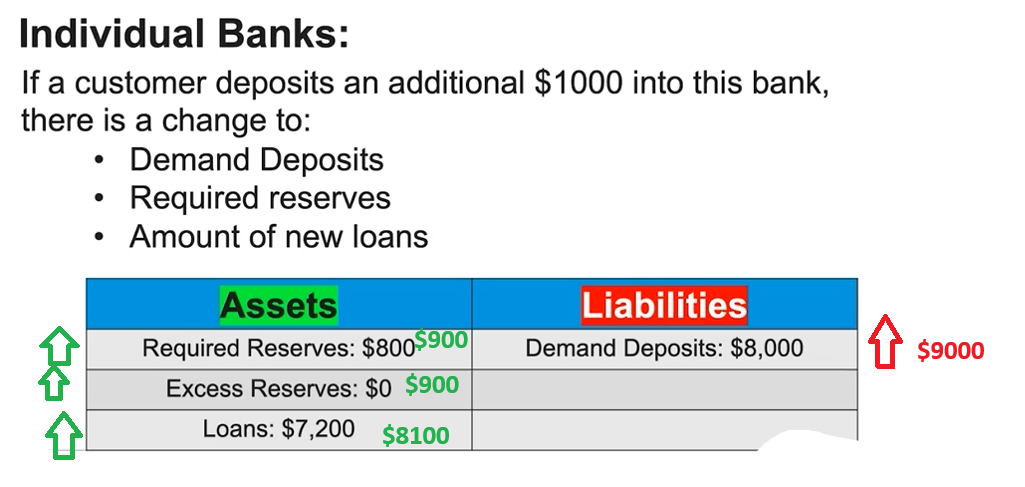
Required reserves are the % of demand deposits banks must hold in their reserves
Excess reserves are the % of demand deposits banks choose to hold on to, to loan out.
Assets and Liabilities must equal each other
Banks and Money Creation
When a bank loans out its excess reserves, those loans get redeposited into other banks
Individual banks can make new loans- or fewer loans- based on the behaviors of their customers
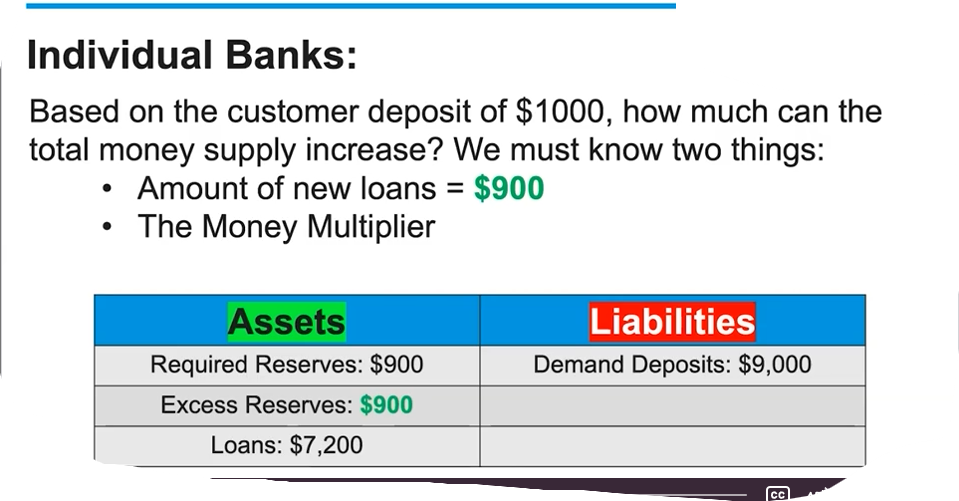
The Money multiplier is used to determine maximum changes to the banking system when deposits or withdrawals from demand deposits occur.
Money Multiplier (MM) = 1 / Reserve requirement (rr)
So, if there are excess reserves of $900 to be loaned out, then, with a 10% reserve requirement, it can create a maximum increase in the money supply of up to $9,000, as the money multiplier of 10 amplifies the initial excess reserves.
To calculate the total change in the banking system of demand deposits, multiply the amount of money invested by the money multiplier
Maximum change in money supply = (amount added (or withdrawn) x money multiplier) - initial investment
Total reserves is found by Monetary base - currency in circulation