Ch. 5 Xray Rube Rad 154
Chapter Overview
Chapter Title: The X-Ray Tube
X-ray tubes are essential for radiographic imaging.
Work on the principle of electron flow through a vacuum.
Production of X-Rays
Key Elements Involved:
Source of Electrons: Cathode filament.
Target: Tungsten anode.
Operates under High Voltage power supply.
Vacuum
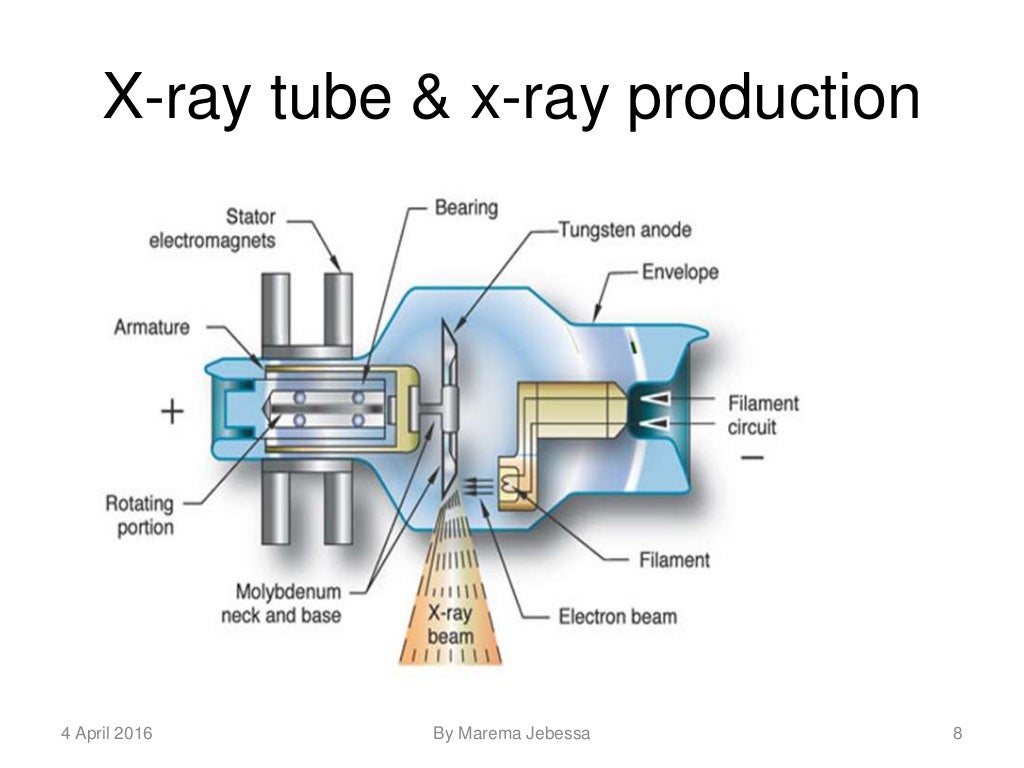
Tube Components
Major Components:
Stator:
Contains electromagnets and bearings.
Envelope:
Encloses the internal components of the tube.
Rotating Portion:
Includes filament and electronic circuits.
Filament:
Made from thoriated tungsten, impacts radiation detail.
Electron Beam:
Generated from the filament and directed towards the target.
Bearing:
Ensures stability and alignment of electron beam
Tungsten anode:
High melting point allows energy absorption and minimizes heat damage.
Armature:
Provides structural support for the anode and proper positioning of X-ray tube components.
Molybdenum neck and base:
Ensures efficient thermal conduction and stability during operation.
The Cathode Assembly
Components:
Filament: Produces electrons when heated; negative side of x-ray tube; low voltage side of circuit & coiled tungsten wire in focus cup.
Focusing Cup: Directs electrons towards the anode.
Wiring: Connects the components for operation.
Cathode: The negative side of x-ray tube.
Function of Cathode: Produce a thermionic cloud, conduct the high voltage to the gap between the cathode and anode, and focus the electron stream as it heads towards the anode.
The Filament
Specifications:
Coil of thoriated tungsten
0.1-0.2 mm thick
1-2 mm wide
7-15 mm long
Filament length and width impact recorded detail
Not all of the electrons that are thermionically emitted from the filament are driven to the anode or return to the filament ; effects causing scatteration and additional x-rays.
Saturation current: Filament that affects the efficiency of x-ray tube. As kVp increases, more thermionically emitted electrons accelerate towards the anode. Once achieved, there is no further thermionic electrons driven towards the anode.
Filament Material
Chosen Materials:
Tungsten: High melting point, difficult to vaporize & will not produce thermionic emission below 2,200 celsius.
Others: Rhenium and molybdenum as alternatives due to their similar properties.
Thermionic Emission
Process:
Heating of filament releases electrons from filament into cathode space.
Cathode filament is in low temperature, pre-heat mode until exposure is initiated.
Tube Failure
Common Issues:
Tube arcing: Caused by tungsten vapor deposit on the inner surface of glass envelope which immediately destroys the tube. Also causing increased filtration of primary beam & decreases tube efficiency.
Happens when there is a short-circuit causing disruption; loss of exposure from x-ray output
Anode heel effect causes tube arcing as a result of the uneven distribution of electrons
Filament breakage: Filaments become very thin as vaporization continues, once 10 percent of the diameter has vaporized, a filament will potentially break, the same way a tungsten light bulb filament burns out.
Results in loss of electron generation
The Focusing Cup
Features:
Composed of nickel
Low negative potential (repels all electrons) applied for thermionic cloud compression
All electrons from filament will return to the anode and contribute to the production of X-rays.
Key Effects:
Made of nickel, applies negative charge to compress the electron cloud.
Biased Focusing Cup: Enhances the focus by adjusting charge; Maintains the cup at a more negative voltage than the filament.
Space Charge Effect: As more electrons build up in the area of the filament, their negative charges begin to oppose the emission of additional electrons; limiting the x-ray tubes.
Grid-Biased Tubes
Function:
Improve control over thermionic cloud causing charges tp alternate in focusing cup from negative (repel) to positive (attracts)
Regulate the flow of electrons producing x-ray photons
Grid acts like gates for electrons
The Anode Assembly
Functions:
Serves as the target surface for electrons.
Conducts high voltage; maintains closed circuit.
Acts as a primary thermal conductor (heat; high voltage)
Components:
Anode, Stator & Rotor
Stationary vs. Rotating Anode
Stationary anodes consist of copper and tungsten targets.
Molybdenum used in rotor construction
Rotating anodes allow for heat dissipation and higher exposure rates .
Tungsten-rhenium alloy material
Rotating Anode
Material:
Tungsten is the metal choice for source of x-ray photons.
Primary reasons: High atomic number, High melting point, Heat conduction
Focal track reaches temperature between 1000-2000 celcius; can go higher if tube load increases.
Rhenium provides greater elasticity when focal track expands rapidly due to the intense heat.
These procedures are specified by the tube manufacturers and are designed to bring the anode heat.
Warm-Up Procedure
Purpose: To evenly heat the anode, preventing cracks and maintaining the vacuum. Also relieves stress on anode.
The Target Area
Definition: Area where the electron stream hits the anode, critical for x-ray production.
Actual focal spot: Describes the physical area of the focal track that is impacted.
Effective focal spot: Describes the area of the focal spot that is projected out of the tube toward the object being radiographed.
The effective focal spot size is controlled by the side of the actual focal spot (controlled by the length of filament) & the anode target angle.
When the target angle is less than 45 degrees, the effective focal spot is smaller than the actual focal spot.
The most common diagnostic radiography target angle is 12 degrees.
Includes:
Portion of anode in contact with electron stream
Terminology: target, focus, focal point, focal spot, focal track
Produces the x-ray photons needed for imaging.
Anode Heat Loading
Factors:
Rotating anode specifications: RPM (3,600-10,000)
Diameter of disk - from 55mm to 100mm
Target material considerations
Difference between actual vs. effective focal spot
Anode Heel Effect
The use of the line-focus principle causes a problem known as the anode heel effect.
As electrons hit the target, x-rays are produced and primarily emitted at angles of 45-90 degrees towards the direction of the electrons. Some x-rays are absorbed by the anode or tube housing, while others emitted from the target surface spread in all directions.
The Stator
The stator is made up of induction-motor electromagnets that rotate the anode. It is the only part of the cathode or anode assemblies located outside the vacuum. The electromagnetic force from the stator makes the rotor turn, while keeping the high voltage away from the stator coils for safety.
If the stator fails, the rotor won't be able to turn the anode. This can cause the anode to overheat and melt in one spot since rotating anodes are not built to handle the heat when they are not moving.
Location:
Located outside the envelope, consists electromagnet banks.
Stator failure can disrupt tube operation.
The Rotor
The rotor is located inside the envelope of the X-ray tube and is connected to the anode disk by a molybdenum shaft. It looks like a hollow cylinder and is turned by the electromagnetic field produced by the stator. This rotation helps in the functioning of the X-ray tube.
Design:
Copper component connected to anode disk.
Activated energized stator, helps in heat dissipation.
The Envelope
The cathode and anode assemblies (expect for the stator) are made of glass or metal envelope called the tube.
The glass envelope of an X-ray tube is made from heat-resistant Pyrex glass that is shaped into a tube. One end of the tube connects to the cathode assembly, and the other end connects to the anode assembly.
Specifications:
Made of Pyrex glass or metal
10" long
6" central diameter
2" peripheral diameter
Contains the window and vacuum necessary for operation
Vacuum
Near perfect and critical to efficient x-ray production
Tube Window
Area of x-ray beam exit to receptor
Protective Housing
Purpose:
Controls leakage and scatter radiation; Isolates high voltages.
Provides cooling tube equipment
Control of Leakage and Scatter Radiation
Construction:
Housing made of lead-lined cast steel, with limits on leakage radiation set at 100 mR/hr at 1 meter.
High-Voltage Isolation and Tube Cooling
Cooling Mechanisms:
Dielectric oil provides insulation and promotes cooling, sometimes circulated through a heat exchanger with an air fan.