PSY335 Quest #1 Study Guide
CHAPTER 1 CONTENT
Bucharest, Themes in Childhood
History of Child Development
What are four reasons why it’s important to study childhood development?
Improving adult health and well-being
Studying child development is optimizing the conditions of development
Asks the question: What potential impact can the research have on broader social policies?
Enhancing parenting and teaching practices
Bucharest Early Intervention Project
Make sure to understand:
Concept of experience-expectant plasticity, and how it relates
A baby’s brain is easily shaped by the experiences/environment that they are exposed to. They are expecting cetain experiences in order for development to procees. In the BEIP, institutionalizion had negative effects on this.
Concept of sensitive periods, and how it relates
Sensitive periods: the window of timing in which exposure needs to happen for development to proceed- this relates to the timing of remediation
The methods (i.e., research questions they were trying to answer, type of study designs they used and why)
Research Questions: What type of effects does institutionalization have?(correlational); Can these effects be remediated?(experimental); Does the timing of remediation make a difference?
Some basic research concepts to know: IV, DV, experimental vs. correlational design
IV: whether they are in foster care or institution
DV: outcomes (IQ score differences)
Experimental vs. Correlational Design: experimental designs test cause and effect by changing variables, while correlational designs only measure natural relationships without changing anything
Why use random assignment?
To eliminate bias
Whether this study is considered ethical (according to the researchers)
researchers said that for kids staying in the institution, this is just a continuation of their life circumstances
Rule of non-interference: if a child was put in the “care as usual” group and a family came by to adopt them, the researchers would not interfere
The three main findings I shared with you (outcomes related to IQ)
Community children had higher averge IQ scores than institutionalized children
children who had been placed into foster care had significantly higher IQ scores than those who remained in “care as usual”
Placement into foster care does appear to remediate some of the negative effects of being institutionalized
What’s the difference between secure vs insecure attachment style?
Secure attachment is characterized by low anxiety and low avoidance, allowing people to form trusting, healthy relationships
Insecure attachment involves high anxiety and/or avoidance, leading to emotional distress, fear of rejection, or discomfort with intimacy
Gist of additional findings I shared with you (three outcomes related to attachment style)
early institutionalization severly disrupts a child’s ability to form normal attachment styles
placement into foster care before the age of two represents a critical window for substantial gains in attachment security compared to later interventions
high-quality foster care can successfully reverse these effects, enabling children to recover and form secure bonds with caregivers
Subsequent policy change as a result of this project
Romanian government changed the law so that children under age 2 could not be placed into institutions
What was the very early view of children? How did they think about children?
Very early view of children was that they were essentially defective adults
How did philosophers then start thinking of children?
Philosophers in 17th and 18th century started thinking about children in a different way. For example, Locke’s concept of tabula rasa (blank slate)
Specifically, what was Locke’s view of how children develop?
Children are not born with any innate knowledge or pre-set ideas.
What is the modern view of child development?
biology and the environment constantly interact to shape a child's brain, physical health, and emotional well-being (nature vs. nurture)
How did Piaget contribute to this?
Piaget saw kids as “little scientists”; children of different ages think in qualitatively different ways.
What were the Piaget diaries?
Diaries that Jean Piaget and his wife kept on the early development of their three children.
Recurring Themes
Make sure you understand the gist of three major themes:
nature/nurture interaction (understand example we used?)
shapes human development through a continuous, bidirectional partnership rather than a simple competition
discontinuous vs. continuous models of development
Discontinuous development: Views development as taking place in specific, unique stages
Continuous development: views development as a slow, steady, and ongoing process.
active child
children shape their own growth and learning through their own actions, curiosity, and choices
CHAPTER 2 CONTENT
HEREDITY PART I and PART II PPTs
Nature of Nature (sec 2.1)
Why do we talk about heredity in a psych class?
Psychology studies both nature (genes/biology) and nurture (environment/experience) to understand why people are the way they are.
Know the basics of chromosomes and genes from the first few slides
DNA = the molecule containing our genetic information.
Genes = sections of DNA that contain instructions for particular characteristics.
Chromosomes = structures made of DNA that contain many genes.
Humans normally have 46 chromosomes, arranged in 23 pairs.
You inherit 23 chromosomes from your mother and 23 from your father.
Know the difference between single gene vs. polygenic traits – which is more common?
Single gene traits: mainly controlled by one gene, uncommon for complex human characteristics
How was King Henry VIII relevant to this lecture?
King Henry VIII famously wanted a male heir and blamed his wives when they didn't produce surviving sons. But genetically, the father determines whether a child receives an X or Y chromosome:
mother always contributes to X, whereas the father can contribute to either X or Y.
What’s a karyotype?
picture of one’s chromosomes, typically used to detect chromosomal abnormalities
What are autosomes vs. sex chromosomes?
autosomes: chromosome pairs 1-22
sex chromosomes: pair 23 (either XX or XY)
Chromosomal abnormalities (sec. 2.2)
Down Syndrome
What causes it?
Chromosome 21 has three copies instead of 2. The error occurs when egg or sperm cell undergoes cell division
What are specific characteristics of it (i.e., facial characteristics, types of health problems, types of psych problems)?
intestinal problems, heart problems, flattened facial profile, hindered speech development, lower intellectual ability
What are commonly researched risk factors for having a baby with Down?
Higher maternal age
Sex-linked chromosomal abnormalities
Male with extra sex chromosome [XYY or XXY (Klinefelter)]
Female with abnormal number of sex chromosomes [X (Turner) or XXX (Triple X)]
Genetic Abnormalities (sec 2.2)
Know these key terms: dominant vs. recessive, homozygous vs. heterozygous, genotype vs. phenotype, alleles
Dominant: an allele that shows up in the phenotype when you have at least one copy (ex, BB, Bb)
Recessive: an allele that usually only shows in the phenotype when you have two recessive copies (ex: bb)
Homozygous: you have two of the same alleles (ex: BB= homozygous dominant)
Heterozygous: you have two different alleles (ex: Bb)
Genotype: the alleles/genetic combination you have
Phenotype: the observable trait produced
Alleles: different versions of the same gene (ex: B and b)
Do you understand how Mendelian inheritance patterns work?
How traits can be passed from parents to children through alleles
Could you work out an example with a Punnet square?

What would baby need to happen to inherit an autosomal recessive disorder?
The disorder will be expressed only in the homozygous recessive child
carriers have one recessive gene and one dominant gene
Do autosomal recessive disorders affect males and females equally?
Yes, they do
What three autosomal recessive disorders did we discuss?
PKU: occurs when someone can’t metabolize phenylalanine, an amino acif found in protein-rich foods
leads to severe intellectual disability
screened for in newborn screening
Sickle Cell Disease: occurs when abnormal hemoglobin makes red blood cells stiff and sickle-shaped
chronic pain, fatigue
more common in certain ethnic groups where malaria is common
treated through blood transfusions
Tay-Sachs Disease: genetic mutation stops baby’s body from making an enzyme, without the enzyme, fatty acid buildup damages nerve cells in the brain
symptoms include seizures, motor skill regression, cherry red spots around retina
What are sex-linked genetic abnormalities?
genetic disorders caused by genes located on the sex chromosomes (X or Y) rather than the autosomes.
Do they affect male and female babies equally?
men are more likely to inherit the abnormality
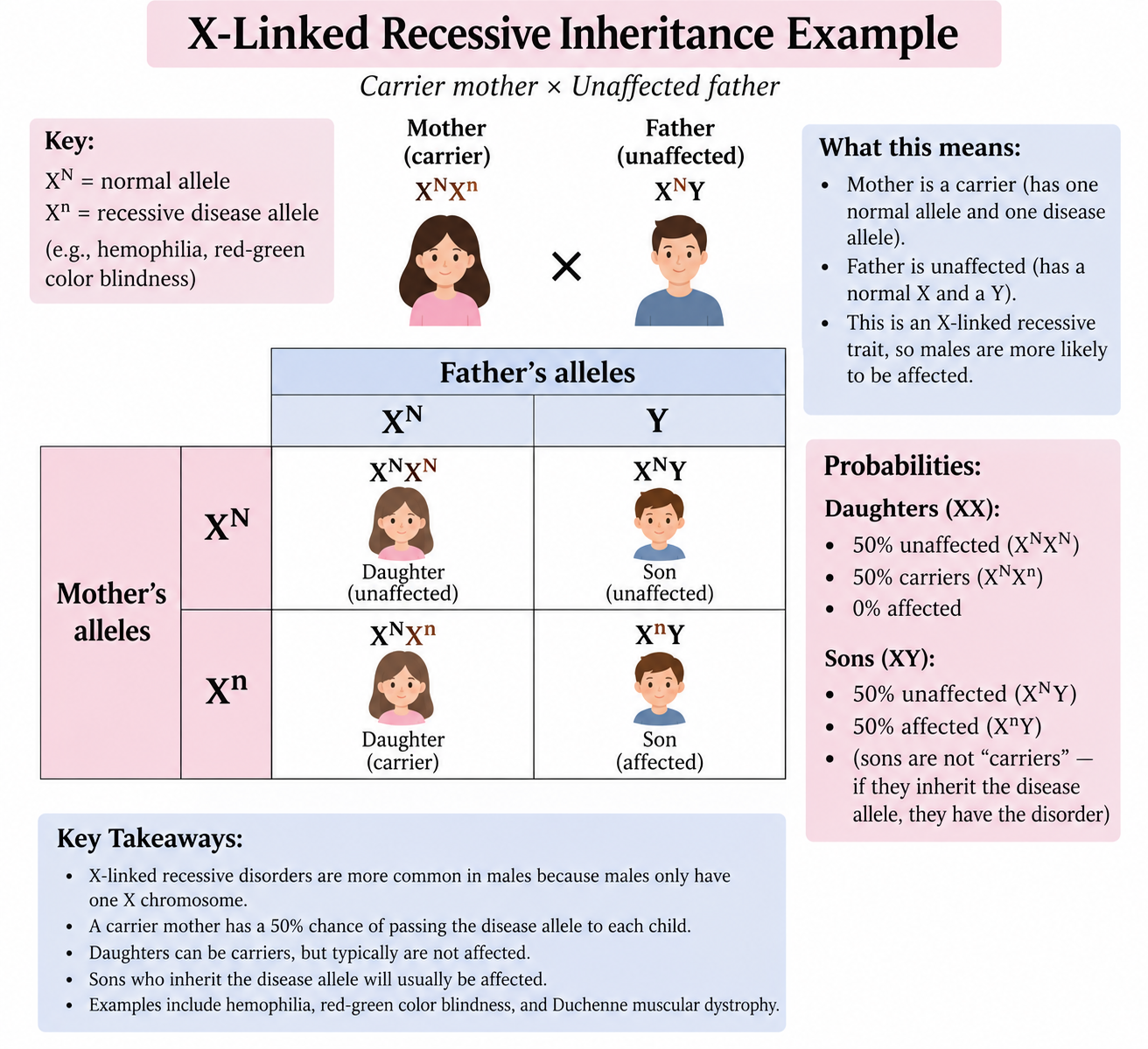
What are two specific examples of X-linked, recessive genetic abnormalities that we discussed?
Red-green color blindness and Hemophilia (Royal Disease)
Could you figure out the chance of son or daughter being a carrier (or having the trait/disease) in an example?
CHAPTER 3 CONTENT
PRENATAL DEVELOPMENT PPT
Environmental Influences on Prenatal Development (sec 3.4)
Which of the four conceptions about pregnancy are true vs. false?
False: fetal heart rate is an indicator of the sex of a baby
False: you have to double your diet when your’re pregnant. However, a higher caloric and nutrient intake is important
True: women may have difficulty concentrating during the first trimester of a pregnancy
False: having sex while pregnant will hurt the baby
What are teratogens?
environmental agents that can harm the embryo or fetus
Make sure you understand the specifics of the Thalidomide example and how that relates to the idea of a “critical period.”
drug originally meant for sleep, eventually began being market as a nausea medication for pregnant women
women who took thalidomide during the critical period (weeks 5-7) ended up giving birth to children with limb-related deformities
What is Minamata Disease?
neurological disorder caused by severe mercury poisioning
fish in Minamata Bay, Japan became contaminated with waste and plastic from a factory
many people ingesting the fish from the bay developed minamata disease
difficulty speaking, tremors, seizures, poor vision (vast majority passed away)
pregnany women with the disease had impacted fetuses that were born with neurological problems
Alcohol:
What are its effects on the fetus? How come we see these effects?
difficult for the fetus to metabolize alcohol
we see these effects because alcohol can cross the placenta into the fetus’ bloodstream
What percentage of women drink during pregnancy (in the US)?
15%; 4% binge-drink
What age group is most likely to drink during pregnancy? How about binge drink? (CDC graph)
aged 34-39 are most likely to drink during pregnancy, 18-24 most likely to binge-drink
What are the specific characteristics of fetal alcohol syndrome? Make sure you understand the details here.
facial deformities (small head, upturned nose), physical health problems, and psychological problems
What does the course of FAS look like over time?
physical attributes fade away over time
often, academic and behavioral deficits persist (resemble ADHD)
Cigarettes:
What are its effects on the fetus?
short-term stimulates the fetus, less is known about long-term effects
cognitive difficulties and birth problems
What are some negative outcomes associated with smoking while pregnant?
pre term birth, low birth weight, stillbirth
What demographic may be more likely to smoke? (CDC graph)
younger mothers with lower levels of education
Illegal drugs:
What is neonatal abstinence syndrome, including symptoms? How long does it usually last?
babies will excessively cry, very hard to sooth
issues with feeding: vomiting, not getting enough calories
tremors, seizures
What types of drugs can cause this? And then, what drug exposure most commonly causes this?
heroin, methadone; opioids most commonly cause this
How is NAS typically treated?
sometimes with medication
baby may be given some of the drug/a substitute and slowly waned off it
Long-term effects: What’s the problem in trying to study these?
very difficult to isolate the effects of one drug
inethical to experiement with
much of the research must be observational