Second Semester Final Study Guide
UNIT 4 – Inheritance of Traits
- DNA/Genetic Material
a. Role of DNA- containstheinstructionsneededforanorganismtodevelop,survive,andreproduce
b. Structure of DNA - doublehelix
c. What does DNA stand for? deoxyribonucleicacid
d. What are chromosomes? - threadlikestructuresmadeofproteinsandDNA,locatedinthenucleusofthecell
e. What are homologous chromosomes?- twochromosomesinapairnormallyinheritedfromthemotherandonefromthefather
f. Define haploid and diploid- havingasinglesetofunpairedchromosomes;containingtwocompletesetsofchromosomes,onefromeachparent
g. What is the normal human chromosome number?- 23
h. What are gametes?- amaturehaploidorfemalegermcellwhichisabletounitewithanotheroftheoppositessexualreproductiontoformazygote
- Meiosis
a. What is the main purpose of Meiosis?- toproducegameteswithhalfofthegeneticcomplementoftheparentcells
b. What is the result of Meiosis?- fourgametecells
\
- Inheritance Terminology – Define the following.
a. Gene - thebasichereditypassedfromparenttochild
b. Allele - oneoftwoormorealternativeformsofagenehatarisebymutationandarefoundatthesameplaceonachromosome
c. Trait - ageneticallydeterminedcharacteristic
d. Homozygous - havingtwoidenticalallelesofaparticulargeneorgenes
e. Heterozygous - havingtwodifferentallelesofaparticulargeneorgenes
f. Dominant - adominanttraitorgene
g. Recessive - arecessivetraitorgene
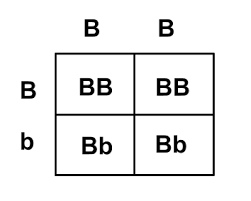
- Punnett Squares (reference practice sheets)
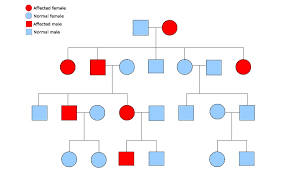
- Pedigrees
a. Know all symbols and how to differentiate between a marriage and offspring
b. Know how many generations are listed
c. Know the difference between male and female
UNIT 5- Structure, Function, and Growth
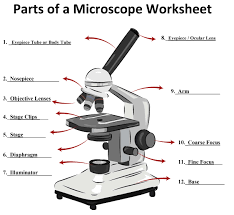
- Microscopes a. Know major parts/functions
- Organelles a. Know the different organelles/structures in animals vs. plants
i. Lysosome- anorganelleinthecytoplasmofeukaryoticcellscontainingdegradativeenzymesenclosedinamembrane
ii. Large central vacuole- foundinplantcells,aspherefilledwithfluidandmoleculesthatstoreswaterandmaintainspressure
iii. Chloroplast- aplastidthatcontainschlorophyllinawhichphotosynthesistakesplace
iv. Cell Wall- arigidlayerofpolysaccharideslyingoutsidetheplasmamembraneofthecellsofplants
v. Mitochondria- thebiochemicalprocessesofrespirationandenergyproductionoccur
vi. Golgi Apparatus- afactoryinwhichproteinsarereceivedfromtheERarefurtherprocessedandsortedfortransport
vii. Nucleus- therepositoryofgeneticinformationandasthecell’scontrolcenter,DNAreplication,transcription,andRNAprocessingalloccurinhere
viii. Cell Membrane- thesemipermeablesurroundingthecytoplasmofacell
ix. Ribosomes- aminuteparticleconsistingofaRNAandassociatingproteinsfoundinlargenumbersinthecytoplasmoflivingcells
- Cell Cycle – Define the following
i. Interphase- periodofthecellcyclebetweencelldivisions
ii. Mitosis- partofeukaryoticcelldivisionduringwhichthenucleusdivides
iii. Cytokinesis- divisionofthecytoplasm
- DNA
a. Structure & Function
b. Components/Synthesis
i. Back bone- sugar and phosphate
ii. Bases- adenine, guanine, cytosine, thymine
iii. Base Pairing- a and t (apple in the tree) and c and g (car in the garage)
- RNA a. Structure & Function b. Components/Synthesis i. Back bone ii. Bases iii. Base Pairing iv. Comparison to DNA
- Protein Synthesis a. Structure & Function b. Components i. Amino acids ii. mRNA iii. iii. Codon c. Synthesis location and orderi. Translation ii. Transcription
- Central Dogma of Molecular Biology
- Mutations
- Body Systems and Homeostasis
a. What is homeostasis?
b. Hierarchy of Living Things
c. Feedback mechanisms
i. Positive and example
ii. Negative and example
d. Be familiar with the Body Systems
Unit 6 – Ecosystems Stability and the Response to Climate Change.
- \
\
\
\
\
\
\
Human Impact on Ecosystems
Define and explain the following.
a. Anthropogenic Changes:b. Habitat Destruction:c. Deforestation:d. Invasive Species:e. Overexploitation:
f. Pollution:g. Impact of technology:
h. Impact of mining:i. Geosphere:j. Hydrosphere:
k. Atmosphere:
l. Biosphere:
What can you do?
- \
\
\
Describe three things you can do to reduce greenhouse gases and reverse global warming.i.ii.iii.
- \
\
\
\
\
\
\
Climate and Ecosystemsa. What is climate change?b. What are the specific greenhouse gases and why are we concerned about them?c. Why are our oceans becoming more acidic?
d. Where events can we link carbon dioxide to?e. What is causing sea level rise?f. What are the environmental impacts on species?g. What is extinction?h. What are causes of extinction?
\