L6 ion Channels
Explain the structure and function of ion channels
Discuss characteristics and examples of ligand-gated ion channels
Discuss characteristics and examples of voltage-gated ion channels
What are Ion Channels?
Selective, Integral Proteins
Na+, K+, Ca++, Cl-
Do Ion Channels require energy?
No
What is the speed like for ion channel signaling?
Fast signaling
What are the 3 states of ion channels?
Open
Closed
Inactivated
What are the 2 characteristics of ion channels
Mean Open Time
Probability of Opening
Who won the Novel Prize in Physiology or Medicine 1991 for their discoveries concerning the functions of single ion channels in cells
Erwin Neher and Bert Sakmann
What targets ion channels?
Drugs
What are the 2 examples given for Blocking Ion Channels
Sodium (Na+) Channel Blockers
Anti-arrhythmic drugs
Local Anesthetics
Calcium (Ca+) Channel Blockers
Anti-arrhythmic
Antianginal drugs
What was the example given for ion channel activation
GABAA agonists → Antianxiety
What are Channelopathies
Diseases that affect Ion Channels in Excitable and Nonexciteable cells
How are Channelopathies produced
Mutation in Single Ion Channels
What are Channelopathies in Excitable Cells?
Periodic Paralysis
K+/Ca++/Na+ Channels
Myasthenia
Nicotinic Acetylcholine Receptor
Myotonia
K+
Malignant Hyperthermia
Ca++ channel
Ryanodine Receptor
Long QT Syndrome
Na+ & K+ Channels
What are Channelopathies in Nonexcitable Cells
Cystic Fibrosis
Cl- Channels
Bartter Syndrome
K+ Channels
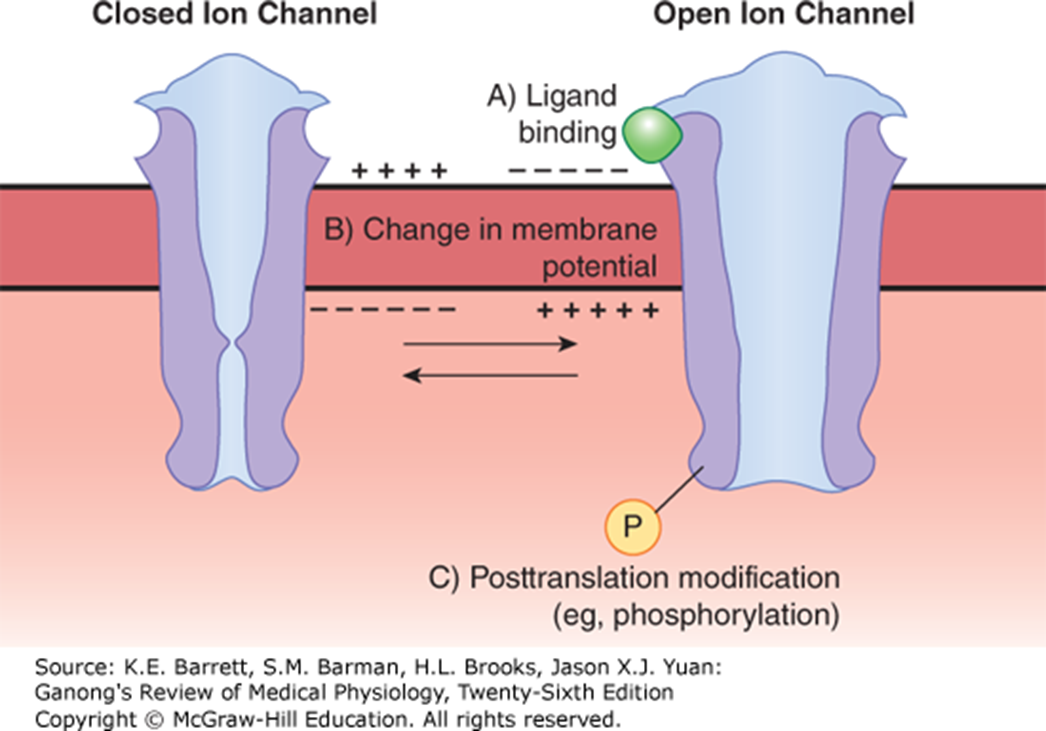
What are the 3 Types of Ion Channels?
Ligand-gated
binding of the ligand allows the channel to change/open
allows influx
Voltage-gated
opens in response to a change in membrane potential
Second Messenger-regulated
responds to post-translation modification
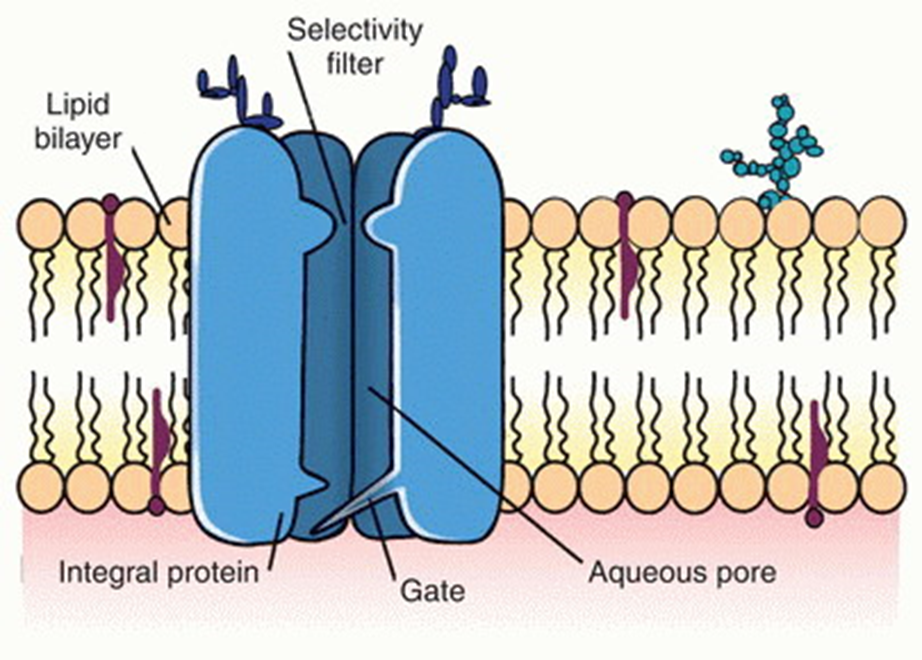
What makes up the structure of ion channels
Polypeptide subunits
Aqueous Pore
Gate
Selectivity Filter
What happens when an ion channel is open?
Very rapid diffusion of ions go down the concentration gradient (~ 108 ions/s)
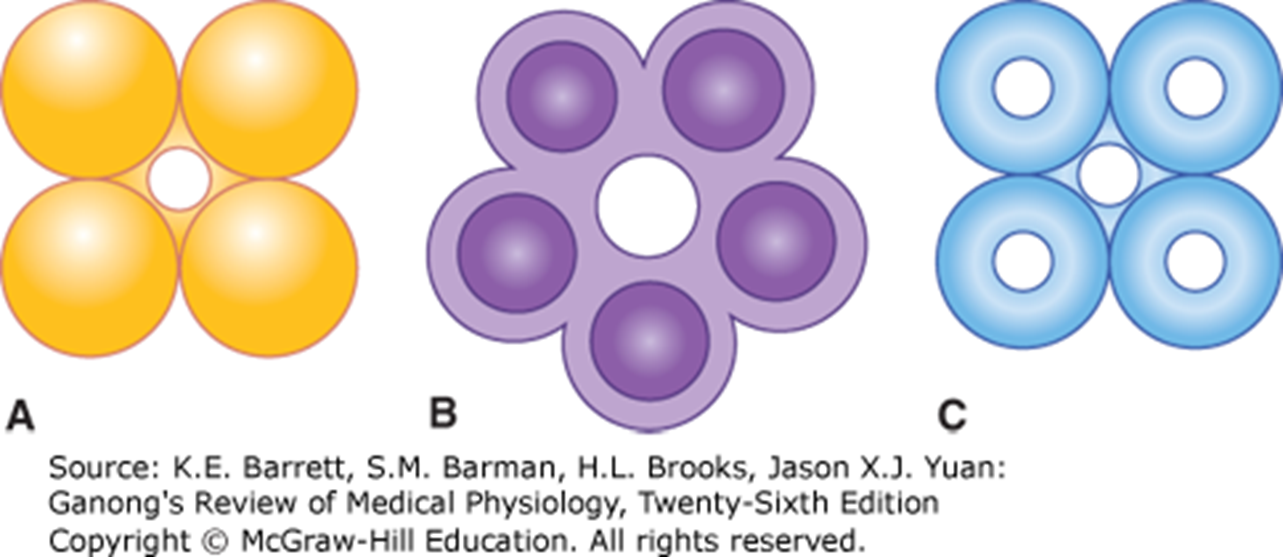
What are the 3 ways ion channels form pores?
K+ Channels
4 subunits
Acetylcholine (Nicotinic) Receptor
5 subunits
Aquaporin
4 subunits
Cells are placed in an environment where the concentration of extracellular sodium (Na+) is greater than the intracellular concentration of Na+ but the extracellular concentration of calcium (Ca2+) is less than the intracellular concentration of Ca2+. Considering the cells have Na+ and Ca2+ channels which of the following will occur?
Na+ being transported along its gradient through a Na+ channel
What is a neurotransmitter
signaling molecule
Explain the steps of an activated Ligand-Gated Ion Channel
Binding of a neurotransmitter (ligand) to an orthosteric site
Conformational change
conducting state — opens
How are ligand-gated ion channels’ gates modulated?
binding of Endogenous/Exogenous modulators to Allosteric sites
What is the function of Ligand-Gated Ion Channels (LGIC)
Fast synaptic transmission in CNS and Neuromuscular Junction
has excitatory, inhibitory, and post-synaptic potential
List examples of excitatory, cation-selective ligand-gated ion channels
Nicotinic Acetylcholine Receptors (nAchR)
Ionotropic Glutamate Receptors
5-HT3 Receptors
P2X Receptors
List examples of Inhibitory, anion-selective ligand-gated ion channels
GABAA Receptors
Glycine Receptors
List examples of non- excitatory/inhibitory ligand-gated ion channels
Epithelial Sodium Channel (ENaC)
Acid-Sensing (Proton-Gated) Ion Channels (ASICs)
Zinc-Activated Channel (ZAC)
IP3 Receptors
What are the 4 examples of voltage gated ion channels
Na+ channel
Ca++ channel
K+ channel
Cl- channel
How many genes in the human genome are encoded in Voltage-Gated Ion Channels (VGIC)?
143
List the subfamilies of Voltage Gated Ion Channels VGIC
Voltage-gated calcium channels (CaV)
Voltage-gated sodium channels (NaV)
Potassium channels
CatSper and Two-Pore channels (TPC)
Cyclic nucleotide-regulated channels (CNG)
Ryanodine receptors (RyR) (* not voltage-gated)
Transient Receptor Potential channels (TRP) (* not voltage-gated)
Voltage-gated proton channel (Hv1)
Some of the ion channels placed under the 'Voltage-gated' umbrella are not in fact gated by voltage (eg, KIR, K2P, RyR,TRP)
What is the NMDA receptor for glutamate?
Ligand gated Ca++ channel
What voltage gated channel is present in most excitable cells
Ca++ channels (Cav)
What type of complexes do Ca++ channels form?
Hetero-Oligomeric Complexes
What is the purpose of Alpha1 Subunits in Ca++ channels?
pore-forming
provides binding sites for all agonists and antagonists
What are the 3 families of Alpha1 subunits
High -Voltage Activated Dihydropyridine-Sensitive Channels (L-Type, CaV1.x)
High-Moderate-Voltage Activated Dihydropyridine-Insensitive Channels (CaV2.x)
Low-Voltage-Activated Channels (T-Type, CaV3.x)
What is the function of K+ Channels?
Regulates excitability and controls the shape of the action potential
What type of cells has K+ channels?
all cells in the body
What functions do K+ channels involve in?
Cognition, Muscle Contraction, Hormone Secretion
How are K+ Channels divided?
families based on their structural and functional properties
List the K+ channel families
Voltage-gated potassium channels (KV)
Calcium & Sodium Activated Potassium Channels (KCa, KNa)
Inwardly Rectifying Potassium Channels (KIR)
Two Pore Domain Potassium Channels (K2P)
Where are Voltage-Gated Na+ Channels (NaV) located?
membrane of most excitable cells
What subunits does NaV channels’ one pore-forming Alpha subunit associates with?
1-2 Beta subunits
Explain the composition of NaV Alpha subunits
4 Homologous Domains (I-IV)
What are the contents in each of the 4 Homologous Domains?
6 Transmembrane Segments (S1-S6)
Pore-Forming Loop
What is the function in S4?
a positively charged voltage sensor that’s involved in channel gating
What is Refractoriness
a set period of time where a voltage channel cannot be reactivated