Interspecific Competition
Interspecific Competition
Interspecific competition is competition between different species, influencing community dynamics and species richness.
dominant theme in ecology theory for many years
community dynamics
explanation of control of ‘local’ richness
What limits number of species in community?
Why aren’t there as many species locally as at a larger scale?
Mechanisms of Interspecific Competition (Shoener's Theory)
Tom Shoener developed mechanisms to explain how species compete.
These mechanisms can be categorised into:
Resource/scramble competition
Interference/contest competition
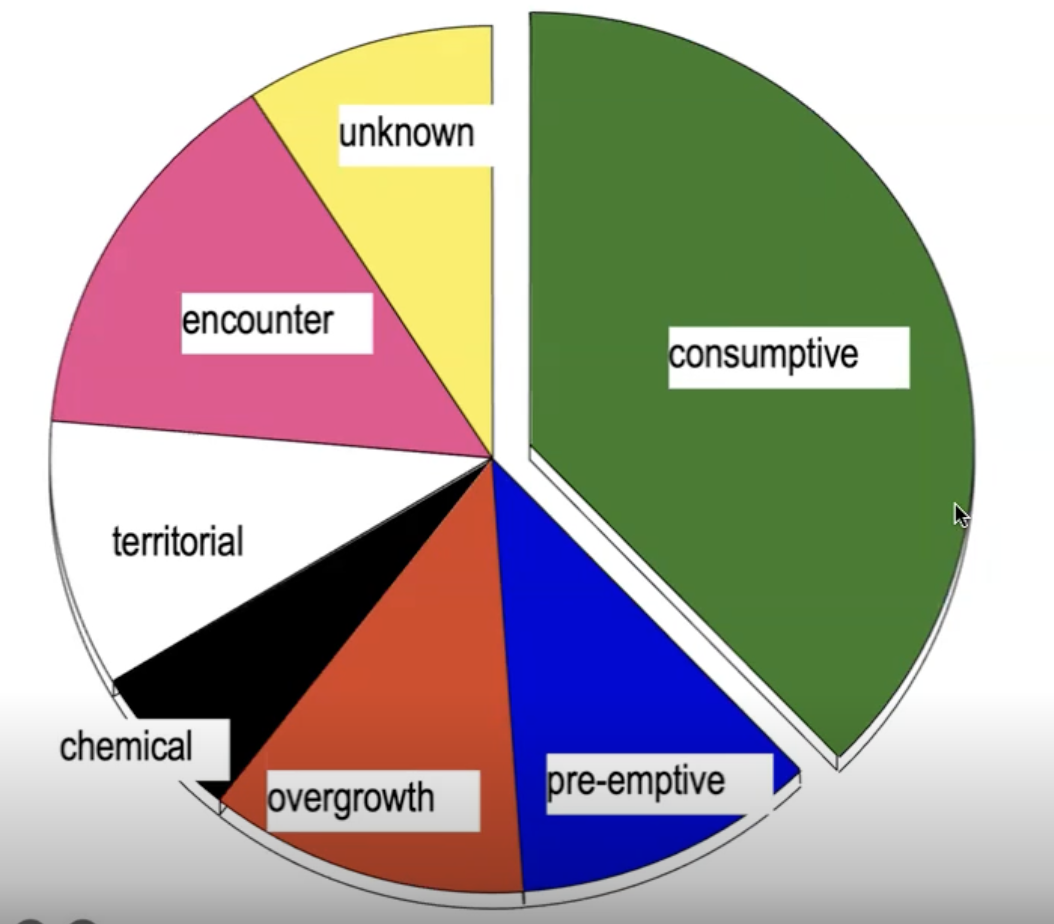
Consumptive competition is considered the most dominant type of interspecific competition.
Resource/scramble Competition
Consumptive/Exploitative Competition
Using up resources like food, limiting access for others.
Pre-emptive Competition
Dominating space and preventing others from using it in anticipation of limitations
Example: Barnacles dominating intertidal zones.
Overgrowth
Blocking access to light or resources from othger species.
Example: Trees outshading shrubs and prevent them from coming out — further prevents competition in the future to ensure the understory remains clear for their seedlings in the next gen
Interference Competition
Chemical Competition
(Allelopathy)
Plants releasing chemicals into the soil they themselves can tolerate but other species can not - that inhibit other species.
Effectively removing competition from space
Territorial Competition
Defending territories through fights and displays.
ward off other individuals encroaching on their space
Encounter Interactions
Short-term interactions for space
Often incidental interactions - organisms bump into each other and fight to occupy that location in the short term
Local vs. Regional Species Richness - The important questions
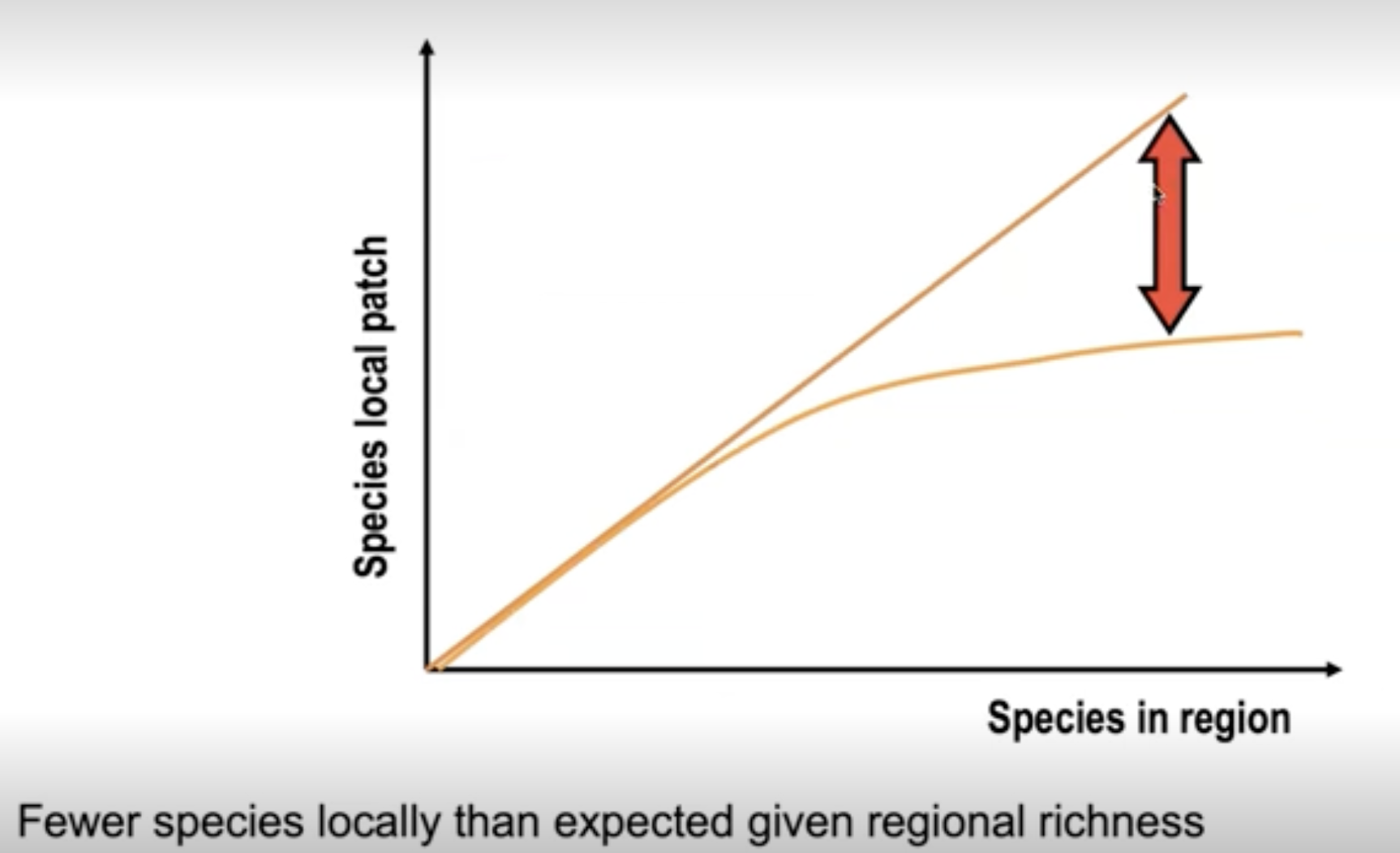
The question is, why are there fewer species locally compared to a broader regional scale?
Consider a local habitat patch with a species richness of four bird species versus a regional area with a greater species richness of seventeen bird species.
Each local patch is theoretically habitable by all species in the region.
This raises two important questions:
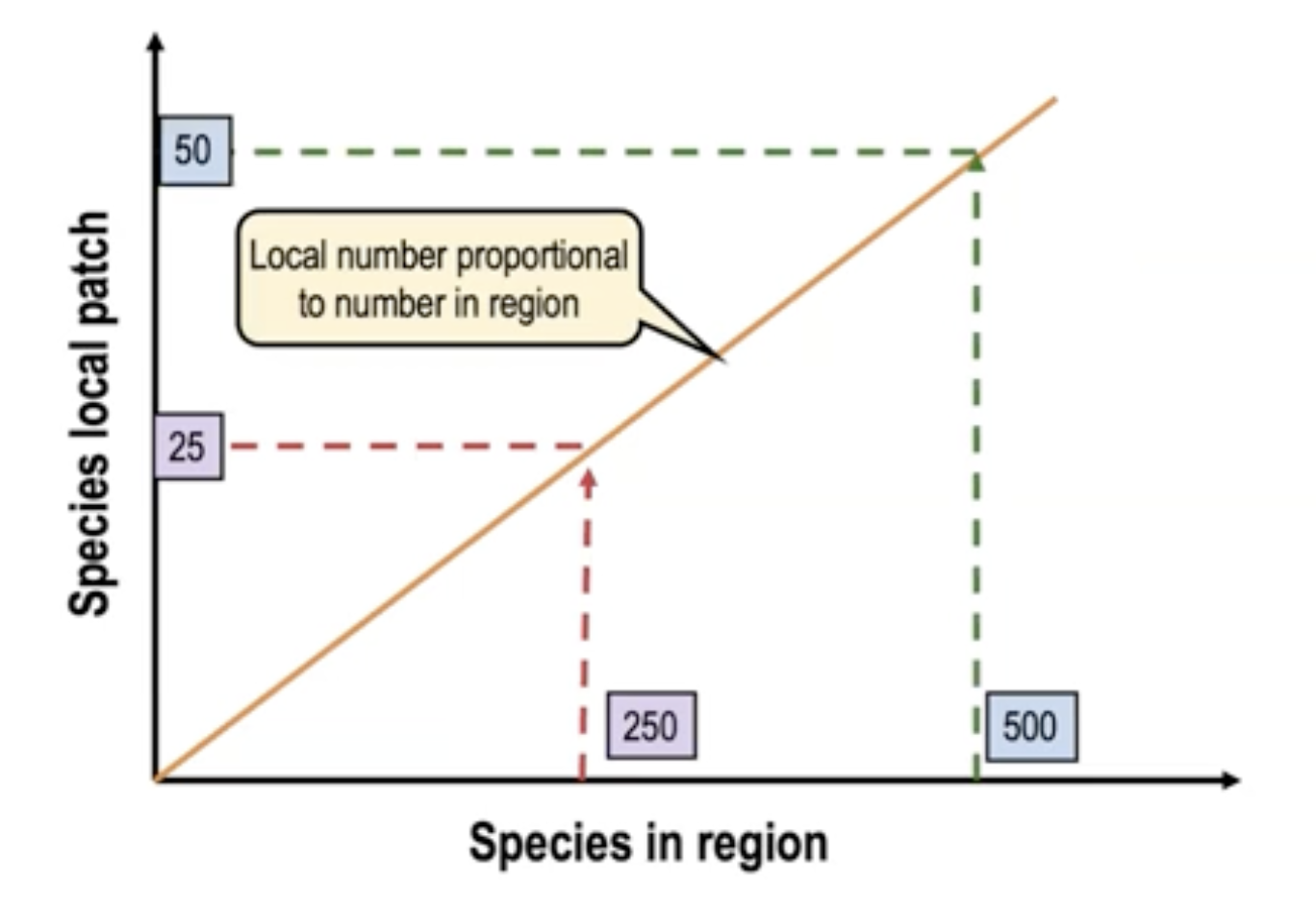
Is the number of species in the ‘local’ area a fixed fraction of the species that could occur there (regional pool)?
So, is the interspecific competition limiting the number of species in local communities?
Area and Species Scaling
If species number scaled linearly with area, a region four times larger than a local area with five species would have 20 species.
In reality, species numbers level off as the region gets larger.
Competition Theory
Limiting similarity: Species that are too similar cannot coexist for long due to direct competition for resources/space
One species will eventually outcompete the other
Gause’s competitive exclusion principle
Chequerboard patterns: Exclusive presence of species in archipelagos suggests out-competition.
one species has exclusive space on one island while another species is exclusively found on another island —> they are never found together
suggests they are outcompeting each other on their respective islands
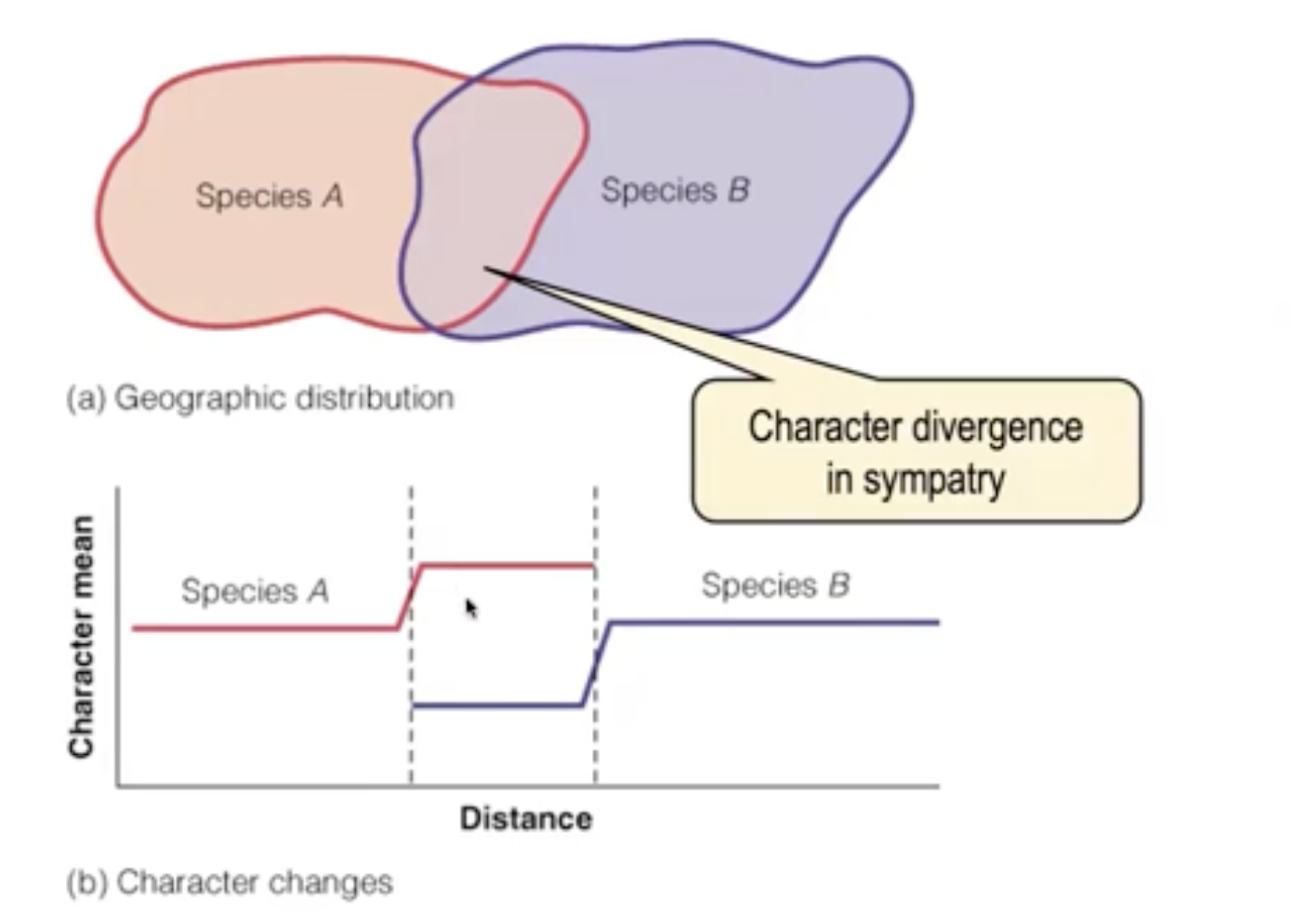
Character divergence and displacement: need to have traits that are diverging from each other —> otherwise displacement happens
Depressed population density: Species found only in small areas of a whole region may lack resilience and perhaps suffer from inbreeding depression as well.
Competitive Exclusion Principle (Gause's Principle) and limiting similarity
Two competing species can coexist in a stable environment if they have niche differentiation.
In an unstable environment, species may coexist if they respond differently to environmental shifts
e.g., temperature changes - one species does better in the cold and one does better in warm conditions
allows them to co-exist due to this fluctuation
Niche: Environmental factors influencing growth, survival, and reproduction of a species OR all the factors necessary for its existence.
No differentiation or habitat constraints lead to the exclusion of one species, one species will inevitably be eliminated.
Two species with identical niches cannot coexist indefinitely.
Evidence from least to most strength in inference (confidence)
Circumstantial evidence: Observations without environmental control which are inconclusive.
Laboratory experiments and math models: Controlled conditions and mathematical models.
Field experiments: Manipulations in natural environments are the most reliable but are difficult to control.
Circumstantial evidence: Chequerboard Patterns: Cuckoo Doves
The McKinley's cuckoo dove and bar tailed cuckoo dove demonstrate a chequerboard pattern in Papua New Guinea islands.
Only one species or neither is found on each island, suggesting competitive exclusion.
Both species are never found in the same place
Suggests that if there was a dispersal from one island to another, one species would outcompete the other (unable to mix)
This is circumstantial evidence, therefore there may be alternative explanations that we could not identify from observations alone, such as microclimatic factors.
If you continue to see this pattern over and over again across different species, you may feel more confident in this circumstantial evidence
Character Displacement: Darwin's Finches
In the Galapagos Islands, finch beak sizes vary depending on whether species are found alone or together.
Example: Geospiza fortis and Geospiza fuligenosa.
In isolation beak size is different that when species are found together:
G. fortis beak depth ranges from 9 to 12.
G. fuligenosa beak depth ranges from 7 to 10.
When together on Santa Cruz, beak depths diverge:
The beak depth of G fortis increases.
The beak depth of G fulugenosa reduces in the other direction.
Beak size and shape influences diet, and differentiation in beak depth reduces competition for resources as they are no longer in direct competition because they now eat different sized food.
If birds kept the same beak size (overlapping), when present together there would be competition amongst birds in each species
EVIDENCE that interspecific competition is occurring between different species —> hence character displacement involves traits diverging to reduce competition.
Context-Dependent Competition
Different abiotic or biotic backgrounds can switch competitive advantage
Which species wins may be changed by subtle differences in:
Climatic conditions
Availability of refuges (habitat heterogeneity)
Community composition
Competition Experiments in the Lab
Controlled lab experiments can manipulate factors easily —> hence you can be more sure of the results
Example: Beetle species competition under different temperatures.
Researchers controlled for humidity/moisture
Measured which beetle species did better under each temperature
Calandra species outcompetes Rhizoperpha at 29 degrees.
Rhizopurtha outcompetes Calandra at slightly higher temperature of 32.3 degrees.
A small change in temp can have a big impact of competition between species and competitive ability
Yeast growth experiments demonstrate differences when species are grown alone versus together.
Species 1: Saccharomyces
Species 2: Schizosaccharomyces
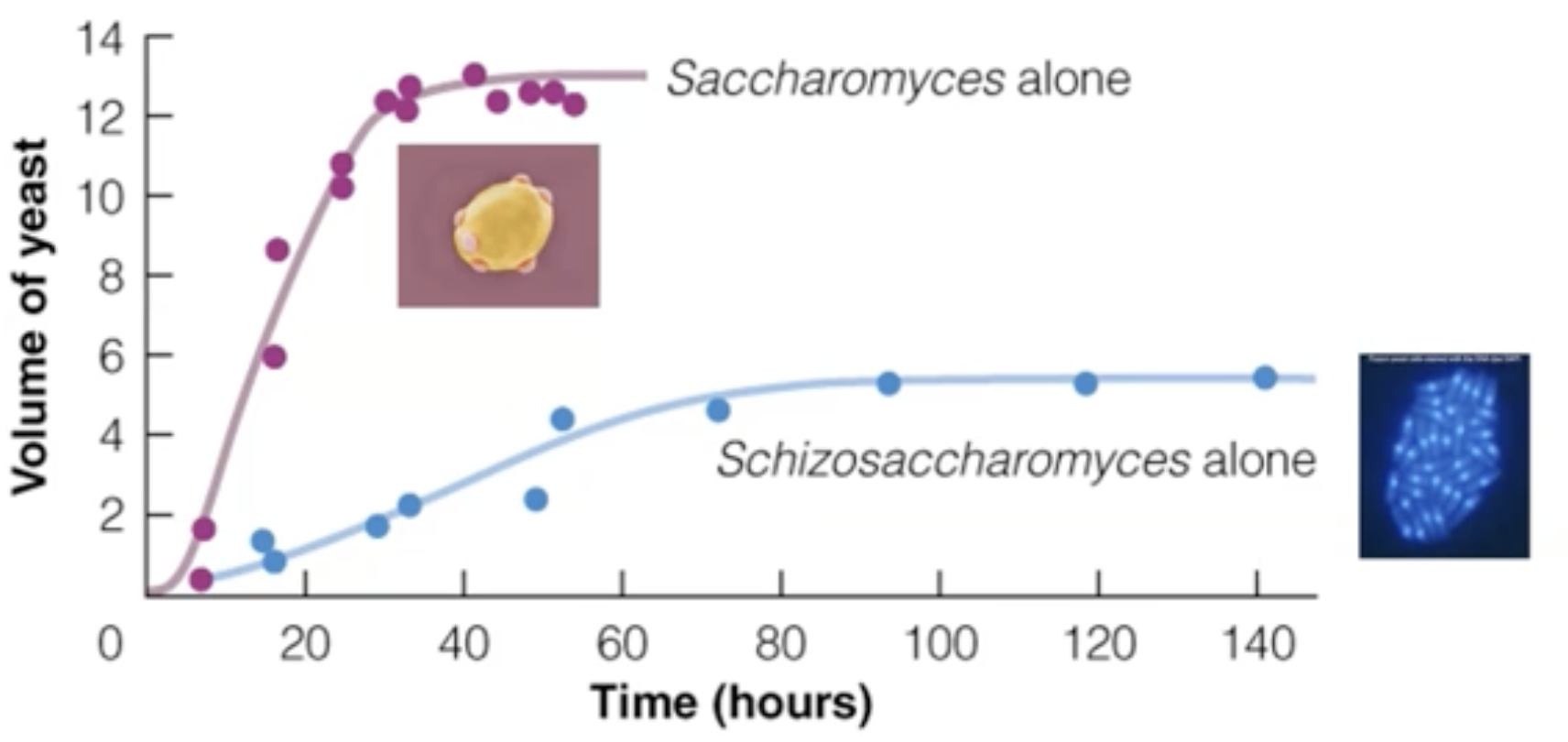
When grown alone, they grow until their carrying capacity and then flatten out
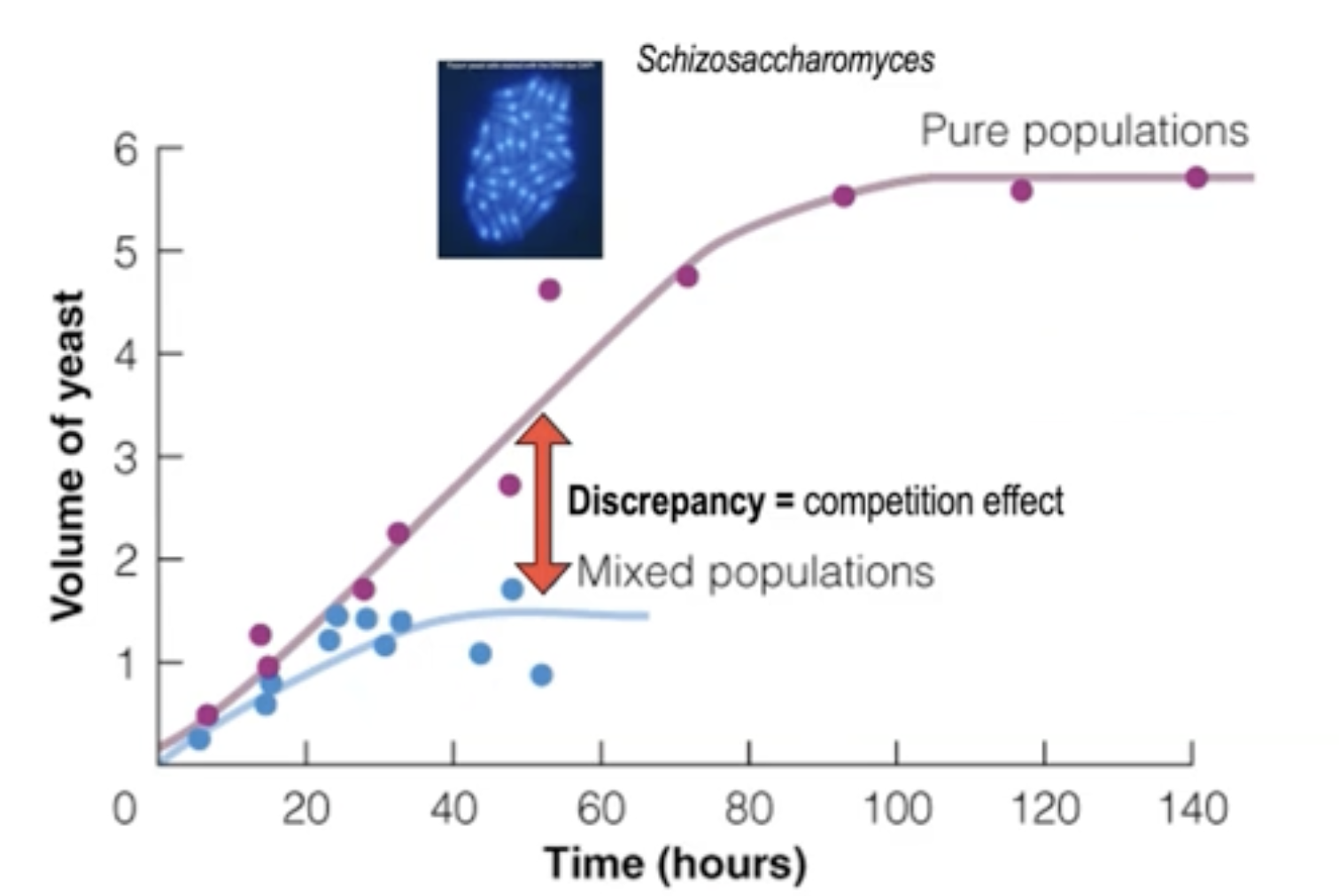
A mixed population results in a lower carrying capacity for each species compared to when grown alone due to being outcompeted by the other species.
Field Study: Rodents in Arizona
Species include:
Kangaroo rat (largest, eats seeds - large granivore).
Pocket mouse (eats seeds and vegetation - small granivors).
Grasshopper mouse (insectivore).
Researchers removed kangaroo rats and observed the response of other species.
Removal plots with exclusion barriers were used and compared to control plots.
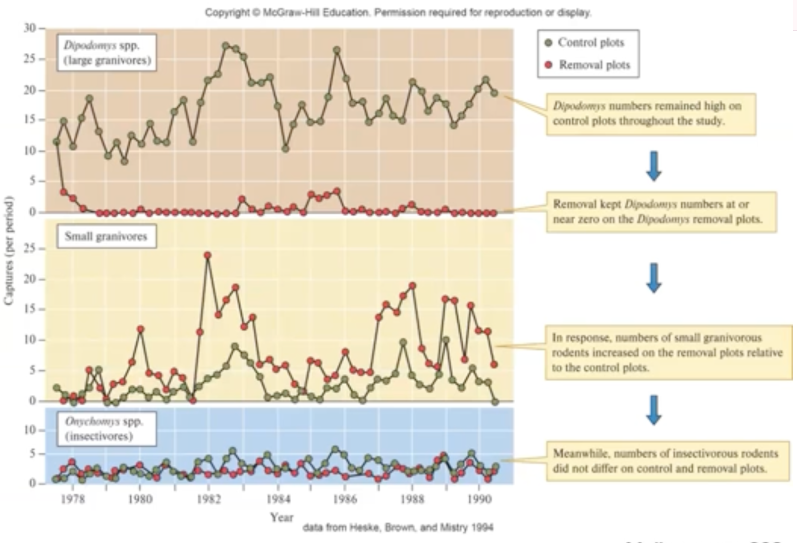
Results showed that when kangaroo rats were removed, small granivorous (seed eaters) increased, indicating kangaroo rats were competing with the small granivorous rodents for food. —> overlap in niche between large and small granivores
Insectivorous rodents showed no change, as they do not compete for the same resources. -—> no overlap in their niche and the niche of small granivores
Repeated experiments in permanent research plots confirmed these effects, showing similar species abundance in control and removal plots before removal, but significant differences after removal.
Conclusion
Competition between species is an important factor determining why local species richness is lower than regional richness.
Competitive exclusion reduces the number of species in a local environment.