DNA Replication
3/20/24
Rules of Replication
Requirements:
Speed: Very fast
1000 BP per secon in E.coli- one bubble in a circle
50 BP per second per replication fork in humans
Multiple bubbles= 1 chromsomes in a few hours
Fidelity: Few mistakes
the mutatin rate (SNP) in human is between 1e^-8 to 2.5e^-8 per base per generation
this means roughly ~1 mistake in 100 million base pairs
Organization:
DNA should not be broken or wound into knots etc. If this happens it should be repaired!
Rules of Replication
Strands are complementary
the two strands are separate
Both strands serve as a template
New DNA is synthesized 5’ to 3’
DNA is synthesized by DNA polymerase
1) Strands are Complimentary
Antiparallel and complimentary
DNA sequence: 5’ TGTA
3’ TACA (read 5’ -3’ so reversed)
2) The Two strands are separate
The Y shaped junctions on either side where the two strands are separating are called replication forks.
The structure where the two strands are pulled apart is called a bubble, in this case a replication bubble.
3) Both strands serve as a template
The semi conservative model of DNA replication. After synthesuis of the new strands, each original strand forms a DNA duplex with the newlty synthesized strand that is complementary in sequence
4) New DNA is synthesized 5’-3’ by DNA polymerase
A DNA polymerase is not one protein, it is a huge protein complex with multiple proteins (a holoenzyme)
DNA polymerase active site
DNA polymerase: Synthesizes new strands of DNA from an ssDNA template in the 5’ to 3’ direction by catalyzing phosphodiester bonds
Replication in Bacteria
Replication starts in the origun of replication
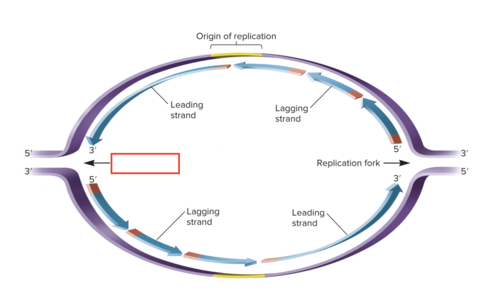
Unwinding the DNA strands creates a replication bubble
For each replication bubble there are two replication forks which open continuously as DNA is synthesized in opposite directions
Replication Requires Proteins
Prokaryotic DNA replication
Polymerase is shortened to pol- there are multiple types of DNA polymerase
SSB stands for single stranded binding protein
Topoisomerase is also called Gyrase
DNA binds to the origin and initiates replications
An Ori is a sequence of DNA- In real DNA sequence there is a common pattern in a binding site (sometimes called a box) but the specific sequence has some variation
DnaA proteins bind to specific sequences in the origin called DnaA boxes
DNA Sequences Where Proteins Bind
Consensus Sequence- the m ost commonly observed base at eavh position in a functional sequence a specific sequence exactly
Motif- a functional sequence represented by a pattern of the miost likely bases at each position
Steps in Bacteria DNA Replication
Step 1) Initiation
DnaA proteins binds to DnaA boxes
DnaA complex bend DNA initiating replication. by creating an initail opening
DnaC Protein- Delivery factor
DnaB Protein- the helicase
Helicase breaks hydrogen bonds, Topoisomerase relaxes supercoiling and prevents DNA tangling
Replication is initiated by opening the DNA at the origin of replication (ori).
Single Stranded Binding Protein (SSB) prevents reannealing
Step 2) Beginning DNA synthesis with RNA
A Primer is required for Synthesis added by primase- this proves the free 3’ OH for DNA polymerase
Bases are added to the 3’ end building the DNA in the direction of 5’ to 3’ by DNA polymerase II
DNA Polymerase III Synthesizes daughter strand. Leading strand SSB has been deleted for clarity
DNA polymerase III elongates the leading strand continuously and the lagging strand discontinuously.
Error Correction
DNA polymerase III:
3’ to 5’ exocnulease (think erasing) activity ti correct errors
5’to 3’ for normal activity for synthesis
Leading and Lagging Strand
Leading Strand: 5 to 3 into each fork
Lagging strand synthesis away from each fork
Prokaryotic Elongation
DNA polymerase I removes and replaces the RNA primer bases
DNA ligase joins Okazaki fragments
Finally nicks in the strand are sealed by the enzyme ligate
Stopping the Process
In E.Coli Tus (terminus utilization substance) protein binds to termination sequences and stalls the replication fork terminating the replication process
Interlocking rings of DNA are separated by topoisomerase
Product is 2 circular chromosomes that are half old template dna and half newly synthesized DNA
Steps in Eukaryotic DNA Replication
We have more chromosomes and ours are linear
A replicon is a region of replication
Bacteria have 1 replication origin whereas eukaryotes have many origins and multiple replicons during synthesis
In eukaryotes, replication is licensed and replication is only allowed once per origin per round of DNA synthesis
regular synthesis will leave gaps at the 5’ ends when the primer is removed
DNA polymerase cant add bases to a 5’ end, there is no free 3’ OH group
A specialized polymerase called telomerase is brought in to extend ends and keep DNA at telomeres from beginning shorter each round of replication
Translocation of telomerase
Elongation of DNA
The ends (telomaeres) then consist of disctinct repetitive DNA and form a protective structure called a T loop
Telomaere completion (by DNA polymerse)
If the T loops break down and ther is no telomerase, programmed cell death (apoptosis) occurs, this determines a cell’s life span and how many times it can go through the cell cycle before it dies