Unit 6
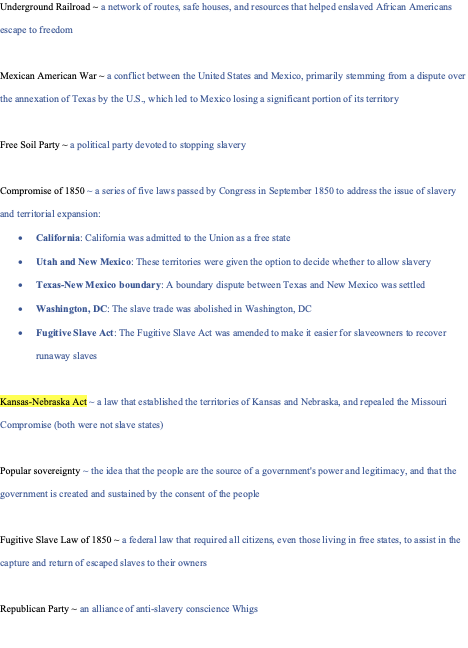
Underground Railroad ~ a network of routes, safe houses, and resources that helped enslaved African Americans escape to freedom
Mexican American War ~ a conflict between the United States and Mexico, primarily stemming from a dispute over the annexation of Texas by the U.S., which led to Mexico losing a significant portion of its territory
Free Soil Party ~ a political party devoted to stopping the expansion of slavery
Compromise of 1850 ~ a series of five laws passed by Congress in September 1850 to address the issue of slavery and territorial expansion:
California: California was admitted to the Union as a free state
Utah and New Mexico: These territories were given the option to decide whether to allow slavery
Texas-New Mexico boundary: A boundary dispute between Texas and New Mexico was settled
Washington, DC: The slave trade was abolished in Washington, DC
Fugitive Slave Act: The Fugitive Slave Act was amended to make it easier for slaveowners to recover runaway slaves
Kansas-Nebraska Act ~ a law that established the territories of Kansas and Nebraska, and repealed the Missouri Compromise (both were not slave states)
Popular sovereignty ~ the idea that the people are the source of a government's power so the people are allowed to decide if their state shall be free or slave, leading to a significant conflict
Fugitive Slave Law of 1850 ~ a federal law that required all citizens, even those living in free states, to assist in the capture and return of escaped slaves to their owners
Republican Party ~ an alliance of anti-slavery conscience Whigs
Dred Scott v. Sandford ~ a landmark Supreme Court case in 1857 where the court ruled that enslaved people, like Dred Scott, were not considered citizens of the United States and therefore could not sue in federal court, effectively denying them any legal protection and upholding the institution of slavery in U.S. territories
“Bleeding Kansas” ~ a period of violence and political conflict in the Kansas Territory from 1854 to 1861, when the territory was plagued by dishonest voting, bloodshed, and guerrilla warfare
Lincoln-Douglas debates ~ a series of formal political debates between the challenger, Abraham Lincoln, and the incumbent, Stephen A. Douglas, in a campaign for one of Illinois' two United States Senate seats. Although Lincoln lost the election, these debates launched him into national prominence which eventually led to his election as President of the United States
Secession Winter ~ the period between Abraham Lincoln's election as president in 1860 and his inauguration in 1861, when the Confederacy of eleven Southern states seceded from the United States
Dred Scott ~ an enslaved Black who sued for his and his wife’s freedom in St. Louis Circuit Court because they claimed that they were free due to their residence in a free territory where slavery was prohibited
Roger Taney ~ chief justice in Dred Scott case who decided that slaves were not US citizens having no right to sue in federal court, being brought to a free state does not make you free, and any Congress attempt to prevent the expansion of slavery was unconstitutional
Abraham Lincoln ~ became the United States' 16th President in 1861, issuing the Emancipation Proclamation that declared forever free slaves within the Confederacy in 1863
Stephen Douglas ~ a politician who ran against Lincoln for president and lost
John Brown ~ a militant American abolitionist whose raid on the federal arsenal at Harpers Ferry in 1859 made him a martyr to the antislavery cause