Lectures 1 and 2 Introduction and legal system (1)
Lecture 1: Introduction and the Hong Kong Legal System
Introduction to Law
Definition of Law:Law is a comprehensive framework of rules established and enforced by societal or governmental bodies to govern behaviors within a specified community or society. These laws can differ widely among jurisdictions and play a critical role in ensuring social order and safeguarding individual rights. 法律是社會或政府機構制定和執行的規則的綜合框架,用於規範特定社區或社會內的行為。這些法律在不同司法管轄區之間可能存在很大差異,但在確保社會秩序和維護個人權利方面發揮關鍵作用。
Importance of Studying Law:
Civic Engagement 公民參與: Awareness of laws enables citizens to understand their rights and responsibilities, facilitating active participation in governance and public matters.
Social Justice 社會正義: Legal education enhances awareness of injustices, empowering individuals to seek reforms that benefit underprivileged and marginalized groups, thereby advancing societal equity.
Critical Thinking 批判性思維: The study of law fosters analytical skills, urging students to navigate complex situations and engage in logical argumentation, relevant across various aspects of life.
What is a Legal System?
Definition:A legal system denotes the organized structure within a specific geographical region that establishes, interprets, and enforces laws, as highlighted by scholar DK Srivastava.
法律體係是指特定地理區域內制定、解釋和執行法律的組織結構。
Components of a Legal System:
A Collection of Laws: Legal systems often comprise a coherent body of statutes, regulations, and case law governing diverse societal aspects.
Institutions Involved 參與機構: Courts, legislatures 立法機關, and law enforcement agencies are fundamental in establishing, interpreting, and enforcing laws to ensure justice.
Legal Philosophies 法律哲學: Varied schools of thought, such as natural law and legal positivism, shape how laws are perceived and applied, influencing interpretations and the ethical underpinnings of legal paradigms.
自然法和法律實證主義等不同的學派塑造了法律的理解和應用方式,影響法律典範的解釋和道德基礎。Processes: The legal system encompasses the creation (e.g., legislative actions), interpretation (court decisions), application (practical use), and enforcement (law enforcement efforts) of laws.
Individuals Involved: The legal landscape includes legal professionals (solicitors, barristers), judges, policymakers, and citizens, each contributing uniquely to the legal framework's operation.
Functions of Law
Social and Economic Stability: Law establishes a predictable environment conducive to individual and business operations, promoting economic progress and societal cohesion.
Promotion of Fairness and Social Change: Legislative reforms can mirror and promote shifting societal values, addressing inequalities and fostering a more equitable society.
Behavior Regulation: Clear norms and expectations set by laws guide behavior, preventing actions that could undermine social harmony.
Conflict Resolution: Legal systems provide structured mechanisms for resolving disputes among individuals, communities, or organizations, reducing the likelihood of violence and conflict escalation.
Importance of Law in Business
Key realms of law significantly impacting business operations include:
Contract Law: Governs lawful agreements between parties, ensuring compliance with obligations and providing legal recourse for breaches, a cornerstone of business transactions.
Company Law: Regulates the establishment, operation, and dissolution of corporations, ensuring accountability and adherence to regulatory frameworks.
Employment Law: Encompasses the legal aspects of the employer-employee relationship, addressing issues such as worker rights and workplace safety.
Intellectual Property Law: Safeguards the rights of creators and businesses by protecting creative works from unauthorized usage, fostering innovation through legal channels for infringement.
Types of Legal Systems
Common Law System: This system develops primarily through judicial precedents set in courts. The doctrine of precedent (stare decisis) ensures consistent treatment of similar cases, promoting stability in legal interpretations.
Civil Law System: This system relies on codified statutes created by the legislature, with judges having limited interpretative authority, primarily focused on applying these statutes to individual cases.
Religious Law 宗教法System: Governed by the doctrines of specific religions, this system influences legal norms based on religious beliefs and practices, significantly shaping the legal landscape in particular regions.
Common Law System Overview
Sources:The common law system derives its authority mainly from judicial decisions rather than legislative statutes, with the principle of stare decisis ensuring legal consistency in rulings.普通法體系的權威主要來自司法判決而非立法法規,遵循遵循先例原則確保裁決的法律一致性。
Vertical Stare Decisis 垂直遵循決策: Inferior courts are required to follow precedents established by superior courts, maintaining hierarchical consistency in legal application. 下級法院必須遵循上級法院制定的判例,以保持法律適用的層級一致性。
Horizontal Stare Decisis 水平遵循先例: Courts of the same level are required to adhere to their prior decisions, enhancing stability in legal outcomes at that level. 要求同級法院堅持既往判決,增強本級法律結果的穩定性。
Practicing Regions 執業地區: This system is widespread in countries such as the United Kingdom, the United States, Canada (with the exception of Quebec), India, and South Africa, with some regions like Pakistan and Nigeria integrating religious law into their common law frameworks. 該制度在英國、美國、加拿大(魁北克省除外)、印度和南非等國家普遍存在,巴基斯坦和奈及利亞等一些地區將宗教法納入其普通法框架。
Civil Law System Overview
Source of Law:The civil law system is based on comprehensive legal codes enacted by the legislature, where the role of judicial interpretation is largely confined to applying these codes to the facts of specific cases. 民法係以立法機關制定的綜合法律法規為基礎,司法解釋的作用很大程度上局限於將這些法規適用於具體案件的事實。
European Union Influence: The Court of Justice of the European Union plays a pivotal role in unifying laws across its member states, emphasizing the significance of case law in the legal framework.
歐盟法院在統一成員國法律方面發揮關鍵作用,強調判例法在法律框架中的重要性。
Legal Procedures in Legal Systems
Inquisitorial System 糾問制度 (Civil Law): In this system, judges are actively involved in gathering evidence and questioning witnesses, generally without juries, which centralizes decision-making authority in the hands of the judge. 在這種制度下,法官積極參與收集證據和詢問證人,一般沒有陪審團,決策權集中在法官手中。
Adversarial System 對抗系統 (Common Law): In contrast, this system features opposing parties presenting their cases along with evidentiary arguments, frequently allowing for jury participation, which promotes fair representation and impartiality. 相較之下,該系統的特點是反對方提出案件並提供證據論證,通常允許陪審團參與,從而促進公平代表性和公正性。
Religious Law Example
Islamic Law:This system encompasses a detailed set of moral and legal guidelines derived from Islamic teachings, governing both personal and communal conduct. For instance, laws prohibiting the consumption of intoxicants like alcohol aim to encourage ethical behavior and promote spiritual discipline among followers.
Uniqueness of the Hong Kong Legal System
One Country, Two Systems:This principle highlights the coexistence of two distinct legal systems—those of China and Hong Kong—following Hong Kong's transition in 1997, which allows it to retain its common law legal structure while being part of the People's Republic of China.Historical Milestone:The handover on July 1, 1997, marked a significant transition of Hong Kong from British colonial governance to a Special Administrative Region (SAR) of China, fundamentally changing its legal and political landscape. 這項原則凸顯了 1997 年香港轉型後中國大陸和香港兩種不同法律體系的共存,使其成為中華人民共和國的一部分,同時保留了普通法的法律結構。 ,標誌著香港從英國殖民統治向中國特別行政區(SAR)的重大轉變,從根本上改變了其法律和政治格局。
Legal Framework in Hong Kong
Sino-British Joint Declaration 中英聯合聲明: This agreement guarantees the preservation of the common law system in Hong Kong for 50 years following the handover, thereby bolstering the region’s legal autonomy. 該協議保證香港在回歸後50年保留普通法制度,從而加強該地區的法律自治。
Basic Law基本法: The Basic Law provides the constitutional foundation for Hong Kong, ensuring the protection of fundamental rights and the continuation of the common law system, while detailing the relationship between Hong Kong and the Chinese mainland.
Judicial Precedents in Hong Kong 香港的司法判例
Stare Decisis 遵循先例: The principle of stare decisis is upheld within Hong Kong law, compelling courts to adhere to established legal precedents in future cases, ensuring uniformity and consistency in judicial processes.
Ratio Decidendi and Obiter Dictum決定比例和附言:
Ratio decidendi refers to the essential legal principles underlying a court’s decision that bind future cases, whereas
obiter dictum consists of remarks made by judges that may not be legally binding but can be persuasive in subsequent judgments.
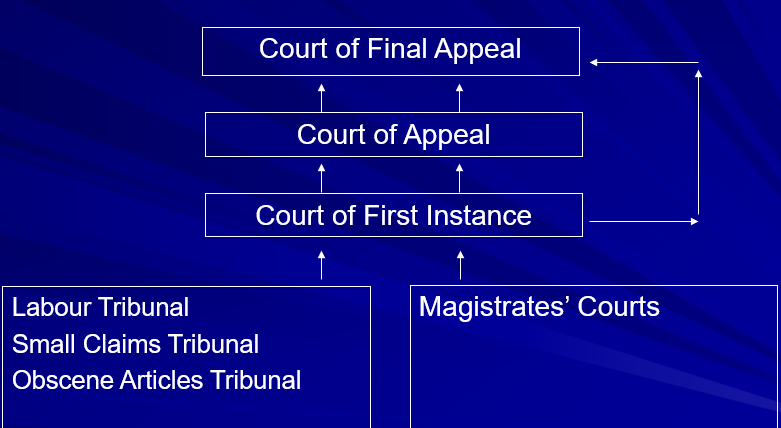
Hierarchy of Courts in Hong Kong 香港法院的架構
Court of Final Appeal: This serves as the highest court in Hong Kong, responsible for adjudicating appeals and ensuring coherent law application throughout the territory.
Court of Appeal and Court of First Instance (all civil matters): These intermediate courts manage a diverse range of important cases, enabling proper case management and judicial review.
Specialized Courts: This category includes District Courts* and various tribunals, which address specific legal concerns, such as employment disputes and administrative complaints, ensuring adjudication by judges with relevant expertise.
Sources of Law in Hong Kong
Basic Law (Article 18): This article delineates the sources of law, asserting that Hong Kong's legal system is grounded in common law, statutes, and customary practices. 本文闡述了法律淵源,主張香港的法律制度以普通法、成文法和習慣做法為基礎。“National laws shall not be applied in the Hong Kong Special Administrative Region except for those listed in Annex III to [the Basic Law]” [annex III is concerned with foreign affairs and defence] 「除【基本法】附件三所列的法律外,全國性法律不在香港特別行政區實施」【附件三涉及外交和國防】
Article 8: This provision guarantees that laws existing prior to the establishment of the Basic Law remain in force, provided they do not conflict with the Basic Law, maintaining legal continuity. 這項規定保證了《基本法》制定之前已有的法律在不與《基本法》相抵觸的情況下仍然有效,並保持了法律的連續性。
Sources: The legal framework in Hong Kong is based on the Basic Law, local legislation passed by the Legislative Council, and customary laws that reflect the region's historical and cultural practices.
Laws stipulated in Article 8 [laws previously in force in Hong Kong, i.e. the common law, rules of equity, other ordinances and customary law] 第 8 條規定的法律 [香港先前有效的法律,即普通法、衡平法、其他條例及習慣法]
Classifications of Law
Criminal Law: This branch articulates definitions of crimes and stipulates respective penalties, reinforcing the presumption of innocence until proven guilty for defendants.
該分支闡明了犯罪的定義並規定了相應的處罰,加強了被告在被證明有罪之前的無罪推定。
Civil Law: Civil law addresses private rights and responsibilities between individuals, focusing primarily on compensating damages and resolving disputes that arise in personal and business contexts. 民法涉及個人之間的私人權利和責任,主要著重於賠償損害和解決個人和商業環境中出現的爭議。
Statutory Interpretation 法定解釋
Statutory interpretation plays a crucial role in the application of law, as it involves the judiciary's efforts to elucidate legislative intent and the meaning behind statutes. Courts engage in this interpretive process using various well-established methods:
Literal Rule 字面規則: This approach takes the ordinary meaning of the language used within a statute, ensuring that the words are interpreted in their simplest, most commonly understood sense. 這種方法採用法規中所用語言的普通含義,確保以最簡單、最普遍理解的含義來解釋這些詞語。
Golden Rule 黃金法則: This rule allows courts to deviate from the literal meaning of words when such a literal interpretation would lead to an absurdity or result that the legislature could not have intended. 當這種字面解釋會導致立法機關無法預料的荒謬或結果時,該規則允許法院偏離單字的字面含義。
Mischief Rule 惡作劇規則: This rule is applied to understand the legislative intent behind a statute, looking at the “mischief” that the law aims to remedy, guiding the interpretation towards the purpose of the legislation. 該規則適用於理解法規背後的立法意圖,並著眼於法律旨在補救的“弊端”,指導對立法目的的解釋。因此,法院在適用此規則時,會考慮法律制定時所面臨的具體問題,從而確保法律的解釋與其原本的目標相符。
Purposive Approach: This contemporary method seeks to ascertain the broader purpose and intention of the legislation, often employing aids such as legislative history to inform the interpretation process effectively.The significance of statutory interpretation is accentuated by evolving societal norms and circumstances, which necessitate that laws adapt over time to remain relevant. Courts often encounter challenges when interpreting statutes that were drafted in a different historical context, hence necessitating a flexible approach. Additionally, the interpretation process is vital for maintaining consistency in how laws are applied, thereby fostering public trust in the legal system and ensuring equitable treatment across similar cases. Recent developments, including technological advancements and global legal trends, continuously shape the way laws are interpreted and applied, highlighting the need for ongoing adaptation within the legal framework. 這種當代方法旨在確定立法的更廣泛目的和意圖,通常利用立法歷史等輔助手段來有效地為解釋過程提供資訊。隨著時間的推移而適應保持相關性。法院在解釋在不同歷史背景下起草的法規時經常遇到挑戰,因此需要採取靈活的方法。此外,解釋過程對於保持法律適用的一致性至關重要,從而培養公眾對法律體系的信任並確保類似案件的公平對待。最近的發展,包括技術進步和全球法律趨勢,不斷影響法律的解釋和適用方式,凸顯了在法律框架內不斷調整的必要性。
Legal Profession in Hong Kong
Branches:The legal profession is divided into two main branches: solicitors, primarily engaged in preliminary matters and document preparation with more limited rights in lower courts, and barristers, who enjoy full rights of audience and specialize in courtroom advocacy and litigation. 法律專業分為兩個主要分支:事務律師,主要從事初步事宜和文件準備,在下級法院的權利較為有限;出庭律師,享有充分的出庭權利,專門從事法庭辯護和訴訟。
Summary of Key Concepts
This lecture encapsulates essential concepts such as the different types of law, various legal systems, the distinctive characteristics of Hong Kong's legal structure, the hierarchy of courts, and the crucial role of statutes in defining legal norms.It emphasizes the interconnectedness of legal principles with societal governance and prepares students to navigate the complexities inherent in both local and global legal contexts.