Ecosystems
Population: all the organisms of one species that live in the same place and the same time and that can breed together
Habitat: the place where an organism lives (e.g. pond, field, wood)
Community: all the populations of different species who live in the same place at the same time and can interact with each other
Ecosystem: any group of living organisms and non living things occurring together and their interrelationships. (i.e. the interactions between the community and habitat)
Niche: the role that each species plays in an ecosystem
Factors that affect ecosystems
Abiotic (non-living things)
Sunlight
Temperature
Soil
pH
Moisture
Type
Water
Humidity
Oxygen/carbon dioxide levels (mainly for aquatic life)
Wind
Aspect, orientation
Biotic (living things)
Disease
Predators
Food
Competition
Interspecific - different species
Intraspecific - same species
Territory/space
[Human activity]
Breeding partners
Ecosystem: Made up of all the living organisms that interact with one another in a defined area, and also the physical factors present in that region
E.g.
Rock pool
Playing field
Tree
Entire biosphere of Earth
Tiny colony of bacteria
Dynamic ecosystems
Ecosystems are dynamic (i.e. constantly changing). Populations in the community fluctuate depending on many factors, e.g. predation, seasonal changes etc.
All populations are linked to all other populations
Energy and matter in ecosystems
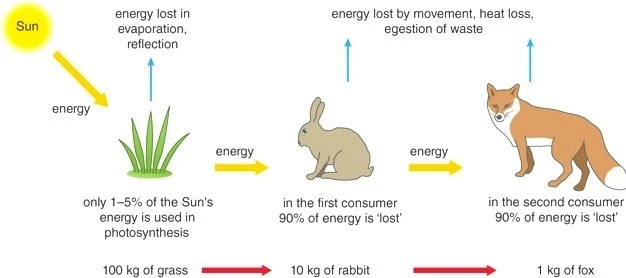
Energy flows through an ecosystem and will eventually be lost as heat energy
All matter is cycled (e.g. carbon and nitrogen cycle)
efficiency = total energy converted to biomass/total energy in x 100
Measuring biomass
Mass of fresh material present
Easiest method but unreliable as mass of water varies greatly
Dry mass
Most accurate but organisms have to be killed and put into an oven at 80oC to evaporate all the water
Net production / kJm-2year-1 = gross production - respiratory losses
Net production: energy available to pass on to next trophic level
Gross production: total solar energy that plants convert to organic matter
Respiratory losses: plants use 20-50% of their energy for respiration