Genetics Lec 1.1-1.2
Introduction to Genetics
Genetics = Study of Heredity and Variation
Heredity = Passing down of traits from one generation to another
Variation = Differences in inherited characteristics among members of a population
Genetics has many subfields
1. Transmission genetics is the study of heredity
How are traits passed down between generations, and how can you gain a clue where the trait is going?
Example: My mom has a disease, my spouse's uncle has the same disease → Will our kids have it?
Key questions: Is the allele dominant or recessive? Is the trait on the X chromosome or an autosome?
2. Molecular genetics
Structure and function of individual genes
Includes cancer genetics, genetic engineering (manipulation of genes), study of chromosome structure (cytogenetics)
3. Population/Evolutionary genetics
Study genetic variation in populations
Includes conservation genetics: In terms of species, how can you help them gain a suitable habitat and maintain genetic diversity, which is crucial for their survival and adaptation to changing environments?
Genetics in Bio I: Core Concepts
Nucleus vs nucleoid
Nucleus = membrane-enclosed organelle inside eukaryotic cells that holds chromosomes, upper-level.
Nucleoid = region of a prokaryotic cell cytoplasm in which the chromosome resides
Chromosome
A single piece of DNA & Protein
Can be linear (eukaryotes) or circular (prokaryotes)
Eukaryotes have many chromosomes; prokaryotes have one
Divided into many genes
Genetic Terms and Relationships (Bio I Review)
3. Gene
Defined as a nucleotide sequence on a chromosome that provides instructions to make a single product (a protein)
That protein can be categorized as an expressed (E) or repressed (P) form, determining whether the product is synthesized under specific conditions.
One chromosome may contain ~
1,000 genes
Chromosomes are subdivided into genes, which are composed of DNA
4. Diploid vs. haploid
Most eukaryotic organisms have 2 copies of each chromosome in somatic cells (Where do the 2 copies come from? parental)
2 copies = 2n = DIPLOID
Gamete cells (sperm, eggs) contain only 1 copy
1 copy = 1n = HAPLOID
Example: insiln/ATP synthase/actin/hemoglobin as gene products
5. Alleles
Alternate forms of the same gene are caused by minor differences in the DNA sequence.
Alleles can lead to variations in traits such as eye color and may follow different inheritance patterns, such as dominant, recessive, or codominant expression.
6. Genotype vs phenotype
Genotype = genetic makeup of an organism (what the genes look like)
It is within the DNA where the genes are instructed
Phenotype = observable characteristics (e.g., blue vs brown eyes)
Both genotype and environment influence phenotype
Physical characteristics are the result of the genotype interacting with environmental factors, leading to a variety of expressions.
7. Transcription vs translation
Goal: Use DNA instructions to make a product (protein)
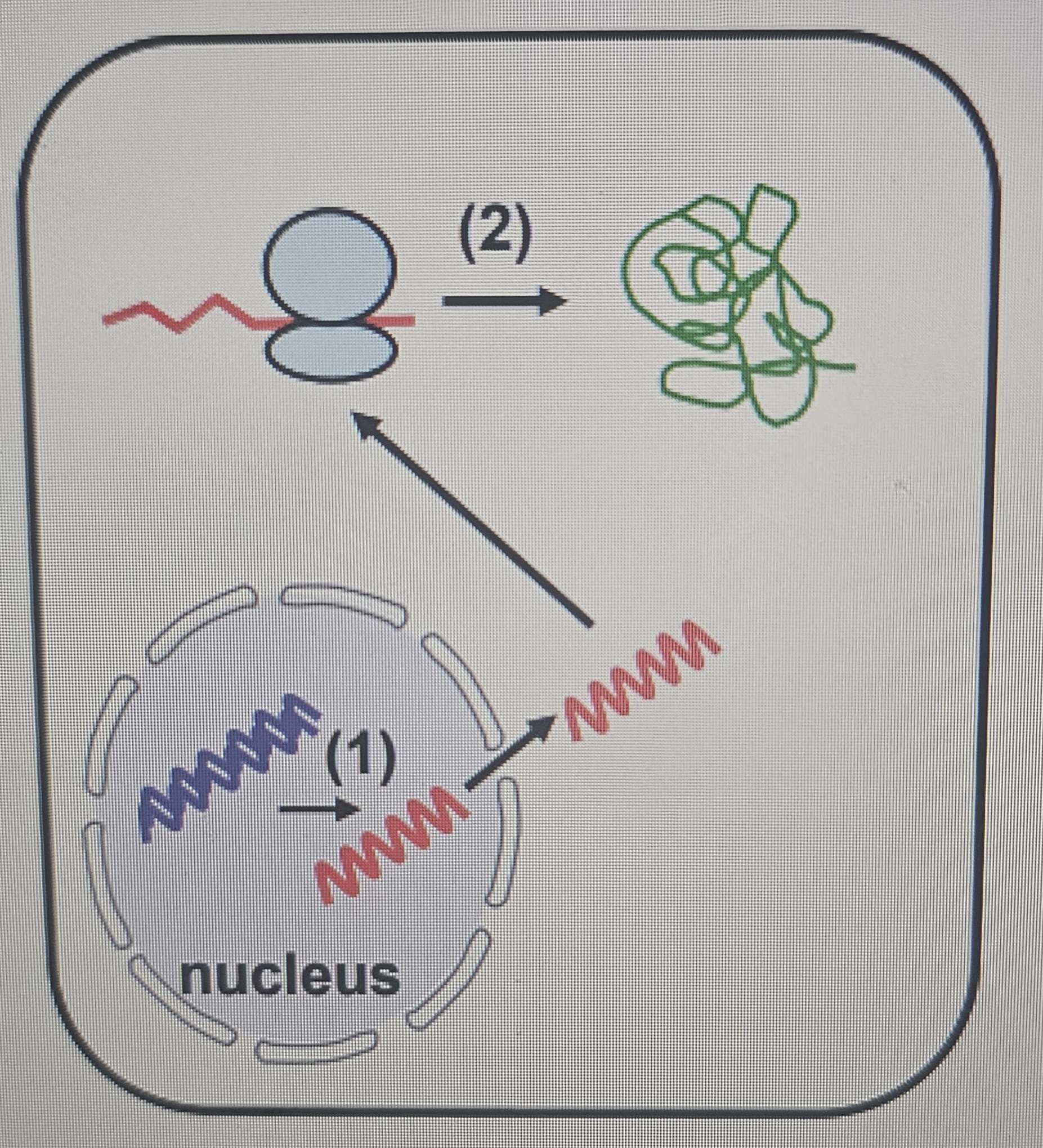
Process: Information in the DNA (gene) is copied into an RNA molecule → transcription. The RNA copy leaves the nucleus, binds to a ribosome, and is translated into a protein → translation
Central Dogma: Visual of Information Flow
Normal flow of information:
(transcription and translation)
Location cues: transcription occurs in the nucleus; translation occurs at the ribosome in the cytoplasm (or ribosome vicinity)
This does not apply to a Pro. cell as it does not have a nucleus
History of Genetics: Early History
Early genetics was more philosophy than science; few experiments
Major outdated concepts:
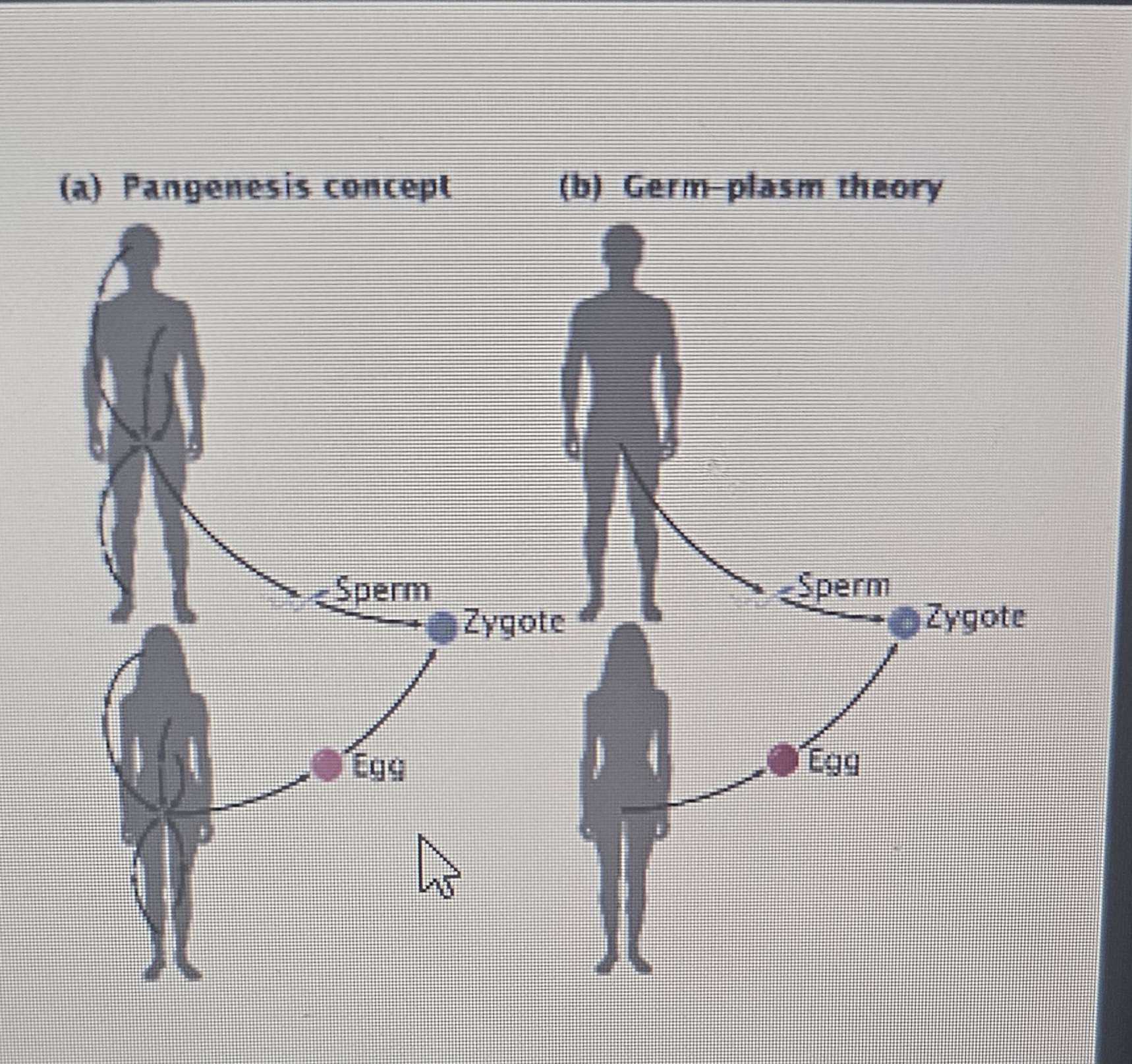
Pangenesis: traits collected from all over the body and placed into sperm/eggs
Lamarckian ideas: acquired characteristics can be inherited
Disproved in late 1800s (e.g., mouse tail experiment)
Ex: You cut off a mouse's tail, then the offspring should have short tails, but this did not occur; the offspring were born with normal tails, demonstrating that acquired traits do not influence the genetic information passed on to the next generation.
Pre-formationism: homunculus (little person inside gametes)
Ex: The concept suggested that reproduction involved the miniature version of a human being, known as a homunculus, pre-existing in the sperm or egg, which would grow into a fully formed individual.
Blending inheritance: traits blend in offspring
Ex: This theory proposed that the traits of parents mix together, resulting in offspring that have intermediate characteristics, rather than distinct traits from each parent. Thrown in a blender and spits out a child with random triats.
Technological and scientific developments in the 1800s transformed genetics:
Microscopes enabled direct observation of gametes
Darwin and Mendel revolutionized genetics; evolution and transmission genetics began
Chromosomes were observed and found to carry genetic information (early 1900s) — the question: contain DNA or protein as hereditary information?
Discovery of the Genetic Material: Early Beliefs
Early evidence suggested proteins might be the genetic material due to:
Protein complexity
4 bases vs 20 amino acids
Proteins can adopt billions of shapes/folds, and there are thousands of different proteins
Proteins comprise roughly 50% of the dry weight of the cell, showing their abundance.
1910 Levene study
Suggested DNA was repeating and simple:
Discovery of DNA as the Genetic Material: Key Experiments
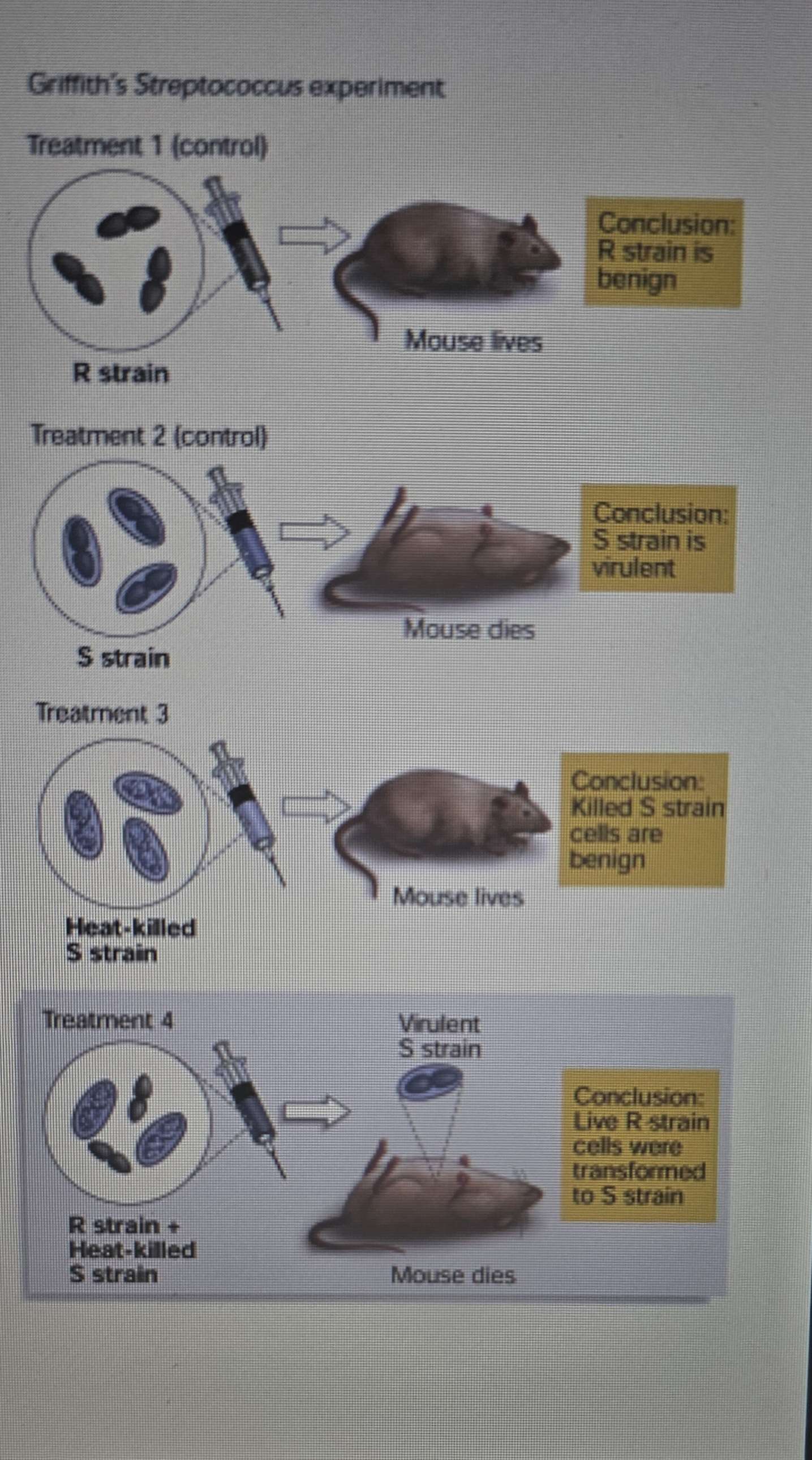
Griffith transformation study (1920s)
R strain (rough) vs S strain (smooth) pneumococcus
Inference: some transforming material from dead S with the live R become virulent causing live S to appear: was it either the protein or DNA ?
Further experiments are needed to identify the exact nature of this transforming principle and to determine whether it is indeed DNA or some other component. Basically was some transformational test occured but they didnt know how or what genetic material it was being expressed.
Avery, MacLeod, and McCarty (1944)
Experimental setup
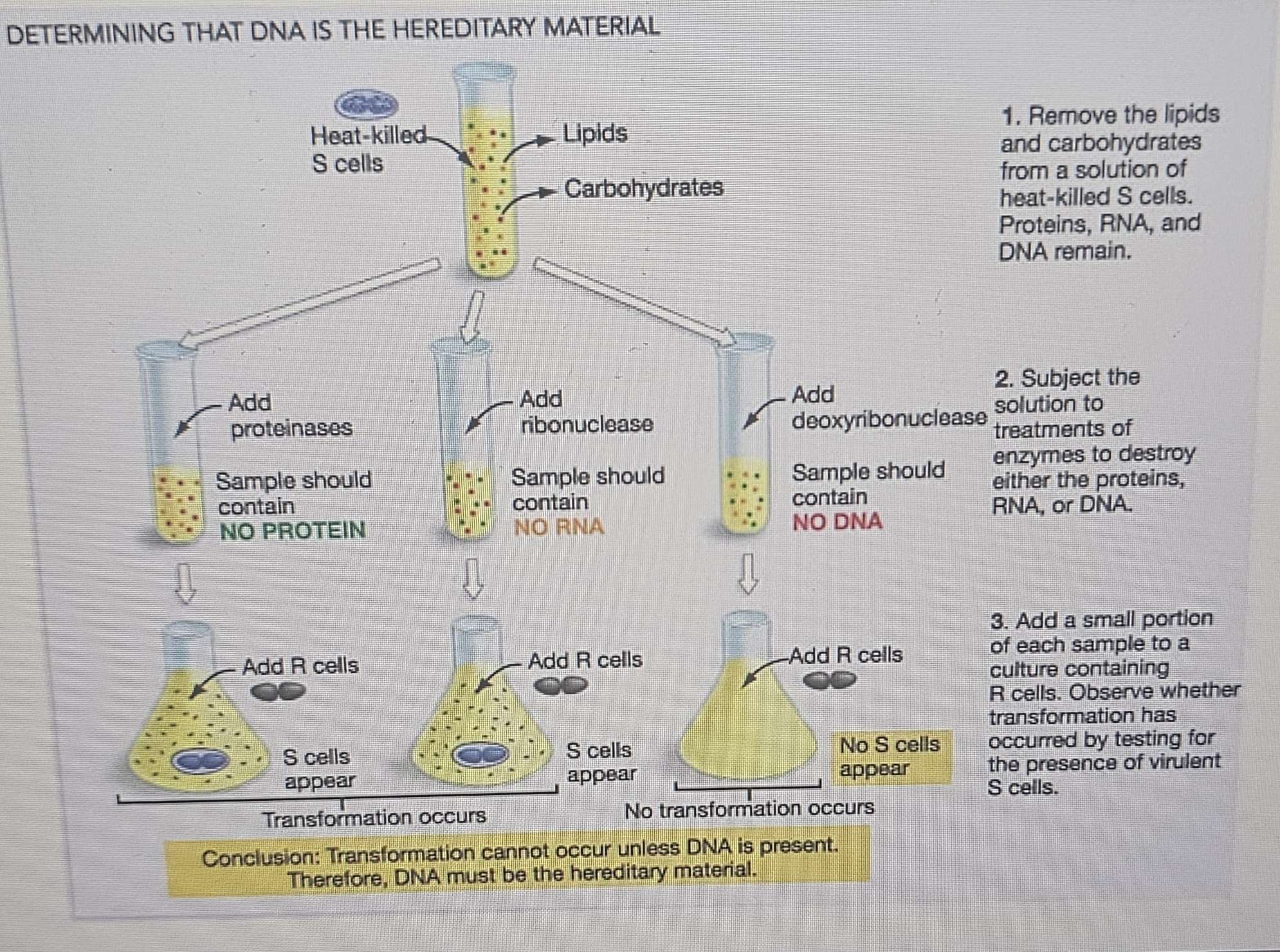
1. Isolation: of the genetic material, making sure one of these three things isnt solution of lipid and carbs.
2. ASE: DNA, PROTEIN, RNA breakdown
The breakdown of DNA, protein, and RNA was crucial in demonstrating that DNA was the transforming principle and not proteins or RNA, as only DNA was able to induce transformation in non-virulent strains.
3. Read below for more details on the experiments…
Conclusion: Transformation can not occur unless DNA is present. Therefore demonstrated that DNA is the transforming principle, the hereditary material, providing strong evidence that genetic information is carried through DNA rather than proteins or other molecules.
Basically defined the test that expanded our understanding of genetics by establishing that DNA is the molecule responsible for heredity in living organisms.
Important Question:
If it dosent contain the DNA it contains the other two ?
Yes, because you are removing the other factors or varaibles, so the first one your removing protein(RNA+DNA is left), the second one your removing RNA(DNA+protein is left) and the third one your removing DNA(RNA+Protein is left) but tranformation didnt occur since there isnt DNA present.
Hershey and Chase (1952): DNA as the Genetic Material
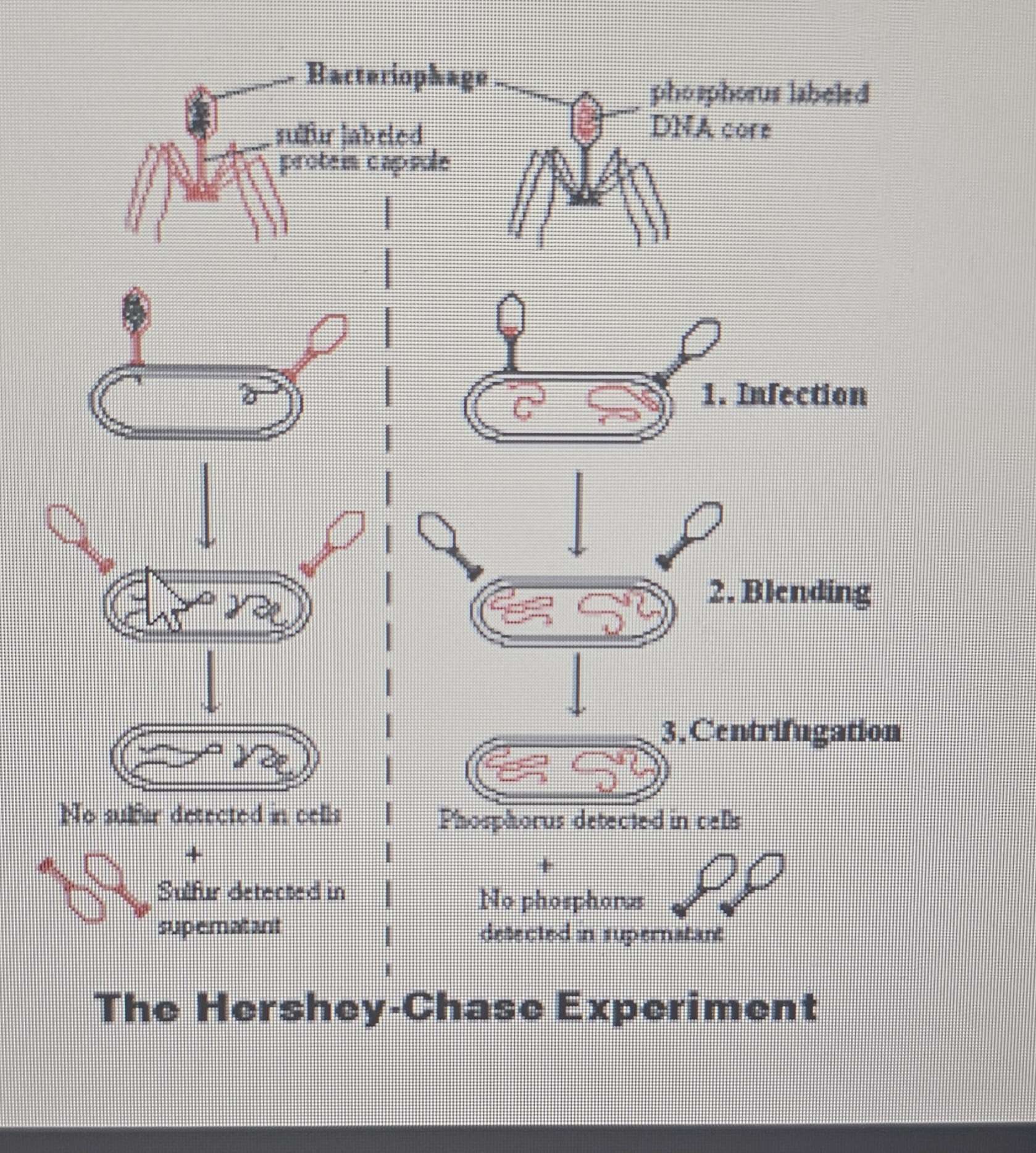
Used bacteriophage composed of DNA and protein
Experimental setup:
They used T2 bacteriophages (viruses that infect E. coli bacteria).
Phages are basically just DNA inside a protein coat.
The Labeling Trick
They tagged DNA with radioactive phosphorus-32 (³²P) (because DNA has phosphorus in its backbone, but proteins don’t).
They tagged protein with radioactive sulfur-35 (³⁵S)
(because proteins have sulfur in some amino acids, but DNA doesn’t).
So now they had two batches of phages:
One with glowing (radioactive) DNA.
One with glowing protein coats.
The Infection
Each batch of phages was allowed to infect E. coli.
The phages inject their genetic material into the bacteria like little syringes.
The Blender Move 🌀
After infection, they put the samples in a blender to shake off the empty phage protein coats from the outside of the bacteria.
Then they spun everything in a centrifuge:
The bacterial cells went to the bottom (pellet).
The empty protein coats stayed in the liquid (supernatant).
After blending:
They spin the mixture in a centrifuge, which separates components by weight:
Heavier bacteria form a pellet at the bottom.
Lighter virus coats stay in the liquid supernatant.
Then they measure radioactivity:
If ³²P (DNA) is in the pellet → DNA went into bacteria.
If ³⁵S (protein) is in the supernatant → protein stayed outside
Result: Infected cells contained radioactive phosphorus (DNA) but not radioactive sulfur (protein)
Conclusion: DNA is the genetic material, it specified DNA is the reason for those results without a doubt.
Is DNA Universal Genetic Material?
Yes!
Indirect evidence
1) Diploid cells should contain twice the amount of genetic material than haploid cells (e.g., sperm and eggs); observation matched DNA, not protein.Direct evidence data (example organisms):
Organization of data with haploid (n) and diploid (2n) values:
Human:
Chicken:
Trout:
Carp:
2) UV mutagenesis experiments: DNA absorbs at 260 nm; proteins absorb at 280 nm → DNA is the target for mutagenesis
Direct evidence (Genetic engineering)
Add DNA to a cell → see the expected protein produced
Basically if you modify an inject UV light DNA , you can observe resultant mutations through the transformed expression of proteins, proving the direct link between UV exposure and genetic alterations.
DNA Structure and Composition
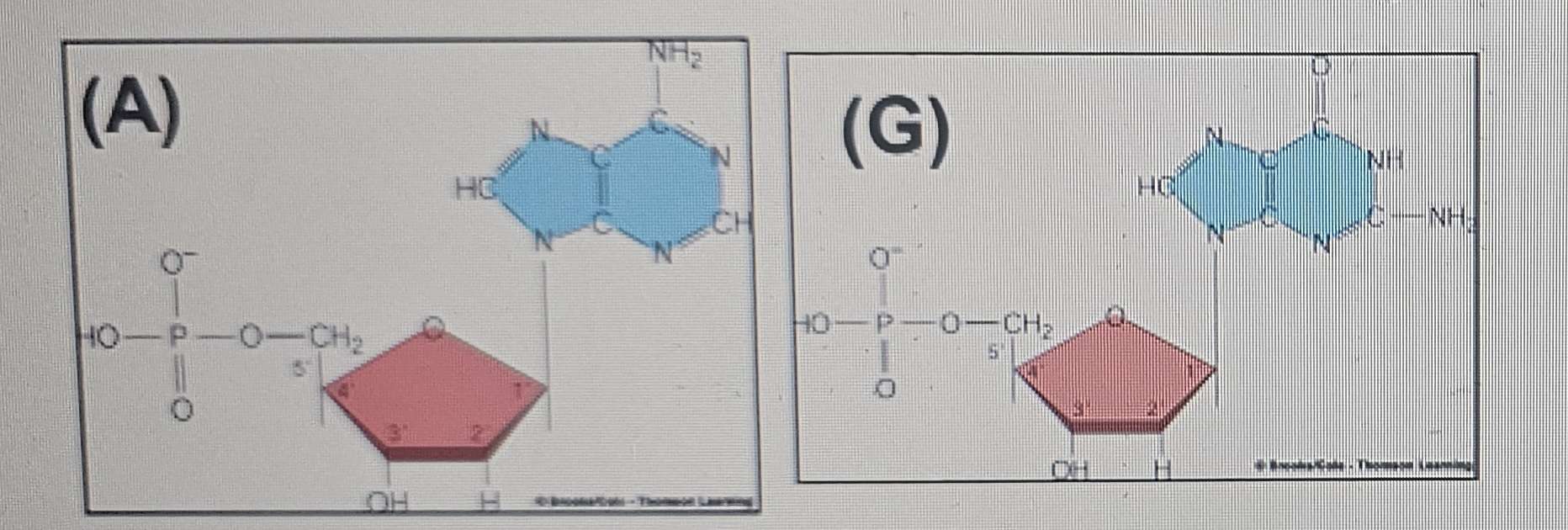
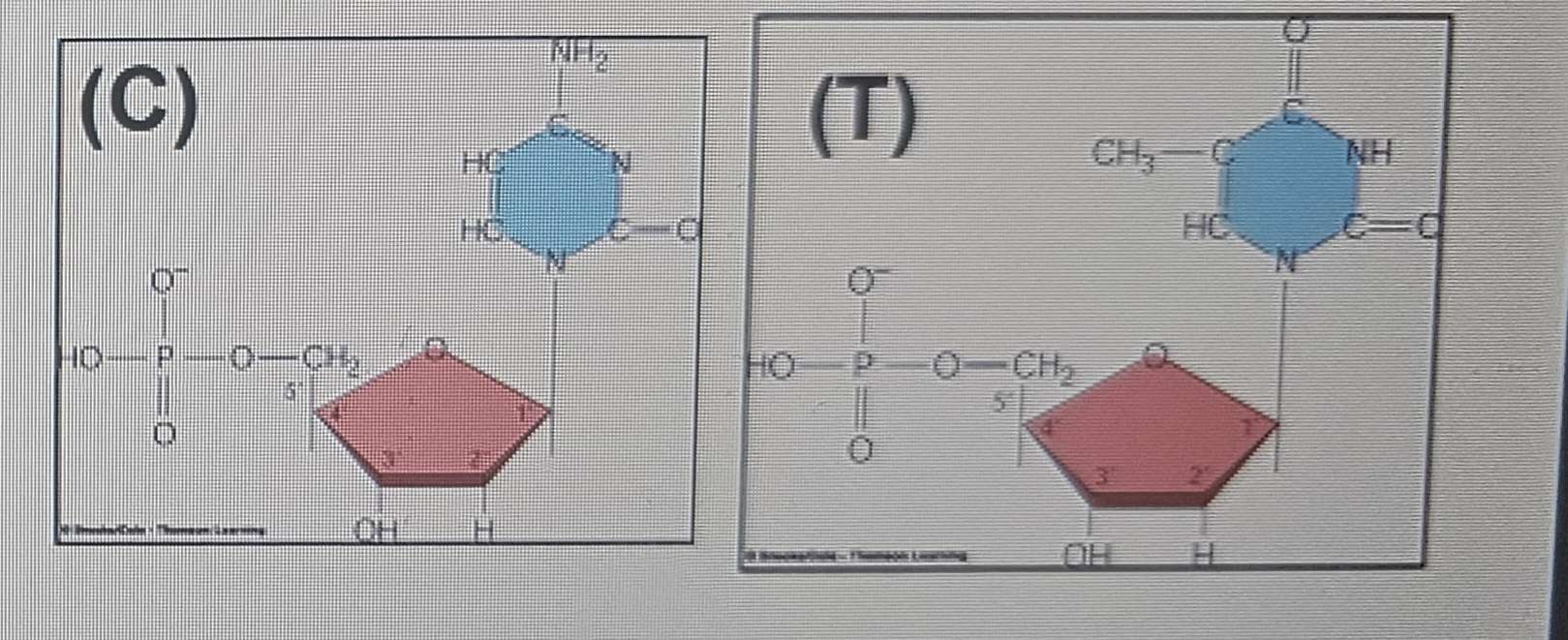
DNA is composed of four nucleotides
Each nucleotide contains:
A 5-carbon sugar: deoxyribose(Is missing a oxygen)
A phosphate group
One of four nitrogen-containing bases:
Base types
Purines: (double-ring structures)
Pyrimidines: (single-ring structures)
Deoxyribose sugar (structure and numbering)
Base attaches to C1 of the sugar
Phosphate attaches to C5
C2 bears a hydrogen (H) instead of an OH group
C3 bears an OH group
Further explaination
5′ carbon → attached to phosphate
|
O———C1′ — Base (A, T, G, or C)
| \
C4′ C2′ (H for deoxy)
| /
C3′ — OH (where chain extends)
1′ carbon → attaches to the base (A, T, G, or C).
2′ carbon → in DNA, just has an H (that’s the “deoxy” part); in RNA, it has an OH.
3′ carbon → has an OH group that bonds to the next nucleotide’s phosphate (super important).
5′ carbon → attaches to the phosphate group.
Nucleotides and Phosphodiester Bonds
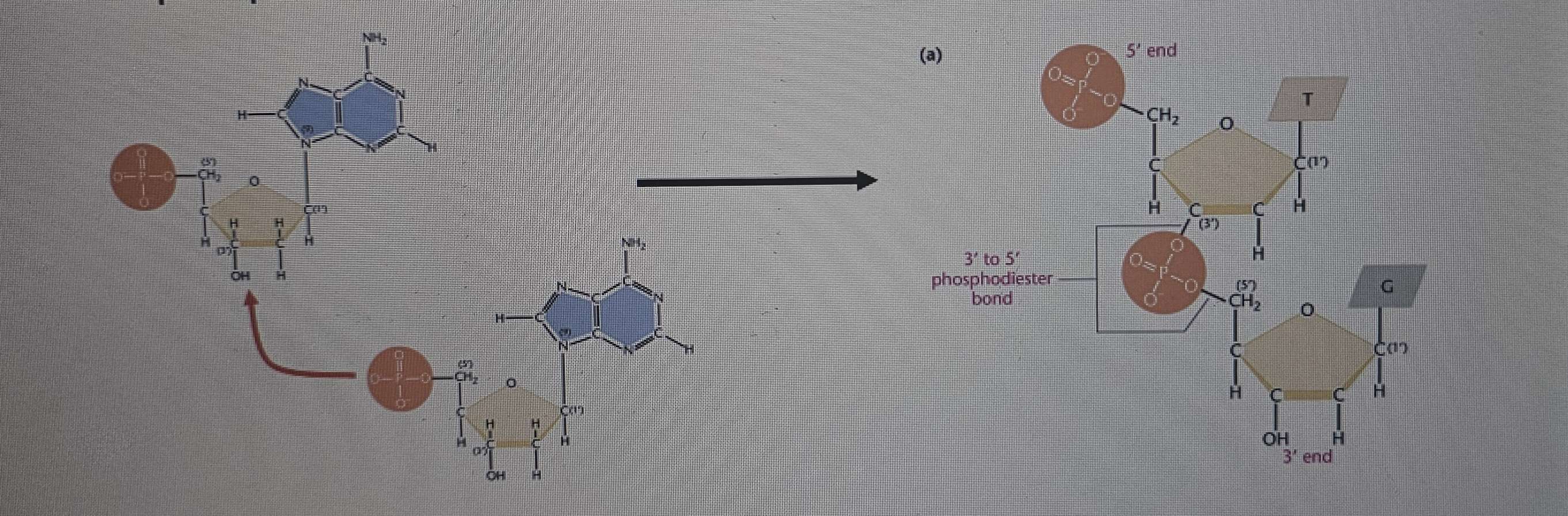
Nucleotides are connected via phosphodiester bonds
Bonding occurs between the 5' phosphate group of one nucleotide and the 3' OH group of the next nucleotide
Each phosphate links two sugars
Polarity and ends
One end (5' end) has a free 5' phosphate
The other end (3' end) has a free 3' OH group
DNA 5’ to 3’ and PDB 3’ to 5’
5’ is the CH2 group that attaches to the sugar molecule in the backbone, contributing to the overall structure and stability of the DNA helix. But also how the radioactive isotopes(Phosphous)used in labeling can interact with these ends, allowing researchers to trace and visualize DNA replication and repair processes, thereby enhancing our understanding of genetic mechanisms.
DNA Structure: Pre-1953 Knowledge and the Double Helix Model
Chargaff's rules (pre-1953):
Relative ratios in DNA show A roughly equals T and G roughly equals C within a sample (A = T and G = C)
Watson, Crick, Franklin, and Wilkins model (1953):
1) DNA is a double-stranded polynucleotide that adopts a right-handed helix
The two strands are antiparallel (one runs 5'→3', the other 3'→5')
2) Bases lie flat in the plane, perpendicular to the helix axis
3) The 3-D shape is a helical structure with the base pairs stacked inside
4) 5' end of one strand interacts with the 3' end of the other strand (antiparallel pairing)Note:
Minor binding can form, such as a protein entering through, 10.4 base pairs leading upwards.
The base pairs are paired up with hydrogen; the DNA is made of a phosphate sugar backbone.
DNA structure 3-D shape
Outside of each strand (the backbone)
Consists of sugar and phosphate groups attached to one another as described previously.
The bases face the inside and form the hydrogen bonds with the bases from the opposite strand.
Hydrogen bonds only form between A-T (2) and C-G (3)
Contains alternating major and minor grooves
Empty spaces in the 3-D structure of the double helix
Common location of protein binding
DNA structure, Alternate forms of A and Z DNA
DNA structure: alternate forms of DNA
The type of DNA described by Watson and Crick and the type found in most normal cells is called B-DNA However, DNA can adopt other 3-D shapes
1. A-DNA – Observed when water is removed from the DNA (dehydration/high-salt)
- It is more compact than B DNA (11-12 bases/turn)
- Still a right-handed helix
- Bases are tilted upwards slightly (not flat)-Grooves are deeper, but narrower
Base tilt
In A-DNA, bases aren’t flat across the helix axis like in B-DNA.
Instead, they’re tilted (~20°) and displaced from the axis.
This tilt compresses the helix lengthwise, making it shorter and fatter compared to B-DNA.
Groove shape
Because of the tilt + displacement:
The major groove gets pushed inward → deep but narrow.
The minor groove gets pushed outward → shallow but wide.
Why this happens
The sugar puckers differ:
B-DNA = C2′-endo sugar pucker
A-DNA = C3′-endo sugar pucker
This subtle shift in sugar geometry drags the backbone closer to the helix axis and forces the bases to tilt.
That backbone repositioning reshapes the grooves.
2. Z-DNA – Observed when DNA is constructed
to have mostly C-G base pairs
- Has a spread-out, zig-zag shape
- LEFT-HANDED helix
- Major groove is not present
A and Z DNA have some biological relevance
1. A DNA and bacterial endospores
Some bacterial species (Gram-positive) form protective endospores when environmental conditions become too harsh
Protected against heat, UV light, most harsh chemicals, drying, super saline etc...
How?
1. Remove most of their water and have a tough outer coat
Thick layers of peptidoglycan (in the cortex)
Protein-rich spore coat (resistant to toxins/enzymes)
2. Produce SASPs that bind to the DNA and convert it from B to A
- Tightens the DNA and protects it from damaging agents (e.g. UV light)
Small acid-soluble proteins (SASPs)
Wrap tightly around DNA like bubble wrap.
Protect DNA from UV light, heat, and chemical damage.
Metabolic dormancy
Endospores basically “shut down” life functions.
With no metabolism running, there’s less that can be destroyed.
👉 In short: Layers of armor + dehydration + DNA shield + dormancy = nearly indestructible survival capsule.
2. Z-DNA and the proteins that bind to them
Scientists have discovered cellular and viral proteins that have the ability to
bind tightly to Z DNA (but not A or B DNA)
Cells wouldn’t have such proteins if Z DNA did not exist naturally
Now believe that many genes have stretches of sequence (GC rich) that
adopt a Z-like conformation (may be involved in transcription regulation)
DNA structure
RNA structure
RNA/DNA similarities
Helical-shaped, polynucleotide chain that is composed of 4 types of nucleotides
Nucleotides are attached via phosphodiester bonds
RNA/DNA structural differences
RNA is mostly single-stranded (but can fold back on itself and form double-stranded regions)
RNA does not contain the base thymine. Instead, it contains a different pyrimidine called uracil (A-U hydrogen bond)
The sugar in the RNA nucleotides is RIBOSE (not deoxyribose)
RNA serves as the genetic material template.
RNA HAS A OH ON CARBON 2 and DNA HAS A H ON CARBON 2
RNA serves as the genetic material for a number of viruses
e.g. influenza, HIV, polio, yellow fever