Chapter 3
3.1
Learning objectives
Explain how the triangle of meaning describes the symbolic nature of language
Distinguish between denotation and connotation
Discuss the function of the rules of language
Key points:
The triangle of meaning is a model of communication that indicates the relationship among a thought, symbol, and referent, and highlights the indirect relationship between the symbol and the referent. The model explains how for any given symbol there can be many different referents, which can lead to misunderstanding.
Denotation: Refers to the agreed on or dictionary definition of a word.
Connotation: Refers to definitions that are based on emotions or experiences associations people have with a word
The rules of language help make it learnable and usable. Although the rules limit some of the uses of language, they still allow for the possibility of creativity and play.
Language acquisition: The process by which we learn to understand, produces and use words to communicate within a given language group. This process happens at an amazing speed during the first two years of life, and we attain all the linguistic information we need to participate in everyday conversations, assuming normal development, by our early teens.
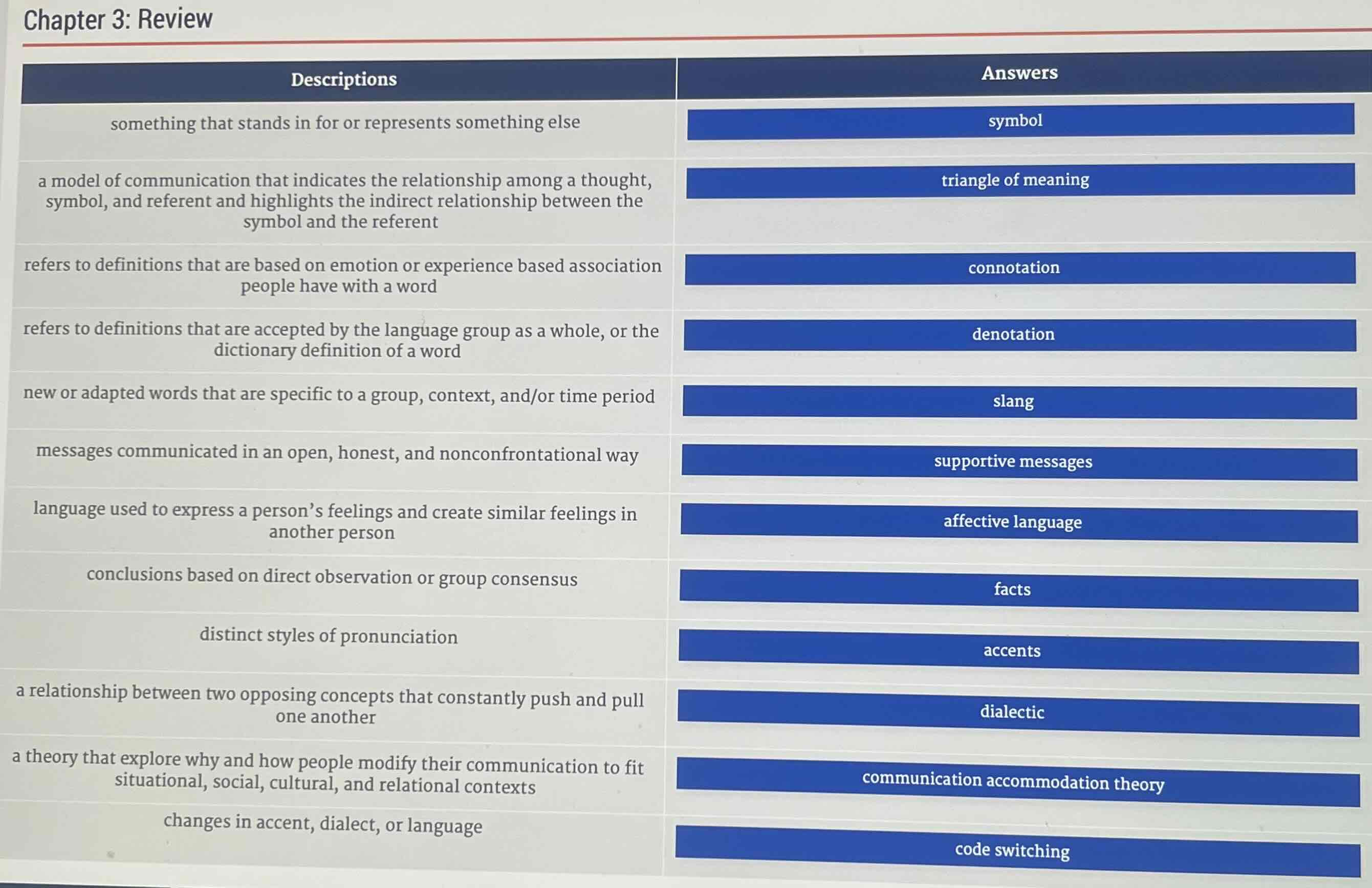
Symbol: Something that stands in for or represents something else.
Can be communicated verbally, in writing or no verbally.
Codes: Culturally agreed on and ever-changing system of symbols that help us organize, understand, and generate meaning.
Displacement: Our ability to talk about events that are removed in space or time from a speaker and situation.
The Triangle of Meaning: is a model of communication that indicates the relationship among a thought, symbol, and referent and highlights the indirect relationship between the symbol and referent.
Denotation: refers to definitions that are accepted by the language group as a whole, or the dictionary definitions of a word
Connotation: refers to definitions that are based on a motion or experienced based associations people have with the word
Grammar: refers to the rules that govern how words are used to make phrases in sentences.
Language acquisition: refers to the process by which we learn to understand produce, and use words to communicate within a given language.
Somewhat of a mystery relationship between the brain, eyes, ears, and voice.
Great variation between individuals
Babies learning of Language:
2-4M: Can respond to different tones
6 m: can associate some words and respond with behaviors
8-10 m: learn that pointing can attract or direct attention and follow conversation with their eyes
1 y: Recognize some individual words and may begin to interact in a conversational way and mimic sounds and pitch.
3.2
Learning objectives
identify and discuss the four main types of linguistic expressions
discuss the power of language to express our identities affect or credibility control others and perform actions
discuss some of the sources of fun within language for explain how federalism and slang contribute to the dynamic nature of language, identify the ways in which language can separate people and bring them together.
Key takeaways
language helps us express observations (reports on sensory information) thoughts conclusions, and adjustments based on observations or ideas feelings and needs
language is powerful, and that it expresses our identities through labels used by and on us affects our credibility based on how we support our ideas services as it means of control and performs actions when spoken by certain people in certain context The productivity and limitless of language creates the possibility for countless word games and humorous use of language
language is dynamic, meaning it is always changing through the addition of neurologist, new words or old words with new meaning, and the creation of slang
language is relational and can be used to bring people together for a shared reality, but can separate people through unsupportive and diverse messages
Verbal expression: Helps us communicate our observations, thoughts, feelings, and needs
Directives: Utterances that try to give another person to do something
Commissives: Is when a speaker is committed to a certain course of action such as a promise
Neologisms: Newly coined are used words
Slang:Refers to new or adaptive words that are specific to a group context and or time. Regarded as less formal and representative of people’s creative play with language.
Language is Relational
We use verbal communications to initiate, maintain, and terminate our interpersonal relationships.
Language can bring us together
Suportive messages: Which are messages communicated in an open, honest and non confrontation way.
Esperanto: First attempt at a common language from the 1980s
Language can separate us:
Unsupportive messages: messages that make others respond defensively, which can lead to feelings of separation and actual separpration or dissolution of a relationship.
Common types of unsupportive messages
Global labels: you’re a liar, labeling someone irresponsible on trustworthy, selfish or lazy, cause his or her whole identity as a person into question
Sarcasm: even though sarcasm is often distinguished as humor usually represents passive aggressive behavior if through which person, indirectly communicates negative feelings
Dragging up the past: bringing up negative past experience is attacked accused by people when they don’t want to discuss a current situation
Negative comparisons: holding a person up to the standards or characteristics of another person could lead to feelings of inferiority or resentment
Judgmental “you”messages: accusatory messages are usually generalized overstatements about another person that go beyond labeling, but still do not describe specific behavior any productive way
Threats: threatening someone with violence or some other negative consequence usually signals the end of productive communication
3.3
Learning objectives
Discuss how the process of abstraction and creation of whole messages relate to language
Employ figurative and vocative language
Identify strategies for using language ethically
The ladder of abstraction: A model used to illustrate how language can range from concrete to abstract
Jargon: Refers to specialized words used by a certain group of profession
Whole messages: Include all the relevant types of expressions needed to most effectively communicate in a given situation, including what you see what you think what you feel and what you need
Partial messages: Are missing a relevant type of expression and can lead to misunderstanding and conflict
Contaminated messages: Include mixed or misleading express expressions
Effective language: Refers to language used to express a person‘s feelings and create similar feelings in another person
Figurative Language:
A simile: A direct comparison of two things using the word like or as
A metaphor: An implicit comparison of two things that are not alike, and or are not typically associated
Personification: Refers to the attribute of human qualities or characteristics of other living things to non-human objects or abstract concepts
Common individual and situational influences that may lead to breach of civility
Individual differences; some people differ in their interpretation of civility in various settings, and some people have enter personality traits that may lead to actions deemed on civil on a more regular
Ignorance: in some cases, especially novel situations involving uncertainty people may not know what social norms are expected of them
Lack of skill: even when we know how to behave we may not be able to do it such frustrations may lead a person to revert to undesirable behaviors, such as engaging in personal attack during a conflict because they don’t know what else to do
A lapse of control: self control is not an unlimited resource, even when people know how to behave and have the skill to respond and a situation appropriately. They may not do so. Even people who are careful to monitor their behavior have occasional slip ups
Negative intent: some people in an attempt to break with conformity or challenged societal norms or for self benefit (public embarrassing someone in order to look cool or edgy) are openly on civil such behavior can also result from mental or psychological stresses or illnesses.
Swearing
Social swearing: Is to create social bonds or for impression management (seem cooler attractive)
Annoyance swearing: Provides a sense of relief as people use it to manage stress and tension, which can be a preferred alternative to physical aggression
Influences: Our conclusions based on thoughts or speculation, but not direct observation
Facts: Our conclusion based on direct observations or group consensus
Judgments: Expressions of approval or disapproval that are subjective and not verifiable
Inferences-observation confusion: Or the misperception of an inference (conclusion based on limited information) or an observation (un observed or agreed on fact)
Key takeaways
The symbolic nature of language means that misunderstanding can easily occur when words and their definitions are abstract (fall removed from the object or idea to which the symbol refers) the creation of whole messages which contain relevant observations, thoughts, feelings, and needs can help reduce misunderstandings
Affective language: refers to language used to express a person’s feelings and create similar feelings. In another person metaphor, simile, personification, and vivid language can evoke emotions in speaker and listener.
Incivility: our occur when people deviate from accepted social norms for communication and behavior and manifest and swearing and polarized language that cost people and ideas as opposites people can reduce sensibility by being more accountable for the short and long-term effects of their Communication.
3.4
Learning objectives
Discuss some of the social norms that guide conversational interaction
Identify some of the ways in which language varies based on cultural context
Explain the role that accommodation and code switching plan
Discuss cultural bias in relation to specific cultural identities
Adjacent pairs: are related communication structures that come one after the other (adjacent to each other) in an interaction
There is back-and-forth that is often verbally managed through rephrasing and clarification
People need to feel like they’re contributing something to an interaction so turn taking as a central part of how conversations play out
Some conversational elements are highly scripted and ritualized, especially at the beginning and end of an exchange and topic changes
Accent: Are distinct styles of communication dialect accents can vary by region class or ancestry, and they influenced the impressions that we make of others
Dialect: our versions of languages that are distinct words, grammar, and punctuation
Communication accommodation theory: is a theory that explores why and how people modifyTheir communication to fit situational, social, cultural, and religious context
Divergence: meaning a person uses communication to emphasize the differences between his or her conversational partner and his or herself
Code switching: refers to change an accent dialect or language
Cultural bias: is a skewed way of viewing or talking about a group that is typically negative
Key Takeaways:
Getting integrated: social context influences the ways in which we use language and we have been socialized to follow implicit social rules like those that guide the flow of conversation conversations, including how we start and end our interactions and how we changed topics the way we use language changes as shift among academic professional, personal, and civic context
The language that we speak influences our cultural identities and our social realities, we internalize the norms and rules that help us function in our own culture, but that can lead to misunderstanding when used in other cultural context
We can adapt to different cultural context by propose changing our communication. Communication accommodation theory explains that people may adapt their communication to be more similar to or different from other others based on various context.
We should become aware of how our vocal communication reveals biases towards various cultural groups based on race, gender, sexual orientation, and ability.