The Structure of the Sun (Part 4)
Solar Model
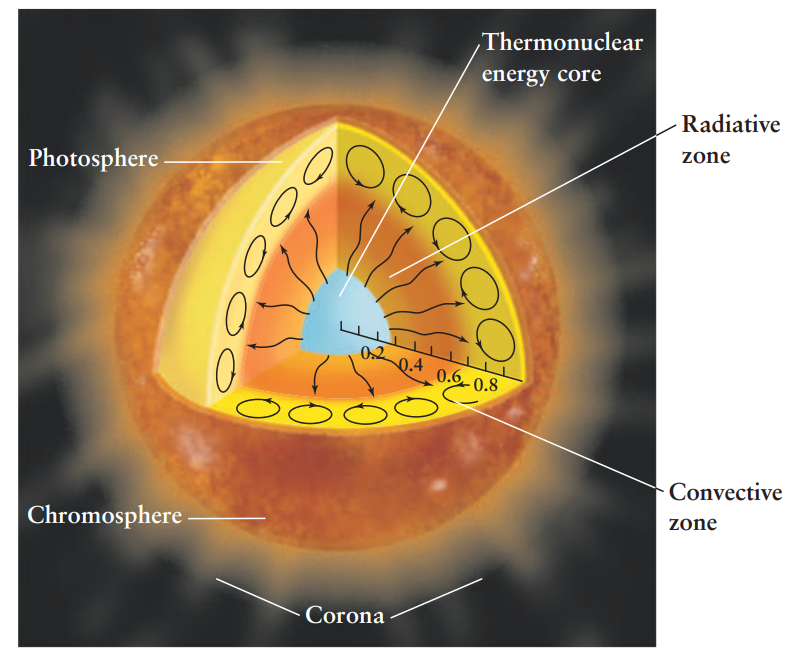
Definition:
The solar model is a scientific framework explaining the Sun's interior structure and how the energy from nuclear fusion in its central core gets to its photosphere.
It begins with the inward force created by the Sun’s mass due to gravity, which compresses matter in the core.
The model describes the balance between this inward gravitational force and an outward force, primarily created by gamma-ray photons generated during fusion, which prevents the Sun from shrinking.
Hydrostatic Equilibrium: This is the balance between the inward force of gravity and the outward force from the motion of the hot gas. Over fusion events occur every second in the Sun’s core, providing the energy needed to prevent its collapse.
Energy Transport Mechanisms:
Radiative Transport: This is the dominant means of outward energy flow in the Sun’s radiative zone, extending from the core to about 70% of the way out to the photosphere.
Energy is carried by individual photons hitting particles, which then bounce off other particles and reemit photons.
Photon Journey: A gamma-ray photon created by fusion slams into a nearby ion, transferring its energy. The energized ion moves, colliding with another particle, causing a lower-energy photon to be emitted. This process of energy loss repeats throughout the journey, and the photons emitted from the photosphere have a wide range of energies and wavelengths, contributing to the blackbody nature of the photosphere’s spectrum. From fusion to sunlight typically takes about 170,000 years.
Convective Zone: Near the photosphere, energy is carried the remaining distance to the surface by the bulk motion of the hot gas, rather than by energetic photons. This circulation of gas blobs is called convection.
Hot gas travels up to the top of this zone by convection, and from there it radiates photons into space, which we observe as sunlight. The photosphere is at the bottom of the solar atmosphere and also at the top of the convective zone.
Once gases in the convective zone lose energy by emitting photons into space, they cool and settle back into the Sun. This convective flow is also the origin of solar granules.
Mathematical Representation:
A set of mathematical equations (equations of stellar structure) describes the Sun’s pressure, temperature, and density at varying depths.
Given the complexity of these equations, modern astrophysicists employ computer models for solutions.
Graphical Representation:
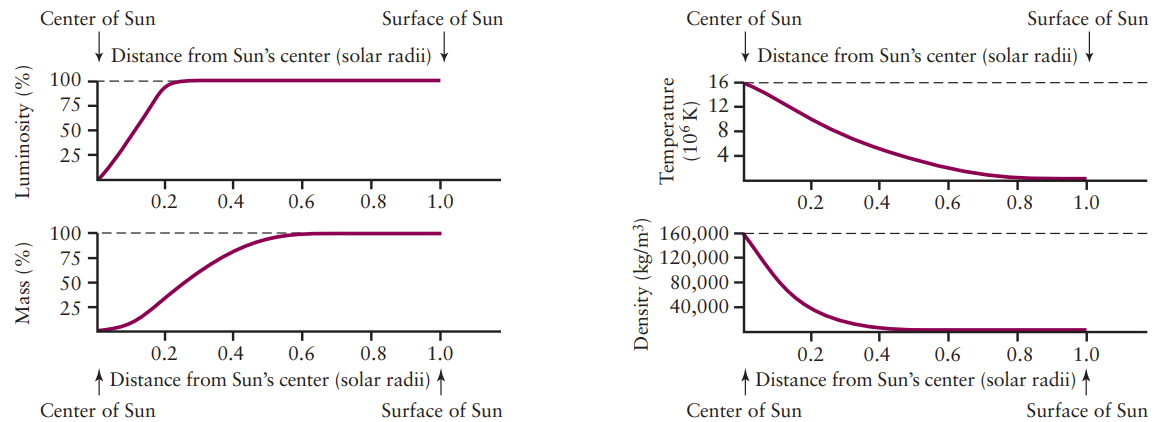
The relationships between luminosity, mass, temperature, and density from the Sun's core to its photosphere can be represented graphically, revealing:
Luminosity: Reaches 100% at about a quarter of the distance from the center to the photosphere.
Mass Distribution: Nearly 100% mass is contained within 60% of the radius from the center.
Photospheric Density: The density at the photosphere is approximately 10^4 times less than Earth’s atmospheric density.