Existence of God
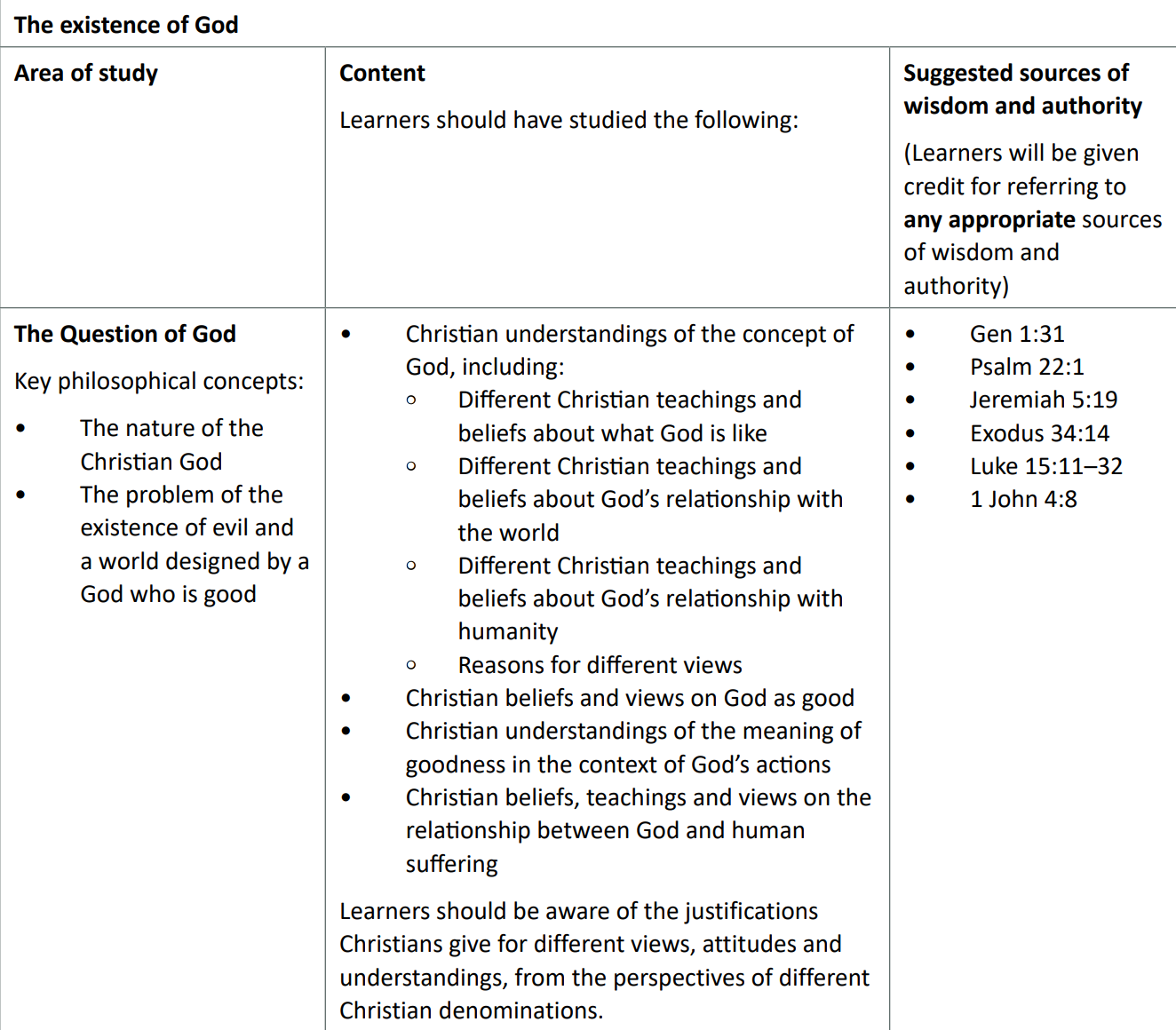
The Question of God in Christianity:
Nature of God:
Omnipotent (all-powerful): God is the creator and governor of the universe.
Omnibenevolent (all-loving): God desires the well-being of creation.
Omniscient (all-knowing): God knows all things—past, present, and future.
Omnipresent (present everywhere): God is always involved in the world.
God’s Relationship with the World:
Creator: God designed the world with order and purpose (Genesis 1:1).
Sustainer: Continuously maintains the existence of the universe (Hebrews 1:3).
Different Christian denominations emphasize God’s transcendence (beyond human understanding) and immanence (active involvement in the world).
God’s Relationship with Humanity:
God as a Loving Father: Provides care and guidance.
God as a Righteous Judge: Rewards good and punishes sin.
Denominations differ on practices, with Protestants focusing on individual relationships and Orthodox Christians focusing on communal worship.
The Problem of Evil and Suffering
Types of Evil:
Moral evil: Suffering caused by human actions (e.g., war).
Natural evil: Suffering caused by nature (e.g., earthquakes).
Christian Responses to Evil:
Free Will Defense: Evil exists because humans have free will to choose.
Soul-Making Theodicy (Irenaean Theodicy): Suffering is necessary for spiritual growth and moral development.
Augustinian Theodicy: Evil is the absence of good, caused by humanity's sin, but redemption through Christ is available.
Denominational Differences in Responses:
Roman Catholics: Suffering is tied to Christ’s suffering and can be redemptive.
Pentecostals: Focus on prayer for divine intervention and healing.
Epicurus and the Problem of Evil
Epicurus’ Dilemma: The problem of reconciling the existence of evil with an omnipotent and omnibenevolent God.
Inconsistent triad:
Evil exists.
God is omnipotent.
God is omnibenevolent.
These three cannot coexist simultaneously.
Theories of Evil
Augustinian Theory:
Sin entered the world through Adam and Eve, upsetting the natural balance.
Evil is the absence of good, and humans can achieve salvation through Christ.
Irenaean (Soul-Making) Theodicy:
Evil is necessary for moral and spiritual growth.
Humanity is created childlike and matures through experiencing good and evil.
Free will allows humans to choose between good and evil, leading to development.
God’s Omnipotence and Logical Limits
God is omniscient and omnipotent, but only within logical constraints.
Some argue that God’s power is not about arbitrary control but logical actions that align with His nature.
If God is not omnipotent in controlling all natural laws, does this undermine His divinity?
Christian Responses to Suffering
Suffering is seen as a test of faith and a means to strengthen believers.
It’s viewed as part of God’s plan, and faithful Christians will be rewarded in the afterlife.
Prayer, meditation, and acceptance of suffering help Christians cope and grow spiritually.
Christian Beliefs on God as Good
Reasons Christians Believe God is Good:
Creation: The world is seen as perfect and orderly, reflecting God’s goodness.
Moral Guidance: God provides laws, such as the Ten Commandments, to guide humans toward living rightly.
Forgiveness: The sending of Jesus to redeem humanity showcases God’s mercy and love.
Bible Reference: “The LORD is good to all; He has compassion on all He has made.” (Psalm 145:9)
Denominational Emphasis:
Protestants: Focus on God’s grace, understanding His goodness as unearned love and favor.
Revelation of God's Goodness:
Through Creation: Everything God created is good, providing everything needed to sustain life.
Through the Law: God gives rules to encourage moral and caring living.
Through Judgment: God will judge humanity based on actions, ensuring justice.
Through Salvation: God sent Jesus out of love for humanity, offering forgiveness through faith.
Christian Views on God and Human Suffering
How Suffering Fits into Faith:
God allows suffering to:
Test faith and encourage reliance on Him.
Christians believe suffering is temporary, with hope in eternal life as an end to suffering.
Bible Reference: “He will wipe every tear from their eyes. There will be no more death or mourning or crying or pain.” (Revelation 21:4)
Christian Practices Around Suffering:
Roman Catholics: Pray for the suffering during Mass and engage in charity.
Pentecostals: Hold healing services, seeking divine intervention to end suffering.
Bible references:
Genesis 1:31: “God saw all that He had made, and it was very good.”
Explanation: God declares creation “very good,” showing His goodness in creating a perfect world.
Psalm 22:1: “My God, my God, why have you forsaken me?”
Explanation: Jesus’ cry on the cross reflects the experience of suffering, raising questions about God’s role in human pain.
Jeremiah 5:19: “When you ask, ‘Why has the Lord our God done all this to us?’”
Explanation: Suffering is sometimes seen as a result of disobedience to God, reflecting divine justice.
Exodus 34:14: “Do not worship any other god, for the LORD, whose name is Jealous, is a jealous God.”
Explanation: God demands loyalty and devotion, emphasizing His exclusive relationship with His people.
Luke 15:11-32 (The Prodigal Son):
Explanation: This parable shows God’s love and forgiveness, portraying Him as merciful and eager to restore sinners.
1 John 4:8: “Whoever does not love does not know God, because God is love.”
Explanation: God’s essential nature is love, which forms the foundation of His relationship with humanity.
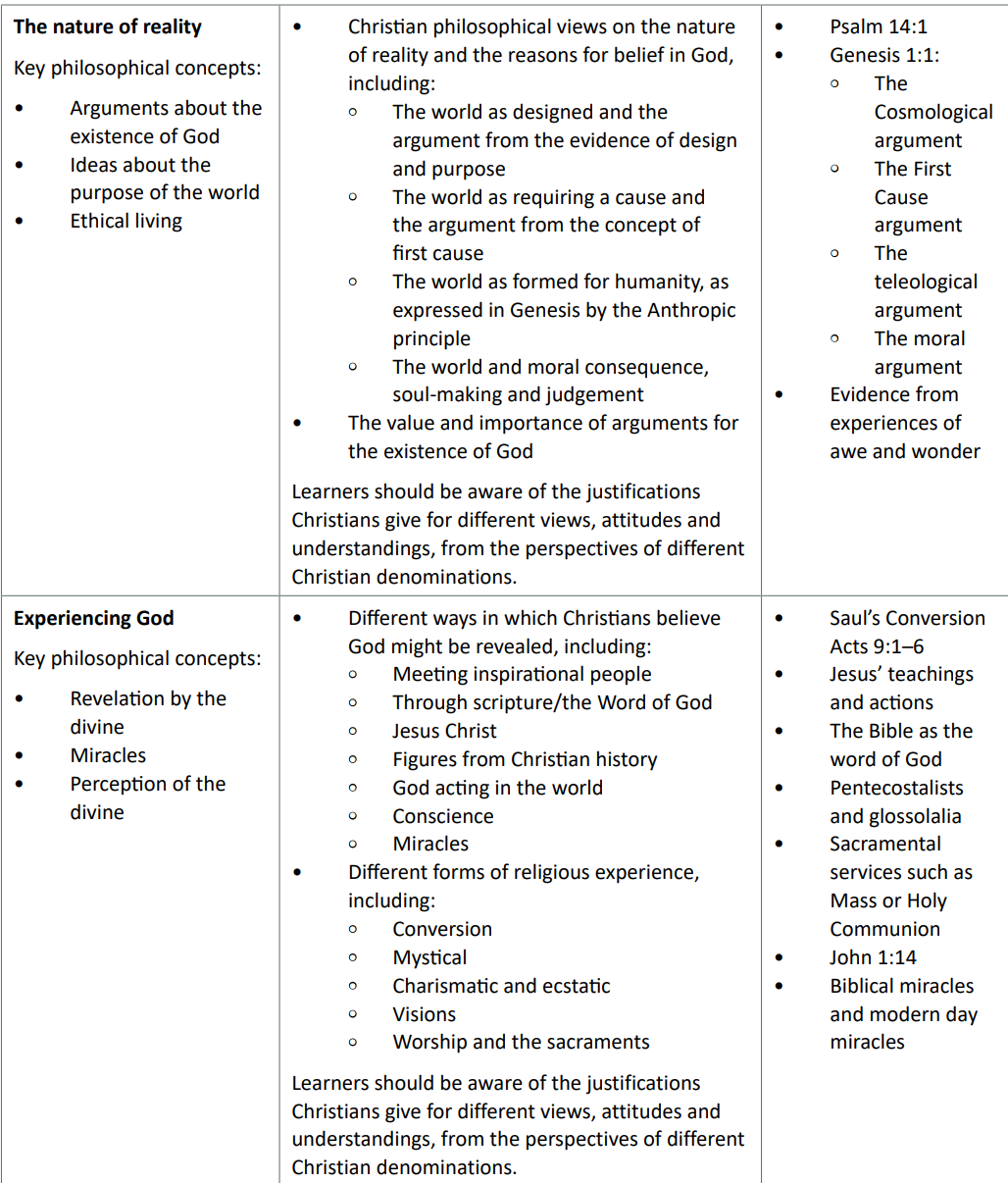
The Nature of Reality
Arguments for the Existence of God:
Design Argument: The complexity and order of the universe point to an intelligent designer.
Bible Reference: “The heavens declare the glory of God; the skies proclaim the work of His hands.” (Psalm 19:1)
Cosmological Argument (First Cause): Everything that exists has a cause; the universe’s first cause is God.
Bible Reference: “In the beginning, God created the heavens and the earth.” (Genesis 1:1)
Moral Argument: Humans’ shared moral understanding points to a divine lawgiver.
Bible Reference: “The requirements of the law are written on their hearts.” (Romans 2:15)
Ideas About the Purpose of the World
Anthropic Principle:
The universe is finely tuned with precise conditions allowing human life, seen as evidence of God’s intentional design.
Bible Reference: “You made them rulers over the works of your hands.” (Psalm 8:6)
This emphasizes humanity's central role in God’s plan and the world’s deliberate design.
Soul-Making and Judgment:
The world is a place of moral and spiritual growth, where actions have eternal consequences (heaven and hell as rewards or punishments).
Methodists: Focus on personal growth, transformation, and mission work as part of God’s purpose.
Ethical Living
Christians are called to live according to moral principles aligned with God’s purpose.
Examples of Ethical Living:
Caring for the environment as stewards of creation (e.g., Anglicanism).
Helping the poor and engaging in charity (e.g., Salvation Army).
Bible Reference: “Whatever you did for one of the least of these brothers and sisters of mine, you did for me.” (Matthew 25:40)
The Value of Arguments for God's Existence
These arguments help rationalize faith, bridging the gap between reason and belief.
Evangelical Christians: Often focus on personal experiences with God as the most compelling evidence.
Catholics: Combine rational arguments with teachings from Church tradition.
Bible references:
Psalm 14:1: “The fool says in his heart, ‘There is no God.’”
Explanation: Denying God’s existence is seen as foolish, highlighting that creation points to a Creator.
Genesis 1:1: “In the beginning God created the heavens and the earth.”
Explanation: God is the Creator of everything, affirming that the universe has a purposeful origin.
Cosmological Argument:
Explanation: The universe must have a cause, and that first cause is God, supporting the belief in a Creator.
Moral Argument:
Explanation: Objective morality points to a divine lawgiver, supporting the idea that moral laws come from God.
Anthropic Principle:
Explanation: The world’s fine-tuning for human life suggests it was designed with humanity in mind by God.
Experiencing God
Revelation by the Divine:
God Reveals Himself Through:
Inspirational People: Saints like St. Francis of Assisi, exemplifying God’s love.
Scripture: The Bible is seen as God’s word.
Jesus Christ: The ultimate revelation of God in the Incarnation.
Religious Experience: Miracles and personal experiences of God’s presence.
God’s Actions in the World: Natural events like sunsets or miraculous recoveries seen as signs of God’s presence.
Conscience: Interpreted as God’s voice guiding moral decisions.
Bible Reference: “The Word became flesh and made His dwelling among us.” (John 1:14) — Emphasizing Jesus as the ultimate revelation.
4 Ways the Goodness of God is Revealed:
Creation
Law
Salvation
Judgment
Miracles
Definition: Events beyond natural explanation, attributed to God’s intervention.
Biblical Examples: Jesus healing the sick, turning water into wine.
Modern Examples: Miracles at pilgrimage sites like Lourdes (e.g., healing).
Bible Reference: “With God all things are possible.” (Matthew 19:26) — Emphasizing the belief in miracles as divine acts.
Practices:
Pentecostals: Emphasize miraculous healings and spiritual gifts, such as speaking in tongues.
Catholics: Focus on sacramental miracles, like the Eucharist (believed to transform into the body and blood of Christ).
Perception of the Divine
Awe and Wonder: Profound beauty in nature or during worship can evoke awe.
Different Responses:
Charismatic Christians: Express awe through ecstatic worship.
Orthodox Christians: Experience the divine through icons and chanting.
Forms of Religious Experience
Conversion: A life-changing moment of turning toward God.
Example: The conversion of John Wesley, who felt his heart “strangely warmed.”
Bible Reference: “If anyone is in Christ, the new creation has come.” (2 Corinthians 5:17)
Mystical Experiences: A deep spiritual connection with God, often indescribable.
Example: Teresa of Avila’s visions of God in prayer.
Bible Reference: “Be still, and know that I am God.” (Psalm 46:10)
Charismatic and Ecstatic Experiences: Includes speaking in tongues, prophecy, or physical expressions of worship.
Common in Pentecostal and charismatic churches.
Bible Reference: “All of them were filled with the Holy Spirit.” (Acts 2:4)
Visions: Receiving divine messages or seeing holy figures.
Example: St. Bernadette’s visions of the Virgin Mary at Lourdes.
Worship and Sacraments
Worship Practices Vary:
Catholics and Orthodox Christians: Celebrate sacraments like the Eucharist, seen as moments of divine connection.
Protestants: Focus on personal prayer and the study of scripture as central acts of worship.
Impact of Religious Experiences:
Religious experiences often reaffirm faith and provide hope, especially during challenges.
Interpretations:
Catholics: See them as signs of God’s grace through the Church.
Evangelicals: View them as evidence of a personal relationship with God.
Revelation Through Scripture
Fundamental: Literal interpretation of the Bible, believing God’s decisions are always right and humans should abide by them (e.g., Creationism and strict ethical living like the Amish).
Conservative: The Bible is directly inspired by God but requires interpretation relevant to modern society. The Bible is considered a better source of authority than the Church.
Liberal: The Bible is seen metaphorically, conveying fundamental truths about existence but not scientific truths.
Bible references:
Saul’s Conversion (Acts 9:1-6):
Explanation: Saul’s dramatic conversion on the road to Damascus demonstrates God’s direct involvement in personal transformation.
Jesus’ Teachings and Actions:
Explanation: Jesus’ life reveals God’s love and power, showing God’s nature through His words and deeds.
The Bible as the Word of God:
Explanation: Christians view the Bible as God’s revelation, guiding believers with His teachings and will.
Pentecostalists and Glossolalia:
Explanation: Speaking in tongues is seen as a sign of the Holy Spirit’s presence, showing ongoing divine revelation.
Sacramental Services:
Explanation: Sacraments like the Eucharist are moments where Christians experience God’s presence and grace.
John 1:14: “The Word became flesh and made His dwelling among us.”
Explanation: Jesus is the full revelation of God, showing God’s active involvement in human history.
Biblical Miracles and Modern-Day Miracles:
Explanation: Miracles in both the Bible and today are seen as signs of God’s intervention and power.