C4
Acids and bases
If it’s Ph is higher than 7 its an alkaline
If it’s pH is lower than 7 its Acidic
If the pH is 7 Its pure WATER
You can use an indicator to tell pH, based on its colour
or a pH probe which measures pH electronically

Acids Are proton doners, donating H+ ions which are just protons
Alkaline are proton acceptors with OH- ions:
H+ + OH- = H2O
Strong acids
Think about it like this- It’s an acids job to donate protons/ H+ ions The better it is at its job, the stronger it is as an acid, So strong acids that completely disassociate with their H+ ions Giving them up completely in water are much stronger than acids that still keep the H+ ions in a partial disassociation. Like how a waiter serving food is good if they serve the food and then disassociate with the food instead of only partially disassociating with the plate holding onto it with a death grip a you try to eat the food off it only for them to reverse the serve and take the plate back again.
Acids form H+ ions when dissolved in water
Strong acids Completely disassociate to and release H+ ions in water in an irreversible reaction
They fully ionise meaning that they split up in to their individual ions (The ions are atoms with full outer shells)
E.g.: HCl, Sulfuric acid, Nitric acid
These have a lower pH
Weak acids only partially disassociate into their ions, in a reversable reaction
Only some of the original acid molecules disassociate into ion
e.g.: Ethanoic acid, Citric acid
These have a higher pH
The more H+ ions, the faster the rate of reaction, So strong acid are more reactive than weak acids at the same concentration.
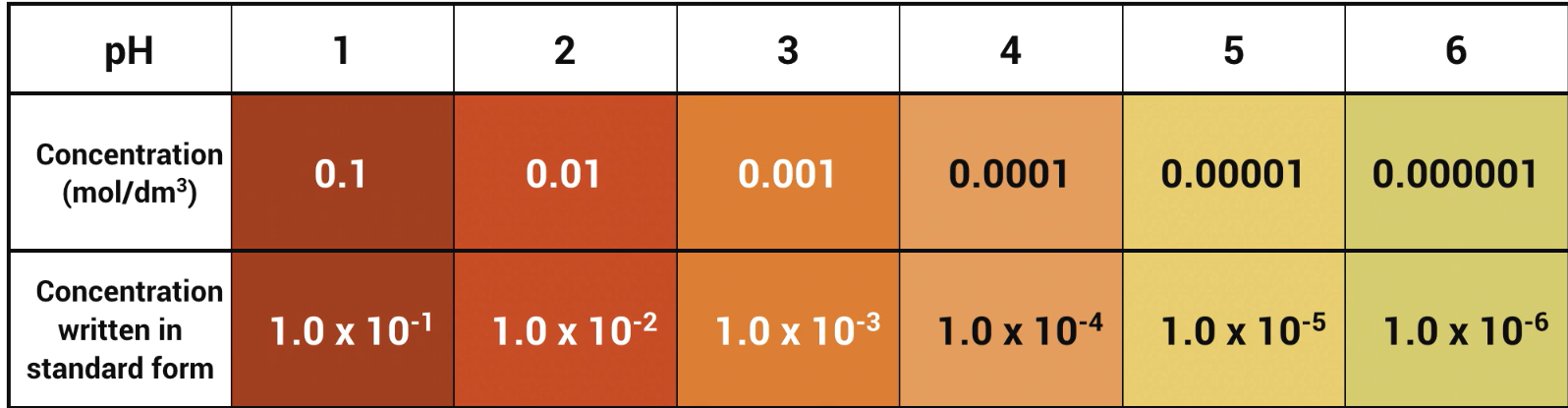
pH is dependant on Both concentration and Strength:
The higher the Strength the more H+ ions there will be as Strong acids, fully disassociate, creating a higher concentration of acids
Titrations
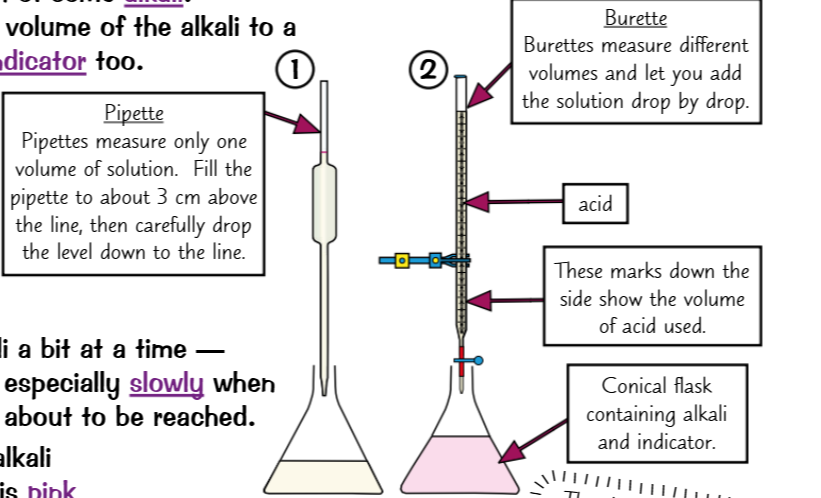
This is an experiment that lets you find out exactly how much acid is needed to neutralise a quantity of alkali or vice versa:
Use a pipette and pipette filter to add a set volume of alkali to a conical flask
Add 2 or 3 drops of indicator to the alkali solution (Phenolphthalein)
Use a funnel to fill a burette with some acid of a known concentration
Record the initial volume of the burette
Use the burette to slowly add the acid to the alkali stirring as you go
Once the colour change is reached shut the tap to the burette and record the final volume
Things that could go wrong
is a parallax error when reading the measurements, -Record with eye level in line with the measurement
Anomalous results - Repeat the experiment multiple times
Picking an indicator
You need an indicator with a sudden colour change like:
Phenolphthalein OR Methyl
This is to ensure that it is easy to tell weather the solution is either acid or alkali
Reactions of acids
All metal oxides react with acids to form a salt and water
And all metal Hydroxides react with acids to form a salt and water.
And all metal carbonates react with acids to form a salt, water and carbon dioxide
And metals react with acids to form a salt, and hydrogen
And metals can react with water to form a Metal hydroxide + hydrogen
For example:


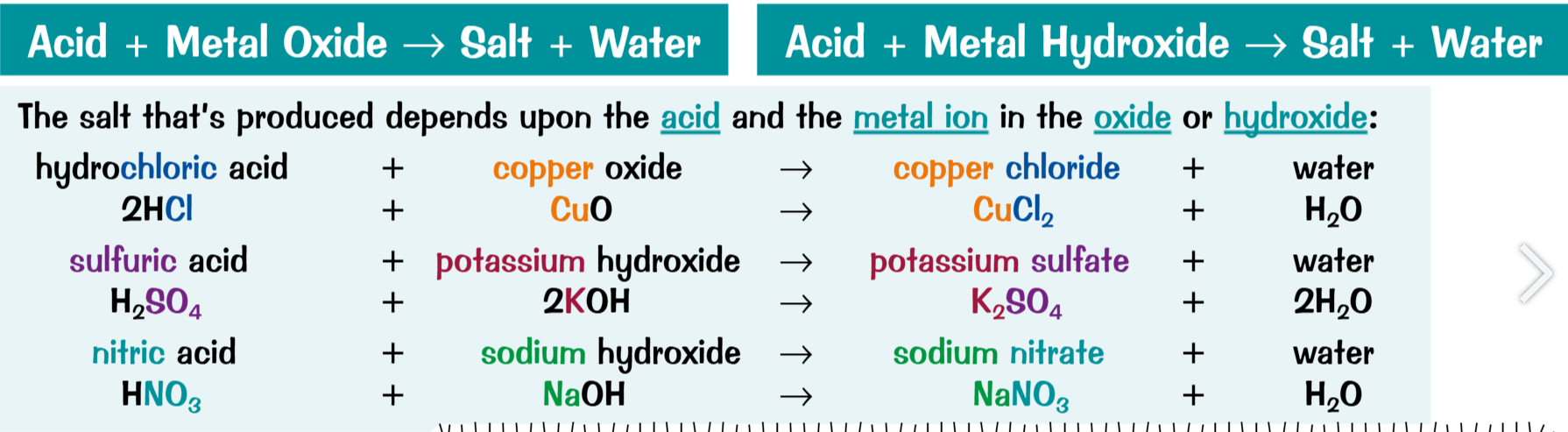

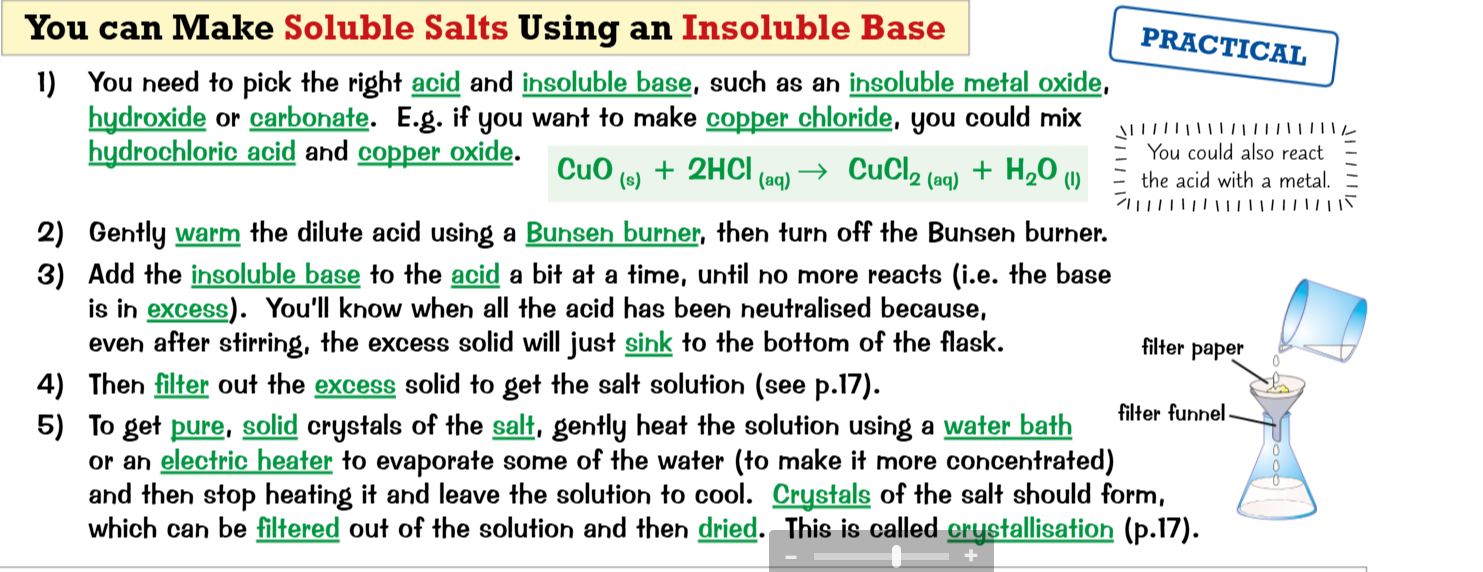
How to balance these equations?
Firstly you need to know the actual symbols of each substance
Then you need to split them up into their ions (including their charges after gaining full outer shells)
Then you react the elements that were not in a compound before and have opposite charges
Making sure that water is one of the products
Then after writing down the new compounds formed you balance the equation
Now do a worksheet.
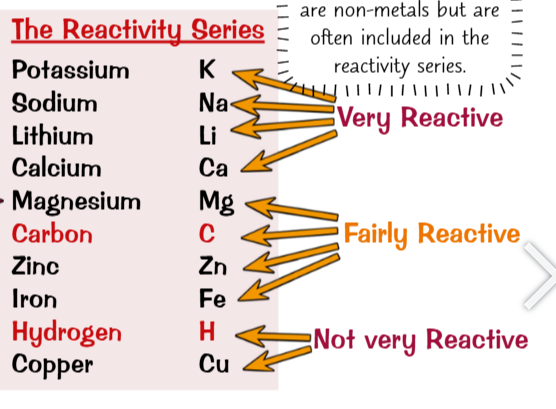
The reactivity series
This follows the reactivity of metals in order with the only ones you have to worry about going from most the least reactive are:
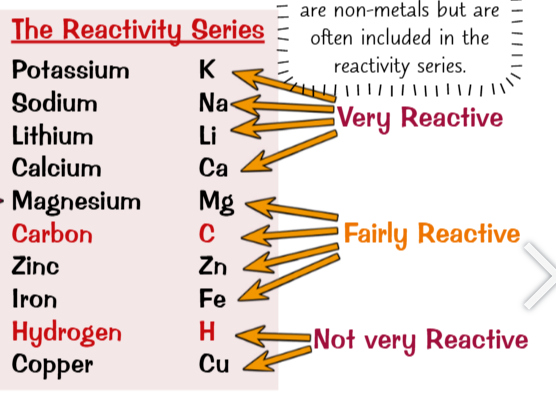
Now If you forget this just know that it is determined my the shielding and how hard it is for the metals to lose or gain electrons so far down group 1 metals, would be more reactive then far up group 2.
The faster hydrogen is released in a reaction the more reactive the metal
The higher the temperature change in a reaction the more reactive the metal
Separating metals from metal oxide
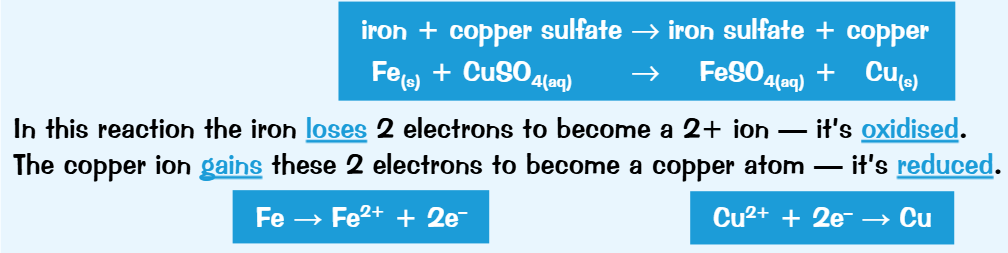
Oxidation → The gain of oxygen / The loss of electrons / The loss of hydrogen
Reduction → The loss of oxygen / The gain of election/ The gain of hydrogen (WELCOME BACK!!)
Oxidation and reduction happen simultaneously with different elements within a reaction (Redox reaction)
Oxides are commonly ores of the metal
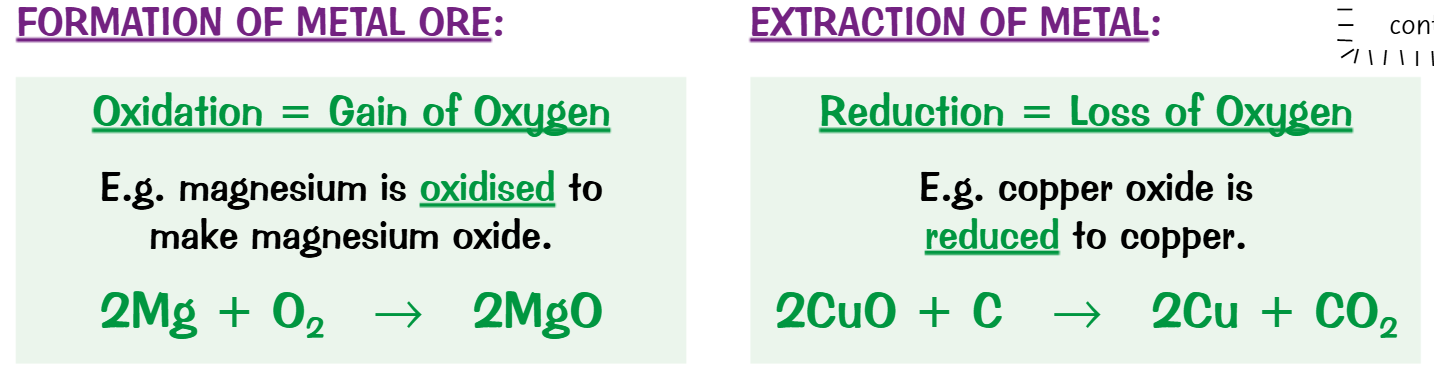
Carbon is commonly used to reduce certain metal ores (Carbon gets oxidized to CO2 in the reaction)
However it can only oxidize metal ores that are less reactive then it:
Zn, Fe, Cu
The rest are reduced by electrolysis
Some elements are so reactive that it cran’t react naturally to from an ore
Penguins
Sit
Lonely
‘cus
Many
Cran’t
ZOOM
into
Copper
Redox reactions
Oil Rig CHOO CHOO!!!
Oxidation is loss reduction is gain
Redox equations can be split into 2 half equations
Each half equation is either oxidation or reduction
It cran’t be both its either or
A displacement reaction is when a more reactive element displaces a less reactive element from its compound
Displacement reaction are redox reactions
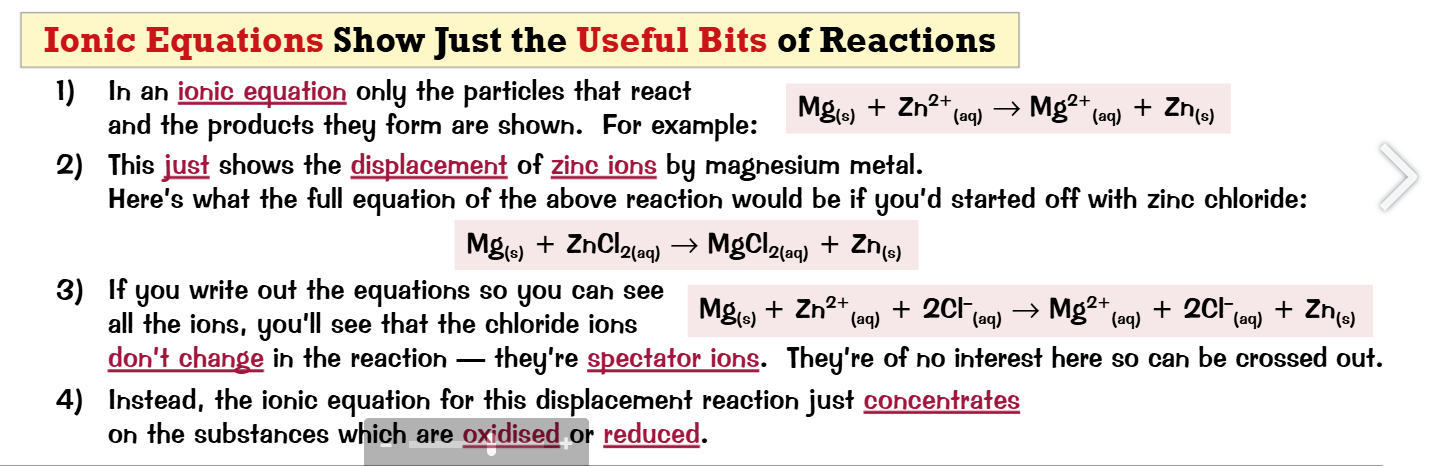
Turning things into ionic equations:
Write out the entire reaction in symbol form
Identify the charge of the metal in the ionic compound
remove the nonmetal
write out the equation with the charges of the metals
Electrolysis
Electrode - Electrically charged rod
Electrolysis - Using electricity to break down electrolytes to form elements
Electrolyte- A dissolved or molten ionic compound
Electrolysis is using electricity to separate Molten or dissolved ionic compound back into their original elements
This is done by first getting them molten/ dissolved
as the ions and particles can’t move freely in solid form
But they can move freely when dissolved in certain solutions or molten
Meaning that they can conduct electricity
This means that they can be used to complete a circuit
So electrodes are attached to oppositely charged ends of a circuit and dunked into the electrolyte, Attracting differently charged ions, thus separating them
These two ends have different names- one is the-
Cathode
Cathodes are negatively charged electrodes
So they have a current of electrons flowing through them
So when Positive ions move towards them due to forces of electrostatic attraction
So these positive ions get Reduced as that gain full outer-shells
And are no longer dependant on oxygen for that
Usually metals
Anode
These are positively charged electrodes
So they Have a lack of electrons
So negative ions move towards them due to forces of electrostatic attraction
The ne negative ions lose electrons, Becoming oxidised
Usually nonmetals
This creates a flow of electrons as electrons get transferred throughout the circuit
Forming uncharged elements as the surplus electrons a discharged from the electrolyte via the electrodes
This process can be used to Extract pure metals from their ores:
This works because metals positive ions meaning that they will be attracted to the cathode in electrolysis, whilst the non-metals into ore will be attracted to the anode
This is used on metals that are too reactive to be reduced by carbon e.g. aluminium:
Positive Aluminium ions are attracted to the
The circuit is completed by the non-metal giving up electron at the positively charged electrode, which travels up the circuit as they are attracted to the positive side, then bushed out the other end to give the metals electrons to make them become neutral at the other end
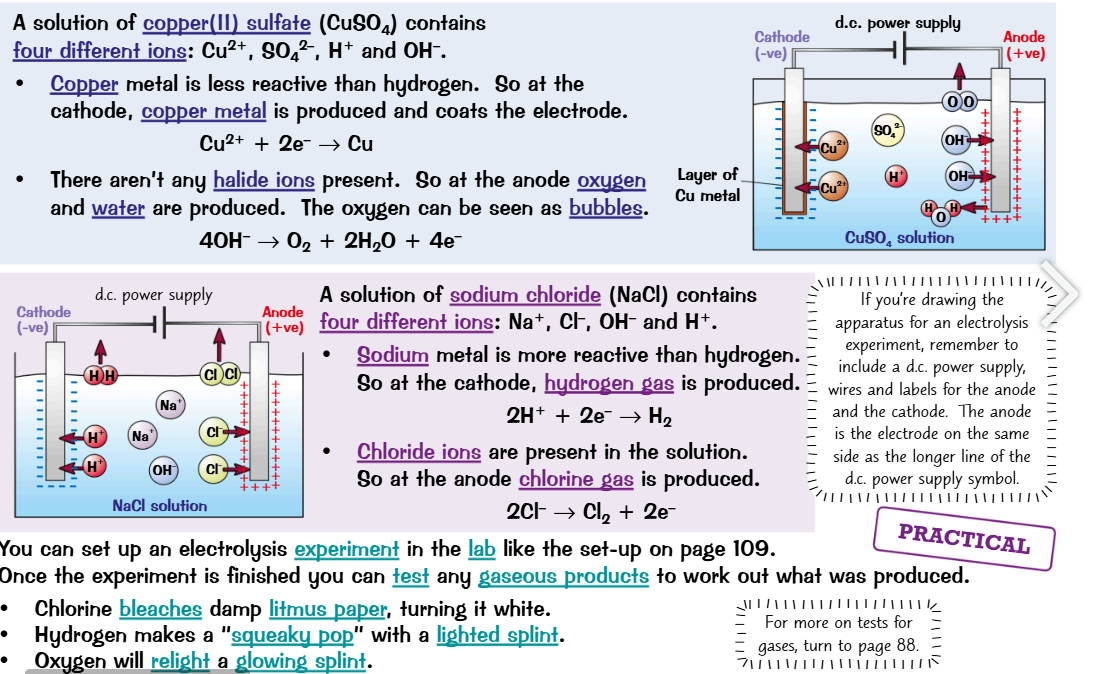
Electrolysis of Aqueous solutions
This means that Hydrogen ions from the water will be added to the mix meaning that:
At the cathode:
For metals more reactive than Hydrogen, hydrogen gas will be produced
For metals less reactive than hydrogen a solid layer of the metal is made instead
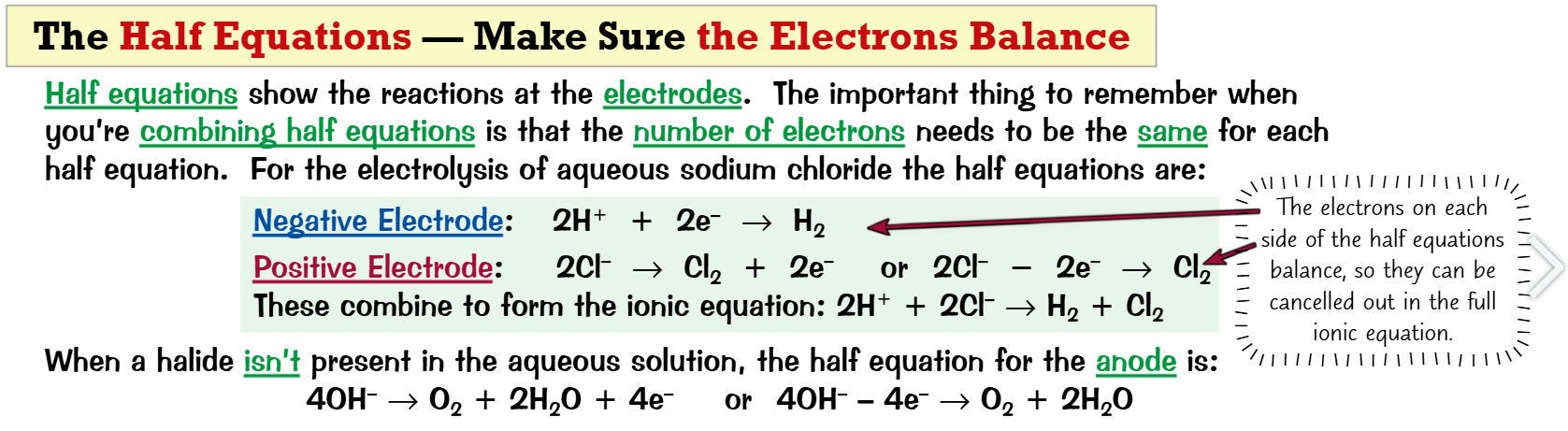
At the anode:
If halogen ions (Group 7 ions) are there then their molecules will be formed
If not then OH- ions will be turned into oxygen