Protein Synthesis
Protein is an essential macronutrient in building and repairing tissues, producing enzymes and hormones, and supporting overall growth and development.
D1.2.1 - Transcription as the synthesis of RNA using a DNA template
Students should understand the roles of RNA polymerase in this process
Production of messenger RNA (mRNA) using the DNA as a template
Eukaryotic → transcription takes place in the nucleus of the cell
Prokaryotic → transcription takes place in the cytoplasm
Transcription happens in 3 stages
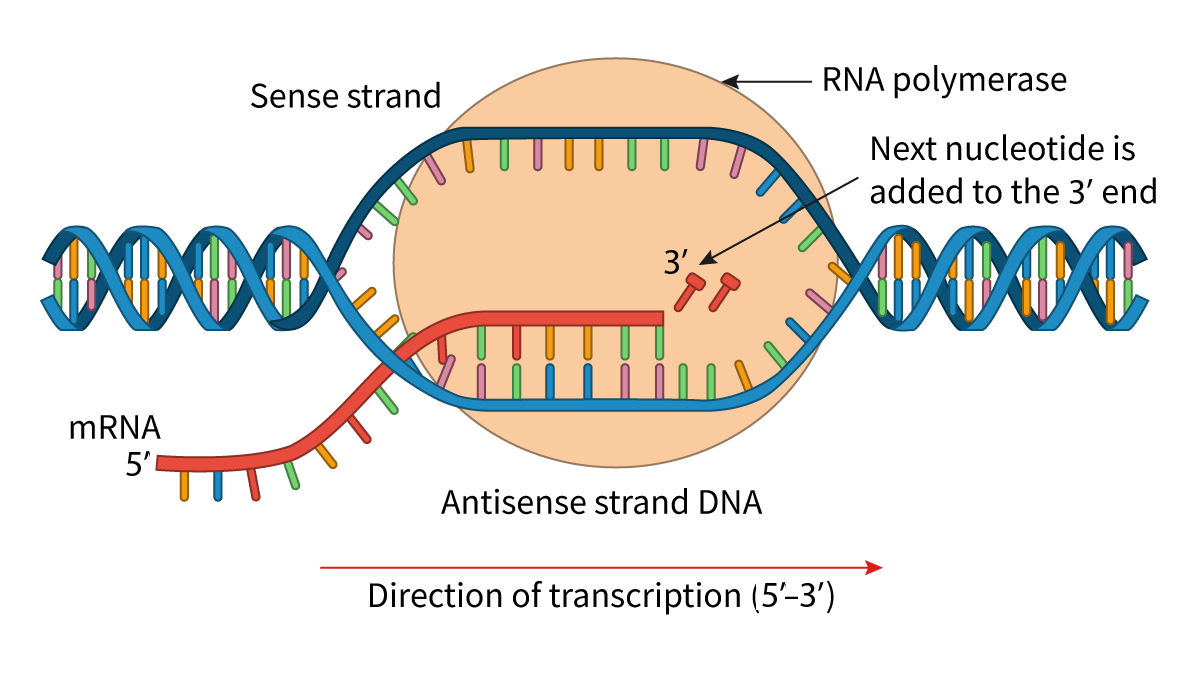
Initiation stage → RNA polymerase binds to the DNA at the start of the gene. It then separates the two strands of the DNA by breaking the hydrogen bonds, exposing the bases
Elongation stage → RNA polymerase builds a mRNA molecule on one of the strands of DNA. The strand used is known as the template or antisense strand, while the other strand is known as the coding or sense strand. The RNA polymerase moves along the DNA reading it one base at a time, adding free RNA nucleotides to the growing mRNA
Termination stage → a terminator sequence in the DNA is reached and the mRNA is released. The RNA polymerase detaches from the DNA strand, allowing the two strands to come together again
D1.2.2 - Role of hydrogen bonding and complementary base pairing in transcription
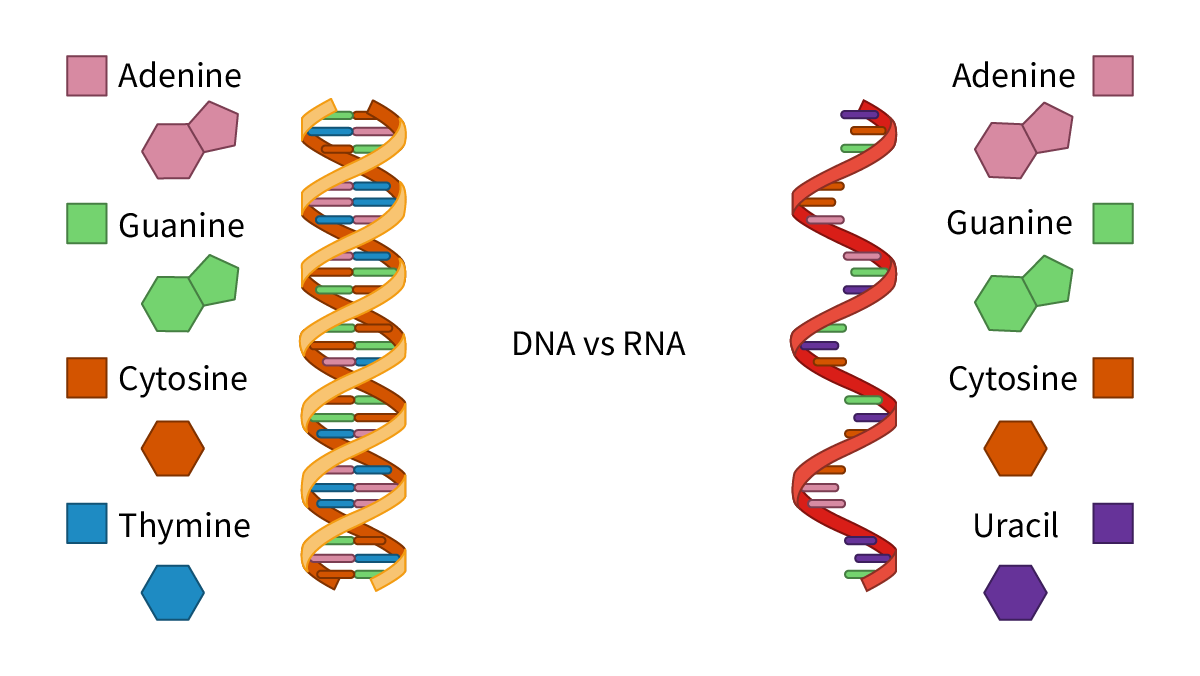
Include the pairing of adenine [A] on the DNA template strand with uracil [U] on the RNA strand
RNA polymerase unzips the two strands of DNA by breaking the hydrogen bonds between the nitrogenous bases
Nitrogenous Complementary Base Pairing Rule
In DNA:
[A] Adenine → Thymine [T]
[C] Cytosin → Guanine [G]
In RNA
[A] Adenine → Uracil [U]
[C] Cytosin → Guanine [G]
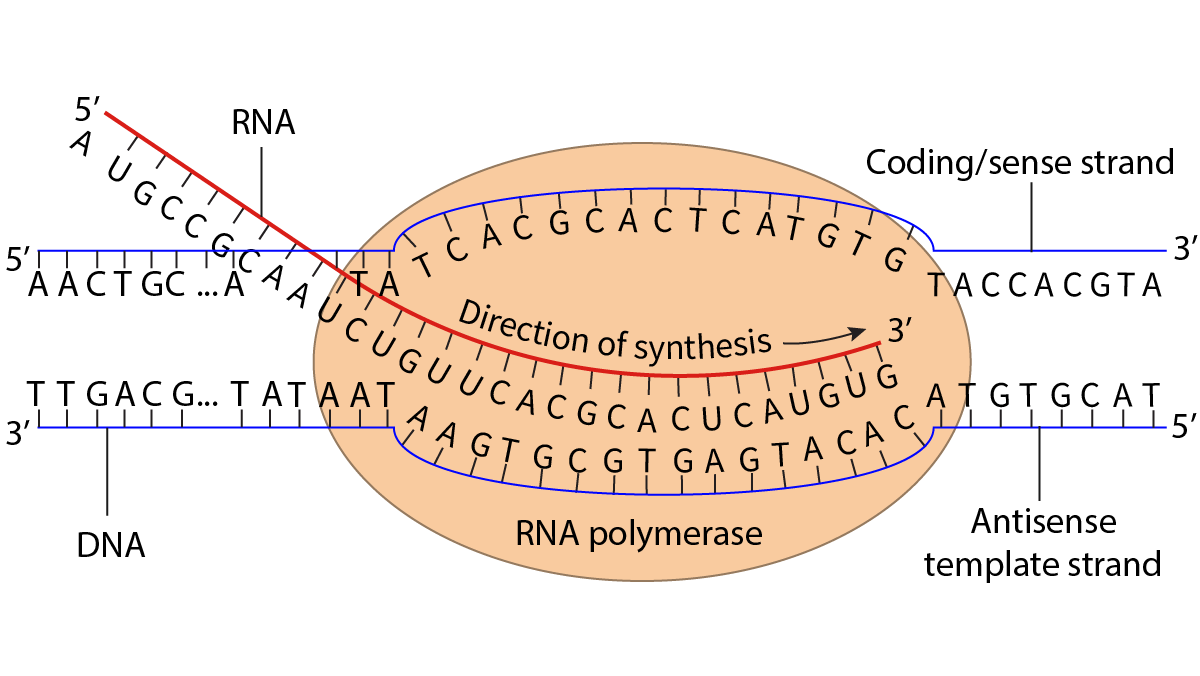
RNA polymerase adds the free RNA nucleotides along the template strand based on the complementary base pairing rule
Due to the nitrogenous complementary base pairing rule, RNA polymerase will add uracil to the mRNA strand when it encounters adenine on the DNA template strand
It is only through the base pairing rule that the correct placement of bases, which makes up the code or message within these molecules, can be assured. When the correct RNA nucleotide is placed by RNA polymerase, it will temporarily form hydrogen bonds with the complementary base on the DNA template strand.
Two hydrogen bonds form between A and T/U and three hydrogen bonds form between C and G.
The DNA strand with the base sequence to be copied into RNA is called the sense strand (or the coding strand). The other strand, which has a complementary base sequence to the sense strand, is called the template strand (or the antisense strand). Transcription of this strand results is a strand of RNA with the same base sequence as the sense strand of DNA except that uracil is is replaced with thymine
D1.2.3 → Stability of DNA templates
Single DNA strands can be used as a template for transcribing a base sequence, without the DNA base sequence changing. In somatic cells that do not divide, such sequences must be conserved throughout the life of the cell
The stability of DNA templates is crucial for accurate transcription, as it ensures that the genetic information is faithfully copied and minimises errors during the process. The DNA template may be transcribed many times during the life of the cell, stability is essential
When RNA splits DNA in 2 strands, NO CHANGES should occur to the base sequence of the DNA
After transcription the 2 DNA strands pair up again with each base linked by hydrogen bonds to its complementary base on the opposite strand, restoring the original double helix structure and maintaining the integrity of the genetic information.
The 2 strands are only parted for a short time as the RNA polymerase moves along the genes
The bases are only briefly vulnerable to chemical changes that would cause mutations
If mutations were common, DNA templates would accumulate mutations and the RNA copies would contain more and more errors
Proteins translated form these copies would have increasing numbers of amino acid substitutions, which is likely to make them function less well
D1.2.4 → Transcription as a process required for the expression of genes
Explain the use of transcription and its control of gene expression.
Describe translation as the use of the mRNA produced in transcription to synthesise polypeptides.
Describe the roles of mRNA, ribosomes and tRNA in translation.
Limit to understanding that not all genes in a cell are expressed at any given time and that transcription, being the first stage of gene expression, is a key stage at which expression of gene can be switched on and off
Gene expression is the process by which information carried by a gene has observable effects on an organism. The sequence of the bases of the bases does not determine the observable characteristics in an organism.
The function of most genes is to specify the sequence of amino acids in a particular polypeptide
It is the proteins produced that directly or indirectly determine the observable characteristics of an individual. Two processes are needed to produce a specific polypeptide using the base sequence of a gene: transcription and translation
Transcription is the first step stage in gene expression and the key stage at which it can be switched on or off
Only some genes are switched on in a cell at any particular time. Some gene may never switch on in the life of a cell
FOR EXAMPLE: insulin is only expressed in pancreatic beta cells. In all the other cells this gene is never normally transcribed
There are also genes that are always expressed because the proteins they code for are always required. These are housekeeping genes with functions such as cell respiration.
Transcriptome → the full range of mRNA types made in a cell
Within an individual, different cells or tissue types have different transcriptomes. Over time, the transcriptome changes as the activity of the cell changes.
D1.2.5 → Translation as the synthesis of polypeptides from mRNA
The base sequence of mRNA is translated into amino acid sequence of a polypeptide