Chapter 12~ Political Ideology
Political Ideology is an individual's beliefs on what should happen as a result of the government's actions. Party ideology is a party’s philosophies on the role of government. One’s party identification- which is an individuals attachment to a particular party, is influenced heavily by political and party ideology.
\
Party Ideologies
\
Conservatism, liberalism, and libertarianism are different from political parties, but do influence them.
\
- Conservatism favors more control over social behavior (traditional values), less government & regulation, strong military & law enforcement, and individualism and personal responsibility
- Liberalism favors less control over social behavior, minority rights, more regulation of business and economy and expanded government
- Libertarian-ism favors little government regulation and intervention besides with property and liberty.
\
The Republican party tends to be more conservative.
The Democratic party tends to be more liberal.
\
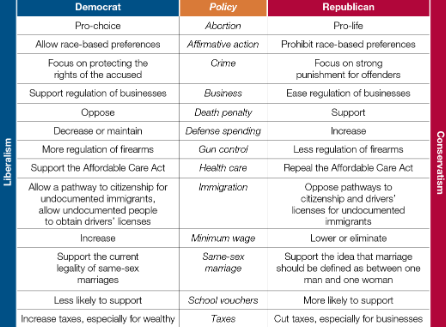
Though they believe in similar ideas, they implement them in different ways. They both want freedom, but Republicans want freedom from business regulation, and Democrats want more freedom of privacy. They both want order, but Republicans focus on immigration reform while Democrats focus on gun reform. Below is an oversimplification of either parties ideologies.
\
\
\
\
The parties disagree over a variety of policies, and it would be hard to list them all here. However, in the topics below the party’s stances on each issue will be described.
\
Economy
\
Economy is controlled in two ways. Fiscal policy and monetary policy. Fiscal policy means regulating the economy with taxation and spending to support the economy, stabilize it, and lower unemployment. Monetary policy is controlling the amount of money in the government, which can at times be dangerous and unstable.
\
There are two theories about how exactly the government should enact fiscal policy:
\
Keynesian Theory
\
This theory believes that the economy is heavily controlled by people’s decisions. In times of prosperity, people will be overconfident and spend more, sometimes irrationally. In times of recession, people will become gloomy and spend less.
\
Keynesian theory supports the idea that in times of economic struggle, the government should try to inject money into the economy since people will often make it worse. This often includes public works projects that create jobs, which have been implemented by FDR and Obama. Any debt incurred from huge spending will be made back by growth. Democrats tend to favor this theory.
\
Supply Side/Trickle Down
\
This theory was popularized by Ronald Reagan and supports the idea that by giving tax cuts to businesses the money will trickle down to the less wealthy. Critics of this idea point out that this doesn’t usually work out, and the less wealthy rarely feel the effects. This theory also believes that the debt will be healed by business growth, even if in the short term tax cuts increase the debt. Republicans tend to favor this theory.
\
Theory Spectrum
\
Those were the main two theories in the American economy. On the broader economic scale there is also the theory of laissez-faire, where the government does as little intervention as possible, and the theory of command-and-control, where the government regulates most everything, including production and prices. The US is a mix of the two, and within that the Republican party tends to lean more towards laissez-faire, and the Democratic party towards command-and-control. Nevertheless, both parties are still pretty moderate.
\
Economic Cycle & Measurement
\
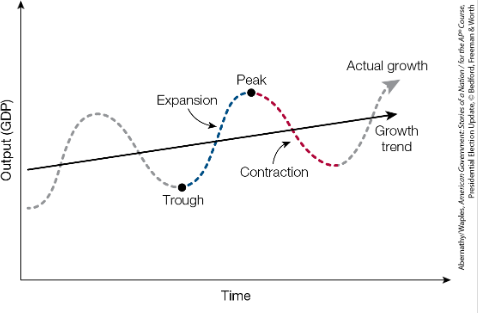
Regardless of how the government interacts with the economy, it tends to follow a cycle:
\
- Expansion
- Peak
- Contraction
- Trough
\
How well the economy is doing can be measured in a variety of ways:
\
- Gross Domestic Product (GDP): Total value of goods and services produced
- Economic Recession: Two quarters of negative GDP
- Unemployment Rate: How many people are unemployed
- Inflation: Rise of price of goods and services
- Consumer Price Index (CPE): Cost of a fixed basket of goods and services meant to measure inflation. Tied with many mandatory spending programs.
\
Federal Reserve
\
Measuring and regulating the economy can be very difficult. Though different parties differ on fiscal policy, the Federal Reserve is a more impartial organization that controls monetary policy. Monetary policy is more supported by conservatives than liberals, and when done wrong, can lead to anarchy, violence, and extremism.
\
The structure of the Federal Reserve includes a panel of seven governors. These governors are nominated by the President and confirmed by the Senate, which some protest raises doubts about the impartiality of the Federal Reserve. All of the governors but the chair serve 14 year terms. The chair serves 4 year terms. None of them can be removed, giving them more independence. The Reserve also includes twelve regional banks, and six thousand member banks.
\
The main goal of the Federal Reserve is to keep inflation below 2%. Some say they should be stricter, since inflation can build. Nevertheless, the Fed employ a variety of tools to maintain their goal:
\
- Buy treasury securities: These are bills that invest in the government and loan them money in hopes they will eventually pay it back with interest.
- Set reserve rates: This is the amount of deposits banks need to keep in reserve. Higher rates mean less money to loan out to people.
- Control interest rates: These determine how much banks need to pay to borrow from the government. Lower interest rates can encourage growth and more borrowing.
\
Healthcare
\
Some people believe healthcare is a right, others believe it is a privilege. The Democratic party tends to support healthcare being more of a right, and expanding people’s access. The Republican believes it is a privilege, and should be left up to choice.
\
President Johnson was the first president to establish medicare for the elderly. Nixon extended it to the disabled, and George W Bush extended it to prescription drugs. Medicare is funded by the government and makes up a huge amount of spending along with Social Security.
President Johnson also established medicaid for low income people, and is funded by both states and government.
\
In March 2010, Obama passed landmark healthcare reform known as the Patient Protection and Affordable Care Act. It did six things:
\
- Required employers with more than 50 workers to provide them with healthcare or pay a fine.
- Required individuals to purchase healthcare or pay a fine. The individual mandate
- Extended medicare benefits
- Established a system of health care exchanges to make it easier for people and small businesses to get some.
- Required insurance companies to cover young adults up to 26 under the parent/guardians plans.
- Prevented discrimination against those with preexisting conditions
\
This act had a variety of effects. For many it was helpful, and allowed them to pay for what they had not been able to before. For some, it made their healthcare insurance more expensive because it now covers more.
\
Since the act, there has been much controversy, especially over the individual mandate which was meant to lower the overall cost of healthcare. The Republican Party has expressed dislike for the act, and Trump tried to repeal it. He failed, and only managed to repeal the penalty for the individual mandate.
Education
\
Though education is not as hot a topic as healthcare and economy, the parties still differ. Republicans want parents and guardians to choose their schools and increase competition. They want to do this by allocating taxpayer money to pay for vouchers that support private and religious school tuition.
\
Opponents fear it will drain money from public schools, and leave many behind. They also argue supporting religious vouchers violates the First Amendment establishment clause.